Used cooking oil theft is one of those restaurant industry problems that operators rarely talk about publicly but deal with regularly in practice. A thief with a pump truck and a few minutes alone with your unlocked bin can walk away with a few hundred dollars of rendered-value yellow grease, leaving your kitchen manager with a compliance gap, a service schedule to rearrange, and a very specific irritation about the state of the used cooking oil aftermarket.
This guide covers why used cooking oil theft happens in California, what the actual financial impact looks like, what federal prosecutors have uncovered about theft rings, and the practical steps your restaurant can take to stop being a target.
Why Used Cooking Oil Is Worth Stealing
The starting point for understanding cooking oil theft is understanding that used cooking oil has commodity value. When a CDFA-registered hauler collects your oil and delivers it to a rendering facility, the renderer pays the hauler per gallon based on the yellow grease spot market price. That price fluctuates, it has run anywhere from roughly $2 per gallon in softer markets to over $5 per gallon at the peak of biofuel credit cycles, but it is never zero. Your used cooking oil is a feedstock for biodiesel, renewable diesel, sustainable aviation fuel, animal feed, and oleochemicals.
That commodity value is what makes the theft economy work. A thief with a pump truck who drains ten restaurants in a night can walk away with 500 to 2,000 gallons of oil, sell it to an unlicensed middleman who does not ask questions about CDFA compliance, and pocket several hundred to several thousand dollars per night. The middleman then launders the oil into the legitimate supply chain or routes it to buyers who are willing to accept undocumented feedstock.
California concentrates this problem because the state has:
- A very high density of restaurants (over 90,000 food service facilities statewide)
- A concentration of biodiesel and renewable diesel production in the state and neighboring states
- Long haul distances that make it difficult for registered haulers to patrol their account base
- A long coastline with port access for export to markets that care less about feedstock documentation
The result is a quiet but active theft economy operating primarily after business hours behind restaurants, hotels, and commercial kitchens across the state.
What Federal and State Investigations Have Uncovered
Used cooking oil theft is not just an anecdote, it has been the subject of federal criminal prosecutions. The most visible cases involve organized theft rings operating across multiple states, using pump trucks registered to shell companies, with hundreds of thousands to millions of dollars in stolen oil flowing into the aftermarket.
The scale is not exaggeration. In December 2025, a federal grand jury in the Southern District of Iowa returned a nine-count indictment against 13 people on racketeering conspiracy, interstate transportation of stolen property, and money laundering charges, accused of driving trucks to restaurant collection tanks across roughly ten states in the Midwest and South, then moving the stolen oil through a network of warehouses in Nevada, Iowa, Tennessee, Alabama, and Ohio before laundering the proceeds. Federal prosecutors in Des Moines set a trial date for February 2026. That case is one of several recent multistate prosecutions, and it illustrates the pattern investigators keep finding: this is not a lone thief with a pump truck, it is coordinated theft built around the same commodity value that makes an unlocked restaurant bin worth targeting in the first place.
Court filings from these cases typically describe:
- Multi-truck operations with coordinated nightly routes hitting 15 to 40 restaurants per shift
- Sophisticated knowledge of restaurant pickup schedules (thieves often arrive the night before a scheduled hauler visit)
- Buyers who knowingly accept undocumented oil at discounted rates
- Cross-state movement of stolen oil to rendering markets that applied less scrutiny to feedstock origin
- Laundering through intermediate storage tanks that blend stolen and legitimate oil
CDFA's Inedible Kitchen Grease enforcement program operates in parallel with federal investigations. CDFA investigators work with local law enforcement to identify unregistered transporters, audit rendering facility intake records, and build cases against theft rings. The Department has authority to revoke transporter registrations, impose fines, and refer cases for criminal prosecution.
For restaurant operators, this means two things. First, used cooking oil theft is a real crime that real prosecutors pursue, your police report and your hauler's variance documentation have a destination. Second, your cooperation with CDFA investigations (preserving security footage, sharing manifest history, reporting suspicious activity) is a meaningful contribution to catching the rings operating in your area.
The Actual Cost of Used Cooking Oil Theft
The direct cash value of stolen oil is often small on any single incident. A typical theft drains 50 to 200 gallons from a restaurant bin. At current yellow grease prices that translates to roughly $100 to $600 of lost commodity value. For most restaurants, the more painful costs are operational:
- Service disruption. Your bin is empty ahead of schedule. Your next oil change has nowhere to go. Your kitchen manager is stuck improvising storage or stacking drums somewhere they should not be.
- Emergency pickup fees. If you cannot wait for your next scheduled pickup, you call your hauler for an unscheduled visit. Registered haulers try to keep these affordable for existing customers, but it is still a disruption.
- Compliance paper trail gaps. You had 180 gallons of oil on Tuesday. You have 40 on Wednesday. Your manifest history does not explain where 140 gallons went. A good hauler will document the variance, but the paper trail has a hole in it.
- Container damage. Some thieves cut hinges, bend lids, or damage pump access points to get to the oil. Your container may need repair or replacement.
- Staff time. Your kitchen manager is now dealing with police reports, insurance calls, camera review, and conversations with the hauler instead of running service.
Over a year of repeated thefts, a Southern California restaurant can easily rack up $2,000 to $5,000 in operational cost from unsecured bin theft, on top of the direct oil loss.
Why Unlocked Restaurant Bins Are Easy Targets
If you walk behind most commercial restaurants in California at 11 PM, you will find a 45-gallon containers or a 130-gallon bin sitting in a low-traffic area with a hinged lid that opens when you lift it. Some have a chain wrapped around them. Many do not. Either way, a pump truck can pull up, run a hose over the bin, draw the oil out in under 10 minutes, and drive off. No alarm, no witness, nobody the worse for wear until the next morning.
The factors that make a bin easy to hit:
- Location. Bins placed behind the building, next to the dumpster, in a dark corner of the parking lot.
- Unlocked access. Hinged lid with no padlock, or a padlock cut ages ago that was never replaced.
- Predictable schedule. Thieves learn when legitimate haulers arrive and time their visits for maximum fill between pickups.
- Lighting. Poorly lit service areas make it easier to pump without detection.
- Camera coverage. No camera or camera that does not cover the bin itself.
- Neighboring business awareness. If the adjacent business is closed overnight, there is nobody watching.
Restaurants in Southern California's denser food corridors, Koreatown, Little Saigon, Belmont Shore, Old Town Pasadena, Downtown San Diego, are routinely hit because there are enough targets in a 10-block radius that a pump truck can fill in a single night and move on before anyone notices.
How Locked Cooking Oil Containers Actually Work
Every CDFA-registered hauler should offer locked cooking oil containers as part of their pickup program at no extra charge. The containers that work have several layers of protection:
- Steel enclosure around the pump access point, the hose port is inside a small steel compartment secured with a padlock. You cannot pump oil out without opening that compartment.
- Heavy-duty padlock, a shrouded-shackle padlock with a boron-steel shackle, rated for outdoor use, key or combination. Cheap padlocks get cut with bolt cutters in seconds; a boron-steel shackle resists standard bolt cutters and forces a thief to bring an angle grinder, which means more time and more noise.
- Physical anchor point, the container is secured to a wall bracket, a post, or a pad via a steel cable or chain. A thief cannot simply pick up the whole 500-pound container and put it in a truck bed.
- Internal anti-siphon baffle, a baffle plate mounted beneath the lid opening blocks a hose from reaching the oil directly, so even a partially compromised lid does not hand a thief a clean draw point.
- Tamper-evident seals, some haulers add tamper seals that show if a thief tried and failed to access the container.
- Driver-owned key, only your hauler's drivers have keys to the lock. Your kitchen staff never touches it.
The economics matter: a locked container raises the effort per gallon of theft from "10 minutes with a pump" to "30+ minutes with bolt cutters and angle grinders and the risk of getting caught." Thieves running an efficient operation move on to the next unlocked bin rather than invest that effort. Your restaurant stops being an easy target.
For a restaurant that has already been hit more than once, the container itself is only one layer. Positioning the bin inside its own fenced corral or behind a locked service gate, in addition to the container lock, forces a thief through a second barrier before they ever reach the padlock.
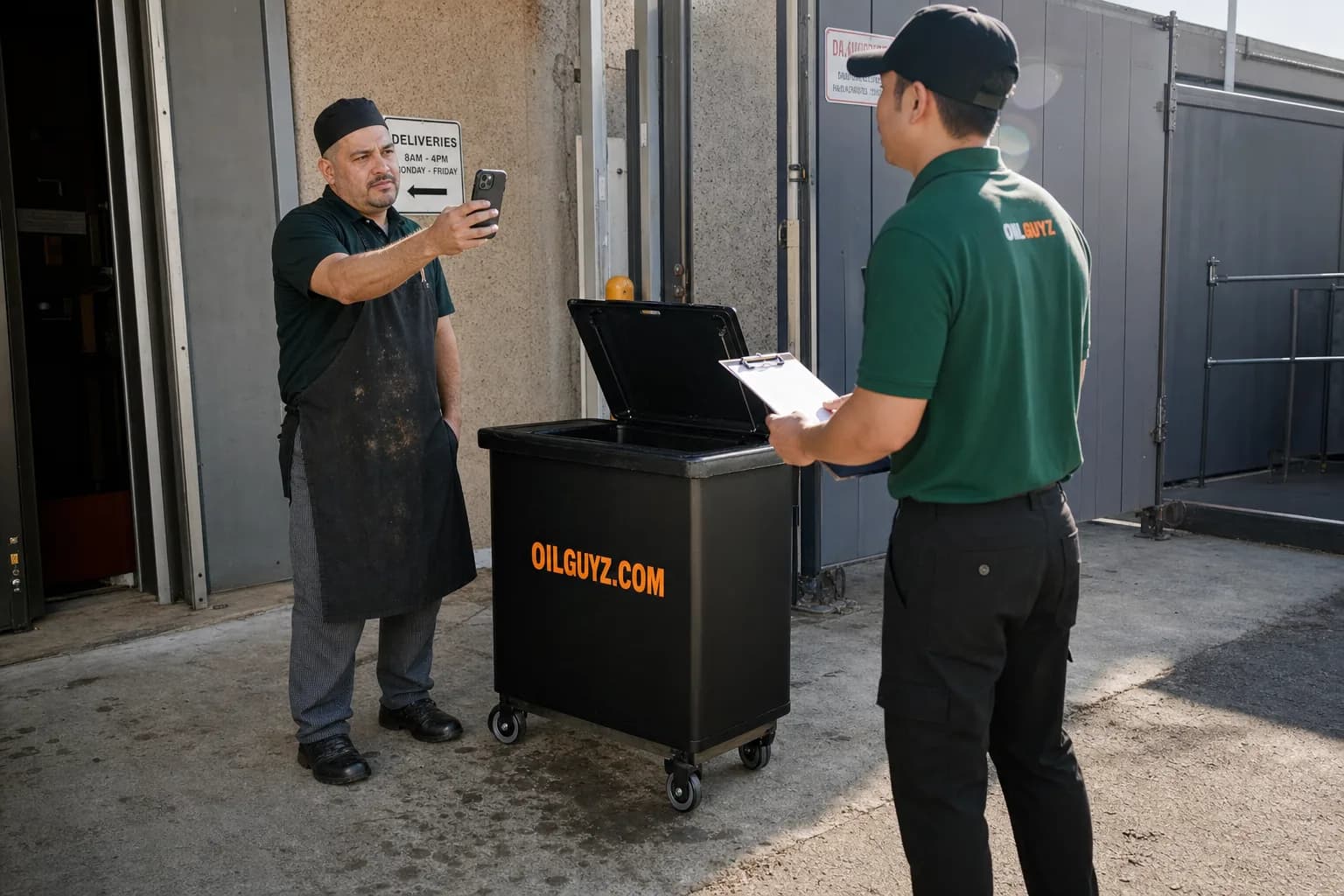
A locked container and a fenced enclosure solve the overnight pump-and-run problem, but they assume the person at the container is trying to defeat a lock, not simply asking a staff member to open it for them. A different pattern targets the kitchen during business hours: someone in a plausible uniform claims to be your hauler, or a new company taking over the account, and asks a cook or dishwasher to unlock the container or sign something. See Grease Pickup Impersonation Scams for the verification script that stops that version of the theft.
Camera Placement and Evidence Gathering
Security cameras are the second layer that stops repeat theft. If a thief's first visit produces identifiable footage, vehicle, plate, face, time stamp, most operations decide that your restaurant is not worth a second visit.
Effective camera placement for cooking oil theft prevention:
- Direct line of sight on the container. The camera should see the bin itself, not just the general service area.
- Night-vision capability. Most thefts happen between 11 PM and 4 AM. Your camera needs usable infrared or low-light performance.
- Two-camera coverage beats one. A camera fixed on the bin identifies who accessed it, a second camera on the vehicle approach or exit path captures the plate as the truck pulls in, not just the bin itself. Some newer camera systems add automatic license plate recognition (LPR), so identification does not depend on someone freeze-framing a blurry clip after the fact.
- Retention of at least 30 days. Many restaurants do not notice theft for a week or more. 30-day retention gives you enough window to review after the fact.
- Accessible remote viewing. A camera whose footage you cannot pull quickly is not helpful during an investigation.
Position the camera high enough that a thief cannot reach it or block it, but with an unobstructed view of the bin. If your property layout allows, adding a motion-activated floodlight next to the camera deters casual theft attempts before they even start.
What to Do When You Discover a Theft
If you walk into your back lot and realize your cooking oil bin is empty or obviously tampered with, the response sequence that matters:
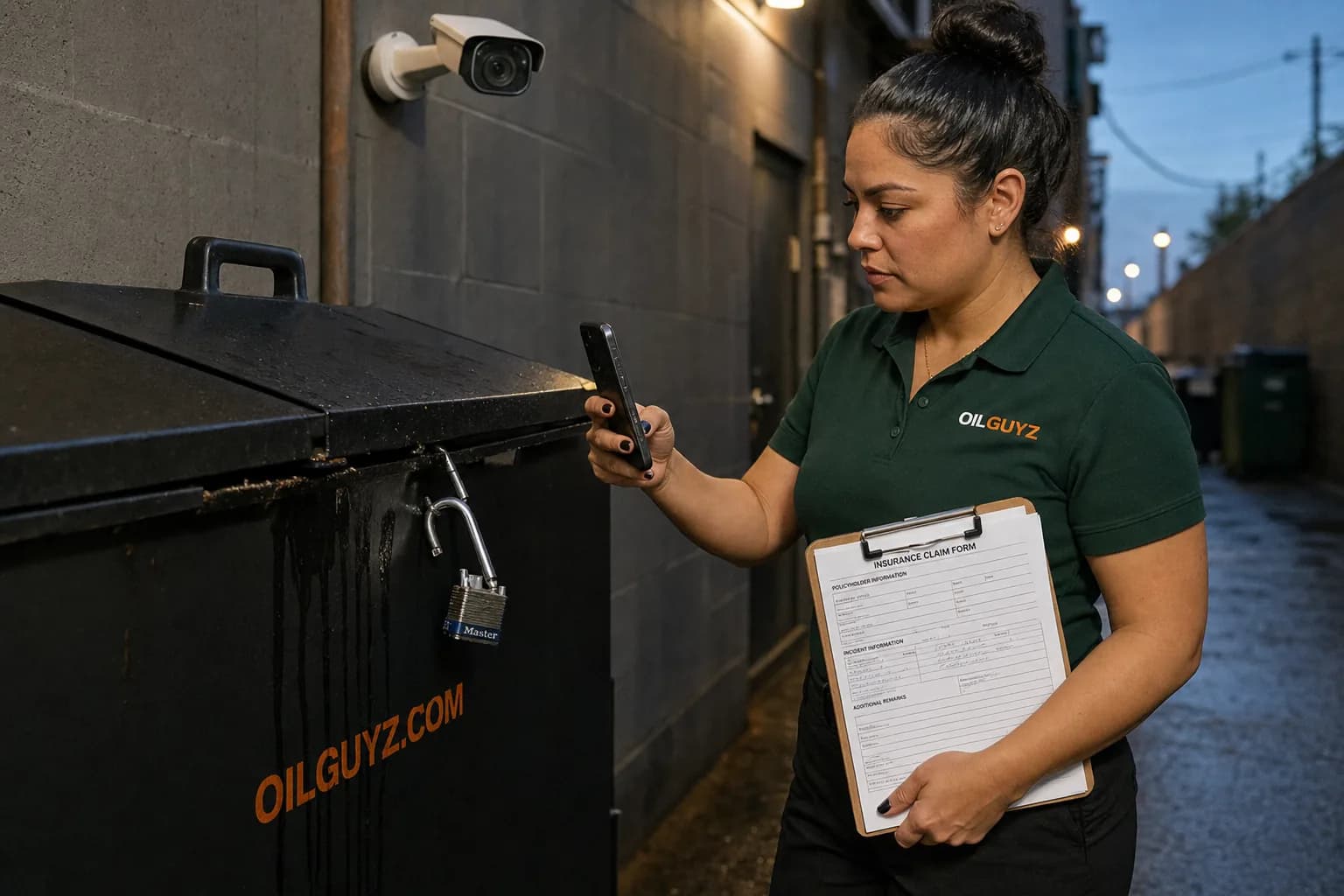
- Document the scene. Photos of the container, the lock (or the cut lock), any damage, the time of day. Do not move anything until you have photos.
- Check security footage immediately. The window of time you need to review is usually the last 24 to 72 hours. Identify vehicle, plate number, and any identifying marks.
- Call your CDFA-registered hauler. They will generate a variance note in your manifest history documenting the discrepancy. This protects your compliance file and gives CDFA investigators a data point they can cross-reference with other reports.
- File a police report. Even if the dollar value feels small, the report contributes to the local crime pattern data. Many theft rings have been broken through pattern analysis across multiple small reports.
- Report to CDFA. CDFA's Inedible Kitchen Grease enforcement unit maintains records of theft patterns. If multiple restaurants in your corridor are hit, they will investigate.
- Review your container and location security. Is the bin visible from the street? Is the lock adequate? Is your camera working? What do you change so this does not happen again?
- Consider upgrading your container. If you are on an unlocked bin, switching to a locked container should be free with any CDFA-registered hauler running a legitimate restaurant program.
What you should not do: try to catch the thief yourself. These are commercial operations with trucks, pump equipment, and (occasionally) multiple people. They also carry exactly the physical risk profile of any petty property crime, rare but real escalation if a confrontation happens. The right response is camera footage, police report, and hauler variance note.
If the loss is large enough that you are weighing whether to file a claim instead of absorbing it, read does restaurant insurance cover stolen cooking oil before you call your agent. Most single-load thefts fall into the same range as a typical commercial deductible, and whether coverage applies at all often depends on exactly the evidence, forced entry, camera footage, a police report, that the steps above are designed to capture.
Why CDFA-Registered Haulers Are the Core of the Solution
The full cooking oil theft prevention ecosystem rests on one foundation: every restaurant in California should be on a service agreement with a CDFA-registered Inedible Kitchen Grease transporter. Here is why that matters.
A CDFA-registered hauler is a regulated participant in the legitimate yellow grease supply chain. They generate a manifest for every pickup. Their drivers carry current transporter credentials. Their rendering facility destinations accept only documented feedstock. The more restaurants on the licensed side of this chain, the fewer unlicensed middlemen can operate profitably.
Theft rings rely on the parallel market of unlicensed buyers. If every restaurant in California ran on a CDFA-registered hauler with a locked container and a manifest for every gallon, the parallel market would collapse because no rendering facility or exporter could accept volumes that did not tie back to a documented chain.
In practical terms for your restaurant, choosing a CDFA-registered hauler does four things at once:
- Keeps you in full compliance with California's Inedible Kitchen Grease regulations
- Gives you a manifest for every pickup that protects you during FOG and health inspections
- Reduces theft incentive by integrating your bin into a locked, documented collection chain
- Contributes to shutting down the aftermarket by starving unlicensed buyers of their feedstock supply
If your current hauler cannot produce a current CDFA registration, cannot deliver a locked container, and cannot generate a digital manifest for every pickup, your restaurant is not fully protected, from either theft or compliance risk. That is the threshold you want every used cooking oil pickup vendor in California to meet.
The Quiet Payoff of Getting Theft Prevention Right
Restaurants that upgrade to locked cooking oil containers, position cameras correctly, and stay on a CDFA-registered pickup schedule stop thinking about cooking oil theft entirely. The bin fills on schedule, the hauler arrives on schedule, the manifests stack up in the dashboard, and the back lot stays quiet.
That is the whole goal. Used cooking oil theft is a problem that gets dramatic in the headlines and tedious in real life. The right prevention is not flashy, it is a locked container, a working camera, and a professional hauler who shows up when they say they will. Once that is in place, theft stops being something your kitchen manager thinks about, and your restaurant's cooking oil becomes exactly what it should be: a scheduled service that produces no drama.