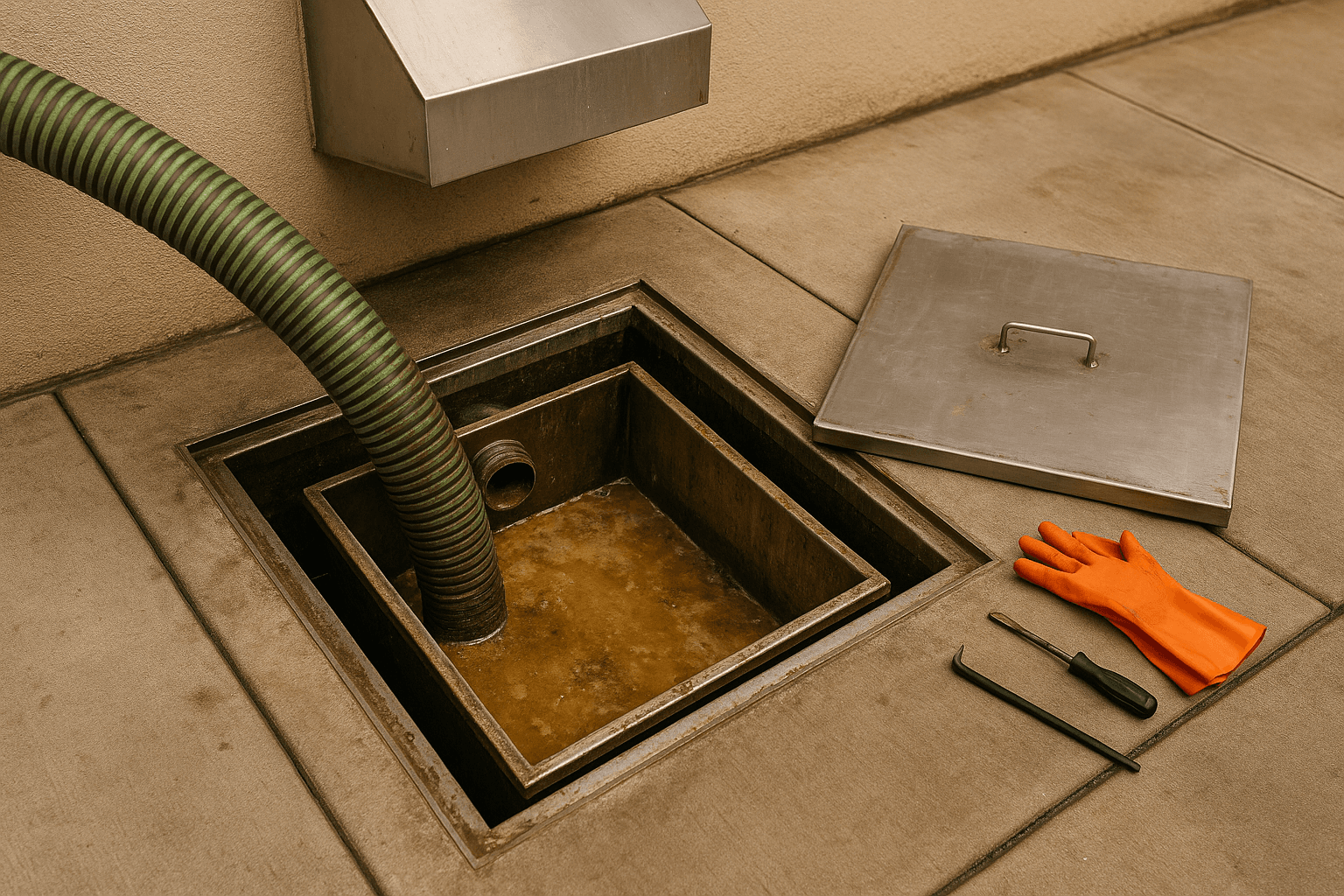
Restaurant Grease Trap Cleaning and Interceptor Pumping
Oil Guyz provides grease trap cleaning and interceptor pumping for restaurants across Orange County, Los Angeles, San Diego, the Inland Empire, the Bay Area, and Puget Sound, WA. Call (714) 880-4788 for a quote. Done to the 25 percent rule: every compartment pumped empty, walls and baffles scraped, tees inspected, disposal record filed the same day. Priced upfront from size, access, and required frequency, no term contract. Orange County, Los Angeles, San Diego, Inland Empire, San Francisco Bay Area, and Tacoma.
Google rating
oil recycled, zero landfill
phones answered 24/7
“Oil Guyz are A+++!! We had 14 containers of used frying oil from our little league snack bar.”
Quick Answer
Grease trap cleaning is a scheduled pump-out that empties every compartment, removes both the floating grease and the settled solids, and produces a dated disposal record your sanitation district will accept. Oil Guyz cleans indoor traps and buried interceptors across Orange County, Los Angeles, San Diego, the Inland Empire, the San Francisco Bay Area, and Tacoma / Pierce County, Washington, quoted upfront from size, access, and the frequency in your permit. This one is billed; our used cooking oil pickup stays free. Get started today: call (714) 880-4788 or request a quote online to get scheduled.
How Restaurant Oil Collection Works In 3 Simple Steps
Set up restaurant oil collection in about five minutes. We confirm your route the same business day and drop a free bin before your first pickup. After that, Oil Guyz handles every used cooking oil pickup on schedule. You never chase a hauler again.
Site & Access Assessment
We identify whether you have an indoor grease trap or a buried interceptor, log the nameplate rating and compartment count, and confirm truck access on the first visit.
Full Pump-Out
Every compartment is vacuumed completely empty, wastewater included, not just the floating grease layer on top.
Walls, Baffles & Tees Scraped Clean
Once the trap is dry, walls, baffles, and the inlet and outlet tees are hand scraped and inspected before the lid goes back on.
Disposal Record Filed the Same Day
A waste removal receipt showing date, working capacity, and volume removed lands in your dashboard, alongside your cooking oil manifests.
Recurring Schedule Confirmed
Cleaning frequency is set from your discharge permit, then tuned to measured accumulation so you stay under the 25 percent limit.
Get Your Free Pickup Set Up
Tell us where your kitchen is. Free locked container, route started this week, no contract or minimum volume.
- Truly free. We are paid for the oil, not by you
- No contracts. Cancel anytime
- No minimum volume. Any kitchen size
- Free locked, anti-theft bin
- Compliant digital manifest after every pickup
- Instant confirmation, then a real person calls you
Request your free oil pickup
Free bin · No contract · Cancel anytime. You get an instant confirmation that we got it, then a real person calls to set up your pickup. No spam, no robocalls.
Prefer to talk? Call (714) 880-4788
Grease Trap or Interceptor: Know Which One You Have
A grease trap and an interceptor are not the same equipment, and the difference sets your price, your truck, and your paperwork. Los Angeles County Public Works defines a grease trap as a small, multi-baffle, single compartment fixture of 25 to 75 gallons, usually indoors under a three-compartment sink or beside the dish machine, and an interceptor as a precast concrete vessel of 750 gallons or greater with two or more compartments, buried outside (LA County's restaurant pretreatment guidelines). Tacoma draws the line differently, calling the indoor fixture a hydromechanical grease interceptor and the buried one a gravity grease interceptor at 500 gallons or greater (Tacoma's grease interceptor policy). Same hardware, different label, different reporting. So we identify your grease trap on the first visit by nameplate flow rating, compartment count, and working capacity, not by whatever the last vendor typed on an invoice. A 40-gallon indoor grease trap can fill in a few weeks. A 1,500-gallon buried interceptor may hold a full quarter, but cleaning it takes a bigger vacuum truck and two open manholes.
- Indoor grease trap: one compartment, roughly 25 to 75 gallons, serviced inside
- Buried interceptor: two or more compartments, 500 to 1,500 gallons and up
- Nameplate rating, compartment count, and working capacity logged on visit one
- Trap or interceptor decides the quote, the truck we send, and time on site
- Codes classify identical hardware differently, so we clean to your agency definition
What a Grease Trap Pump-Out Actually Involves
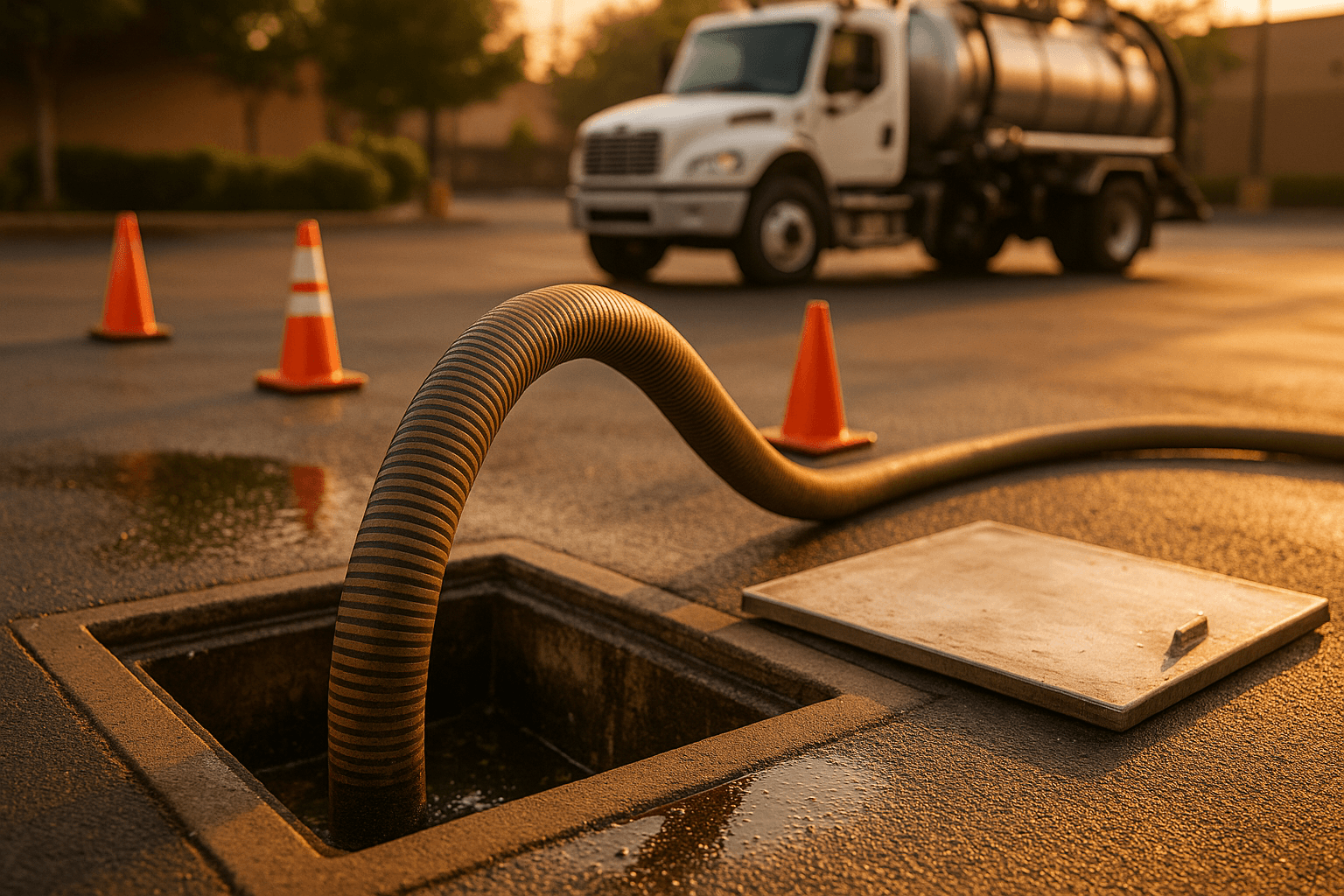
Cleaning a grease trap properly is not a skim off the top. The technician opens every access point, at least two manholes on a buried interceptor, measures the floating layer and the settled solids against total liquid depth, and records both. Every compartment is then vacuumed completely empty, wastewater included. Once your grease trap is dry, walls, baffles, and the inlet and outlet tees get scraped by hand, because hardened grease bonds to concrete and a suction hose will not pull it. Tees and any flow control are inspected and reinstalled before the lid goes back on. A cracked or missing outlet tee feeds your sewer lateral directly and is the defect we write up most. Your grease trap is refilled with clean water so it works on the next wash cycle, and depths before and after, volume removed, and condition go on the record before the truck leaves. Most visits run thirty to sixty minutes on site. Two shortcuts to watch for: pumping only the grease cap and leaving the sludge bed, and decanting wastewater back in to cut hauled volume. Both put you over the limit again within days, and both show the moment an inspector drops a dipstick.
- Every compartment vacuumed empty, not just the floating layer
- Walls, baffles, and inlet and outlet tees hand scraped once it is dry
- Tee and flow control inspection, with photos on anything damaged
- Refilled with clean water, depths recorded before and after
- No decanting and no partial pumping: the load leaves in the truck
The 25 Percent Rule, and Who Sets Your Grease Trap Frequency
Nearly every FOG program across our markets applies one ceiling: the floating grease layer plus settled solids may not exceed 25 percent of liquid depth. Tacoma writes it as cleaning whenever 25 percent of the collection chamber fills with grease or solids, or when visible grease is seen discharging through the outlet tee, and says plainly that maintenance frequency will vary for each facility. Your enforceable schedule comes from the local sanitation district, usually written into a discharge permit, not from a vendor calendar. Central Marin Sanitation Agency, for example, sets a floor of once every three months on larger interceptors and once a month on small indoor traps (CMSA's FOG ordinance), with the 25 percent limit applying regardless of what the permit says. How fast your grease trap fills swings with fryer count, whether the dish machine and prep sinks tie in, whether a food waste grinder is connected, and how much of the menu is fried. Two identical units on the same block routinely need cleaning four weeks apart. There is upside in the records: agencies will often stretch a required schedule when an operator brings a year of documented service showing it never approached the limit.
- 25 percent of liquid depth, grease plus solids, is the common hard ceiling
- Your discharge permit and local sanitation district set the enforceable minimum
- We schedule to the permit first, then tune from measured accumulation
- A year of clean records can support a request to stretch your schedule
- We flag fast-fill causes: added fryers, grinder tie-ins, hot dish machine discharge
Disposal Records, and What Grease Trap Cleaning Costs
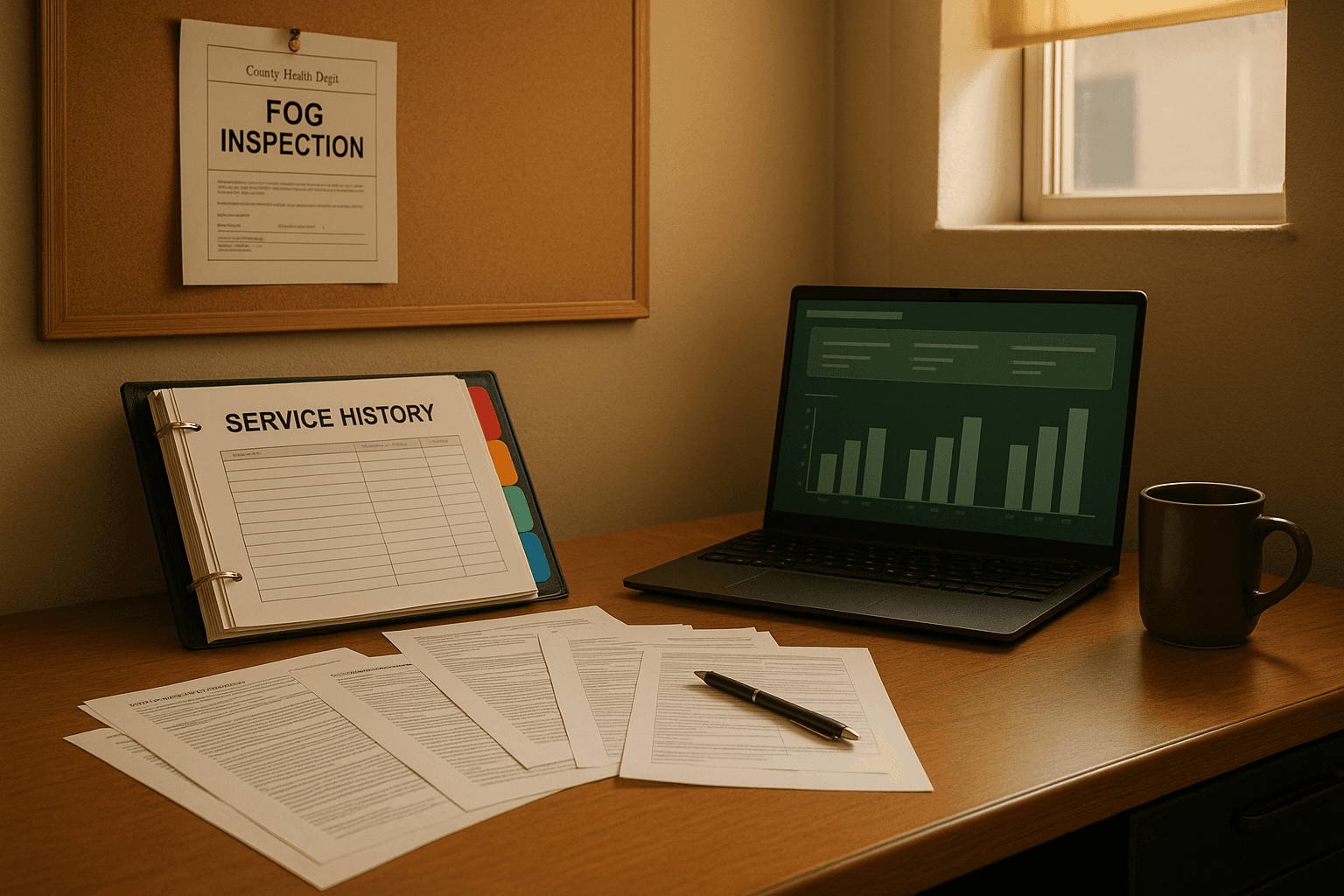
What comes out of a grease trap is a separate waste stream from used cooking oil, and it moves on separate paperwork. The pump-out is performed by a CDFA-registered transporter of inedible kitchen grease, and the load is delivered to an authorized receiving facility. State rules require that transporter to hand you a waste removal receipt showing your business name, the service date, the working capacity of the unit pumped, and the total volume removed. Many agencies want copies monthly, so the record lands in your dashboard the same day beside your cooking oil manifests. California sets a two-year minimum for manifest retention; we hold copies for two years as company policy. That chain of custody protects you, because the generator carries the liability when a load is dumped improperly. On price: grease trap cleaning is a billed service, quoted upfront from size, compartment count, truck access, and frequency, with no fuel surcharge, no per-gallon overage, and no term contract. The used cooking oil side stays free, locked container included, because we are paid for the oil rather than by you. Call us or send the quote form and we will price your grease trap and start the oil route on one account.
- Waste removal receipt every visit: date, working capacity, volume removed
- Pump-out by a CDFA-registered transporter, delivered to an authorized facility
- Records in your dashboard the same day, held two years by company policy
- Quoted flat from size and frequency, no surcharges and no term contract
- Free used cooking oil pickup and free locked container on the same account
What's Included
Everything you need, nothing you don’t.
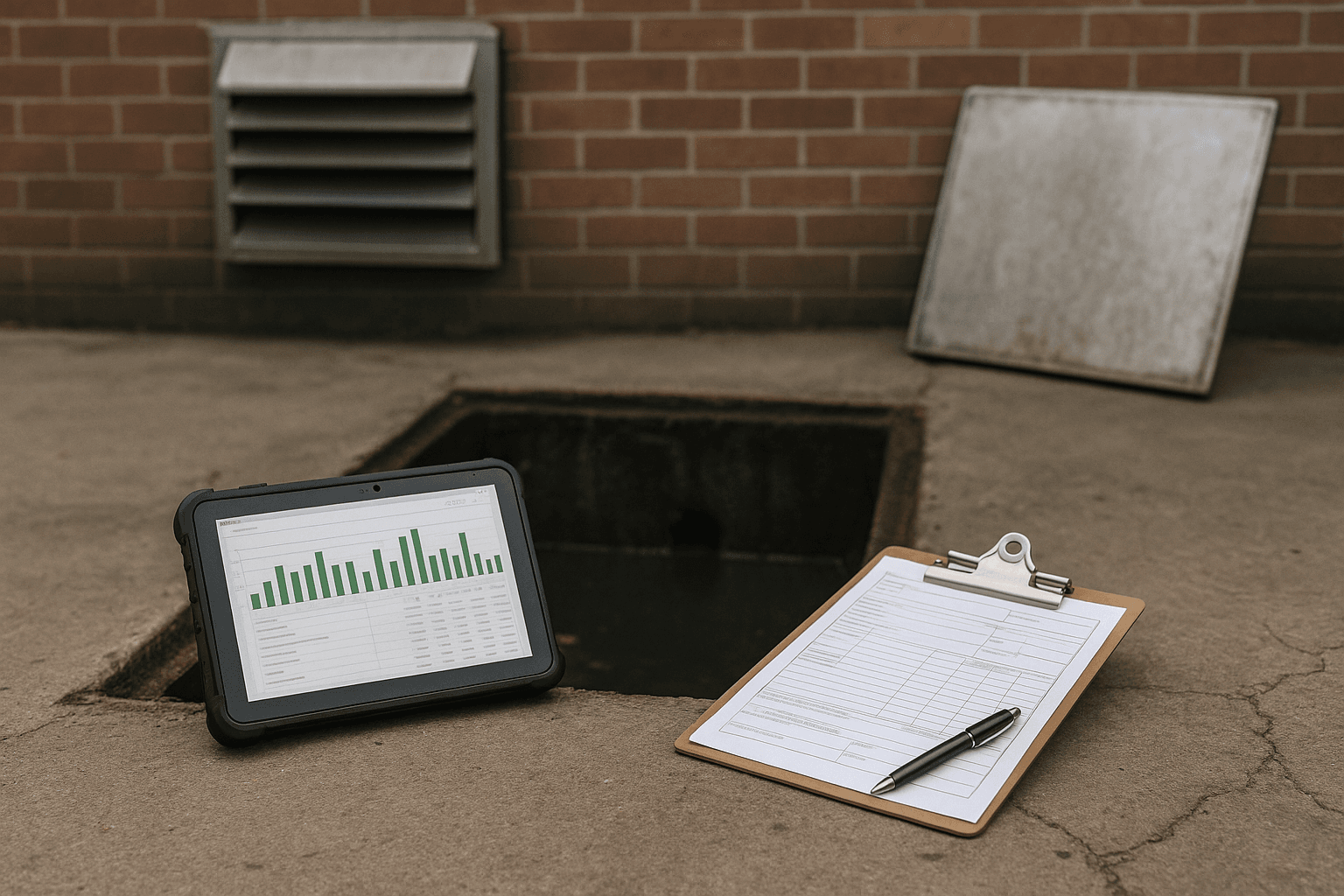
- Full pump-out of every compartment, wastewater and solids included
- Hand scraping of walls, baffles, and the inlet and outlet tees
- Depth measured before and after against the 25 percent limit
- Tee, lid, and flow control inspection with photos on any defect found
- Waste removal receipt and disposal record filed the same day
- Dashboard holding grease trap records beside your cooking oil manifests
- Cleaning frequency set from your permit, then tuned to real accumulation
- Upfront quoted pricing, no fuel surcharge, no long-term contract
- One account covering the grease trap and free used cooking oil pickup
Frequently Asked Questions
The measurable test is depth. Floating grease plus settled solids past a quarter of the liquid depth means you are due, and in most jurisdictions already out of compliance. The signs you can catch without a dipstick: a three-compartment sink draining slowly, gurgling floor drains, a sulfur smell near the lid or in the alley, standing water around a buried manhole, and grease visible at the outlet tee. Tacoma treats that last one as its own trigger for cleaning, independent of the 25 percent measurement. If you notice any of them, do not wait for the next scheduled date. Our phones are answered 24/7 by a real person and we respond the same business day. Waiting risks a sanitary sewer overflow, and that cleanup lands on you.
It is billed, and we price it upfront. The quote is driven by size and compartment count, how the truck reaches it, and how often your permit requires cleaning. A small indoor grease trap on a monthly schedule and a 1,500 gallon interceptor on a quarterly schedule are nowhere near the same number, which is why we quote after seeing it rather than over the phone from a guess. What we will not do is quote low and add fuel surcharges, disposal surcharges, or per-gallon overage later, and we do not require a term contract. Used cooking oil pickup is a different story: genuinely free, locked container included, because the oil has value and our licensed renderer pays for it.
No, and dosing without permission can be a violation on its own. Los Angeles County Public Works states that introducing bacteria or similar products into a grease interceptor or the sanitary sewer for maintenance purposes is subject to prior approval by its Environmental Programs Division. The mechanical problem is straightforward: additives can emulsify the fats so they pass through instead of being captured, which relocates the blockage downstream into your lateral or the public main, where it costs far more and the liability is still yours. Settled solids keep building either way. Additives can help with odor between visits. They remove no volume, and no inspector accepts them in place of a pump-out record.
You receive a notice of violation and a corrective action, which in practice means an immediate pump-out plus proof of service submitted to the agency. Penalty amounts, escalation steps, and appeal windows are set locally and differ by district, so the figure on a citation depends on who regulates your address. The escalation pattern is consistent across our markets: repeat findings lead to a shorter mandatory pumping schedule at your expense, and in serious or repeated cases the agency can require you to upsize, which is a construction project rather than a service call. A dated, complete service history is the cheapest defense.
For buried interceptors, almost nothing changes indoors. The work happens at the manhole in the parking lot or alley and your line keeps running. For an indoor grease trap, the technician needs access to it and to the drain lines feeding it, and you should keep water out of those lines while the lid is off, generally under an hour. We book around your slow window, and early morning before prep is the most common choice. The date is confirmed with your manager in advance, and if anything changes you get a call. We do not quote arrival windows we cannot keep, so what you get is a scheduled date rather than a promise about a specific hour.
Often yes, and it is worth setting up that way. When the schedules line up we combine them so a single visit covers both and you sign once. The two produce separate documentation, a waste removal receipt for the pump-out and a CDFA manifest for the oil, and both land in the same dashboard. If they do not align naturally, we can shift one to synchronize them. Coverage is Orange County, Los Angeles, San Diego, the Inland Empire, the San Francisco Bay Area, and Tacoma and Pierce County in Washington. New accounts get a callback the same business day, and a first pickup within three to five business days.
What Our Clients Say

Bryan Baird
Google review
“We are a medium sized institutional kitchen located in San Juan Capistrano. When we needed a certified oil and grease removal partner the Oil Guyz were there. Fantastic customer service, fast, reliable, quick follow up and very efficient. They make it super easy to leave a GREAT review!”See full review

Alex Camacho
Google review
“I'm an up and coming new food vendor and properly disposing of used frying oil was a difficult task. That is until I contacted the Oil Guyz! There webpage made it easy to setup their free service of oil pickup. Within a few days I had a free container to store the used oil until ready for the free pickup. This service is very convenient and Joey has been very accommodating to answer all my questions and facilitate the process.”See full review

Ujwal Chaudhary
Google review
“Great service from Oil Guyz! They came and picked up my full barrel of used cooking oil completely free of charge. The process was easy, quick, and professional. I really appreciate their excellent customer service and reliable pickup. If you have used cooking oil that needs to be collected, I definitely recommend Oil Guyz. Great company and great people! 👍”See full review

Nicholas Saccoccia
Google review
“Excellent experience with Oil Guyz! They got me on the schedule fast, showed up on time, were very professional, and were in and out in no time! I would absolutely use them again.”

LA BREAKFAST CASITA
Google review
“We’ve had a great experience with Oil Guyz! I submitted a quote request through their website for our restaurant, and Joey reached out to us right away. From our first conversation, he has been extremely helpful, patient, and responsive. Joey really made the whole process easy for us. He was willing to work with our team on the best location for the bin, answered all of our questions, and kept in touch to make sure everything was taken care of. I especially appreciate his follow-through and willingness to help without ever making us feel rushed. Good customer service can be hard to find, and Joey has definitely made a great impression on us. We’re very happy we chose Oil Guyz for our used commercial oil pickup service at LA Breakfast Casita in Azusa, CA. Thank you, Joey, for making the process so smooth and for taking such good care of us. We look forward to working with Oil Guyz for a long time!”See full review

Mike Fishman
Google review
“Superb service!”

Celso Bahena
Google review
“I’m in the Santa Ana area great reliable service!”

Myk Espinoza
Oakland Ballers · Oakland, CA · Google review
“These dudes really bailed me out of a tough situation. My previous oil collection service had been really screwing me over. Spent 4 weeks of unanswered phone calls, texts, and empty promises with a company we've been using for two years just to get a used oil recepticle, all to no avail. We were sitting on 6 fryers with of oil I that I had nowhere to put. Called Joey and The Oil Guyz and he got me set up just a few hours later. Used oil container, service agreement, answered all of my questions. We're running a very odd program where our schedule is all over the place, so having a "regular" pick up schedule is out of the question. We worked out a way for quick/easy retrieval in about 5 minutes. Can't recommend these guys enough.”See full review

Maryam Tngrian
Google review
“As a manufacturing bakery, we recently needed a one-time pickup of approximately 3,000 lbs of used donut oil. Unfortunately, there was very little information available regarding the company that had handled this service previously, so I had to start from scratch. I found Oil Guyz online and was impressed from the first conversation. Joey, the owner, was extremely helpful and took the time to walk me through the entire process, making the coordination simple and straightforward. Prior to contacting Oil Guyz, I had attempted to reach other providers and had difficulty getting assistance. Oil Guyz was responsive, accommodating, and easy to work with from start to finish. The pickup was completed within the timeframe communicated, and the team handled the removal seamlessly with no disruption to our operation. Their professionalism and customer service made what could have been a challenging process very easy. We would absolutely use Oil Guyz again and would recommend them to other food manufacturing facilities looking for a reliable used cooking oil recycling partner.”See full review

Kengo Kido
Google review
“Joey took care of our needs quickly, efficiently and professionally. I highly reccoemnd his service to anyone!”

Brenda Wu
Google review
“Prompt response from Joey. Great service with problem solving. Highly recommended!”

Camille Bamford
Google review
“Fast and great to work with!”
Related Resources
Guides
Free Tools
- Grease Trap Calculator
Find your recommended pumping frequency
- Compliance Checker
Check if you meet California grease requirements
Grease Trap Cleaning Across Our Service Markets
We run scheduled routes through every kitchen in the markets below. Click your region for the local route schedule, the direct line for that market, and the cities we cover.
- Orange CountyCA
Anaheim to San Clemente, countywide
Compliance: CDFA-IKC
View Orange County details - Los AngelesCA
LA County from Downtown to the South Bay
Compliance: CDFA-IKC
View Los Angeles details - San DiegoCA
San Diego County from Oceanside to Chula Vista
Compliance: CDFA-IKC
View San Diego details - Inland EmpireCA
Riverside, San Bernardino, Ontario, Corona and beyond
Compliance: CDFA-IKC
View Inland Empire details - Bay AreaCA
Fremont, Oakland, San Francisco, San Jose and the East Bay
Compliance: CDFA-IKC
View Bay Area details - TacomaWA
Tacoma, Lakewood, University Place, Puyallup, Fife
Compliance: WA-FOG
View Tacoma details - King CountyWA
Seattle, Bellevue, Kent, Renton, Federal Way and King County
Compliance: WA-FOG
View King County details - Snohomish CountyWA
Everett, Marysville, Edmonds, Lynnwood, Lake Stevens
Compliance: WA-FOG
View Snohomish County details
Grease Trap Cleaning by City
We provide grease trap cleaning to restaurants and commercial kitchens across Orange County, Los Angeles, San Diego, the Inland Empire, the Bay Area, and Pierce, King, and Snohomish Counties in Washington. Every county hub lists the full route coverage.
Grease Trap Cleaning in Tacoma15 cities
See the Tacoma hub below for every community on the route.
See all 15 Tacoma citiesGrease Trap Cleaning in King County31 cities
See the King County hub below for every community on the route.
See all 31 King County citiesGrease Trap Cleaning in Snohomish County15 cities
See the Snohomish County hub below for every community on the route.
See all 15 Snohomish County citiesGet a Grease Trap Cleaning Quote for Your Site
Send the form or call us with your grease trap size and required frequency. Upfront pricing, no contract, a disposal record every visit, and free used cooking oil pickup on the same account.
Or call (714) 880-4788 and talk to a real person today.