
Free Used Cooking Oil Pickup & Recycling for Restaurants
Oil Guyz provides free scheduled used cooking oil pickup and recycling for restaurants and commercial kitchens across Orange County, Los Angeles, San Diego, the Inland Empire, the Bay Area, and Puget Sound, WA. Call (714) 880-4788 to schedule service. Scheduled fryer oil pickup that runs on your kitchen’s cadence, not a generic route, across all six of our markets, from Orange County to Tacoma. Free locked bin, a digital manifest after every stop, month to month with no contract. Call and a real person answers, 24/7.
Google rating
oil recycled, zero landfill
phones answered 24/7
“Oil Guyz are A+++!! We had 14 containers of used frying oil from our little league snack bar.”
Quick Answer
Used cooking oil pickup is the scheduled removal of spent fryer oil from a commercial kitchen, documented on a manifest and delivered to a licensed renderer for recycling. Oil Guyz provides it free across Orange County, Los Angeles, San Diego, the Inland Empire, the San Francisco Bay Area, and Pierce, King, and Snohomish Counties in Washington. The locked bin, the collection, and the manifest all cost nothing, and there is no contract and no volume minimum. Get started today: call (714) 880-4788 or request a pickup online, and your first stop lands 3 to 5 business days later.
How Restaurant Oil Collection Works In 3 Simple Steps
Set up restaurant oil collection in about five minutes. We confirm your route the same business day and drop a free bin before your first pickup. After that, Oil Guyz handles every used cooking oil pickup on schedule. You never chase a hauler again.
Request Service
Fill out a 30-second form or call us. No credit card, no commitment.
Pickup Day Is Pickup Day
Your scheduled window is locked in. A CDFA-registered transporter completes the pickup, pumps your container empty, and we email your digital manifest the moment the work is logged.
Stay Compliant Automatically
Get digital manifests, service reports, and compliance records in your dashboard.
Get Your Free Pickup Set Up
Tell us where your kitchen is. Free locked container, route started this week, no contract or minimum volume.
- Truly free. We are paid for the oil, not by you
- No contracts. Cancel anytime
- No minimum volume. Any kitchen size
- Free locked, anti-theft bin
- Compliant digital manifest after every pickup
- Instant confirmation, then a real person calls you
Request your free oil pickup
Free bin · No contract · Cancel anytime. You get an instant confirmation that we got it, then a real person calls to set up your pickup. No spam, no robocalls.
Prefer to talk? Call (714) 880-4788
What Happens Between Your Call and the First Cooking Oil Pickup
Opening the vendor account starts with four numbers, not a sales pitch: how many fryer vats the kitchen runs, the capacity of each vat in pounds, how often the crew dumps them, and whether the bin goes indoors or outside. Phones are answered 24/7 by a real person, and a form submission gets a callback the same business day. On that call we size the bin, agree on exactly where it sits, and capture the access details that quietly break routes later, the gate code, which alley a truck can physically turn in, the hours the back lot is blocked by a produce delivery, whether a manager has to sign. Restaurant owners, facilities managers, and franchise procurement teams all get the same setup, the same single service contact, and the same audit-ready paperwork, whether the business is one storefront or a fifty-unit food service group. The bin is delivered and placed before your first stop, and that stop runs 3 to 5 business days from the day you call. Nothing is signed, nothing is deposited, nothing is rented. If the size turns out wrong once you have run a real week on it, we swap it at no charge.
- Four inputs set everything: fryer count, vat capacity in pounds, change cycle, indoor or outdoor placement
- Phones answered 24/7 by a real person, callback the same business day on any form
- Access details captured at signup: gate code, turn radius, delivery windows, who signs
- Container delivered and placed before the first stop, first stop in 3 to 5 business days
- No contract, no deposit, no rental fee, no setup fee, and a free swap if the size is wrong
What Happens on Your First Cooking Oil Pickup
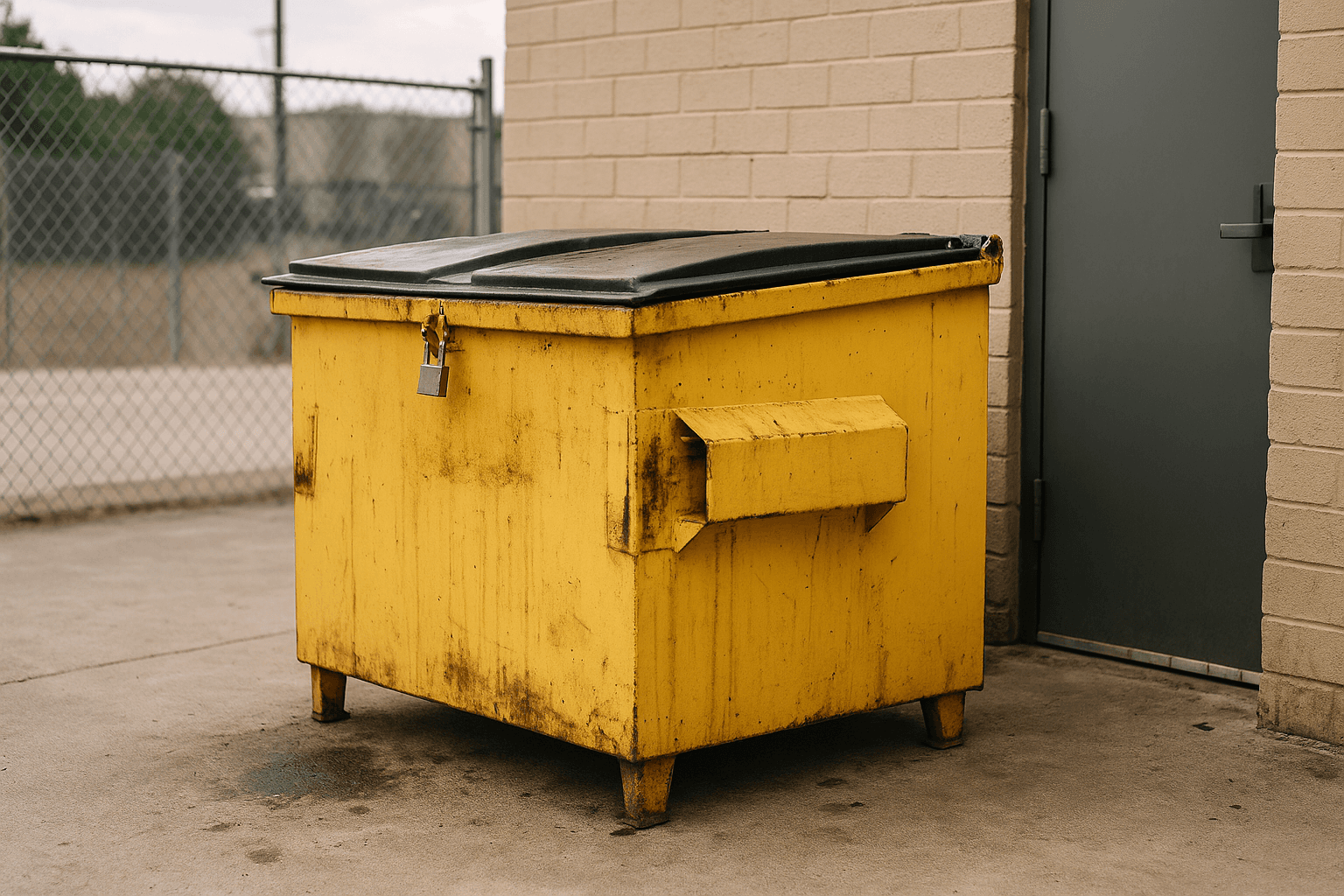
Your first used cooking oil collection is a real pickup, not a site survey. Everything that determines it gets settled on the call: fryer count, vat capacity, and change cycle set the container size, and access notes, the gate code, the turn radius, the hours a delivery blocks the lot, get logged so the driver is not guessing when the truck shows up. That container arrives sized and placed at the exact spot agreed on the call before your first stop runs, and that stop lands 3 to 5 business days from the day you call. So when the truck pulls up for the first pickup, the bin is already sitting where you expect it, not something the driver has to locate on the fly. The visit itself runs the same as every stop after it: a CDFA-registered transporter unlocks the container, pumps it empty, wipes the fill collar and lid seat, and locks it again, in about ten minutes with nobody on your crew needing to stop what they are doing. What is different about this one is what it starts. The manifest generated at that first stop is the first entry in your compliance record, and the two-year retention clock for it begins that day. It is also the visit that tells us whether the size call from the phone was right. If the container comes in noticeably fuller or emptier than expected, the interval gets adjusted, tighter or looser, at no charge, once there is a real week of fill behind it instead of an estimate from a phone call.
- The container arrives sized and placed at the agreed spot before the first stop runs, so the bin is not something the driver has to locate on day one
- The first stop is a real pickup, not a site survey: pumped empty and locked again in about ten minutes, the same as every visit after it
- Nobody on your crew has to be present or pause service for the first stop any more than for a routine one
- The manifest generated at that stop is the first entry in your compliance record, and the two-year retention clock for it starts that day
- The interval gets checked against real fill rate after this first visit and adjusted, tighter or looser, at no charge
How Fry Volume Sets Your Cooking Oil Pickup Schedule
How often used fryer oil collection needs to happen is arithmetic, not a guess, and getting it wrong is the most common reason a kitchen ends up with oil on the concrete. Take each vat capacity in pounds, divide by 7.6 to get gallons, then multiply by how many times a week that vat gets dumped. Commercial fryers are sold by oil weight and commonly run 30, 40, 50, 70, and 100 lb. NW Biofuel puts the average fast-food store at 35 lb a day and 12,775 lb a year, roughly 4.6 gallons daily, while a light-fry cafe may not clear that in a week. We size so a full service interval lands between about 75 and 90 percent full, which leaves headroom for the week your covers spike without burning a stop on a half-empty container. Filtering does not change the math, because top-off replaces only what the food absorbs and the vat still comes out at capacity. That is why the level rises in steps instead of evenly, and why a site that changes every fryer on the same slow Tuesday puts a third of its month out back in one shift. Containers run 45 and 60 gallons indoors and 70 to 200 gallons outdoors. When the arithmetic runs past the largest container, we shorten the interval rather than pretend a bigger vessel exists.
- Two 50 lb fryers changed weekly is roughly 13 gallons a week, a 70-gallon container at about 80 percent on a monthly stop
- Four 40 lb fryers on a four-day cycle is roughly 37 gallons a week, near 160 a month, a 200-gallon container at about 80 percent
- Six 50 lb fryers on a two-day fried chicken cycle is roughly 138 gallons a week, which moves that site to weekly service
- Sizes run 45 and 60 gallons indoors, 70 to 200 gallons outdoors, matched to the fryer lineup
- The interval is reviewed against real fill rate after the first month and adjusted, tighter or looser, at no charge
What Kind of Kitchen You Run Sets Your Container, Not Your Eligibility
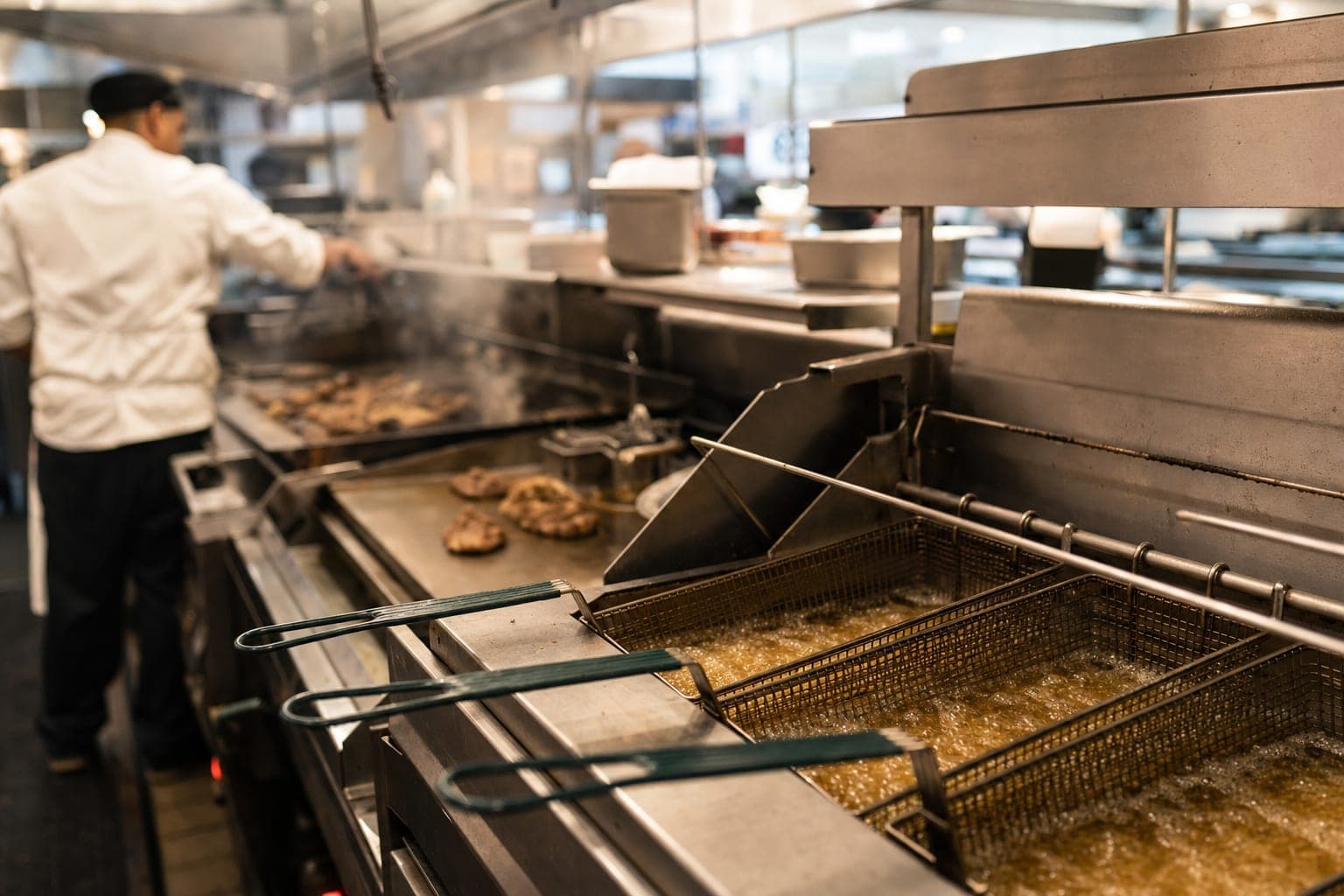
Every commercial kitchen qualifies for free pickup regardless of size, from a single countertop fryer to a twelve-fryer operation, because there is no minimum volume and no contract. What changes with volume is the container and the interval, and kitchen type is the fastest way to estimate both without weighing a single vat. A cafe or bakery, a coffee shop, a deli, or light breakfast frying, typically falls in the 3 to 10 gallon-a-week range; at the midpoint of that range a single 45-gallon indoor bin lands around 77 percent full over a full month, one pickup and done. A small full-service kitchen, a neighborhood diner, a pizzeria, a pub, or a small family restaurant, runs 8 to 20 gallons a week and generally sets up on a 100-gallon outdoor bin at about 78 percent full on a monthly stop. A busy full-service restaurant with 2 to 3 fryers, a burger spot, a taqueria, or a casual dining room, runs 20 to 35 gallons a week, which typically lands on a 130-gallon outdoor bin around 83 percent full monthly. A fry-heavy kitchen, fried chicken, fish and chips, donuts, or wings, runs 35 to 60 gallons a week and moves past what any single bin holds for a full month, so that account steps up to a 200-gallon bin serviced roughly every three weeks instead of monthly. A high-volume or multi-fryer kitchen, a large Chinese or Korean barbecue operation, banquet service, a ghost kitchen, or a hotel, runs 60 to 120 gallons a week and typically lands on a 200-gallon bin serviced about every two weeks. These are starting points, not fixed brackets. Run your own numbers on the bin size calculator, or just describe your kitchen on the call, and the container gets sized from there.
- Cafe or bakery (coffee shop, deli, light breakfast frying): 3 to 10 gal/week, typically a 45-gallon indoor bin around 77 percent full monthly
- Small full-service (diner, pizzeria, pub): 8 to 20 gal/week, typically a 100-gallon outdoor bin around 78 percent full monthly
- Busy restaurant (burger spot, taqueria, 2 to 3 fryers): 20 to 35 gal/week, typically a 130-gallon outdoor bin around 83 percent full monthly
- Fry-heavy kitchen (fried chicken, fish and chips, donuts, wings): 35 to 60 gal/week, typically a 200-gallon bin serviced about every three weeks
- High-volume or multi-fryer (banquet, ghost kitchen, hotel): 60 to 120 gal/week, typically a 200-gallon bin serviced about every two weeks
What the Cooking Oil Pickup Looks Like From Inside the Restaurant
On your scheduled day a CDFA-registered transporter services the container and is gone in about ten minutes. The container is unlocked, pumped empty in place, and locked again. Nothing is swapped out, nothing is carried through the kitchen, and nobody on your crew has to stop what they are doing or even be present. The volume is metered and recorded, the fill collar and lid seat are wiped down, and the manifest is generated on site, so the confirmation reaches your manager on the same visit rather than at the end of the month. The one thing that reliably breaks a stop is access. If a gate is locked, a delivery is parked across the approach, or a contractor fenced the area that morning, the restaurant gets a phone call first so it can be sorted on the spot. If nobody can be reached, the attempt is logged as an access issue and dispatch calls to reschedule. Repeat access failures are what turn a healthy restaurant account into an overflow, so after the second one we push to move the container or change the access method rather than quietly miss again.
- About ten minutes, no kitchen staff required, no interruption to service
- The container is pumped empty in place, never swapped and never carried through the kitchen
- Volume metered and recorded, fill collar wiped, lid and lock replaced before the stop is closed
- Digital manifest generated on site and emailed to your manager with volume and destination
- Blocked access is called in, logged, and rescheduled, never silently skipped
What Is on the Manifest, Field by Field
California tracks this waste stream with a document, not a handshake, so every cooking oil pickup leaves a record you can produce on demand. Under 3 CCR 1180.24 the manifest has to show your name and address as the generator, the date and time the grease was collected, the printed name and signature of the driver who collected it, the number on the department-issued decal affixed to the vehicle, the amount in pounds or gallons, the name and the address of the authorized receiving facility, the date and time it was received there, a printed name and signature from an on-site representative at your location, and a printed name and signature from a responsible individual at the receiving facility. The manifest is issued in three parts: you keep one, the receiving facility keeps one, and the transporter retains one. Electronic manifests are explicitly legal when they conform to the California Uniform Electronic Transactions Act, which is why yours is generated digitally instead of handed over as a smudged carbon. Two years is the legal floor for retention. We hold yours for two as our own policy, filterable by date and exportable as a PDF, so an inspector, an insurer, or a buyer running diligence on your group gets an answer in about a minute.
- Generator name and address, collection date and time, and the volume in pounds or gallons
- Driver printed name and signature, plus the number on the department-issued vehicle decal
- Name and address of the authorized receiving facility, and the date and time it took delivery
- Signatures from an on-site representative at your location and from the receiving facility
- Two-year minimum retention under 3 CCR 1180.24, two years as our own policy, PDF export any time
Restaurants, Hotels, and Food Service Operations We Collect From
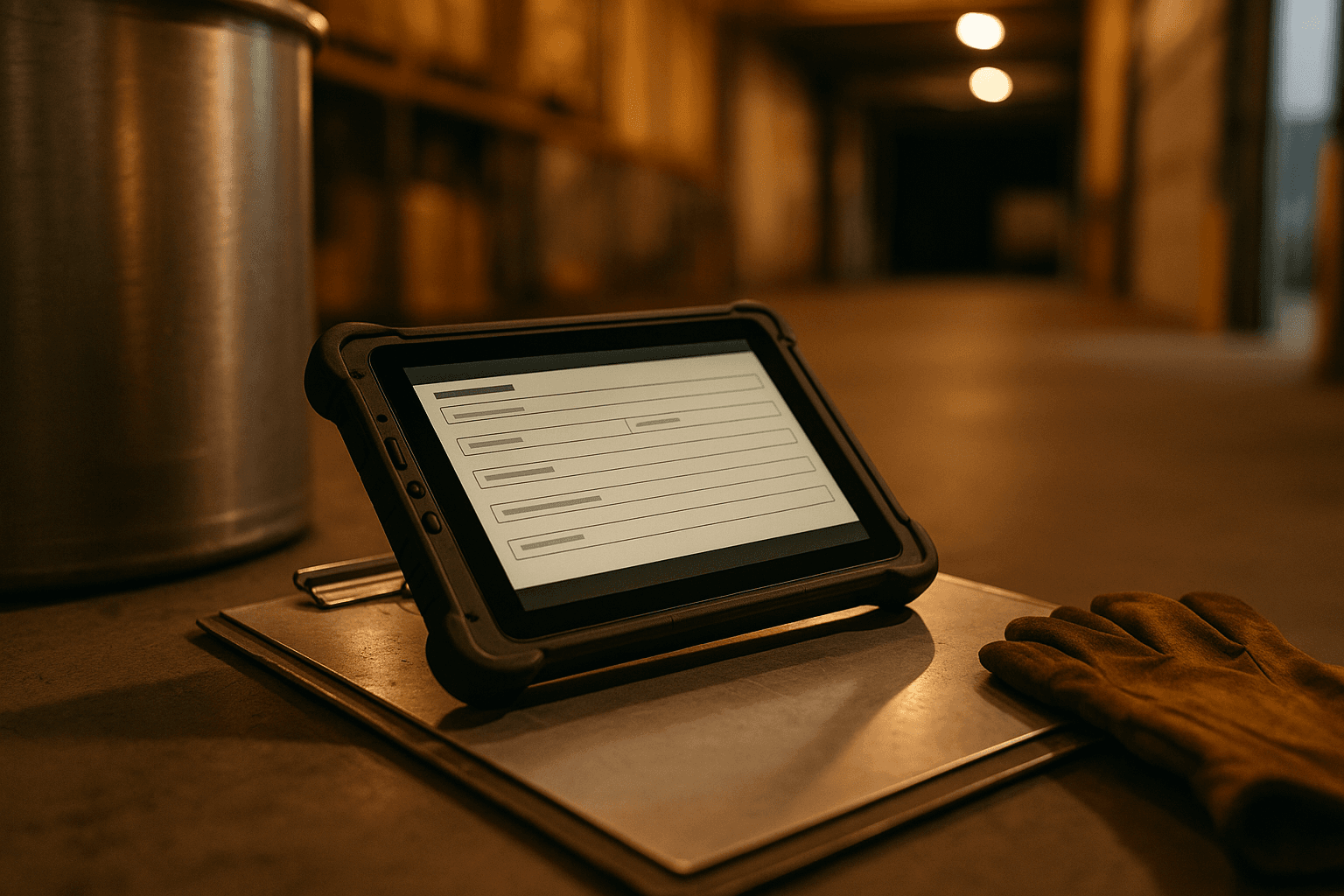
What decides a schedule is fry volume per location, not cuisine. A steakhouse running two flat-tops at 250 covers can produce less than a single-fryer chicken counter doing 600, so we schedule from the fry line rather than from the sign on the building. A hotel spreads volume across banquet, poolside, and room service, and the number that matters there is the banquet calendar, not the room count. A stadium or arena fries in surges tied to an event schedule, so the bin sits idle for ten days and then has to absorb a season opener. A commissary or shared kitchen aggregates several food businesses behind one roll-up door, which is one stop for us and one less vendor account for the building manager. University and school dining follows an academic calendar with a dead summer. Hospital food service runs steady seven days a week and cares more about a documented waste stream than about speed. Multi-unit restaurant groups and franchisees get one account, one compliance contact, and one export instead of a different vendor at every address.
- Quick-service and fast-casual restaurants, the heaviest fry loads and the tightest change cycles
- Full-service restaurants, steakhouses, and fine dining, scheduled around dinner service
- Hotels, resorts, casinos, and country clubs, one stop covering several dining outlets and banquet
- Stadiums, arenas, and event venues, surge volume tied to an event calendar
- Ghost kitchens, commissaries, and shared kitchens, one stop serving several food businesses
- University and school dining, hospital food service, corporate cafeterias, and grocery delis
- Food trucks and small-format kitchens, plus multi-unit restaurant groups on a single account
Switching Your Cooking Oil Pickup From Another Provider
Most restaurants that call already have somebody collecting. They are just tired of guessing whether it will show. Switching is simpler than operators expect, and only two things are worth checking first. Read your current agreement for the renewal clause, because grease agreements frequently roll over automatically and require written notice inside a fixed window before the anniversary date, commonly 30 to 90 days. Send that notice in writing and keep a copy, even if someone on the phone tells you a call is enough. The second thing is the container, which belongs to whoever supplied it. Your incumbent provider has to come collect its own, and the timing rarely lines up cleanly. We would rather place ours early and let a restaurant run two containers for a few days than leave the kitchen with nowhere to drain a fryer, and we can start service before the old agreement lapses if the notice window demands it. Nothing you already have disappears when you leave, either. Old manifests are still your records, and the retention clock runs on the pickups, not on the vendor, so keep the file.
- Check the current agreement for auto-renewal and the written-notice window, commonly 30 to 90 days
- Send cancellation in writing and keep a copy, a phone call is not a paper trail
- Your incumbent provider owns and removes their container, we place ours so the kitchen is never without one
- We can start service before the old agreement lapses so there is no gap in coverage
- Keep your old manifests, the retention clock runs on the pickups, not on the vendor
Where the Oil Goes After the Cooking Oil Pickup
Nothing collected gets dumped. The load moves under manifest to a licensed renderer, where it is screened, dewatered, and processed into feedstock for biodiesel, renewable diesel, and sustainable aviation fuel. That is the whole reason the service costs you nothing. The oil is a commodity, and we are paid for it rather than by you. It is also why contamination matters more than most kitchens expect: water, degreaser, and rinse residue from a boil-out night devalue a load and can get it rejected at the receiving facility, so boil-out solution follows your local FOG rules and only oil goes in the container. The environmental math is independently reported. Renewable diesel reduces carbon intensity by an average of 65 percent against petroleum diesel according to the U.S. Department of Energy Alternative Fuels Data Center, and every gallon that leaves in the bin is a gallon that never went down a floor drain or into a grease line.
- Every load travels under manifest to a licensed renderer, chain of custody documented end to end
- Processed into biodiesel, renewable diesel, and sustainable aviation fuel feedstock
- Renewable diesel averages a 65 percent carbon intensity reduction against petroleum diesel (U.S. DOE Alternative Fuels Data Center)
- Keep water and degreaser out, a contaminated load loses value and can be rejected
- Export-ready documentation for corporate sustainability and franchise compliance reporting
What's Included
Everything you need, nothing you don’t.
- Free container sized to your fryer lineup, 45 to 200 gallons, delivered and placed
- Locked lid standard on every container, never an add-on and never a rental
- Scheduled cooking oil pickup on a fixed day, at an interval set by your real fill rate
- CDFA-compliant digital manifest issued after every stop
- Online dashboard with full pickup history, date filters, and one-click PDF export
- Two-year record retention as our own policy, meeting the legal minimum
- Free container resize or repositioning when your volume or floor plan changes
- Phones answered 24/7 by a real person, callback the same business day
- Month to month, no contract, no minimum volume, no setup or rental fees
- One vendor account, one service contact, and one compliance export across every location
- One account across all eight markets, from Orange County to Tacoma
Frequently Asked Questions
It is scheduled removal of spent fryer oil from a commercial kitchen. A collector places a locked bin at your back door, and a CDFA-registered transporter pumps it out on a route matched to your volume. You get a digital manifest after every stop, and the oil is recycled into renewable fuel. It is free, with no contract.
Yes, it is the same service under two names: collectors in the industry tend to say collection, while kitchens tend to say pickup. Either way it means a locked bin at your back door, pumped out on a route matched to your volume, and a digital manifest after every visit. It covers fryer oil, shortening, and any other spent cooking oil, and it is free with no contract.
Cooking oil pickup is free for the vast majority of kitchens we serve. There is no invoice for the collection, the container, the manifest, or the record retention, and there is no minimum volume, setup fee, fuel surcharge, or contract. It is free because the oil is a commodity: it becomes feedstock for biodiesel and renewable diesel, and we are paid for it rather than by you. An off-cycle stop on a scheduled account is free as well. The only work we quote a price for is grease trap cleaning and a spill that needs containment and cleanup labor rather than a hose, and in both cases the number is given before anyone is dispatched.
Your first stop runs 3 to 5 business days from the day you call. That window covers the sizing conversation, container delivery and placement, and route assignment. Phones are answered 24/7 by a real person, and a form submission gets a callback the same business day. If you are in an actual bind, an overflowing container from a hauler who stopped showing up, say so on the call and it gets triaged as an emergency overflow instead of a normal signup. There is no paperwork to sign, no deposit, and nothing to install.
Yes. In California, CDFA classifies both as inedible kitchen grease, so they are one regulated stream. Deep fryers, flat-top griddles, woks, and pressure fryers all drain into the same container and leave on the same stop. There is no need to sort by fryer type, oil age, or whether it has already been through your filter. What has to stay out is water, degreaser, and boil-out solution, because that contamination devalues the load and can get it rejected at the receiving facility. Boil-out water follows your local FOG rules instead.
Run the arithmetic before anyone guesses. Take each vat capacity in pounds, divide by 7.6 for gallons, and multiply by how many times a week that vat gets dumped. Two 50 lb fryers changed weekly is roughly 13 gallons a week, which a 70-gallon outdoor container holds comfortably on a monthly stop. Four 40 lb fryers on a four-day cycle is roughly 37 gallons a week, near 160 a month, which is a 200-gallon container. Six 50 lb fryers on a two-day fried chicken cycle is roughly 138 gallons a week, past what any single container holds for a month, so that site goes weekly instead. Sizes run 45 and 60 gallons indoors and 70 to 200 gallons outdoors. If the first size is wrong, we swap it at no charge with no penalty and no re-quote.
The driver calls your site first to try to solve it on the spot, whether the blocker is a locked gate, a delivery truck parked across the approach, or a contractor who fenced the area that morning. If nobody can be reached, the attempt is logged as an access issue and dispatch contacts you to reschedule for the next available slot. We would rather fix the cause than keep rescheduling, so during onboarding we settle on a reliable access method, a gate code, a lockbox, or a placement reachable from the street. If access fails twice for the same reason, we will push to move the container or change the method, because repeated misses are how a container becomes an overflow.
Yes, and this is a large share of what we do. Every site rolls up into one dashboard with one point of contact, whether the portfolio sits inside one county or spans all eight of our markets, from Orange County, Los Angeles, San Diego, and the Inland Empire to the San Francisco Bay Area and Pierce, King, and Snohomish Counties in Washington. Each location keeps its own container, its own interval, and its own route assignment, because a 45-gallon cafe and a 200-gallon fry house should never share a schedule. Compliance reporting is consolidated, so a franchisor audit or a corporate sustainability request is answered from one export rather than a dozen vendor relationships. Adding a location takes about two minutes: the address, the fryer count, and a preferred day.
Standard routes run Monday through Saturday, and most stops land on weekday mornings before the kitchen gets busy. We do not run standard routes on Sundays or major holidays, but the emergency line is answered every day of the year by a real person, holidays included. Being answered is not the same as being dispatched instantly, and fewer trucks run on a holiday, so dispatch will be straight with you on the phone about what that day can actually do rather than let you plan a dinner service around a truck that is not coming. If a holiday week is going to spike your volume, tell us in advance and we tighten the interval around it.
Usually, and you do not have to be free of the old agreement to get on our schedule. Check the renewal clause first, because grease agreements often auto-renew and require written notice inside a fixed window before the anniversary date, commonly 30 to 90 days. Send that notice in writing and keep a copy. Your incumbent owns its container and has to collect it, so there is often a few-day gap in the handoff, and we would rather place ours early and let a restaurant run two containers briefly than leave the kitchen with nowhere to drain a fryer. Your old manifests stay your records, and the retention clock runs on the pickups, not on the vendor, so hold onto the file rather than handing it back.
Small residue around the fill collar is normal and gets wiped at every stop. For a larger spill, from an overfilled container, a cracked drum, or a tipped caddy, do not rinse it toward a storm drain, which is an environmental violation in California. Contain it with absorbent material such as oil-dry pads or cat litter, keep foot traffic off the area so it does not track into the kitchen or become a slip hazard, and call the emergency line. Spill calls are triaged ahead of routine stops, and the container gets pumped, the area cleaned, and damaged equipment replaced. A pump-out is free on a scheduled account, and if the job needs containment and cleanup labor, that number is quoted on the call before anyone is dispatched.
Yes, and the service is identical. The same locked container, scheduled interval, and digital CDFA manifest cover ghost kitchens, hotel and resort outlets, commissary and shared-kitchen buildings, casino dining, stadium concessions, school and university dining, hospital food service, grocery delis, food trucks, and multi-unit restaurant groups. What changes between them is the arithmetic, not the process: a stadium fries in surges tied to an event calendar, a hotel spreads volume across outlets and banquets, a commissary aggregates several businesses behind one roll-up door. We size and schedule from the fryers in the building, not from the sign on it.
What Our Clients Say

Bryan Baird
Google review
“We are a medium sized institutional kitchen located in San Juan Capistrano. When we needed a certified oil and grease removal partner the Oil Guyz were there. Fantastic customer service, fast, reliable, quick follow up and very efficient. They make it super easy to leave a GREAT review!”See full review

Alex Camacho
Google review
“I'm an up and coming new food vendor and properly disposing of used frying oil was a difficult task. That is until I contacted the Oil Guyz! There webpage made it easy to setup their free service of oil pickup. Within a few days I had a free container to store the used oil until ready for the free pickup. This service is very convenient and Joey has been very accommodating to answer all my questions and facilitate the process.”See full review

Ujwal Chaudhary
Google review
“Great service from Oil Guyz! They came and picked up my full barrel of used cooking oil completely free of charge. The process was easy, quick, and professional. I really appreciate their excellent customer service and reliable pickup. If you have used cooking oil that needs to be collected, I definitely recommend Oil Guyz. Great company and great people! 👍”See full review

Nicholas Saccoccia
Google review
“Excellent experience with Oil Guyz! They got me on the schedule fast, showed up on time, were very professional, and were in and out in no time! I would absolutely use them again.”

LA BREAKFAST CASITA
Google review
“We’ve had a great experience with Oil Guyz! I submitted a quote request through their website for our restaurant, and Joey reached out to us right away. From our first conversation, he has been extremely helpful, patient, and responsive. Joey really made the whole process easy for us. He was willing to work with our team on the best location for the bin, answered all of our questions, and kept in touch to make sure everything was taken care of. I especially appreciate his follow-through and willingness to help without ever making us feel rushed. Good customer service can be hard to find, and Joey has definitely made a great impression on us. We’re very happy we chose Oil Guyz for our used commercial oil pickup service at LA Breakfast Casita in Azusa, CA. Thank you, Joey, for making the process so smooth and for taking such good care of us. We look forward to working with Oil Guyz for a long time!”See full review

Mike Fishman
Google review
“Superb service!”

Celso Bahena
Google review
“I’m in the Santa Ana area great reliable service!”

Myk Espinoza
Oakland Ballers · Oakland, CA · Google review
“These dudes really bailed me out of a tough situation. My previous oil collection service had been really screwing me over. Spent 4 weeks of unanswered phone calls, texts, and empty promises with a company we've been using for two years just to get a used oil recepticle, all to no avail. We were sitting on 6 fryers with of oil I that I had nowhere to put. Called Joey and The Oil Guyz and he got me set up just a few hours later. Used oil container, service agreement, answered all of my questions. We're running a very odd program where our schedule is all over the place, so having a "regular" pick up schedule is out of the question. We worked out a way for quick/easy retrieval in about 5 minutes. Can't recommend these guys enough.”See full review

Maryam Tngrian
Google review
“As a manufacturing bakery, we recently needed a one-time pickup of approximately 3,000 lbs of used donut oil. Unfortunately, there was very little information available regarding the company that had handled this service previously, so I had to start from scratch. I found Oil Guyz online and was impressed from the first conversation. Joey, the owner, was extremely helpful and took the time to walk me through the entire process, making the coordination simple and straightforward. Prior to contacting Oil Guyz, I had attempted to reach other providers and had difficulty getting assistance. Oil Guyz was responsive, accommodating, and easy to work with from start to finish. The pickup was completed within the timeframe communicated, and the team handled the removal seamlessly with no disruption to our operation. Their professionalism and customer service made what could have been a challenging process very easy. We would absolutely use Oil Guyz again and would recommend them to other food manufacturing facilities looking for a reliable used cooking oil recycling partner.”See full review

Kengo Kido
Google review
“Joey took care of our needs quickly, efficiently and professionally. I highly reccoemnd his service to anyone!”

Brenda Wu
Google review
“Prompt response from Joey. Great service with problem solving. Highly recommended!”

Camille Bamford
Google review
“Fast and great to work with!”
Related Resources
Guides
Free Tools
- Grease Trap Calculator
Find your recommended pumping frequency
- Compliance Checker
Check if you meet California grease requirements
Free Used Cooking Oil Pickup Across Our Service Markets
We run scheduled routes through every kitchen in the markets below. Click your region for the local route schedule, the direct line for that market, and the cities we cover.
- Orange CountyCA
Anaheim to San Clemente, countywide
Compliance: CDFA-IKC
View Orange County details - Los AngelesCA
LA County from Downtown to the South Bay
Compliance: CDFA-IKC
View Los Angeles details - San DiegoCA
San Diego County from Oceanside to Chula Vista
Compliance: CDFA-IKC
View San Diego details - Inland EmpireCA
Riverside, San Bernardino, Ontario, Corona and beyond
Compliance: CDFA-IKC
View Inland Empire details - Bay AreaCA
Fremont, Oakland, San Francisco, San Jose and the East Bay
Compliance: CDFA-IKC
View Bay Area details - TacomaWA
Tacoma, Lakewood, University Place, Puyallup, Fife
Compliance: WA-FOG
View Tacoma details - King CountyWA
Seattle, Bellevue, Kent, Renton, Federal Way and King County
Compliance: WA-FOG
View King County details - Snohomish CountyWA
Everett, Marysville, Edmonds, Lynnwood, Lake Stevens
Compliance: WA-FOG
View Snohomish County details
Free Used Cooking Oil Pickup by City
We provide free used cooking oil pickup to restaurants and commercial kitchens across Orange County, Los Angeles, San Diego, the Inland Empire, the Bay Area, and Pierce, King, and Snohomish Counties in Washington. Every county hub lists the full route coverage.
Free Used Cooking Oil Pickup in Tacoma15 cities
See the Tacoma hub below for every community on the route.
See all 15 Tacoma citiesFree Used Cooking Oil Pickup in King County31 cities
See the King County hub below for every community on the route.
See all 31 King County citiesFree Used Cooking Oil Pickup in Snohomish County15 cities
See the Snohomish County hub below for every community on the route.
See all 15 Snohomish County citiesGet Your First Cooking Oil Pickup Scheduled
Takes about 30 seconds. No contract, no credit card, no minimum volume. Call and a real person answers, 24/7, or send the form and you get a callback the same business day.
Or call (714) 880-4788 and talk to a real person today.