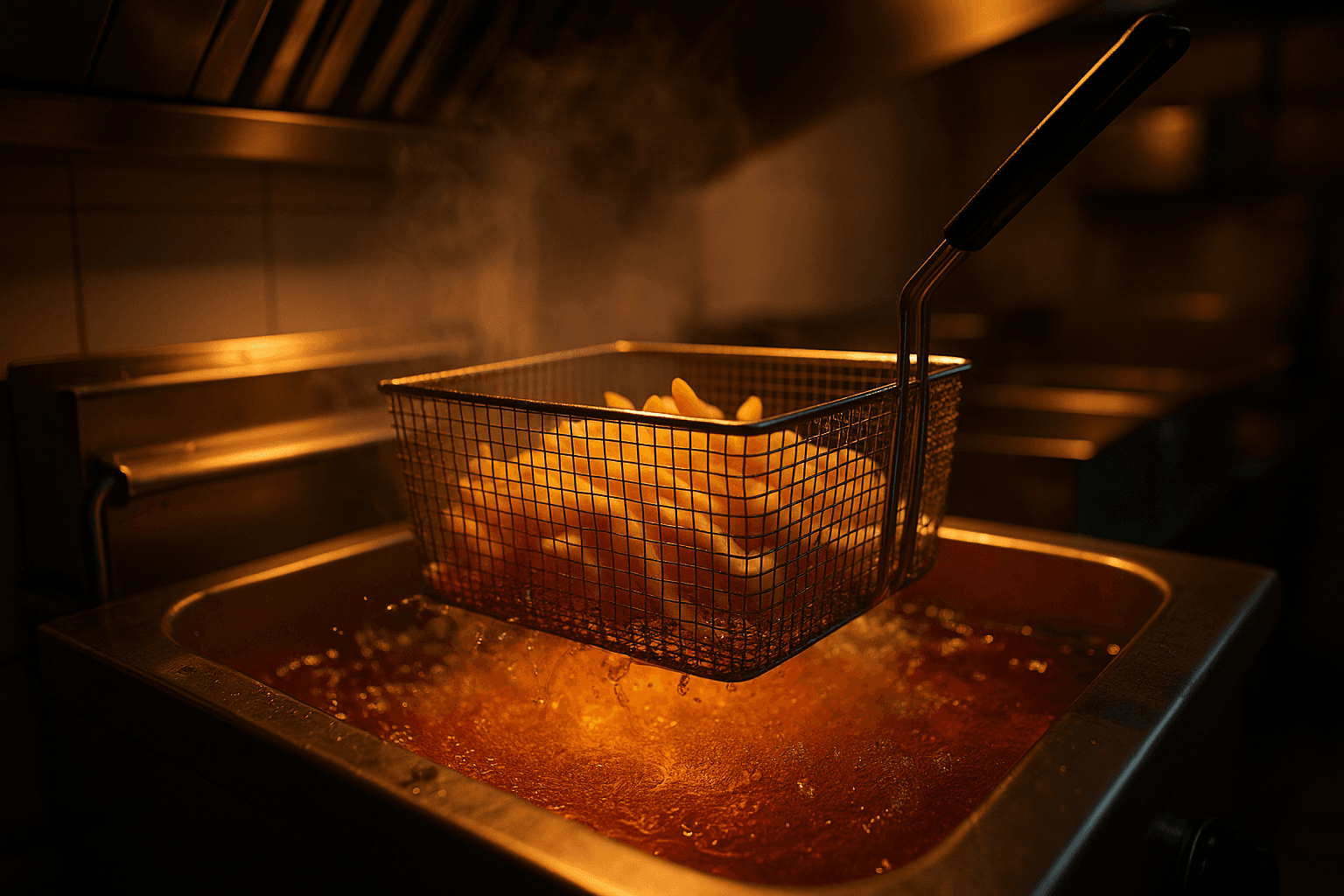
Bulk Used Cooking Oil Disposal & Recycling for Food Processors
Oil Guyz provides bulk used cooking oil disposal and recycling for food processors, manufacturers, and high-volume kitchens across California and Puget Sound, WA, pulled by tote, tank, or tanker. Call (714) 880-4788. Pulled by tote, fixed tank, or tanker: bulk cooking oil leaves a site through a hose, not on a hand truck. We size the containment to how you actually store the oil, set the cadence against your production runs instead of a route day, and issue a digital manifest after every pull. Month-to-month, no long-term contract, and a real person answers the phone 24/7.
Google rating
oil recycled, zero landfill
phones answered 24/7
“Oil Guyz are A+++!! We had 14 containers of used frying oil from our little league snack bar.”
Quick Answer
Bulk cooking oil disposal is used cooking oil collection pumped out of a tote or a tank instead of lifted from a wheeled bin. Oil Guyz runs bulk pulls by 275 or 330 gallon tote, a fixed outdoor tank, or a direct tanker, across Orange County, Los Angeles, San Diego, the Inland Empire, the San Francisco Bay Area, and Pierce, King, and Snohomish Counties in Washington, on a cadence set against your production runs. Every pull generates a digital manifest and moves to a licensed renderer under CDFA transport rules. Collection is free at ordinary volume: get started today, call (714) 880-4788 or send your volume and storage details online.
How Restaurant Oil Collection Works In 3 Simple Steps
Set up restaurant oil collection in about five minutes. We confirm your route the same business day and drop a free bin before your first pickup. After that, Oil Guyz handles every used cooking oil pickup on schedule. You never chase a hauler again.
Volume & Storage Assessment
We review how you store bulk oil, tote, fixed tank, or direct tanker, and size the containment to your actual production output.
Access & Transfer Check
We confirm the pump-out fitting, hose run, and truck access before the first pull so every collection after it is uneventful.
Cadence Built to Your Runs
Collection is timed against your production runs and the delivery window you name, not a fixed route day.
Manifest Every Pull
Each pull generates a digital manifest tied to date, site, volume, and destination, filed in your account.
Chain of Custody Confirmed
A CDFA-registered transporter delivers the load to our licensed renderer, completing the documented chain of custody.
Get Your Free Pickup Set Up
Tell us where your kitchen is. Free locked container, route started this week, no contract or minimum volume.
- Truly free. We are paid for the oil, not by you
- No contracts. Cancel anytime
- No minimum volume. Any kitchen size
- Free locked, anti-theft bin
- Compliant digital manifest after every pickup
- Instant confirmation, then a real person calls you
Request your free oil pickup
Free bin · No contract · Cancel anytime. You get an instant confirmation that we got it, then a real person calls to set up your pickup. No spam, no robocalls.
Prefer to talk? Call (714) 880-4788
When a Kitchen Crosses Into Bulk Cooking Oil Territory
Bulk cooking oil disposal starts at the point where oil stops being carried and starts being pumped. A restaurant sets out a container a driver wheels to the curb and lifts. Once a site turns over more than that container holds between visits, the answer is not more visits, it is a different handling method entirely. That threshold shows up in a commissary emptying six fryers a night, a hotel where four outlets drain into one basement tank, a ghost kitchen hall with twenty brands sharing a single back of house, a casino or club running fryers through an event weekend, and a snack plant dumping a continuous line into a day tank. What changes is not the gallon count alone, it is the physics of the handoff. Bulk UCO, the trade shorthand for used cooking oil at this scale, goes into a day tank or a holding vessel hot, cools, and then has to move through a hose under suction. From that moment the job is about fittings, hose runs, truck access, and whether the oil is still thin enough to pump, none of which a bin route was ever designed to solve.
- Bulk UCO is pumped through a hose, never carried, wheeled, or lifted
- Containment becomes a tote, a fixed tank, or a direct tanker pull
- Common at commissaries, plants, hotels, casinos, clubs, and ghost kitchen halls
- Access, fittings, and pumpability decide whether a bulk pull succeeds
- Cadence is set by how fast your vessel fills, not by a route day
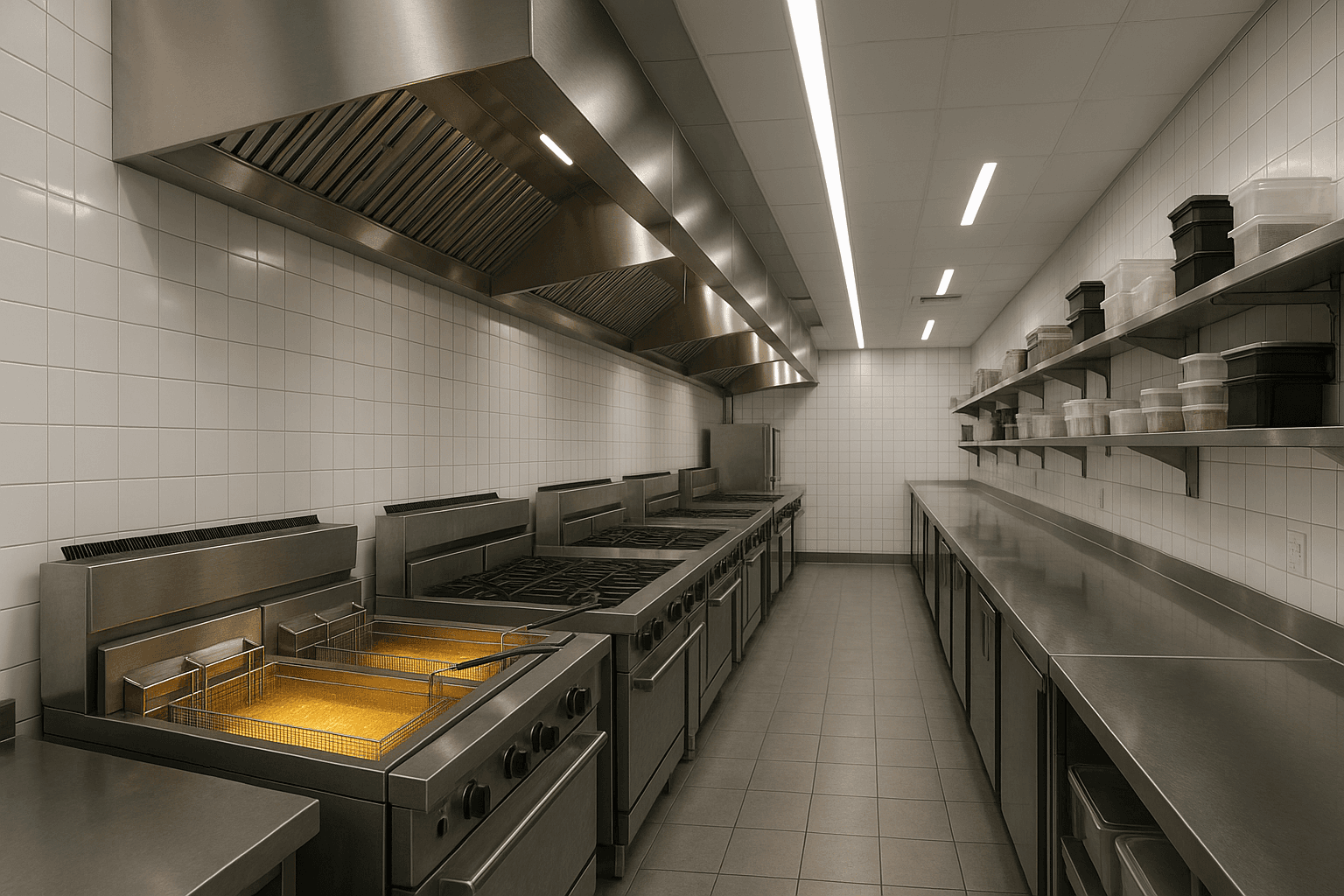
Tote, Fixed Tank or Direct Tanker: Three Ways Bulk UCO Leaves a Site
There are three ways bulk UCO leaves a site, and the right one is decided by how you store it, not by an annual gallon figure. Totes are the entry point: a standard 275 or 330 gallon IBC on a pallet, staged on flat pavement a forklift can reach, swapped full for empty so nothing has to be pumped in the rain. Totes suit a commissary, a co-packer running one line, or a hotel that can spare a corner of the loading dock. A fixed outdoor tank is the next step for a site with steady daily turnover. It sits near the fence line with a pump-out fitting a driver can reach without ever entering the kitchen or the production area, a sight gauge or level sensor so nobody is guessing how full it is, and secondary containment underneath the outlet. A direct tanker pull skips intermediate storage altogether and suits the highest-volume plants, where bulk UCO goes from your holding vessel straight onto the truck. A tanker is the cheapest way to move a large load and the most expensive way to move a small one, so the honest test is whether you hold enough between visits to justify bringing a tractor-trailer into your yard. When you do not, totes or a fixed tank will serve you better, and we will tell you so instead of selling you the bigger setup.
- Bulk totes: standard 275 or 330 gallon IBC, forklift-swapped full for empty
- Fixed outdoor tank: pump-out fitting at the fence line, level gauge, containment pad
- Direct tanker pull: no intermediate storage, for the highest-volume sites
- Containment sized to how you store bulk UCO, not to a sales target
- A straight answer when a tanker is the wrong call for your volume
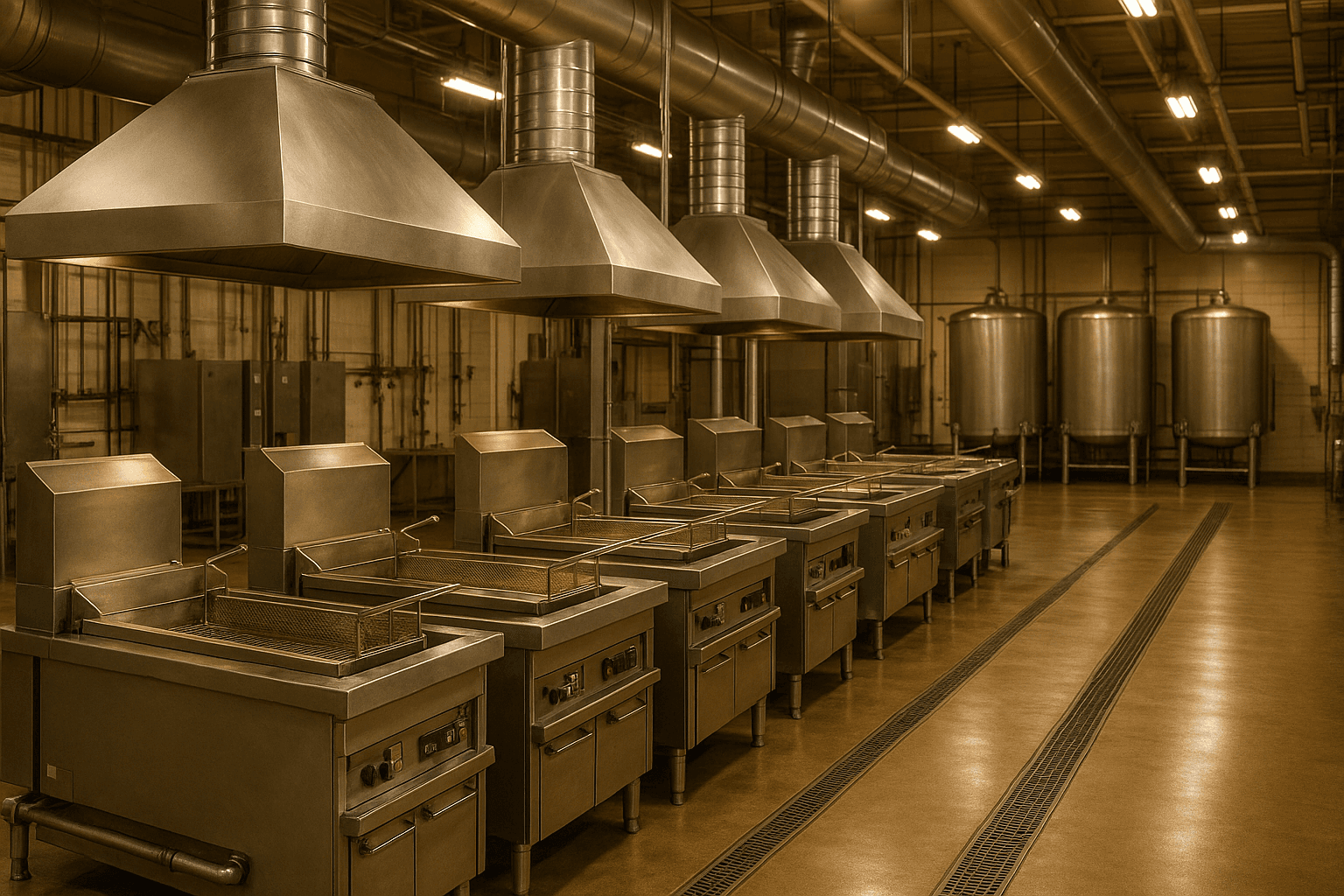
Pump-Out Fittings and Access: Why Bulk Pickups Actually Fail
More bulk UCO pickups fail on access than on volume. The outlet needs a fitting the driver already carries a match for, and a two-inch cam-and-groove quick connect is the common denominator; anything proprietary turns into an adapter hunt with a truck idling in your lot. The hose has to physically reach from that outlet to a spot where a tractor-trailer can legally and safely sit, which is a very different question at a hotel with a subterranean garage than at a plant with an open yard. Elevation matters too, because a pump lifting out of a below-grade vault works considerably harder than one drawing off a pad. So does temperature: bulk UCO thickens as it cools, and a vessel that has sat through a cold week without heat trace or an insulated line can simply refuse to move on the first attempt. Then come the unglamorous obstacles that actually kill pickups, such as bollards in front of the outlet, a low canopy over the only approach, a gate code nobody passed along, a fire lane that fills with staff parking after six, and a turning radius a long trailer cannot make. We walk the access before the first bulk UCO pull and record all of it on the account, so the second collection and the hundredth are uneventful.
- Two-inch cam-and-groove quick connect confirmed before the first pull
- Hose run measured from the outlet to a legal tractor-trailer position
- Below-grade vaults, lift height, and pump limits identified in advance
- Heat trace or an insulated line where cold weather thickens bulk UCO
- Gate codes, clearances, bollards, and turning radius recorded on the account
Bulk Collection Timed to Your Production Runs, Not a Route Day
A fixed route day is a convenience for the hauler, and it is the wrong unit of scheduling for anything that fills a vessel. Plants run campaigns: a heavy pack week, a changeover, a seasonal item that doubles output for six weeks and then stops. Hotels fill on the convention calendar. Casinos, clubs, and event venues fill on the event calendar. University dining fills for nine months and goes quiet for three. Bulk UCO cadence gets built from that shape, so the level never climbs to the point where a fryer line, a banquet, or a dinner service is waiting on us. Just as important is the window inside the day, which at most high-volume sites is narrow and non-negotiable: after receiving clears the dock and before wet sanitation owns the floor, between the lunch push and dinner prep, or overnight when the lines are down. You name that stretch and the schedule gets built around it. When your output changes, and it will, a real person picks up 24 hours a day and re-cuts the cadence rather than routing you into a ticket queue. Callbacks come the same business day, and a new bulk UCO account is typically collecting within 3 to 5 business days.
- Cadence built from run schedules, event calendars, and academic terms
- Collections planned inside the window you name, around receiving and sanitation
- Overnight, weekend, and off-shift bulk pulls where that is the only clean window
- Cadence re-cut when a new item or a busy season changes your fill rate
- A real person answers 24/7, callbacks same business day, first pickup in 3 to 5 business days
Load Quality: What the Renderer Actually Pays For
Bulk UCO is graded, not just counted, and three numbers move the grade: free fatty acid, moisture, and insoluble solids. Free fatty acid climbs with fry temperature, fry time, and how long oil sits hot before it is dumped. Moisture arrives from wet product going into the fryer, from condensate, from wash-down water finding an open fill point, and from rain into a vessel that is not truly sealed. Insolubles are the breading fines, batter, crumb, and carbon that settle to the bottom. Water is far and away the most common reason a good load comes back discounted, and the fixes are cheap and mechanical: a sealed lid, a covered fill point, a screen on the transfer, and leaving the settled fines alone instead of stirring things up right before a collection. What ruins a load outright is contamination from another stream. Grease trap and interceptor waste is brown grease, a separate material with its own handling path, and running it in with fryer oil does not blend two products, it turns saleable bulk UCO into a disposal problem. The same goes for motor oil, hydraulic fluid, solvent, cleaning chemical, and the water flush off a fryer filter. One lid left open overnight can cost more than a month of service is worth, so we tell you how your loads are grading and what changed rather than staying quiet until the value is already gone.
- Bulk UCO is graded on free fatty acid, moisture, and insoluble solids
- Water is the usual reason a clean load comes back discounted
- Sealed lid and covered fill point keep rain and wash-down runoff out
- Never mix trap or interceptor waste, motor oil, or solvent into the vessel
- Feedback on how your loads grade, not silence until it costs you
How Bulk Cooking Oil Pricing and Rebates Differ From the Free Small-Volume Service
For an ordinary restaurant the service is simply free. Free collection, a free locked container, and no contract, because used cooking oil carries commodity value as biodiesel feedstock, which means we are paid for the oil rather than by you. Bulk UCO changes that arithmetic in your favor. Once a site is producing meaningful volume, roughly 250 gallons a month and up, the oil is worth enough that money can move the other direction, and high-volume accounts are welcome to ask about a rebate. What a rebate is worth is not a fixed number, and anyone quoting one sight unseen is guessing. It moves with the market price for the feedstock, with the quality of what you have stored, and with how much handling your setup requires: a sealed fixed tank a driver pumps in twenty minutes is a cheaper load to collect than a scatter of totes that each have to be forklifted and staged. That difference is real and it shows up in what your bulk UCO is worth. Nothing on the compliance side changes at any volume. The manifest, the licensed transporter, and the licensed renderer are identical whether we pull sixty gallons or six thousand. Send us your volume, your storage setup, and your locations, and we will price it honestly.
- Free collection, free locked container, and no contract at ordinary volume
- It is free because we are paid for the oil, not by you
- Roughly 250 gallons a month and up: ask about a rebate on your bulk UCO
- Rebate value moves with feedstock market price, load quality, and handling effort
- No fixed quote sight unseen; send volume, storage setup, and locations
A Digital Manifest After Every Bulk UCO Pull
California requires a manifest for every used cooking oil collection, and at this volume that record is the only thing that proves a load left legally and shows where it went. Every bulk UCO pull generates a digital manifest tied to the date, the site, the volume, and the licensed destination, and it lands in your account instead of a binder in one plant office. Pickup is performed by a CDFA-registered transporter under the state Inedible Kitchen Grease program, and the load is delivered to our licensed renderer, where it is recycled into biodiesel and renewable-diesel feedstock. Electronic manifests are legal in California under the Uniform Electronic Transactions Act. The state sets a two-year minimum on retention; Oil Guyz holds records for two years as company policy, which is longer than the rule requires and long enough for most customer, insurance, and certification audits. For quality teams working to a GFSI-recognized scheme such as SQF or BRCGS, a per-pull record naming the destination is exactly what fills the line on outbound material and approved outside vendors. Regulation text: 3 CCR §1180.24
- Digital manifest generated after every bulk UCO collection
- Tied to date, site, volume, and the licensed destination facility
- Pickup performed by a CDFA-registered transporter, delivered to a licensed renderer
- Two-year state minimum on retention; two years as Oil Guyz company policy
- Per-pull records a quality auditor can be handed without a search
Who Signs Off on a Bulk Account, and What Each of Them Needs
Bulk UCO sits in an awkward spot on the org chart, which is the real reason bad service survives for years at large sites. Four or five people each hold one piece and none of them owns the whole thing, so nobody fixes it. The plant manager or GM cares about exactly one outcome, that a full vessel never slows a line or a service. Facilities and engineering own the tank, the fitting, the heat trace, and the containment pad, and they are the first to find out when a fitting does not match. The executive chef or food and beverage director owns what happens in the kitchen and wants collections kept out of service hours. Procurement owns the terms and asks the questions nobody else does: is this month to month, does it auto-renew, is there a lien against our equipment. Sustainability owns the volume number and the documented end use. One bulk UCO account answers all five without any of them going through the others, and for operators running several sites, pickup history, containers, schedules, and every manifest roll up into one portal with per-location access, so a site sees its own activity while corporate sees the whole footprint. Locations get added or dropped without re-papering an agreement.
- Plant manager or GM: a cadence where a full tank never stops the work
- Facilities and engineering: fittings, access, heat, and containment settled up front
- Executive chef or F&B director: collections that stay out of service hours
- Procurement: month-to-month terms, no auto-renewal, no lien on your facility
- Sustainability: volume collected and a documented end use to report
What's Included
Everything you need, nothing you don’t.
- Bulk cooking oil collection sized to your output: totes, a fixed tank, or a tanker pull
- Free containment, including a free locked container where that is the right fit
- Pump-out fitting, hose run, and truck access confirmed before the first pull
- A cadence set against your production runs, not a fixed route day
- Collections planned inside the delivery window you name
- Overnight, weekend, and off-shift pulls where that is the only clean window
- A digital manifest after every bulk UCO pull, with volume and destination
- Pickup performed by a CDFA-registered transporter
- Documented chain of custody from your outlet to our licensed renderer
- Records retained two years as company policy, well past the two-year state minimum
- One portal across every site, with per-location access and volume rollup
- A rebate conversation for sites running roughly 250 gallons a month and up
- Month-to-month terms, no long-term contract, no auto-renewal, no equipment lien
- A real person on the phone 24/7 when a run or an event changes
- Every gallon recycled into biodiesel and renewable-diesel feedstock, none landfilled
Frequently Asked Questions
Bulk cooking oil is defined by how it is stored and moved, not by a threshold on a price sheet. If your oil is pooled into a tote or a tank and has to be pumped out through a hose rather than wheeled to the curb in a container, you are on bulk service. In practice that starts around the point where a site turns over more than a standard container holds between visits, and it is normal from a few hundred gallons a month at a commissary or hotel up to several thousand at a plant with continuous fryer lines. During onboarding we look at your fryer count, oil change frequency, and run schedule, then size the containment and the cadence to your actual output rather than to an average.
Totes are the usual starting point: a 275 or 330 gallon IBC on a pallet, staged where a forklift can reach it, swapped full for empty. They work well when volume is moderate or when there is no good place to plumb a permanent vessel. A fixed outdoor tank makes sense once turnover is steady and daily, since it puts the pump-out fitting at the fence line where a driver never enters the kitchen or the production floor, and a level gauge means nobody is guessing. A direct tanker pull is for the highest-volume sites and only pays off when you hold enough bulk UCO between visits to justify sending a tractor-trailer. We size it from your real numbers, and if a smaller setup is the better answer we will say so.
Four things decide whether a bulk UCO collection goes smoothly. First, the outlet fitting, since a two-inch cam-and-groove quick connect is what drivers carry and anything proprietary needs to be known in advance. Second, the hose run, measured from that outlet to a place a tractor-trailer can legally and safely sit. Third, elevation and temperature, because a below-grade vault or a cold, unheated vessel makes the oil harder to move. Fourth, the site logistics that quietly kill pickups: gate codes, overhead clearance, bollards, fire-lane parking, and turning radius. We walk it before the first pull and record all of it, which is why the later collections stop being eventful.
Yes, and that is the point of the service. Tell us the shape of your calendar, the heavy weeks, the changeovers, the convention or event dates, the seasonal pack that doubles output, and collection is planned so the level never reaches the point where work has to stop. Inside the day, you name the window a truck can actually be on your dock, usually after receiving clears and before wet sanitation takes the floor, and the schedule gets built around it. Overnight and weekend collections are routine where that is the only clean window. When a new item or a busy season changes your fill rate, call and we re-cut the cadence. A real person answers 24/7 and callbacks come the same business day.
At ordinary volume the service is free: free collection, a free locked container, and no contract. That works because used cooking oil has commodity value as biodiesel feedstock, so we are paid for the oil rather than by you. Once a site is running roughly 250 gallons a month or more, bulk UCO is worth enough that a rebate conversation makes sense, and we welcome it. We will not quote a rebate number sight unseen, because it genuinely depends on the feedstock market, on what you have stored, and on how much handling your setup takes; a sealed fixed tank pumped in twenty minutes is a cheaper collection than totes that each need forklifting. Send your volume, storage setup, and locations and we will price it honestly.
Rendered oil is graded on free fatty acid, moisture, and insoluble solids. Water is the usual culprit behind a downgraded load, arriving through an open fill point, an unsealed lid, condensate, or rain, and it can discount oil that was perfectly good when it left the fryer. Contamination from a different stream is worse: grease trap and interceptor waste is brown grease with its own handling path, and mixing it in turns saleable bulk UCO into a disposal problem. Motor oil, hydraulic fluid, solvent, cleaning chemical, and fryer-filter flush water do the same. A sealed lid, a covered fill point, a screen on the transfer, and not stirring the settled fines before a collection protect value you have already produced.
Every bulk UCO collection generates a digital manifest tied to the date, the site, the volume, the transporter, and the licensed destination facility, and electronic manifests are legal in California under the Uniform Electronic Transactions Act. The state minimum for retention is two years under 3 CCR 1180.24; Oil Guyz keeps records for two years as company policy, which covers most customer, insurance, and certification audit windows. Quality teams working to SQF or BRCGS use the per-pull record for outbound material and approved outside vendors, and sustainability teams use the volume and destination for reporting. See the regulation: 3 CCR §1180.24
Pickup is performed by a CDFA-registered transporter under California Inedible Kitchen Grease rules, which license transporters and renderers and document chain of custody from the generator to the destination. Your load is delivered to our licensed renderer and recycled into biodiesel and renewable-diesel feedstock, never landfilled. For reporting, renewable diesel reduces carbon intensity by an average of 65 percent compared with petroleum diesel according to the U.S. Department of Energy, citing California Low Carbon Fuel Standard certified carbon intensities. Sources: DOE's renewable diesel data and CDFA's Inedible Kitchen Grease program
Yes. Each location gets its own containment, its own cadence, and its own access notes, because a hotel with a basement tank and a plant with a fence-line tank are not the same job. Everything rolls up into one portal showing pickup history, schedules, containers, and every manifest, with per-location access so a site sees its own activity while corporate sees the whole footprint. Billing stays consolidated, and adding or dropping a location does not require re-papering the agreement.
Bulk pulls run in Orange County, Los Angeles, San Diego, the Inland Empire, the San Francisco Bay Area, and Pierce, King, and Snohomish Counties in Washington. If some of your sites fall outside those eight markets, send us the full list anyway and we will tell you what we can cover now and keep you posted as we expand.
Case study
One Rolling Tank, 3,000 Pounds, Pumped Out at the Loading Dock
A contract bakery in La Habra, California whose donut line discharges spent fryer oil into a large rolling tank instead of a bin, and needed one bulk pull rather than a standing route.
The setup
Bulk sites do not look like restaurants. There was no bin behind the building to service. The oil left the fryer line into a rolling tank that plant staff walked out to the loading dock, which meant the pickup had to be timed to the tank rather than to a route day.
The window
Roughly 3,000 pounds was due off the line inside 24 hours, and had to be collected within 24 hours of coming off. Two nationwide recyclers were called first and never responded. We took the call, worked the timing around the production schedule, and met the tank at the dock on August 7, 2026 to pump it out and clean up after.
The result
One pull, no equipment left behind, a full CDFA manifest for the plant records, and a facility that now knows who to call for the next changeover.
“Joey, the owner, was extremely helpful and took the time to walk me through the entire process, making the coordination simple and straightforward.”
What Our Clients Say

Bryan Baird
Google review
“We are a medium sized institutional kitchen located in San Juan Capistrano. When we needed a certified oil and grease removal partner the Oil Guyz were there. Fantastic customer service, fast, reliable, quick follow up and very efficient. They make it super easy to leave a GREAT review!”See full review

Alex Camacho
Google review
“I'm an up and coming new food vendor and properly disposing of used frying oil was a difficult task. That is until I contacted the Oil Guyz! There webpage made it easy to setup their free service of oil pickup. Within a few days I had a free container to store the used oil until ready for the free pickup. This service is very convenient and Joey has been very accommodating to answer all my questions and facilitate the process.”See full review

Ujwal Chaudhary
Google review
“Great service from Oil Guyz! They came and picked up my full barrel of used cooking oil completely free of charge. The process was easy, quick, and professional. I really appreciate their excellent customer service and reliable pickup. If you have used cooking oil that needs to be collected, I definitely recommend Oil Guyz. Great company and great people! 👍”See full review

Nicholas Saccoccia
Google review
“Excellent experience with Oil Guyz! They got me on the schedule fast, showed up on time, were very professional, and were in and out in no time! I would absolutely use them again.”

LA BREAKFAST CASITA
Google review
“We’ve had a great experience with Oil Guyz! I submitted a quote request through their website for our restaurant, and Joey reached out to us right away. From our first conversation, he has been extremely helpful, patient, and responsive. Joey really made the whole process easy for us. He was willing to work with our team on the best location for the bin, answered all of our questions, and kept in touch to make sure everything was taken care of. I especially appreciate his follow-through and willingness to help without ever making us feel rushed. Good customer service can be hard to find, and Joey has definitely made a great impression on us. We’re very happy we chose Oil Guyz for our used commercial oil pickup service at LA Breakfast Casita in Azusa, CA. Thank you, Joey, for making the process so smooth and for taking such good care of us. We look forward to working with Oil Guyz for a long time!”See full review

Mike Fishman
Google review
“Superb service!”

Celso Bahena
Google review
“I’m in the Santa Ana area great reliable service!”

Myk Espinoza
Oakland Ballers · Oakland, CA · Google review
“These dudes really bailed me out of a tough situation. My previous oil collection service had been really screwing me over. Spent 4 weeks of unanswered phone calls, texts, and empty promises with a company we've been using for two years just to get a used oil recepticle, all to no avail. We were sitting on 6 fryers with of oil I that I had nowhere to put. Called Joey and The Oil Guyz and he got me set up just a few hours later. Used oil container, service agreement, answered all of my questions. We're running a very odd program where our schedule is all over the place, so having a "regular" pick up schedule is out of the question. We worked out a way for quick/easy retrieval in about 5 minutes. Can't recommend these guys enough.”See full review

Maryam Tngrian
Google review
“As a manufacturing bakery, we recently needed a one-time pickup of approximately 3,000 lbs of used donut oil. Unfortunately, there was very little information available regarding the company that had handled this service previously, so I had to start from scratch. I found Oil Guyz online and was impressed from the first conversation. Joey, the owner, was extremely helpful and took the time to walk me through the entire process, making the coordination simple and straightforward. Prior to contacting Oil Guyz, I had attempted to reach other providers and had difficulty getting assistance. Oil Guyz was responsive, accommodating, and easy to work with from start to finish. The pickup was completed within the timeframe communicated, and the team handled the removal seamlessly with no disruption to our operation. Their professionalism and customer service made what could have been a challenging process very easy. We would absolutely use Oil Guyz again and would recommend them to other food manufacturing facilities looking for a reliable used cooking oil recycling partner.”See full review

Kengo Kido
Google review
“Joey took care of our needs quickly, efficiently and professionally. I highly reccoemnd his service to anyone!”

Brenda Wu
Google review
“Prompt response from Joey. Great service with problem solving. Highly recommended!”

Camille Bamford
Google review
“Fast and great to work with!”
Related Resources
Guides
Free Tools
- Grease Trap Calculator
Find your recommended pumping frequency
- Compliance Checker
Check if you meet California grease requirements
Bulk Cooking Oil Disposal & Recycling Across Our Service Markets
We run scheduled routes through every kitchen in the markets below. Click your region for the local route schedule, the direct line for that market, and the cities we cover.
- Orange CountyCA
Anaheim to San Clemente, countywide
Compliance: CDFA-IKC
View Orange County details - Los AngelesCA
LA County from Downtown to the South Bay
Compliance: CDFA-IKC
View Los Angeles details - San DiegoCA
San Diego County from Oceanside to Chula Vista
Compliance: CDFA-IKC
View San Diego details - Inland EmpireCA
Riverside, San Bernardino, Ontario, Corona and beyond
Compliance: CDFA-IKC
View Inland Empire details - Bay AreaCA
Fremont, Oakland, San Francisco, San Jose and the East Bay
Compliance: CDFA-IKC
View Bay Area details - TacomaWA
Tacoma, Lakewood, University Place, Puyallup, Fife
Compliance: WA-FOG
View Tacoma details - King CountyWA
Seattle, Bellevue, Kent, Renton, Federal Way and King County
Compliance: WA-FOG
View King County details - Snohomish CountyWA
Everett, Marysville, Edmonds, Lynnwood, Lake Stevens
Compliance: WA-FOG
View Snohomish County details
Bulk Cooking Oil Disposal & Recycling by City
We provide bulk cooking oil disposal & recycling to restaurants and commercial kitchens across Orange County, Los Angeles, San Diego, the Inland Empire, the Bay Area, and Pierce, King, and Snohomish Counties in Washington. Every county hub lists the full route coverage.
Bulk Cooking Oil Disposal & Recycling in Tacoma15 cities
See the Tacoma hub below for every community on the route.
See all 15 Tacoma citiesBulk Cooking Oil Disposal & Recycling in King County31 cities
See the King County hub below for every community on the route.
See all 31 King County citiesBulk Cooking Oil Disposal & Recycling in Snohomish County15 cities
See the Snohomish County hub below for every community on the route.
See all 15 Snohomish County citiesGet Bulk Cooking Oil Collection Sized to Your Site, Free Containment, No Contract
Send us your volume, how you store the oil, and your locations. We will size the containment, confirm the pump-out access, and set a cadence against your production schedule. Call or use the form: callback the same business day, first pickup typically in 3 to 5 business days, and a real person answers 24/7.
Or call (714) 880-4788 and talk to a real person today.