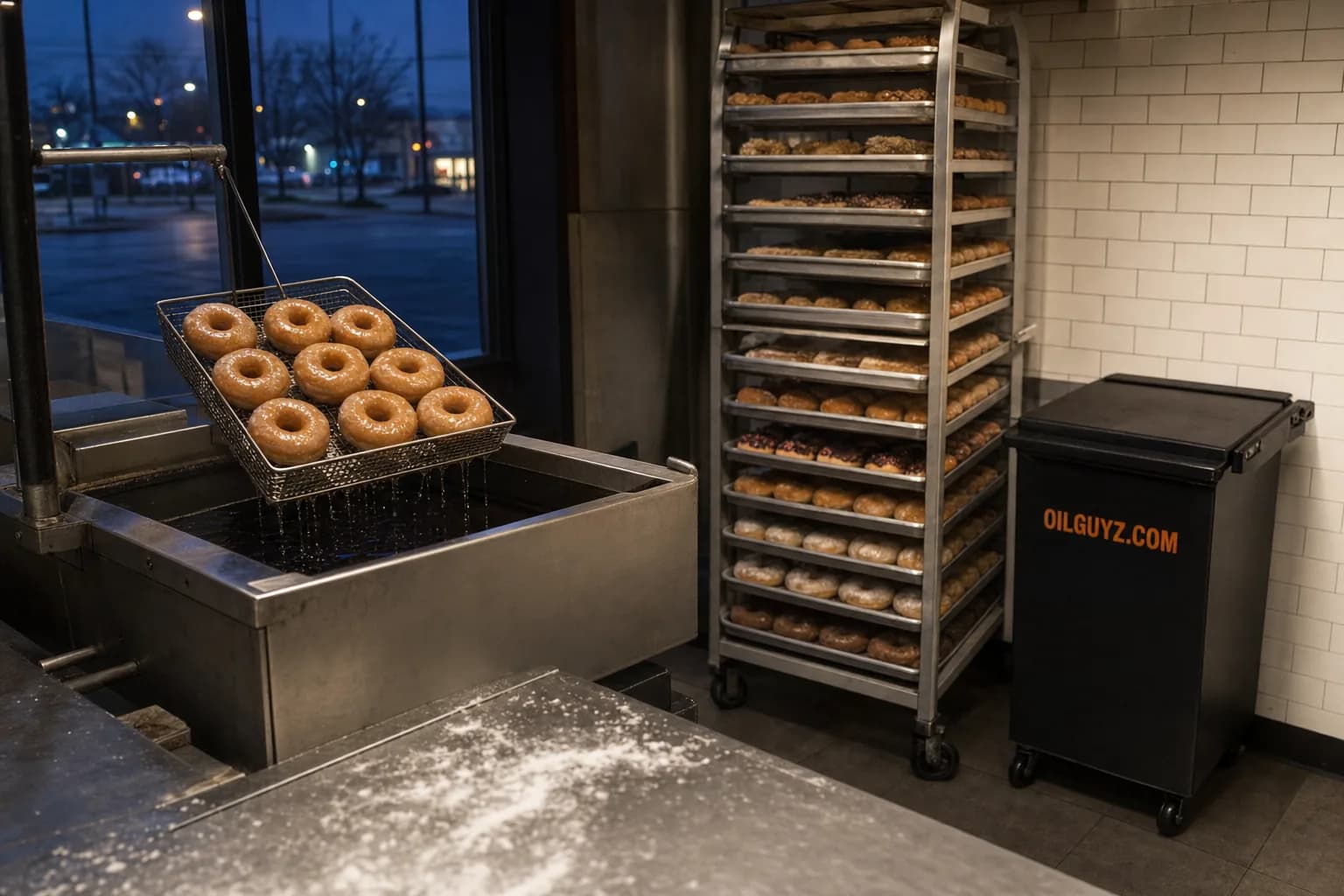
Cooking Oil and Shortening Collection for Bakeries and Donut Shops
Oil Guyz provides used cooking oil pickup and recycling for bakeries and donut shops in Orange County, Los Angeles, San Diego, the Inland Empire, the Bay Area, and Puget Sound, WA. Call (714) 880-4788. Donut shops do not fry in oil. They fry in shortening, and it sets into a solid block once it cools. Collection is timed to your changeover and your overnight fry schedule instead of a fixed route day, with a container sized to how much comes off in one drain, a free locked bin, and a CDFA manifest after every pickup. Month to month, no contract, and a real person answers the phone.
Quick Answer
Cooking oil collection for bakeries and donut shops is free scheduled pickup of used frying shortening, handled while the shortening is still soft or with equipment built for a solid. Donut fry shortening melts near 100F to 115F, so it hardens at room temperature. Pickup is timed to the changeover and the overnight fry, with a digital CDFA manifest after every collection. Month to month, no contract. Call (714) 880-4788.
Donut Shops Do Not Fry in Oil. They Fry in Shortening, and It Sets.
Almost every piece of advice written about used cooking oil pickup assumes a liquid. It assumes a driver arrives, drops a hose into a container, and pumps. That works for a restaurant running canola or a soy blend. It does not describe what happens at a donut shop, because donut production runs on solid shortening rather than a liquid frying oil, and the difference decides how the whole service has to be built.
Most commercial donut frying in North America uses palm-based shortening or an interesterified soy and palm blend. Palm shortening became the category standard after partially hydrogenated oils were pushed out of the food supply over trans fat concerns, and it stayed because it does something liquid oil cannot. The saturated fat sets up on the surface of the donut as it cools, which is what powdered sugar clings to and what keeps a glaze sitting on top of a raised donut instead of soaking in. A hard shortening also means the donut absorbs less of the frying medium, which is why a properly fried cake donut does not read as greasy.
The property that makes the donut work is the same property that makes the used shortening awkward to collect. There is no version of this where a shop switches to a liquid oil and the handling problem disappears without changing the product. So the service has to be built around the shortening rather than around a route sheet.
Shortening Gone Solid? That Is Routine.
Tell us where your kitchen is. Free locked container, route started this week, no contract or minimum volume.
Donut shops fry in shortening, not oil, and it hardens once it cools. Collection gets timed to your changeover and your overnight fry window, with a free locked container sized to one full kettle change instead of a weekly average.
Tell us how many kettles you run and how often you change them. Free service, month to month, and a CDFA manifest after every pickup.
- Truly free. We are paid for the oil, not by you
- No contracts. Cancel anytime
- No minimum volume. Any kitchen size
- Free locked, anti-theft bin
- Compliant digital manifest after every pickup
- Instant confirmation, then a real person calls you
Request your free oil pickup
Free bin · No contract · Cancel anytime. You get an instant confirmation that we got it, then a real person calls to set up your pickup. No spam, no robocalls.
Prefer to talk? Call (714) 880-4788
100F to 115F
where donut shortening melts, above room temperature
Changeover
container sized to one drain, not a weekly average
Every pickup
CDFA digital manifest issued
Why the Shortening Is a Solid Block by Morning
Donut fry shortenings are formulated to a melting point of roughly 100F to 115F, and palm fruit oil shortening specifically tends to land between 102F and 109F. A donut kettle runs around 375F, so the shortening is fully liquid while you are frying. Drained into a container at the end of a run, it is still pourable. Left overnight in a back room, it cools far below its melting point and firms up. That is not spoilage, contamination, or a sign anyone did anything wrong. It is the product behaving exactly as designed, and it happens every single time.
- In the kettle, frying: around 375F, fully liquid
- Just drained: 200F and falling, pourable but dangerous to handle
- An hour later: under 120F, thickening but still soft
- Next morning: room temperature, a solid block
The Collection Window Is Narrower Than for Liquid Oil
Liquid fryer oil can be pumped whenever a driver arrives. Used shortening has a window. It opens when the shortening has cooled enough to be safe and closes when it has firmed up enough that a standard hose will not move it. Miss the window and the collection becomes a different job, handled either by warming the material or with equipment built for thick and semi-solid loads. None of that is a problem when it is planned for. It becomes a problem when a hauler shows up expecting a liquid, finds a solid, and leaves. Telling us up front whether your container will be soft or fully set is what makes the pickup a routine stop instead of a wasted trip.
A Container Sized to the Changeover, Not the Weekly Average
Bakeries and donut shops generate waste shortening in bursts rather than in a steady trickle. A shop filters and tops off through the week, then does a complete kettle change, and the entire month of waste can leave the fryer in one evening. Sizing a container to average weekly volume guarantees an overflow on changeover night and a nearly empty bin the rest of the time. Sizing to the changeover, then setting the collection interval to match, is the arrangement that avoids both. Container shape matters too: a wide opening makes it far easier to recover a hardened mass than a narrow neck designed for pouring liquid.
- Free locked container sized to what one full changeover produces
- Wide-access containment so hardened shortening can actually be recovered
- Indoor placement where possible, since a container left outside overnight sets harder
- Upsize or add a second container at no cost when volume grows
Timed to an Overnight Fry, Not to a Route Day
Donut shops keep hours most vendors are not built around. Frying starts in the small hours, the storefront is busiest from roughly six to ten in the morning, and the calmest moment in the back of house is usually mid-morning after the rush. That schedule is an advantage for collection rather than an obstacle, because shortening drained at the end of an overnight run is still soft a few hours later. A pickup timed to that window avoids the harder scenario, which is a container that has been sitting for several days and has fully set. Wholesale and commissary operations that fry on a production calendar get the same treatment: the collection is scheduled against the changeover rather than against a fixed route day.
Why Bakery Grease Draws Extra Attention on FOG Rules
Donut and bakery production has a particular reputation with sewer authorities, and it is worth knowing where it comes from. In 2009 Fairfax County, Virginia sued Krispy Kreme over waste from a production plant, alleging that years of fats, oils, grease and yeast had built up in the county system, damaged iron pipes and pumps, and contributed to raw sewage leaks. The county sought about 2 million dollars for repairs plus 18 million in civil penalties. It did not go to judgment; the two sides settled roughly seven months later for 750,000 dollars. The settlement figure matters as much as the original claim, and quoting the larger number alone misrepresents what happened. What the case does show is that grease combined with yeast is genuinely hard on municipal infrastructure and that agencies will pursue it. For an independent shop the lesson is not that anyone is coming after you over a few kettles. It is that bakery fats are a known category, local FOG programs know it, and the paperwork trail is what protects you. The transporter side is licensed through the CDFA Meat, Poultry & Egg Safety / IKG Program.
Hardened Shortening Is Still Recyclable
Solidifying is a physical change, not contamination or degradation. Hardened shortening is still accepted as rendering feedstock and is processed into biodiesel and renewable diesel feedstock exactly like liquid fryer oil, displacing petroleum diesel in the fuel supply. None of it is landfilled. What actually ruins a load is what gets mixed in, and that part is entirely within your control.
- Keep water, ice and mop water out, which downgrade or disqualify a load
- Keep dough, glaze and food scraps out, which contaminate and speed spoilage
- Keep cleaning chemicals and degreaser out, which can refuse an entire load
- Never mix in motor oil or any petroleum product
A CDFA Manifest After Every Pickup
In California, inedible kitchen grease has to move through a licensed transporter, and every collection generates a manifest documenting where the material went, as required by CCR Title 3 §1180.24. That document is what a FOG inspector asks for, and it is the reason an unlicensed pickup at the back door is a false economy: no manifest means no proof of proper disposal when someone asks. Manifests are issued digitally after every stop and stay available in the online portal, so a shop that changes managers does not lose its compliance history with the person who had the paperwork in a drawer.
Bakeries and Donut Shops We Serve
Independent Donut Shops
Single-storefront shops running one or two kettles, frying before dawn and selling out by mid-morning. Southern California is dense with them: by the 1990s roughly 1,500 Cambodian-owned donut shops were operating in California, most of them independent family businesses, a lineage [PBS SoCal traces back to a single La Habra shop in 1979](https://www.pbssocal.org/shows/lost-la/the-cambodian-american-reign-of-doughnut-shops-began-in-this-la-habra-shop).
Wholesale and Commissary Production
Central kitchens frying for multiple storefronts or delivery accounts, where a changeover moves far more shortening at once than a retail shop and the pickup has to be staged rather than curbside.
Contract and Manufacturing Bakeries
Plants producing under contract for supermarket and foodservice accounts, where a donut line can shed a ton and a half of shortening in a single changeover and the material leaves in a tank rather than a bin.
Bakery Cafes and Coffee Shops
Cafes with a fryer running alongside the espresso bar, usually lower volume and often overlooked by haulers who consider the account too small to route.
Specialty and Mochi Donut Shops
Newer specialty formats concentrated around Orange County and the San Gabriel Valley, frying in smaller batches through the day rather than in one pre-dawn run.
In-House Bakery Departments
Bakery counters inside a larger operation such as a market, hotel or campus dining hall, where the fryer waste is one stream among several on the same account.
Oil Guyz vs. a General Grease Hauler
Built for
Scheduling
Container sizing
A set container
Paperwork
Terms
What's Included
Everything you need, nothing you don’t.
- Free scheduled pickup of used frying shortening and cooking oil
- Free locked container sized to a full kettle changeover, not a weekly average
- Collection timed to your fry schedule, including early-morning windows
- Handling for shortening that has already hardened in the container
- Digital CDFA manifest issued after every pickup and stored in the portal
- Bulk pump-out by tote or tank for wholesale and manufacturing volume
- Month-to-month terms, no long-term contract, no auto-renewal
- A real person on the phone 24/7 when a changeover moves
How Restaurant Oil Collection Works In 3 Simple Steps
Set up restaurant oil collection in about five minutes. We confirm your route the same business day and drop a free bin before your first pickup. After that, Oil Guyz handles every used cooking oil pickup on schedule. You never chase a hauler again.
Request Pickup
Fill out a 30-second form or call us. No credit card, no commitment.
Pickup Day Is Pickup Day
Your scheduled window is locked in. A CDFA-registered transporter completes the pickup, pumps your container empty, and we email your digital manifest the moment the work is logged.
Stay Compliant Automatically
Get digital manifests, pickup confirmations, and compliance records, all in your dashboard.
Frequently Asked Questions
Yes. It changes how the pickup is handled, not whether it happens. Liquid oil gets pumped straight out of the container, while shortening that has cooled into a solid block cannot be moved with a standard hose and needs either warm-state collection or equipment built for thick material. The practical answer for most shops is timing, coordinating pickup close to the changeover so the shortening is still soft. If a container has already set up hard, say so when you call, because that determines what equipment gets dispatched and prevents a wasted trip for both of us.
Most donut fry shortenings are formulated to a melting point around 100F to 115F, and palm fruit oil shortening typically sits between 102F and 109F. That is above normal room temperature, which is the entire reason donut shortening behaves differently from canola or a soy blend. A donut kettle runs near 375F, so the shortening is fully liquid while frying and stays pourable for a while after draining. Left overnight in a back room it cools well below its melting point and firms into a solid. Nothing is wrong when that happens; it simply needs different handling than a liquid.
Yes. Solidifying is a physical change, not contamination, and hardened shortening is still accepted as rendering feedstock. It is processed into biodiesel and renewable diesel feedstock the same way liquid fryer oil is, and none of it is landfilled. What actually disqualifies a load is what gets mixed in: water, ice, mop water, dough and glaze, cleaning chemicals, or any petroleum product. Keep those out and the shortening stays usable regardless of whether it is liquid or solid when it is collected. A hardened container is a scheduling question rather than a disposal problem.
Yes, including the container. There is no pickup charge, no monthly service fee, and no equipment rental, and there is no minimum volume that disqualifies a one-kettle shop. Recycling revenue is earned downstream at the renderer rather than billed to the kitchen, which is what makes the service free at your end. Terms are month to month with no contract and no auto-renewal, so there is nothing to cancel if you are unhappy. Small shops are frequently told they are too small to route, which is a routing preference rather than an economic fact.
It depends on kettle count and how often you do a complete change rather than a top off. A single-kettle shop changing once a week generates far less than a commissary running overnight production for several storefronts. The more useful trigger is container level rather than the calendar: schedule before the container is full, because an overfilled container is the one that gets spilled while someone tries to move it. Shops on an overnight fry often prefer a mid-morning window, after the rush and while the previous night drain is still soft.
What Our Clients Say

Bryan Baird
Google review
“We are a medium sized institutional kitchen located in San Juan Capistrano. When we needed a certified oil and grease removal partner the Oil Guyz were there. Fantastic customer service, fast, reliable, quick follow up and very efficient. They make it super easy to leave a GREAT review!”See full review

Alex Camacho
Google review
“I'm an up and coming new food vendor and properly disposing of used frying oil was a difficult task. That is until I contacted the Oil Guyz! There webpage made it easy to setup their free service of oil pickup. Within a few days I had a free container to store the used oil until ready for the free pickup. This service is very convenient and Joey has been very accommodating to answer all my questions and facilitate the process.”See full review

Ujwal Chaudhary
Google review
“Great service from Oil Guyz! They came and picked up my full barrel of used cooking oil completely free of charge. The process was easy, quick, and professional. I really appreciate their excellent customer service and reliable pickup. If you have used cooking oil that needs to be collected, I definitely recommend Oil Guyz. Great company and great people! 👍”See full review

Nicholas Saccoccia
Google review
“Excellent experience with Oil Guyz! They got me on the schedule fast, showed up on time, were very professional, and were in and out in no time! I would absolutely use them again.”

LA BREAKFAST CASITA
Google review
“We’ve had a great experience with Oil Guyz! I submitted a quote request through their website for our restaurant, and Joey reached out to us right away. From our first conversation, he has been extremely helpful, patient, and responsive. Joey really made the whole process easy for us. He was willing to work with our team on the best location for the bin, answered all of our questions, and kept in touch to make sure everything was taken care of. I especially appreciate his follow-through and willingness to help without ever making us feel rushed. Good customer service can be hard to find, and Joey has definitely made a great impression on us. We’re very happy we chose Oil Guyz for our used commercial oil pickup service at LA Breakfast Casita in Azusa, CA. Thank you, Joey, for making the process so smooth and for taking such good care of us. We look forward to working with Oil Guyz for a long time!”See full review

Mike Fishman
Google review
“Superb service!”

Celso Bahena
Google review
“I’m in the Santa Ana area great reliable service!”

Myk Espinoza
Oakland Ballers · Oakland, CA · Google review
“These dudes really bailed me out of a tough situation. My previous oil collection service had been really screwing me over. Spent 4 weeks of unanswered phone calls, texts, and empty promises with a company we've been using for two years just to get a used oil recepticle, all to no avail. We were sitting on 6 fryers with of oil I that I had nowhere to put. Called Joey and The Oil Guyz and he got me set up just a few hours later. Used oil container, service agreement, answered all of my questions. We're running a very odd program where our schedule is all over the place, so having a "regular" pick up schedule is out of the question. We worked out a way for quick/easy retrieval in about 5 minutes. Can't recommend these guys enough.”See full review

Maryam Tngrian
Google review
“As a manufacturing bakery, we recently needed a one-time pickup of approximately 3,000 lbs of used donut oil. Unfortunately, there was very little information available regarding the company that had handled this service previously, so I had to start from scratch. I found Oil Guyz online and was impressed from the first conversation. Joey, the owner, was extremely helpful and took the time to walk me through the entire process, making the coordination simple and straightforward. Prior to contacting Oil Guyz, I had attempted to reach other providers and had difficulty getting assistance. Oil Guyz was responsive, accommodating, and easy to work with from start to finish. The pickup was completed within the timeframe communicated, and the team handled the removal seamlessly with no disruption to our operation. Their professionalism and customer service made what could have been a challenging process very easy. We would absolutely use Oil Guyz again and would recommend them to other food manufacturing facilities looking for a reliable used cooking oil recycling partner.”See full review

Kengo Kido
Google review
“Joey took care of our needs quickly, efficiently and professionally. I highly reccoemnd his service to anyone!”

Brenda Wu
Google review
“Prompt response from Joey. Great service with problem solving. Highly recommended!”

Camille Bamford
Google review
“Fast and great to work with!”
Related Resources
Guides
Free Tools
- Grease Trap Calculator
Find your recommended pumping frequency
- Compliance Checker
Check if you meet California grease requirements
Case study
A Donut Line Dropped 3,000 Pounds of Shortening With Nowhere to Send It
A large contract bakery in La Habra that produces for major supermarket chains, running a donut line alongside its other production.
The problem
A scheduled changeover was going to take roughly 3,000 pounds of used shortening off the donut line inside 24 hours, and it had to be collected within 24 hours of coming off. The manager arranging it had recently joined the company and found no record of who had handled the previous pickup. She called two of the largest nationwide recyclers in the country. Neither one answered, and neither one called back.
What made it work
The pickup was built around the production calendar instead of a route day. The line discharged into a large rolling tank, plant staff moved the tank out to the loading dock, and the collection met it there on August 7, 2026 to pump it out and clean the area down.
The result
The full 3,000 pounds left inside the window with no interruption to production, and the plant received a CDFA manifest for its records. The review below was posted five days later.
“We would absolutely use Oil Guyz again and would recommend them to other food manufacturing facilities looking for a reliable used cooking oil recycling partner.”
Related Solutions
Donut Shortening Disposal Guide
The operational detail behind this page: why shortening solidifies, how to get it out of the kettle safely, what container suits a solid, and what not to do with it.
Learn moreCooking Oil Collection for Food Processors
For manufacturing and wholesale bakery volume where the shortening leaves in a tote or a tank rather than a bin.
Learn moreBulk Cooking Oil Disposal and Recycling
Bulk pull by tote, fixed tank, or direct tanker, scheduled against a production run instead of a route day.
Learn moreCooking Oil Compliance and Reporting
How the digital CDFA manifest and chain of custody work, and what a FOG inspector actually asks to see.
Learn moreGet Your Donut Shop on a Pickup Schedule
Tell us how many kettles you run and how often you change them, and we will size a free locked container to your changeover and set a pickup window that fits your fry schedule.
Or call (714) 880-4788 and talk to a real person today.