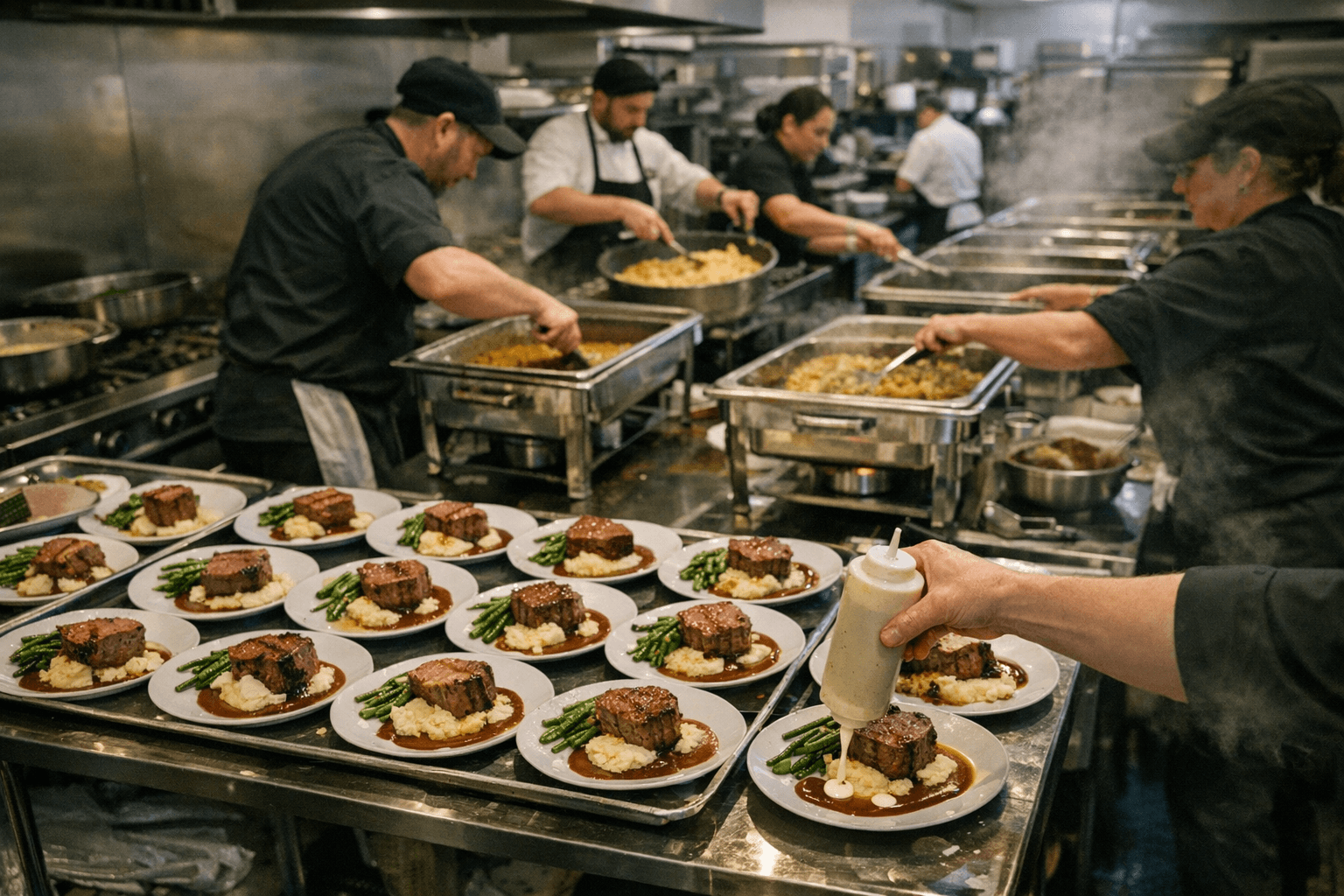
Cooking Oil Collection for Caterers, Scheduled Around Your Events
Oil Guyz provides used cooking oil pickup and recycling for catering companies and commissary kitchens in Orange County, Los Angeles, San Diego, the Inland Empire, the Bay Area, and Puget Sound, WA. Call (714) 880-4788. Cooking oil collection for catering companies works differently than it does for a restaurant, because catering fries in bursts tied to a booking calendar instead of a steady daily service. We put a free locked bin at your commissary, set the cadence off your real event schedule, and leave a digital manifest after every pickup. Free, month-to-month, cancel anytime, and a real person answers the phone around the clock. Orange County, Los Angeles, San Diego, the Inland Empire, the San Francisco Bay Area, and Pierce, King, and Snohomish Counties in Washington.
Quick Answer
Cooking oil collection for catering companies is a free scheduled service that collects used fryer oil from a locked bin at the commissary where a caterer does its production frying. Pickups are timed to the catering calendar rather than a fixed route, a CDFA-registered transporter performs the collection, and a digital manifest documents chain of custody after every stop.
Catering Fries on a Booking Calendar, Not on a Route Schedule
A restaurant fries a little every day, which is why route-based collection was built the way it was. Catering does the opposite. A caterer can go ten days without turning a fryer on, then blanch a hundred pounds of potatoes, fry six hundred passed appetizers, and burn through a full bank of oil in a single prep day for one Saturday wedding. The output is not a line, it is a series of spikes, and every spike is scheduled months in advance on a calendar the caterer is already staring at.
That mismatch is the whole problem. A hauler running a fixed biweekly restaurant route either shows up to pull a nearly empty container during a slow stretch or leaves a catering kitchen with nowhere to put Friday's oil while Saturday's event is still being prepped. The container fills during load-in week, which is exactly the week nobody has a spare hour to chase a schedule change, and the oil ends up in whatever bucket is free, riding loose in a van or sitting on the dock until it becomes somebody's problem.
Then there is the paperwork, which does not flex with the season either. In California every commercial used cooking oil collection needs a manifest documenting chain of custody to a licensed renderer, and there is no exemption for a caterer, no exemption for a slow month, and no exemption for oil that was fried at an off-site event and driven back to base. Catering companies also get asked for those records by people restaurants never hear from: a commissary landlord enforcing a lease clause, a corporate client's vendor audit, a university or hospital procurement office scoring a bid. Oil Guyz built this service around how catering actually runs, on-demand scheduling against your booking calendar, a free locked bin sized to your bay, and a digital manifest every single time.
Pickup That Moves With Your Kitchen
Tell us where your kitchen is. Free locked container, route started this week, no contract or minimum volume.
Catering volume swings with the calendar, and used oil collects fast after a big run. We flex pickup frequency to your bookings so oil never piles up between events.
Tell us about your operation and we'll set a schedule that bends with your season. Free, no contract.
- Truly free. We are paid for the oil, not by you
- No contracts. Cancel anytime
- No minimum volume. Any kitchen size
- Free locked, anti-theft bin
- Compliant digital manifest after every pickup
- Instant confirmation, then a real person calls you
Request your free oil pickup
Free bin · No contract · Cancel anytime. You get an instant confirmation that we got it, then a real person calls to set up your pickup. No spam, no robocalls.
Prefer to talk? Call (714) 880-4788
Free
pickup and locked bin at your commissary
3 to 5
business days from signup to first pickup
Month-to-month
no contract, cancel anytime
Where a Catering Company Actually Makes Its Used Cooking Oil
Almost all of it happens at the commissary, days before anyone eats. Catering production is front-loaded by design: potatoes get blanched and held, proteins get fried to a set point and finished later, spring rolls and arancini and croquettes get fried in batches and chilled for a passed-appetizer service. By the time the trucks load out, the frying is largely done and the fryers are cooling. That makes the commissary the natural collection point, and it makes the timing predictable in a way the event itself is not, because the oil is spent on prep day, not on event day. Multi-day work compounds it: a three-day conference or a wedding weekend with a rehearsal dinner, a reception, and a farewell brunch runs three separate prep cycles against one booking, and a catering company that sized its schedule off cover counts alone will misjudge that every time. We place the bin near where your kitchen already breaks down and washes out, not across a shared yard, so the last task of a prep day is a short carry rather than a trip. The remaining share is fried on site at the event, and that oil comes back to base and gets consolidated into the same container, which is what keeps one clean record per catering operation instead of a trail of loose buckets.
- Commissary prep, not event day, is when a catering kitchen actually spends its oil
- Bin placed at the wash-down and breakdown point your team already uses
- Off-site event oil comes back to base and consolidates into the same container
- One collection point per catering operation keeps the pickup record clean
- Free placement, free swaps, no rental fee and no deposit on the bin
Event-Driven Volume: A 300-Cover Saturday, Then a Dead Tuesday
Catering volume moves in blocks. A plated dinner for three hundred with two fried courses and a fried passed app can turn over a fryer bank once or twice during prep. A week of drop-off corporate lunches, all sandwiches, salads, and boxed sides, may not turn a fryer on at all. Averaging those into a fixed cadence serves neither one. So we start from your booking pattern instead of a route sheet: tell us roughly how many events a month you run and what percentage of your menus fry, we set a baseline, then you move it. Send the month's catering calendar and we schedule a pickup against the heavy dates so a catering kitchen starts the next prep day with an empty container. Push a stop during a quiet stretch instead of burning a visit nobody needs. Nothing about that costs extra, because the schedule is not the product, the oil is. A real person answers the phone around the clock, and a scheduling request gets a callback the same business day.
- Baseline cadence set from your real booking pattern, then adjusted as it changes
- Send the catering calendar and we schedule pickups against the heavy weekends
- Push a stop during a slow stretch rather than pay for a half-empty pull
- No surcharge for an added collection during a stacked event week
- Real person on the phone around the clock, callback the same business day
Wedding Season, Holiday Season, and the January Floor
Catering has a shape to its year, and a container sized to one part of it is wrong for the rest. Wedding and social season runs heavy from late spring through early fall in California, with a hard second peak in October when outdoor venues are still comfortable. November and December flip to corporate holiday parties, which are shorter, more frequent, and land on weeknights, so the frying spreads across the week instead of stacking on Saturdays. Then January and February are the floor: tastings, menu development, a few corporate drop-offs, and very little fryer time. Tastings are their own oddity, a catering team cooking a four-course menu for two prospective clients on a Wednesday afternoon, which produces almost no oil but keeps a fryer in service, so the container never quite goes idle either. A container sized for August sits half empty for two months, and one sized for January overflows on the first triple-booked weekend. We size to your working average and swap it free when the season turns, up before wedding season, down after the holidays. That swap is a phone call, not a contract amendment, because there is no contract to amend.
- Late spring through early fall wedding season, with an October second peak
- Corporate holiday party season spreads frying across weeknights, not weekends
- January and February run on tastings and drop-offs with very little fryer time
- Free seasonal swaps, size up before peak and back down when it cools
- Sized to your working average instead of your single biggest weekend
Oil From an Off-Site Event Kitchen That Has No Bin
This is the part nobody plans for. A catering team sets up in a tent kitchen behind a winery, a hotel banquet back of house it does not control, a museum courtyard with a warming kitchen and drains it has no right to use. Portable fryers go on for a fried course, and at breakdown there are four gallons of hot oil and no container that belongs to you. Two things you cannot do: pour it into the venue's grease bin, which breaks your chain of custody and usually violates the venue agreement, and pour it into a floor drain or a mop sink, which is a fats, oils, and grease violation the venue absorbs and a fast way to never get invited back. What works is boring and reliable. Let it cool, move it into sealed screw-top transport jugs that ride upright and strapped in the van, and empty them into your commissary container at the end of the load-in cycle. That consolidation is what a manifest can document. We size the container with that inbound event oil counted in, because a catering company that forgets to count it runs out of room the week it matters.
- Never pour event oil into a venue's grease bin or down a venue drain
- Cool it, seal it in screw-top transport jugs, ride it upright and strapped
- Consolidate into your commissary bin so one manifest covers the event oil
- Container sized with the inbound off-site oil counted in
- Keeps the venue relationship clean and the chain of custody intact
Catering Without a Commissary of Your Own
Plenty of working caterers do not hold a lease on a kitchen. They buy production hours in a shared prep facility, cook out of a restaurant's kitchen on its dark days, run a hall or club kitchen under an agreement, or share a warehouse bay with two other food businesses. Collection still works, it just gets arranged with whoever controls the address. The usual setup is that the facility hosts the container as a house service and each catering company gets its own collection record and its own manifests underneath it, which is normally exactly what the lease language is asking for anyway. If the landlord will let you keep your own container in your bay, that works too. What we need is practical, not legal: a spot a collection vehicle can reach on level pavement, an approach that is not blocked at pickup time, an access window or a gate code, and the property owner's okay. If you move kitchens next year, the account follows you and the record history comes with it.
- Shared prep kitchens, dark-day restaurant kitchens, hall kitchens, and warehouse bays all work
- Facility hosts the bin, each catering tenant still gets its own records
- Or keep your own container in your bay if the landlord allows it
- Requirements are practical: reachable pavement, clear approach, access window, owner's okay
- Change kitchens and the account moves with you, history included
Storage Reality Inside a Shared Commissary
Square footage in a shared commissary is the most expensive thing a catering company rents, and it is measured in racks and walk-in shelves, not in room for a tank. There is rarely a place to put a large permanent vessel, and the spot it would go is usually a shared aisle, a fire lane, or somebody else's loading zone. So the right answer for most catering companies is a smaller container collected more often rather than a big one collected rarely. It has to sit where a collection vehicle can reach it without a hand truck relay across the yard, where a lid can open fully, and where it is not blocking the path three other tenants use at 5 a.m. Shared commissaries also pool oil, several catering brands and a couple of trucks filling one container, and every one of those operators is individually responsible for its own disposal records. We keep the record per operator on a shared container, so your catering company has its own documented record rather than a share of an anonymous drum.
- Smaller container collected more often beats a tank you cannot fit in a rented bay
- Placement checked against aisles, fire lanes, and other tenants' access
- Shared container, separate records: each catering operator gets its own history
- Right-sized capacity so a pooled container stops overflowing on peak weekends
- Records satisfy the lease clauses that require proof of compliant disposal
What Goes Wrong in Catering, and How the Schedule Prevents It
The failures are predictable enough to plan around. The container fills on Thursday of a load-in week and Friday's prep has nowhere to go, so hot oil gets poured into a plastic bucket that softens, or into a container riding loose in a van that goes over on the first turn out of the lot. A crew short on time empties event oil into the venue's grease bin, and the venue notices. A pooled commissary container overflows and the landlord issues a notice that names every tenant in the yard. Months later a corporate client's vendor audit or a health inspection asks a catering company to produce its disposal records, and what exists is a shoebox of faded paper tickets from a hauler nobody can reach. Every one of those traces back to two fixable things: a container that was the wrong size for the calendar, and a record that was never captured at the moment of pickup. Sizing to the season fixes the first. An automatic digital manifest fixes the second.
- Bin fills during load-in week, the single worst week to be chasing a hauler
- Hot oil in a soft bucket or an unsecured jug is the most common spill in catering
- Dumping into a venue's bin or drain costs the venue relationship and a FOG citation
- Pooled commissary overflow becomes a notice against every tenant, including you
- Paper tickets from an unreachable hauler are not a record when an audit lands
Manifests, Licensing, and the Records a Caterer Has to Produce
Every commercial used cooking oil pickup needs a manifest documenting chain of custody from your container to a licensed renderer, and catering gets no exemption for volume, for season, or for oil that was fried off site. Pickup is performed by a CDFA-registered transporter, and after every collection you get a digital manifest showing date, location, volume, and where the load went, generated automatically instead of handwritten on a carbon ticket. Electronic manifests are explicitly allowed under 3 CCR 1180.24 when they conform to the California Uniform Electronic Transactions Act, and the legal retention minimum in that rule is two years. Oil Guyz holds two years as company policy, meeting the legal requirement, so a catering company that changes commissaries, adds a second production kitchen, or sells to a new owner hands over that history intact. Everything exports in one click when a landlord, an inspector, or a client's audit asks.
- Digital manifest after every collection, including small off-season pulls
- Pickup performed by a CDFA-registered transporter, chain of custody to our licensed renderer
- Electronic manifests are legal under CA UETA, two-year retention minimum in the rule
- We retain two years as company policy, well past the required minimum
- One-click export for commissary landlords, health inspectors, and client audits
Who Signs Off Inside a Catering Company, and What Clients Ask For
The decision sits in a different chair depending on size. At a small caterer the chef-owner decides and also carries the bucket, so the only questions that matter are does the bin fit and can I move a pickup. At a mid-size operation the executive chef or production manager owns the kitchen floor, the operations director owns vendors and the commissary lease, and an office manager owns the paperwork, which means the kitchen can quietly kill a vendor that ignores the prep calendar. At a larger catering company procurement or a controller signs, but the sales team is the one that gets asked, because corporate, university, and hospital clients now put waste and diversion questions directly in the RFP. So we set the service up with the kitchen and copy the office on every manifest, and the recovered oil is recycled through a licensed renderer into biodiesel and renewable-diesel feedstock. Renewable diesel cuts carbon intensity by roughly 65% on average versus petroleum diesel per DOE and CARB, and biodiesel and renewable diesel made from used cooking oil deliver about 79 to 86% lower lifecycle greenhouse-gas emissions per a 2022 Argonne National Laboratory lifecycle study in Environmental Science & Technology. Those are sourced numbers your proposal team can actually cite.
- Chef-owner, production manager, operations director, or procurement depending on size
- The kitchen has veto power, so bin fit and schedule control decide the account
- Manifests copied to the office so paperwork never depends on the prep crew
- Recycled through a licensed renderer into biodiesel and renewable-diesel feedstock
- Sourced DOE and CARB figures your sales team can use in an RFP response
Free Catering Cooking Oil Collection, and Why That Is Not a Catch
Used cooking oil is a traded commodity that gets refined into fuel, so the oil pays for the service. That is the entire explanation. Pickup is free, the locked bin is free, delivery and seasonal swaps are free, and the manifests are free, because we are paid for what we collect rather than by the kitchen that produced it. It is also why there is no contract holding any of it together and no minimum volume, which matters more in catering than almost anywhere else, since a February with three events would blow through a minimum-volume clause on a standard waste agreement. We will be straight about the other side too: rebate pricing starts at much larger sustained volumes than most catering operations produce, so we do not dangle a per-gallon number we would have to claw back through a fee. If your production volume does reach that level, ask and we will tell you honestly.
- Free because we are paid for the oil, not by you, and we will say so plainly
- No minimum volume, which matters in a slow catering February
- Free locked bin, free delivery, free seasonal swaps, free manifests
- Month-to-month with no long-term contract and no equipment lien
- Rebates start at much larger sustained volumes, and we say that up front
Catering Operations We Collect From
Wedding & Social Caterers
Full-service catering companies working out of a commissary, with fryer volume that rises through wedding season and falls off after the holidays.
Convention & Conference Caterers
High-volume catering operations serving convention centers and conference venues, with big single-day frying and long quiet gaps between shows.
Corporate & Office Catering
Weekday drop-off and boxed-meal catering with modest steady output, plus a heavy November and December holiday party run.
Shared Commissary Kitchens
Commissaries hosting several catering brands, food trucks, and ghost kitchens that pool oil into one bin but each need their own record.
Banquet & Venue Kitchens
Hotel, club, and venue banquet kitchens running in-house catering, with heavy frying in event windows and near-zero output between them.
Off-Premise Event Teams
Catering crews frying on portable equipment at tents, wineries, and estates, hauling event oil back to a home base for consolidated collection.
Catering Collection vs. a Fixed Waste-Hauler Route
Schedule basis
Load-in week
Slow months
Seasonal sizing
Off-site event oil
Documentation
Shared commissary
Contract
Reaching a human
What's Included
Everything you need, nothing you don’t.
- Free used cooking oil collection scheduled around your catering calendar
- Free locked collection bin, right-sized to your commissary bay and your season
- Free seasonal bin swaps, size up before wedding season and back down after
- Consolidated collection of off-site event oil brought back to your base
- Pickup performed by a CDFA-registered transporter
- A digital manifest generated automatically after every collection
- Chain-of-custody documentation to our licensed renderer
- Two-year record retention as company policy, meeting the state's legal minimum
- Per-operator records when several catering brands share one commissary container
- One-click manifest export for landlords, inspectors, and client vendor audits
- A real person who answers the phone around the clock, callback the same business day
- Month-to-month terms, no long contract, no minimum volume, cancel anytime
How Restaurant Oil Collection Works In 3 Simple Steps
Set up restaurant oil collection in about five minutes. We confirm your route the same business day and drop a free bin before your first pickup. After that, Oil Guyz handles every used cooking oil pickup on schedule. You never chase a hauler again.
Request Pickup
Fill out a 30-second form or call us. No credit card, no commitment.
Pickup Day Is Pickup Day
Your scheduled window is locked in. A CDFA-registered transporter completes the pickup, pumps your container empty, and we email your digital manifest the moment the work is logged.
Stay Compliant Automatically
Get digital manifests, pickup confirmations, and compliance records, all in your dashboard.
Frequently Asked Questions
We set a baseline cadence from your normal booking pattern and then move it against your actual calendar. Send us the month's events and we schedule a pickup ahead of the heavy dates so your kitchen starts prep with an empty bin, or push a stop during a quiet stretch. There is no surcharge for an added collection during a stacked week and no minimum volume in a slow one. A real person answers the phone around the clock, and a scheduling request gets a callback the same business day.
At the point your kitchen already breaks down and washes out, checked against the yard's shared aisles, fire lanes, and other tenants' access so it does not block anyone at 5 a.m. Space in a rented bay is expensive, so most catering operations do better with a smaller container collected more often than a large one collected rarely. If the commissary already hosts a pooled container, we keep the pickup record per operator so your catering company has its own history and its own manifests rather than a share of an anonymous drum.
Let it cool, move it into sealed screw-top transport jugs, ride them upright and strapped in the van, and empty them into your commissary bin at the end of the load-in cycle. Do not pour it into the venue's grease bin, which breaks your chain of custody and usually violates your venue agreement, and never pour it into a floor drain or mop sink, which is a fats, oils, and grease violation the venue will trace back to you. We size your container with that inbound off-site oil counted in so there is room for it.
Yes. Shared production kitchens, restaurant kitchens on their dark days, hall and club kitchens, and shared warehouse bays all work. Usually the facility hosts the container as a house service and each catering company gets its own records and manifests underneath it, which is what most lease language is actually asking for. If the property owner will let you keep your own container in your bay, that works too. What we need is a reachable spot on level pavement, an access window or gate code, and the owner's okay. If you change kitchens later, the account and the record history move with you.
Yes. Every commercial used cooking oil collection requires a manifest documenting chain of custody to a licensed renderer, with no exemption for catering, for a slow season, or for oil fried off site and driven back to base. Electronic manifests are explicitly allowed under 3 CCR 1180.24 when they conform to the California Uniform Electronic Transactions Act, and the legal retention minimum there is two years. Oil Guyz keeps two years as company policy, matching the legal requirement. See the rule: CCR Title 3, Section 1180.24, Manifest Requirements
It is free and month-to-month, with no long-term contract, no minimum volume, and cancellation anytime. Pickup, the locked bin, delivery, seasonal swaps, and the digital manifests are all included at no charge. We are paid for the recovered oil itself rather than by the kitchen that produced it, which is why the service costs you nothing. No minimum matters in catering more than most trades, because a February with three bookings would blow through a minimum-volume clause on a standard waste agreement.
We size to your working average rather than your single biggest weekend, then swap it free when the season turns. Up before the late spring through early fall wedding run and the October peak, back down after the November and December corporate holiday season ends and you drop to tastings and drop-off work. The swap is a phone call, not a contract amendment, because there is no contract to amend and no swap fee.
It is recycled through our licensed renderer into feedstock for biodiesel and renewable diesel. Renewable diesel cuts carbon intensity by about 65% on average versus petroleum diesel according to DOE and CARB ( Renewable Diesel, DOE Alternative Fuels Data Center ), and biodiesel and renewable diesel made from used cooking oil deliver roughly 79 to 86% lower lifecycle greenhouse-gas emissions per a 2022 Argonne National Laboratory lifecycle study in Environmental Science & Technology ( Biodiesel Production, DOE Alternative Fuels Data Center ). Used cooking oil also qualifies as a renewable feedstock under the EPA Renewable Fuel Standard. Those are sourced figures your team can cite when a corporate or institutional client puts a waste question in the RFP.
We cover Orange County, Los Angeles, San Diego, the Inland Empire, the San Francisco Bay Area, and Pierce, King, and Snohomish Counties in Washington, and we are expanding. If your commissary is outside those regions, tell us where you produce and we will let you know as we reach you. If some of your kitchens are in region and others are not, we will set up the ones we can cover now.
What Our Clients Say

Bryan Baird
Google review
“We are a medium sized institutional kitchen located in San Juan Capistrano. When we needed a certified oil and grease removal partner the Oil Guyz were there. Fantastic customer service, fast, reliable, quick follow up and very efficient. They make it super easy to leave a GREAT review!”See full review

Alex Camacho
Google review
“I'm an up and coming new food vendor and properly disposing of used frying oil was a difficult task. That is until I contacted the Oil Guyz! There webpage made it easy to setup their free service of oil pickup. Within a few days I had a free container to store the used oil until ready for the free pickup. This service is very convenient and Joey has been very accommodating to answer all my questions and facilitate the process.”See full review

Ujwal Chaudhary
Google review
“Great service from Oil Guyz! They came and picked up my full barrel of used cooking oil completely free of charge. The process was easy, quick, and professional. I really appreciate their excellent customer service and reliable pickup. If you have used cooking oil that needs to be collected, I definitely recommend Oil Guyz. Great company and great people! 👍”See full review

Nicholas Saccoccia
Google review
“Excellent experience with Oil Guyz! They got me on the schedule fast, showed up on time, were very professional, and were in and out in no time! I would absolutely use them again.”

LA BREAKFAST CASITA
Google review
“We’ve had a great experience with Oil Guyz! I submitted a quote request through their website for our restaurant, and Joey reached out to us right away. From our first conversation, he has been extremely helpful, patient, and responsive. Joey really made the whole process easy for us. He was willing to work with our team on the best location for the bin, answered all of our questions, and kept in touch to make sure everything was taken care of. I especially appreciate his follow-through and willingness to help without ever making us feel rushed. Good customer service can be hard to find, and Joey has definitely made a great impression on us. We’re very happy we chose Oil Guyz for our used commercial oil pickup service at LA Breakfast Casita in Azusa, CA. Thank you, Joey, for making the process so smooth and for taking such good care of us. We look forward to working with Oil Guyz for a long time!”See full review

Mike Fishman
Google review
“Superb service!”

Celso Bahena
Google review
“I’m in the Santa Ana area great reliable service!”

Myk Espinoza
Oakland Ballers · Oakland, CA · Google review
“These dudes really bailed me out of a tough situation. My previous oil collection service had been really screwing me over. Spent 4 weeks of unanswered phone calls, texts, and empty promises with a company we've been using for two years just to get a used oil recepticle, all to no avail. We were sitting on 6 fryers with of oil I that I had nowhere to put. Called Joey and The Oil Guyz and he got me set up just a few hours later. Used oil container, service agreement, answered all of my questions. We're running a very odd program where our schedule is all over the place, so having a "regular" pick up schedule is out of the question. We worked out a way for quick/easy retrieval in about 5 minutes. Can't recommend these guys enough.”See full review

Maryam Tngrian
Google review
“As a manufacturing bakery, we recently needed a one-time pickup of approximately 3,000 lbs of used donut oil. Unfortunately, there was very little information available regarding the company that had handled this service previously, so I had to start from scratch. I found Oil Guyz online and was impressed from the first conversation. Joey, the owner, was extremely helpful and took the time to walk me through the entire process, making the coordination simple and straightforward. Prior to contacting Oil Guyz, I had attempted to reach other providers and had difficulty getting assistance. Oil Guyz was responsive, accommodating, and easy to work with from start to finish. The pickup was completed within the timeframe communicated, and the team handled the removal seamlessly with no disruption to our operation. Their professionalism and customer service made what could have been a challenging process very easy. We would absolutely use Oil Guyz again and would recommend them to other food manufacturing facilities looking for a reliable used cooking oil recycling partner.”See full review

Kengo Kido
Google review
“Joey took care of our needs quickly, efficiently and professionally. I highly reccoemnd his service to anyone!”

Brenda Wu
Google review
“Prompt response from Joey. Great service with problem solving. Highly recommended!”

Camille Bamford
Google review
“Fast and great to work with!”
Related Resources
Guides
Free Tools
- Grease Trap Calculator
Find your recommended pumping frequency
- Compliance Checker
Check if you meet California grease requirements
Related Solutions
Restaurant Cooking Oil Management
The full picture of scheduled used cooking oil pickup, free locked bins, digital manifests, and how Oil Guyz handles cooking oil end to end.
Learn moreCooking Oil Compliance & Reporting
How the digital manifest and chain of custody to a licensed renderer keep your records audit-ready for inspectors, landlords, and client vendor audits.
Learn moreMulti-Location Cooking Oil Collection
One month-to-month agreement across every production kitchen you run, with consolidated reporting, and locations added or dropped without re-papering.
Learn moreGet Free Cooking Oil Collection for Your Catering Company
Tell us where you produce and roughly how your catering calendar runs, and we will size a free locked bin and set a pickup cadence around it. Month-to-month, no contract, first pickup in 3 to 5 business days. If some of your kitchens are outside our regions, we will note them and let you know as we expand.
Or call (714) 880-4788 and talk to a real person today.