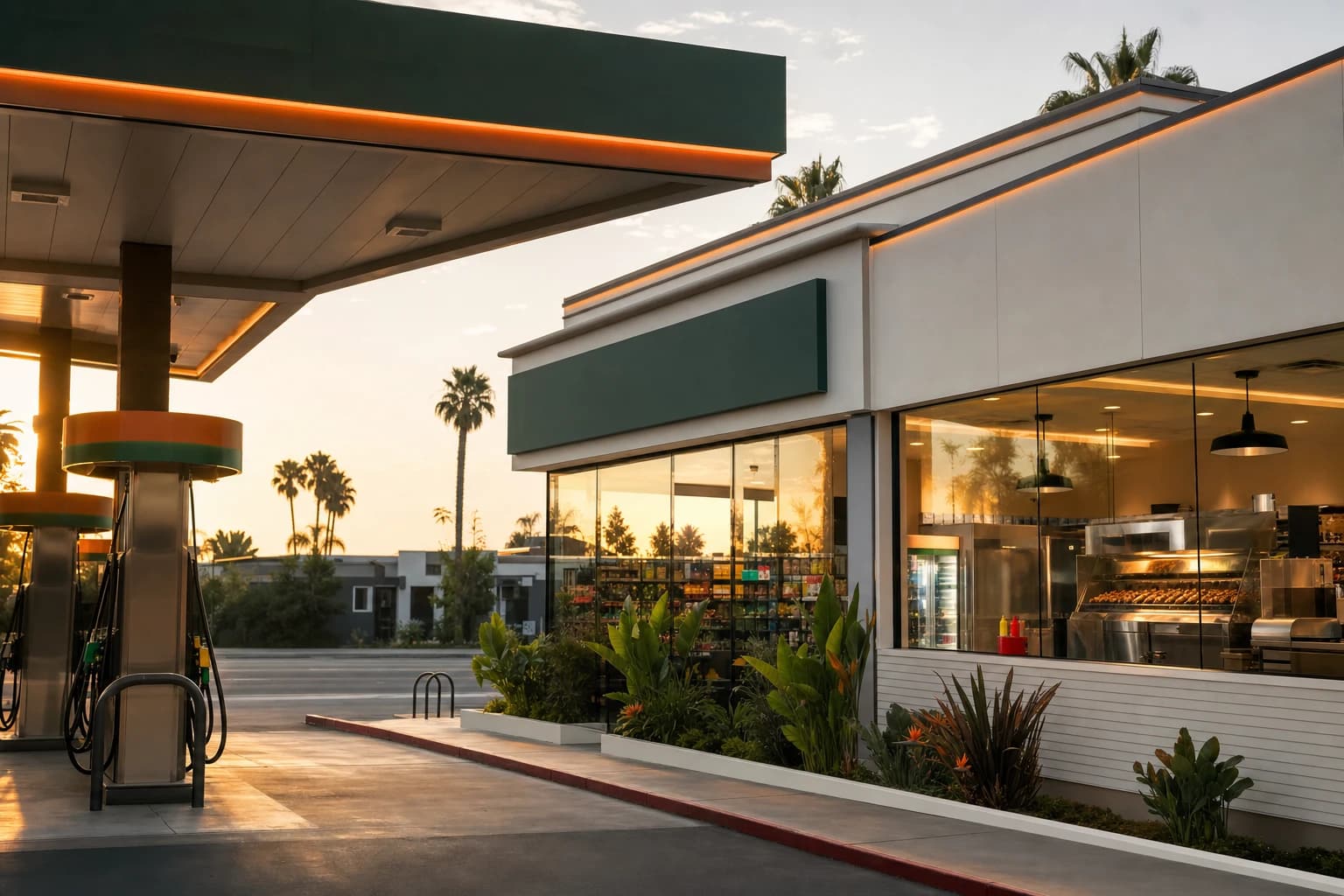
Cooking Oil Collection for Convenience Store Fry Programs
Oil Guyz provides used cooking oil pickup and recycling for convenience store and gas station fry programs in Orange County, Los Angeles, San Diego, the Inland Empire, the Bay Area, and Puget Sound, WA. Call (714) 880-4788. Free scheduled pickup for the fryer oil your convenience store actually produces, sized for one hot-food case or a hundred stores. A free locked container at your convenience store, a compliant digital manifest after every pickup, month to month with no contract. Call and a real person answers, 24/7.
Quick Answer
Cooking oil collection for convenience stores is free, scheduled pickup of the used fryer oil your convenience store or gas station hot-food program produces. Oil Guyz places a free locked container at your convenience store, matches the pickup cadence to how often you actually change the fryer, and issues a digital manifest documenting chain of custody after every pickup. Month to month, no long-term contract.
Why the Fryer Oil Becomes Nobody's Job at Your Convenience Store
Your convenience store fry program is a real kitchen hiding behind a counter. The roller grill everyone pictures produces no oil at all; the small fryer sitting next to it does, and it turns out fried chicken, jojos, taquitos, corn dogs, egg rolls, and hand pies from open to close. The person who filters that fryer and carries the used oil out back is a clerk who is also running the register, the fuel console, the lottery terminal, and the coffee bar. Turnover in convenience retail is fast, so the one clerk who knew where the oil goes moves on, and within a few weeks it is living in a stack of empty jugs behind the stockroom door.
The second problem is volume, or rather the lack of it. A single fryer can take weeks to fill a collection container, which is exactly why most haulers treat your convenience store as an afterthought: one small stop, off the route, not worth the truck. So your convenience store gets dropped onto a schedule designed for restaurants and either waits months for service or pays for a trip that collected almost nothing. Then a hot-food promotion lands, the chicken case runs all weekend, your convenience store produces several times its normal oil, and the bin overflows before anyone thinks to call.
Third, your convenience store is not a restaurant with a quiet back alley. It is a retail box on a fuel site: canopy, dispenser islands, tanker fill ports that have to stay clear, an air and vacuum bay, an ADA path to the front door, and a trash enclosure that is often the only place an oil container can legally sit. On top of that, two stores under the same brand sign can be run completely differently, one corporate operated and one franchised or dealer operated, so the person who can approve a program is sometimes the store manager, sometimes an area manager, and sometimes a franchisee who owns four of your convenience stores outright. Any oil program that ignores where the container can physically go and who really owns the decision ends up back as a pile of jugs.
Get Cooking Oil Collection for Convenience Stores Pickup Set Up
Tell us where your kitchen is. Free locked container, route started this week, no contract or minimum volume.
- Truly free. We are paid for the oil, not by you
- No contracts. Cancel anytime
- No minimum volume. Any kitchen size
- Free locked, anti-theft bin
- Compliant digital manifest after every pickup
- Instant confirmation, then a real person calls you
Request your free oil pickup
Free bin · No contract · Cancel anytime. You get an instant confirmation that we got it, then a real person calls to set up your pickup. No spam, no robocalls.
Prefer to talk? Call (714) 880-4788
Any size
one convenience store or a hundred
$0
free locked container at your convenience store
Month to month
no contract, cancel anytime
What Actually Produces the Oil in Your Convenience Store
Ask an operator where the used oil comes from and half will point at the roller grill. The roller grill is dry heat and produces none. It comes from the fryer beside your hot case, usually a countertop or single-vat unit rather than the fry bank a restaurant runs, plus the donut fryer if your convenience store bakes. Most stores have no filtration machine, so the clerk skims the crumbs, tops the vat back up, and pushes that oil well past the point a restaurant would have discarded it. It comes out dark, heavy, and loaded with breading, which is worth knowing before somebody carries it across a customer-facing forecourt in an open pail. Cooking oil collection for convenience stores starts with that handoff: the container and the caddy get matched to how your convenience store actually moves oil from vat to bin.
- Covers fried chicken, jojos, taquitos, corn dogs, egg rolls, hand pies, and donut fryers
- Sized for a countertop or single-vat fryer, not a restaurant fry bank
- Closed caddy or shuttle so a clerk never walks open oil across the forecourt
- Handles the darker, breading-heavy oil an unfiltered fryer produces
- Indoor caddy where your convenience store has no safe outdoor path for the handoff
Your Convenience Store Should Not Be on a Restaurant Schedule
A store that changes its fryer twice a week is a different collection problem than a restaurant that changes daily, and it should not be forced onto the same calendar. We set the cadence to how often your convenience store really changes oil, then size the container down rather than up. That part is counterintuitive and it matters: an oversized bin at a low-volume site just means older oil sitting in the enclosure longer, which is how a back lot starts to smell and how you end up with a rancid container nobody wants to open. A right-sized container emptied on a rhythm beats a big one that sits. When a hot-food promotion, a holiday weekend, or summer road traffic spikes the fry volume, your convenience store moves up the schedule instead of overflowing. Pickup is free at every cadence, so there is never a reason to stretch an interval to save money.
- Cadence set from how often your convenience store really changes the fryer
- Container sized down so oil does not sit and turn the enclosure sour
- Promotion, holiday, and travel-season spikes get an added collection
- Free at every frequency, so nobody stretches an interval to cut cost
- Low volume never makes your convenience store an unwanted stop
What Changes When Your Convenience Store Never Closes
Most foodservice collection is built around a closing hour. Your convenience store does not have one, so there is no dinner rush to dodge and no narrow window to negotiate. The constraint moves from the clock to the access. Overnight your convenience store is often one clerk alone behind the counter, and that clerk cannot leave the register to unlock an enclosure, move a car, or walk somebody around back. So the access gets mapped before the first pickup instead of discovered at the stop: where the container sits, whether the trash enclosure is padlocked after dark, whether a gate code is needed, and whether any part of the collection requires a human at all. If your convenience store truly cannot be serviced without staff help, we flag it on the account so the stop is planned around a staffed shift rather than assumed away. Call and a real person answers 24/7, you get a callback the same business day, and first pickup is 3 to 5 business days after you say go.
- Access mapped before the first pickup, not improvised at the stop
- Nothing should pull a solo overnight clerk off the register
- Enclosure padlocks and gate codes sorted out in advance
- Stores that need staff help are flagged and planned around a staffed shift
- Real person answers 24/7, callback the same business day
Where the Container Can Sit on Your Convenience Store Forecourt
This is the part a general hauler gets wrong at a gas station. The forecourt at your convenience store has hard constraints on where an oil container can live: clear of the dispenser islands and the canopy drive lanes, off the ADA path of travel to the front door, out of the air and vacuum bay, and above all never blocking the tanker's route to the fuel fill ports. That last one is the expensive mistake. If the tanker cannot reach the fill risers, it is the fuel delivery that gets rescheduled, and your convenience store loses far more on a missed fuel drop than on a missed oil pickup. In practice the right home is inside the trash enclosure, on pavement, lid down, away from the storm drain, which also keeps your convenience store clean under the local FOG and stormwater rules a fuel site already lives under. On a leased pad we work within whatever the landlord or fuel jobber allows for outdoor equipment. The container itself is free and it locks, which matters when you are open all night; sizes and types are on our equipment and containers page.
- Sited clear of dispenser islands, canopy lanes, and the ADA path to the door
- Never placed where it can block the tanker's access to the fuel fill ports
- Inside the trash enclosure on pavement, lid down, away from the storm drain
- Works within landlord and fuel jobber rules on a leased pad
- Free locked container at your convenience store, no rental, no equipment lien
Franchise, Dealer, or Corporate: Who Signs for Your Convenience Stores
Convenience retail ownership is messier than any other foodservice segment, and it decides who can say yes. Day to day, the fryer belongs to your store manager. The program decision usually sits with an area or district manager, or with the foodservice category manager at chain level. When the site is franchised or dealer operated none of that applies, and the franchisee signs for their own stores. We set the account up either way: a chain-level agreement corporate rolls out that your convenience stores opt into at the same terms, or a standalone account for an independent operator with three or four of them who wants nothing to do with corporate procurement. Your convenience stores all show up in one dashboard in the Filtrate portal, with role-based access so corporate sees the whole chain and each manager sees only their own store. Opening a new one or closing one is an account update, not a fresh round of paperwork and a new renewal date.
- Chain-level rollout, or a standalone account for an independent operator
- Franchised and dealer-operated stores opt in at the same chain terms
- Store manager, area manager, and category manager each get the access they need
- One dashboard across your convenience stores, with pickup history per store
- Open or close a store with an account update, no re-papering
One Manifest Per Pickup, Even at Your Smallest Convenience Store
Low volume does not buy an exemption. California requires a manifest documenting chain of custody for every used cooking oil collection, and the rule does not care whether the load came from a 200-seat restaurant or from your convenience store that fries twice a week. The detail that matters to a small operator is that the record is generated per pickup, not per store per year, so a six-week rhythm still produces a complete manifest every single time the container is emptied. Pickup is performed by a CDFA-registered transporter and the oil is delivered to a licensed renderer. Your manifest is digital and captured automatically, so the clerk on shift signs nothing and files nothing, and the history exports cleanly if a franchisor audit, an insurer, or a health inspector ever asks. California sets a two-year minimum retention on those records; we hold two years as company policy, which is our choice rather than the legal floor.
- Digital manifest after every pickup, with no exemption for low volume
- Chain of custody documented from your convenience store to a licensed renderer
- Pickup performed by a CDFA-registered transporter
- No paperwork for the clerk on shift, records captured automatically
- Two-year minimum retention under state rule, two years kept as our policy
Month to Month, and Why Your Convenience Store Pays Nothing
Contracts in this trade are notorious: multi-year lock-ins, auto-renewal traps, sole-provider clauses, and liens filed against store equipment. An operator with a dozen small stops should not have to fight through any of that to get a bucket of oil taken away. This program is month to month. Cancel anytime, no auto-renewal trap, no sole-provider clause, no lien on your convenience store, and your full pickup and manifest history exports cleanly if you leave. It is free because we are paid for the oil, not by you: used fryer oil is a real commodity, recycled into biodiesel and renewable diesel feedstock, so the value in the container covers the service. That is the entire model, and it is why your convenience store gets the same free locked container and the same manifest a high-volume kitchen gets.
- Month to month, cancel anytime, no auto-renewal and no penalty maze
- No sole-provider clause and no equipment lien on your convenience store
- Free because we are paid for the oil, not by you
- Chain terms apply to your convenience stores, not just the busy ones
- Full pickup and manifest history exports on exit
Built for Convenience Store and Gas Station Operators
Convenience Store Chains
Multi-store operators running fried chicken, hot-food, and bakery programs who want one account and one cadence policy across your convenience stores instead of a different jug arrangement at each one.
Gas Station and Fuel Retail Operators
Fuel retailers with a fry program inside the store who need the container sited so it never blocks the tanker, the islands, or the path to the door.
Convenience Store Franchisees and Dealers
Franchised and dealer-operated sites that want chain-level terms without waiting on corporate procurement, and one renewal-free account across your convenience stores.
Travel Centers and Truck Stops
High-traffic travel plazas whose hand-breaded chicken and quick-service kitchens run closer to restaurant volume than to a typical convenience store, and need more frequent collection.
Regional Multi-Brand Operators
Operators running convenience, fuel, and quick-serve concepts side by side who want every location on one dashboard and one consolidated record set.
Foodservice Category and Facilities Managers
The people who actually own the fry program across your convenience stores and need cadence, container siting, and compliance standardized store to store.
A Convenience Store Program vs. a General Waste Hauler
Schedule
Container size
Forecourt siting
Container cost
Multi-store account
Manifest
Term
Adding a store
What's Included
Everything you need, nothing you don’t.
- Free scheduled pickup at your convenience store and every other one on the account
- Cadence matched to how often your convenience store really changes its fryer
- A free locked collection container, sized to the store rather than oversized
- Container siting that clears the fuel fill ports, dispenser islands, and ADA path
- Closed caddy or shuttle so a clerk never carries open oil across the forecourt
- Indoor caddy where your convenience store has no safe outdoor handoff
- Added collections for hot-food promotions and travel-season volume spikes
- Your convenience stores on one account in the Filtrate portal, with per-store history
- Role-based access so corporate sees the chain and each manager sees their store
- A digital manifest after every pickup, chain of custody to a licensed renderer
- Month to month with no lock-in, no auto-renewal, no sole-provider clause, no lien
- A real person on the phone 24/7 and a callback the same business day
How Restaurant Oil Collection Works In 3 Simple Steps
Set up restaurant oil collection in about five minutes. We confirm your route the same business day and drop a free bin before your first pickup. After that, Oil Guyz handles every used cooking oil pickup on schedule. You never chase a hauler again.
Request Pickup
Fill out a 30-second form or call us. No credit card, no commitment.
Pickup Day Is Pickup Day
Your scheduled window is locked in. A CDFA-registered transporter completes the pickup, pumps your container empty, and we email your digital manifest the moment the work is logged.
Stay Compliant Automatically
Get digital manifests, pickup confirmations, and compliance records, all in your dashboard.
Frequently Asked Questions
Tell us how many stores you run and roughly how often each one changes its fryer. We place a free locked container at your convenience store, sited so it clears the fuel fill ports, the dispenser islands, and the path to the front door, then set a pickup cadence. Collection is free, the container gets emptied on schedule, and a digital manifest lands on your account after every pickup. A real person answers the phone 24/7, you get a callback the same business day, and first pickup is 3 to 5 business days after you say go.
No. A roller grill is dry heat, so it produces no fryer oil at all. The used oil in your convenience store comes from the fryer next to the hot case, plus the donut fryer if you bake. This trips people up constantly, because the roller grill is the visible part of the hot-food program and the fryer sits behind the counter. If your convenience store has any fryer at all, even a single countertop unit, it produces used cooking oil that has to leave on a manifest.
No, and low volume is the norm in this segment. A store that fries twice a week can take weeks to fill a container, which is why other haulers treat it as an unwanted stop. We size the container down rather than up so the oil is not sitting in the enclosure going sour between visits, and we set the cadence to match. Pickup is free at any frequency, so there is no reason to stretch an interval to save money, and your convenience store can be moved up the schedule when a promotion runs.
Almost always inside the trash enclosure, on pavement, lid down, away from the storm drain. It has to clear the dispenser islands and canopy drive lanes, stay off the ADA path of travel to the door, stay out of the air and vacuum bay, and never sit where it blocks the tanker's route to the fuel fill ports. That last constraint is the one that costs real money: a blocked fill riser means the fuel delivery gets rescheduled, which hurts your convenience store far more than a missed oil pickup. On a leased pad we work within whatever the landlord or fuel jobber allows for outdoor equipment. Sizes and container types are on our equipment and containers page.
Yes. California requires a manifest documenting chain of custody for every used cooking oil collection, with no exemption for low volume. The record is generated per pickup rather than per year, so your convenience store on a six-week rhythm still gets a complete manifest every time the container is emptied. Yours is digital and captured automatically, so the clerk on shift files nothing. Electronic manifests are explicitly legal in California and the state sets a two-year minimum retention; we hold two years as company policy. See the rule: California Code of Regulations Title 3 §1180.24, UCO Manifests
Yes. Franchised and dealer-operated sites sign for themselves and get the same terms a chain account gets, so four stores are priced on your combined volume rather than one by one. If your franchisor already has a chain-level agreement in place, your convenience stores can opt into that instead. Either way, opening a new one or closing one is an account update, not a new contract with its own renewal date.
It varies enormously by program. One countertop fryer and a small hot case produce a fraction of what a restaurant does, while a travel center with hand-breaded chicken can approach restaurant volume. For a high-end reference point, industry data puts a busy fast-food location around 35 pounds of used cooking oil per day, roughly 12,775 pounds a year; most convenience stores land well under that. We size the container and the cadence to what your convenience store really produces instead of guessing. Benchmark: Cooking Oil Collection for Fast Food, Volume Benchmark
Store-level pickup runs in Orange County, Los Angeles, San Diego, the Inland Empire, the San Francisco Bay Area, and the Puget Sound corridor from Everett to Tacoma. A chain with sites in several of those markets can put every store on one account. Stores outside the footprint go on a waitlist and we tell you when a route opens rather than implying coverage we do not have.
It is free because we are paid for the oil, not by you. Used fryer oil is a commodity, and it is recycled through a licensed renderer into feedstock for biodiesel and renewable diesel, which the U.S. Department of Energy reports cuts carbon intensity on average by about 65% versus petroleum diesel: DOE AFDC, Renewable Diesel That value is what pays for the free locked container, the scheduled collection, and the manifest, which is why your convenience store gets the same program a large kitchen gets.
What Our Clients Say

Myk Espinoza
Oakland Ballers · Oakland, CA · Google review
“These dudes really bailed me out of a tough situation. My previous oil collection service had been really screwing me over. Spent 4 weeks of unanswered phone calls, texts, and empty promises with a company we've been using for two years just to get a used oil recepticle, all to no avail. We were sitting on 6 fryers with of oil I that I had nowhere to put. Called Joey and The Oil Guyz and he got me set up just a few hours later. Used oil container, service agreement, answered all of my questions. We're running a very odd program where our schedule is all over the place, so having a "regular" pick up schedule is out of the question. We worked out a way for quick/easy retrieval in about 5 minutes. Can't recommend these guys enough.”See full review

Maryam Tngrian
Google review
“As a manufacturing bakery, we recently needed a one-time pickup of approximately 3,000 lbs of used donut oil. Unfortunately, there was very little information available regarding the company that had handled this service previously, so I had to start from scratch. I found Oil Guyz online and was impressed from the first conversation. Joey, the owner, was extremely helpful and took the time to walk me through the entire process, making the coordination simple and straightforward. Prior to contacting Oil Guyz, I had attempted to reach other providers and had difficulty getting assistance. Oil Guyz was responsive, accommodating, and easy to work with from start to finish. The pickup was completed within the timeframe communicated, and the team handled the removal seamlessly with no disruption to our operation. Their professionalism and customer service made what could have been a challenging process very easy. We would absolutely use Oil Guyz again and would recommend them to other food manufacturing facilities looking for a reliable used cooking oil recycling partner.”See full review

Kengo Kido
Google review
“Joey took care of our needs quickly, efficiently and professionally. I highly reccoemnd his service to anyone!”

Brenda Wu
Google review
“Prompt response from Joey. Great service with problem solving. Highly recommended!”

Camille Bamford
Google review
“Fast and great to work with!”

John Kim
Google review
“Fast efficient service”

Olivia Valdivia
Google review
“Oil Guyz are A+++!! We had 14 containers of used frying oil from our little league snack bar. They helped us on our last day to meet and pick up our containers. They made it easy, and we will be looking to use them for our next season!! Thanks Joey!!”See full review
Related Resources
Guides
Free Tools
- Grease Trap Calculator
Find your recommended pumping frequency
- Compliance Checker
Check if you meet California grease requirements
Where We Pick Up
Related Solutions
Containers and Equipment
Container sizes, locked outdoor bins, and indoor caddies, including what fits inside a fuel-site trash enclosure.
Learn moreMulti-Location Collection
One agreement across the whole chain, open or close stores without re-papering, consolidated records, clean exit.
Learn moreCompliance and Reporting
The manifest detail, dashboards, role-based access, and audit-ready exports behind every pickup.
Learn moreCooking Oil Management
The full program overview: how scheduled pickup, free containers, and compliance fit together.
Learn moreGet Every Convenience Store on One Free Pickup Schedule
Tell us how many convenience stores and gas stations you run and where they are. We will size a free locked container for each one, find a spot that clears the fill ports and the islands, and set a cadence that matches how often your convenience store really changes its fryer. Month to month, no contract. Call and a real person answers 24/7, or send the form and you get a callback the same business day. If some stores fall outside our markets, we will say so.
Or call (714) 880-4788 and talk to a real person today.