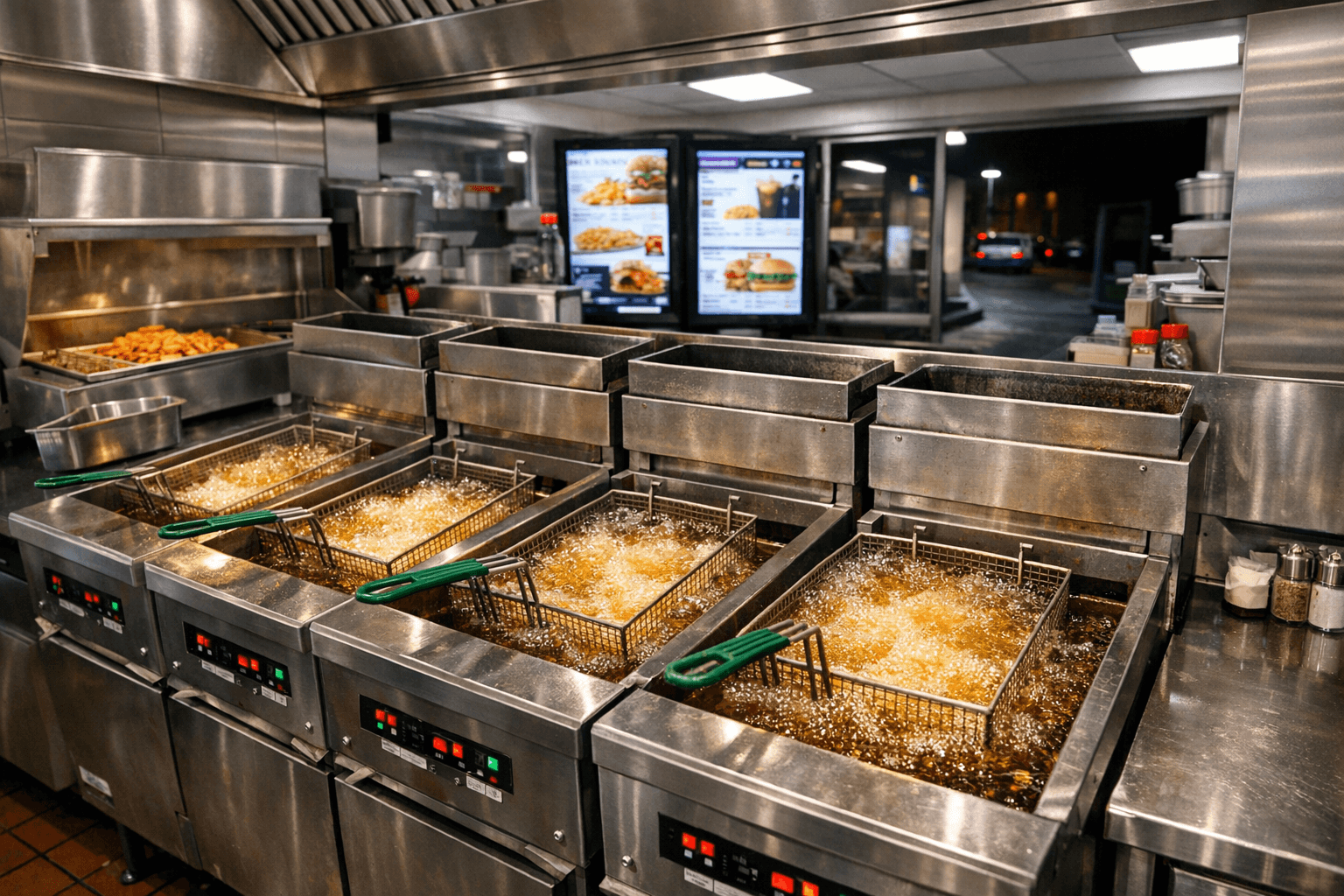
Used Cooking Oil Recycling for Fast Food Restaurants
Oil Guyz provides used cooking oil pickup and recycling for fast food restaurants and franchise groups in Orange County, Los Angeles, San Diego, the Inland Empire, the Bay Area, and Puget Sound, WA. Call (714) 880-4788. Free scheduled cooking oil recycling and collection sized to the fryers your fast food restaurant actually runs and how often the crew dumps them, never a generic weekly route. Free locked container, a digital manifest after every pickup, month to month with no contract. Call and a real person answers, 24/7.
Quick Answer
Cooking oil recycling for fast food restaurants starts with scheduled pickup of spent fryer oil, sized to a store's fryer count and change cycle instead of a generic weekly route. Fast food restaurants average roughly 35 lb of waste oil a day, close to 4.6 gallons at the standard 7.6 lb per gallon. Oil Guyz sizes the container from that volume, supplies it free and locked, issues a CDFA-compliant digital manifest after every pickup, and sends every gallon to a licensed renderer to become renewable diesel.
Why a Standard Route Breaks Down at a Fast Food Restaurant
Fast food restaurants fry harder than almost any other kind of business, and the service that hauls the result is usually the last vendor account anybody looks at. The benchmark is roughly 35 lb of waste oil a day per store, about 12,775 lb a year, or close to 4.6 gallons a day at the standard 7.6 lb per gallon. It does not arrive as a slow drip. It arrives in step changes, one full vat at a time, on whatever shift the crew dumps. Four 40 lb fryers on a four-day change cycle put roughly 37 gallons a week into the container, near 160 gallons a month. A one-size weekly route was never sized for that.
Multiply that across a franchise group and it stops being a kitchen problem and becomes a procurement problem. Operators who run a disciplined supplier list for food, linen, and equipment often end up with a different hauler at every store, a separate service agreement and invoice at each one, a pile of paper tickets, and no single view of which locations are genuinely covered. When a franchisor audit or a county inspector asks where the grease went, the records sit with a dozen suppliers or nowhere at all, and the store that cannot produce them is the one written up.
Inside a single fast food restaurant, nobody owns the grease. The general manager owns labor and food cost, the shift lead owns the fry station, and the container out back belongs to whoever notices it last. So the failure is predictable. The crew dumps into a container that is already full, oil goes on the concrete, someone stacks spent jugs by the back door, and the fryer that should have come out at close gets one more day of service. By the time a district manager hears about it, it is a slip hazard, an inspection finding, or a fry station that cannot run all four vats through a lunch rush.
Keep the Fryers Running, We'll Handle the Oil
Tell us where your kitchen is. Free locked container, route started this week, no contract or minimum volume.
High-volume fryers fill a container quickly. We size your bin and pickup frequency to your throughput so you never have oil piling up by the back door.
Fill out the form and we'll set a reliable schedule that keeps up with your kitchen. Free bin, no minimum.
- Truly free. We are paid for the oil, not by you
- No contracts. Cancel anytime
- No minimum volume. Any kitchen size
- Free locked, anti-theft bin
- Compliant digital manifest after every pickup
- Instant confirmation, then a real person calls you
Request your free oil pickup
Free bin · No contract · Cancel anytime. You get an instant confirmation that we got it, then a real person calls to set up your pickup. No spam, no robocalls.
Prefer to talk? Call (714) 880-4788
35 lb a day
waste oil at a typical fast food restaurant (FrontlineII)
3 to 5 days
common fryer change cycle in fast food
$0
free service, free locked container, month to month, cancel anytime
Fry Volume Sets the Cadence at Your Fast Food Restaurant
Sizing a container for your fast food restaurant is arithmetic, not a guess. Count the fryers, take each vat's capacity in pounds, divide by 7.6 for gallons, then multiply by how many times a week that vat gets dumped. Commercial fryers are sold by oil weight and commonly run 30, 40, 50, 70, and 100 lb. Fast food restaurants change on roughly a three to five day cycle, faster than casual dining and much faster than a light-fry kitchen. We size the container so a full month of that volume lands between about 75 and 90 percent full. That band is what makes a single monthly stop safe rather than optimistic, and when the math runs past the largest container we shorten the interval instead of pretending a bigger vessel exists.
- Two 50 lb fryers changed about weekly is roughly 13 gallons a week: a 70-gallon outdoor container at about 80 percent, monthly
- Four 40 lb fryers on a four-day cycle is roughly 37 gallons a week, near 160 a month: a 200-gallon container at about 80 percent
- Six 50 lb fryers on a two-day fried-chicken cycle is roughly 138 gallons a week, which moves that store to weekly service
- Containers run 45 and 60 gallons indoors, 70 to 200 gallons outdoors, matched to the fryer lineup
- Wrong size on the first try gets swapped at no charge, no penalty and no re-quote
Menu Format Changes the Clock, Not Just the Fryer Count
Fryer count sets the ceiling on volume. What actually goes into the fryer sets how fast that ceiling gets reached. A standard burger-and-fries menu is the baseline this page starts from, roughly 35 lb a day and a three to five day change cycle at most stores. A fried chicken or wing program runs a faster clock for reasons that have nothing to do with how many fryers are in the kitchen. Breading and flour shed sediment that carbonizes in the vat, egg wash and marinade add emulsifiers that drive dark polymer buildup, and a fry station running chicken through an all-day rush never gets the idle time a burger fryer gets between tickets. Busy fried chicken kitchens land on a one to three day change cycle, and the highest-volume fryers change daily, which is exactly why six fryers on a two-day cycle moves a store straight to weekly service instead of a monthly stop. A donut, pastry, or shortening-heavy line runs a third clock entirely, and it is not about speed. Most fry shortening is palm-based and sets up solid around 100 to 115 degrees, closer to 102 to 109 degrees for palm fruit oil specifically, so a caddy that looked liquid at close is a solid block by the next morning. That does not change whether it can be collected, but it does change how the container has to be sized: a shop doing one full kettle change dumps a month of volume in a single night, so sizing to a weekly average leaves the container overflowing on changeover night and sitting nearly empty the rest of the month. A fast food restaurant that adds any of these formats inside the same footprint, a chicken sandwich platform, a wing daypart, a breakfast pastry case, gets that format sized at survey instead of folded into one generic fryer count.
- Burger-and-fries baseline: roughly 35 lb, about 4.6 gallons, a day on a three to five day change cycle
- Fried chicken and wings: busy kitchens run a one to three day cycle, the highest-volume fryers change daily
- Breading, egg wash, and marinade break oil down faster than a plain fry line, independent of fryer count
- Shortening-heavy lines solidify around 100 to 115 degrees once drained, so sizing follows the changeover, not a weekly average
- Adding a chicken platform or a shortening-based item without resurveying the container is how a store overflows first
What Actually Leaves the Fryer, and When
Fast food restaurants filter daily, sometimes between dayparts, and that is what stretches a load to three to five days instead of one. Filtration does not shrink what reaches the container, though, because top-off replaces only what the food absorbs and the vat still comes out at capacity. That is why the level rises in jumps rather than evenly. A store that staggers fryer changes across the week looks steady. A store that changes all four vats on the same slow Tuesday puts close to a third of its monthly volume out back in one shift, and that spike is what the container has to absorb. Boil-out night is the other thing people miss. Water, degreaser, and rinse residue do not belong with the oil. A contaminated load is worth less as renewable-fuel feedstock and can be rejected outright, so boil-out solution follows your local FOG rules and only oil goes in the container.
- Daily filtration stretches a load to three to five days, it does not reduce total volume
- Top-off replaces absorption, so every change still dumps a full vat
- Staggering fryer changes across the week flattens the spike a single dump day creates
- Water, degreaser, and food debris cut the value of the load and can get it rejected
- Boil-out solution follows local FOG rules, only oil goes in the container
The Closing Shift: Getting a Spent Vat From the Fry Station to the Corral
The volume math is the easy half. The hard half is a walk. Fryers run at roughly 325 to 375 degrees, so nobody moves that oil at the moment the fry station shuts down; it has to cool first, which pushes the job to the tail end of a close that is already running long. Then a two-person crew wheels a shortening shuttle out of the kitchen, across a floor that is mid-mop, through a back door somebody has to prop, onto a pad that at most fast food restaurants is shared with the trash compactor. A caddy holds one or two vats, so a four-vat change is several round trips, and every trip is another chance to leave a trail. If the container is full when they get there, or the corral is locked and only the opening manager has the key, the crew does what crews do: the jugs go by the back door and the problem belongs to the morning shift. That is why we place the container on the shortest safe path out of your fast food restaurant and confirm who holds the key on the closing shift, not just the opening one.
- Oil at fry temperature has to cool before it moves, so the job lands at the end of a long close
- A four-vat change is several caddy trips, not one, and each crosses a wet kitchen floor
- Container placed on the shortest safe path out, no curb to lift over and no door to fight
- Corral key or gate code held by the closing manager, not only the opener
- A container that is full at close is what turns into jugs by the back door by morning
A Limited-Time Offer Resets Fry Volume for Weeks, Not Days
Nothing changes fry volume at a fast food restaurant faster than the marketing calendar. A fried sandwich launch, a wing window, a tenders promotion on a national ad buy, and the fry line runs a load it has never run before for the length of the campaign, then drops back. Crews often dedicate a vat to the promo item so flavor does not carry into the regular fry, which quietly adds one more vat to the change rotation for the whole run. Location does the same thing more slowly: a store across from a high school runs a different June than October, a highway store peaks in summer, an office-park store loses its dinner daypart entirely, and a store that opens at 5 a.m. for breakfast is running a hash-brown fryer that monthly sizing usually forgets. Tell us the window before it starts instead of after the container overflows. We raise frequency for the stretch and drop it back when it ends, at no cost, because frequency is not what you pay for. Nothing here is billed by the gallon or by the stop.
- A fried limited-time offer on a national ad window lifts volume for the whole run, then it falls back
- Promo items often get a dedicated vat so flavor does not carry, adding a vat to the rotation
- Campus, highway, and office-park stores swing by season and daypart, not evenly across the year
- A 5 a.m. breakfast fryer adds a daily load that monthly sizing usually misses
- Send the promo window ahead of time: frequency goes up for the stretch and back down after, free
Drive-Thru Peaks Decide When a Truck Can Reach the Corral
The hardest part of servicing fast food restaurants is not the grease, it is getting a truck to the container. At most stores the corral sits behind the building, in or immediately off the drive-thru path, and a pump truck with a hose run parked there at noon does not slow the window down, it stops it. The peaks are predictable, roughly 11 a.m. to 1:30 p.m. at lunch and 5 p.m. to 8 p.m. at dinner, plus a late-night rush at stores that run past midnight, which is exactly why "come after close" is not a universal answer in fast food. So the constraint goes on the account instead of living in someone's head. Tell us the hours your fast food restaurant cannot take a truck, the gate or corral lock, whether a landlord controls a shared pad, and how far a driver can run a hose from a legal parking spot. Those notes ride with the stop. We do not promise a clock time. We do plan around the hours you block off, and a real person answers when they change.
- Blackout hours for lunch and dinner peaks recorded on the account, not left to the driver
- Gate codes, corral lock type, and shared-pad landlord rules captured at setup
- Hose reach from a legal parking spot confirmed before the first pickup, not on the day
- Stores open past midnight get a plan that does not assume an after-close window
- No promised clock time, and phones answered around the clock by a real person
Bulk Oil Tanks, Jugs, and What the Driver Has to Work With
Fast food splits into two very different back-of-house setups, and they look nothing alike from the pad. Some stores run a bulk oil system: fresh oil in a tank plumbed to the fryers with a fill wand at the vat, and a waste side that either drains to an outdoor tank or fills a rolling caddy on demand. Others still take fresh oil in 35 lb jugs or boxed shortening and carry every spent vat out by hand. A plumbed waste tank means the truck has to reach a fixed fitting, so the parking position is not negotiable and hose length matters more than container size. A jug-and-caddy store has total freedom about where the container sits and no freedom at all about how far a closing crew is willing to walk. Tell us which setup each store runs at survey, because it decides how the stop gets planned. And if a location is mid-conversion between the two, it gets surveyed again rather than left on last year's plan.
- Bulk waste tank plumbed to the fryers: fixed fitting, fixed truck position, hose reach decides everything
- Jugs and a rolling caddy: the container goes on the shortest safe path out of the kitchen
- Which setup each store runs gets captured at survey, because it changes how the stop is planned
- Empty fresh-oil jugs and shortening cartons are store recycling, not part of the oil load
- A store mid-conversion gets re-surveyed instead of staying on the old assumptions
A Fry Station Down at Noon Costs More Than the Oil in the Vat
In fast food, fries and fried protein attach to most tickets, so a vat out of service is not a kitchen inconvenience, it is a throughput problem at the window. When the container is full a spent load has nowhere to go, and one of two things happens. Either the fryer stays in service past its useful life and product quality slides, or somebody improvises with jugs and buckets by the back door and the business inherits a spill, a pest issue, and an inspection finding. Both cost your fast food restaurant more than the oil in the vat is worth. Matching frequency to real dump volume is the cheapest fix available, and here it is also free.
- A full container means a spent vat has nowhere to go during the busiest hour of the day
- Improvised jug storage by the back door turns into a spill, pests, or an inspection finding
- Frequency sized to real dump volume so collection is never why a fryer stays in use
- Free scheduled service regardless of volume, so a busier store never costs more
- Callback the same business day, first pickup in 3 to 5 business days
What Gets Written Up Behind Your Fast Food Restaurant
Three different people look at the same square of concrete and each has their own list. A county health inspector checks whether the outdoor waste storage area is clean, whether containers are closed and in good repair, and whether the surroundings are attracting vermin. Local FOG and stormwater rules add their own line: nothing greasy running toward a storm drain, and washdown handled the way your jurisdiction says to handle it. Then a brand operations audit asks for documented disposal, which is a paperwork question rather than a housekeeping one. The failure mode is identical in all three, and it is almost never the oil inside the container. It is the oil around it. A closed lid, no overfill, a clean pad, and a manifest on file covers all three lists at once, and overfilling is a scheduling problem long before it is a cleaning problem.
- Inspectors look at the pad around the container, not only the container itself
- Closed lid, no overfill, no accumulation on the concrete, nothing pooling toward a storm drain
- Local FOG and stormwater rules govern washdown; boil-out solution never goes in the oil container
- A brand operations audit asks for documented disposal, and the manifest is that document
- Most findings trace back to overfilling, which cadence fixes and a mop does not
Where This Sits in a Fast Food Vendor Stack
A single store already carries a long vendor list: a foodservice distributor on a set delivery cadence, a linen service, pest control, a hood and duct cleaner on a fire-code interval, a grease trap service, a waste hauler for the compactor, POS and equipment support, and a landlord or facilities group behind all of it. Cooking oil collection is one more account on that board, and it is the one nobody thinks about until the day it fails. It is also the one most often confused with two others. Grease trap or interceptor service pumps the plumbing under your sinks and is a separate trade with its own local rules; we are not that, and we do not sell it. Your compactor hauler takes solid waste and generally will not touch liquid oil at all. Used cooking oil is its own regulated stream with its own paperwork, which is why it needs its own account and its own record rather than a line item buried in a facilities contract. Practically, that means one named contact, one service history per location, and a document trail an operations team can pull without calling three vendors.
- Used cooking oil is a separate regulated stream from trash and from grease trap service
- Grease trap and interceptor pumping is a different trade with its own local rules; we do not sell it
- Compactor and solid-waste haulers generally will not take liquid oil
- One account, one named contact, one service history per location for the operations team
- No line item buried inside a facilities contract you cannot audit
Franchisee, Area Developer, or Corporate: Who Actually Signs
In fast food, the person who feels the problem is almost never the person who can fix it. The general manager watches the container overflow and has no signing authority. The franchisee owns the P&L and signs, but may operate under a franchise agreement that routes certain vendor categories to an approved supplier list or a national account. An area developer, or a corporate-owned market inside the same brand, changes the answer again. We take the conversation to whoever holds the decision and we never ask a store manager to commit their owner. If a brand standard requires documented waste oil disposal, the manifest record is the document that satisfies it. If your franchise agreement points this category at a national account, we say so up front rather than sell around it. Service is month to month, which matters when a store is mid-transfer, being refranchised, or on a lease that has not been renewed.
- We work with whoever signs: franchisee, area developer, or the corporate market
- Store managers get straight answers without being asked to commit their owner
- Manifest records satisfy a brand standard requiring documented waste disposal
- If your franchise agreement routes this to a national account, we say so up front
- Month to month, no long contract, which matters mid-transfer or on a short lease
Consolidating Fry-Oil Vendors Across a Fast Food Portfolio
A ten-store group producing roughly 35 lb a day per location adds up to close to 127,000 lb of used cooking oil a year, about 17,000 gallons of renewable-fuel feedstock moving through whatever vendors those ten stores happen to have. Most multi-unit fast food operators inherited that vendor list one store at a time: a hauler the original owner picked, a hauler that came with an acquired location, a hauler someone called after a bad week. The result is a different contract, invoice, and manifest format at every address, and no single view of which stores are actually covered. Consolidating onto one program does not mean forcing every store onto an identical schedule. A fried chicken or wing concept in the portfolio still runs heavier than a burger-and-fries store next to it, and a location with a donut or pastry case still gets sized to its changeover instead of a weekly average. What consolidation buys is one contract, one manifest standard, and one Filtrate dashboard that rolls every one of those different cadences up to a single view for whoever runs the portfolio. The full contract structure, rollout sequencing, and role-based dashboard model for a multi-unit group is covered in Multi-Location Cooking Oil Collection.
- Ten stores at the fast food baseline is close to 127,000 lb of used cooking oil a year across the portfolio
- One contract and one manifest standard instead of a different hauler, invoice, and paper trail at every address
- Format-specific cadence stays intact: chicken and wing stores run heavier, donut and pastry cases size to the changeover
- Every store rolls up to one Filtrate dashboard regardless of what cadence it runs on
- Full contract structure and rollout model covered on the multi-location page
Rolling Out Across Every Fast Food Restaurant You Operate
Do not swap thirty stores in one week. The sequence that works starts with your two highest-volume locations, sizes the container from real dump volume, and runs a full month to confirm the fill lands in that 75 to 90 percent band before the rest follow. Then roll by district, so one area manager watches one wave instead of a company-wide vendor changeover. Keep the incumbent hauler at any store that has not been surveyed and cut it only after the first manifest lands there. The practical things that stall a rollout are the ones we collect up front: corral location and lock type, landlord approval on shared pads, bulk system or jugs, and who at each location gets the confirmation. Every store lands in one Filtrate dashboard with role-based access, so corporate sees the portfolio, a district manager sees their region, and a general manager sees only their own store.
- Start with the two highest-volume locations and confirm container fit over a full month
- Roll by district in waves instead of a company-wide swap in one week
- Incumbent hauler stays at a store until its first manifest lands
- Survey per location: corral, lock type, indoor or outdoor, bulk or jugs, landlord approval
- One Filtrate dashboard, role-based from corporate down to each general manager
A Digital Manifest After Every Pickup
Every used cooking oil pickup in California requires a manifest. After each stop at your fast food restaurant you get a CDFA-compliant digital manifest showing the date, gallons, transporter, and the licensed renderer that received the load, stored in the Filtrate portal instead of on a paper ticket taped inside a cabinet. Collection is performed by a CDFA-registered transporter and the load moves to our licensed renderer under a documented chain of custody. Electronic manifests are legal under California's Uniform Electronic Transactions Act. The state's minimum retention is two years; we keep records for two as company policy, which covers most franchisor audit windows without anyone digging through a drawer.
- Digital manifest generated for every pickup at every location
- Chain of custody documented to our licensed renderer
- Two-year state minimum retention, two years kept as our own policy
- One-click export for a franchisor audit or a county health inspection
- Free locked container included, delivered and serviced at no cost
Recycled Into Cleaner Fuel, Not Poured Down a Drain
What leaves your fast food restaurant becomes feedstock for biodiesel and renewable diesel. Waste-feedstock fuels cut lifecycle greenhouse-gas emissions by roughly 79 to 86 percent versus petroleum diesel per Argonne National Laboratory, Environmental Science & Technology, 2022. If your brand reports on waste diversion, the manifest history is the documentation, store by store.
- Recycled into biodiesel and renewable-diesel feedstock
- Per-location manifest history doubles as waste-diversion documentation
Which Fast Food Restaurants This Service Is Built For
Single-Store Franchisees
Owners of one or two locations who need a container sized to their fryer lineup, a cadence that survives a Friday rush, and a manifest they can hand an inspector.
Multi-Unit Franchise Groups
Operators with five to fifty fast food restaurants who want one vendor and one rollout sequence instead of a separate hauler, invoice, and paper trail at every store.
District & Area Managers
Managers accountable across a set of stores who get asked for a manifest by a franchisor auditor and need it from one login, not from twelve suppliers.
Fried Chicken & Fish Concepts
The heaviest fry loads in fast food, often six or more fryers on a two to three day change cycle, which means weekly service on a 200-gallon container, not a monthly stop.
High-Volume Drive-Thru Stores
Locations where the corral sits in the drive-thru path, so the constraint is not capacity, it is when a truck can reach it without blocking the lane.
New Store Openings
Franchisees opening a new fast food restaurant who need the container placed and the account live before the pre-opening inspection, first pickup 3 to 5 business days after setup.
Oil Guyz vs. a General Waste Hauler at a Fast Food Restaurant
Service schedule
Promo and LTO windows
Drive-thru peaks
Back-of-house setup
Compliance proof
Multi-store rollout
Contract
Cost
What's Included
Everything you need, nothing you don’t.
- Free scheduled cooking oil collection for fast food restaurants, at any volume
- Container sized from your fryer count, vat capacity, and change cycle
- Free locked container delivered, serviced, and swapped free if the size is wrong
- Frequency raised for a promo or LTO window and dropped back after, at no cost
- Blackout hours for drive-thru lunch and dinner peaks kept on the account
- Gate codes, corral lock type, bulk-system or jug setup, and landlord rules captured at survey
- CDFA-compliant digital manifest after every pickup at every location
- Documented chain of custody to our licensed renderer
- One Filtrate dashboard with role-based access from corporate to store level
- District-by-district rollout sequencing for multi-unit franchise groups
- Coverage in Orange County, Los Angeles, San Diego, the Inland Empire, the San Francisco Bay Area, and Pierce, King, and Snohomish Counties in Washington
- Recycled into biodiesel and renewable-diesel feedstock
- Month to month, no long contract, no setup fees, cancel anytime
How Restaurant Oil Collection Works In 3 Simple Steps
Set up restaurant oil collection in about five minutes. We confirm your route the same business day and drop a free bin before your first pickup. After that, Oil Guyz handles every used cooking oil pickup on schedule. You never chase a hauler again.
Request Pickup
Fill out a 30-second form or call us. No credit card, no commitment.
Pickup Day Is Pickup Day
Your scheduled window is locked in. A CDFA-registered transporter completes the pickup, pumps your container empty, and we email your digital manifest the moment the work is logged.
Stay Compliant Automatically
Get digital manifests, pickup confirmations, and compliance records, all in your dashboard.
Frequently Asked Questions
Fast food restaurants generate roughly 35 lb a day per store, about 12,775 lb a year, and fried chicken or fish-forward concepts produce considerably more (source: Cooking Oil Collection for Fast Food (FrontlineII)). At the standard 7.6 lb per gallon that is close to 4.6 gallons a day, about 32 gallons a week. Because the change cycle in fast food runs roughly three to five days, we set frequency from your fryer lineup and how often the crew actually dumps rather than dropping you on a generic weekly route.
Take each fryer's capacity in pounds, divide by 7.6 for gallons, and multiply by how many times a week that vat is dumped. Two 50 lb fryers changed about weekly is roughly 13 gallons a week, which a 70-gallon outdoor container holds at about 80 percent full on a monthly stop. Four 40 lb fryers on a four-day cycle is roughly 37 gallons a week, near 160 a month, which is a 200-gallon container at about 80 percent. Six 50 lb fryers on a two-day cycle is roughly 138 gallons a week, past what any single container holds for a month, so that store goes to weekly service instead. Sizes run 45 and 60 gallons indoors, 70 to 200 gallons outdoors, and if the first one is wrong we swap it at no charge.
Yes, it is free, and there is no long contract. Scheduled service is free regardless of volume and includes a free locked container that we deliver, service, and replace at no cost. It works this way because we are paid for the oil, not by you: what you dump has real value as renewable-fuel feedstock. Month to month, no setup fees, cancel anytime.
Yes, and it costs nothing. A fried LTO on a national ad window lifts fry volume for the whole run, and crews often dedicate a vat to the promo item so flavor does not carry, which adds another vat to the change rotation. Send us the start and end dates before the window opens. We raise frequency for the stretch and drop it back when it ends. Nothing is billed by the gallon or by the stop, so more pickups never means a bigger bill.
It changes where the truck parks more than anything else. A waste tank plumbed to the fryers means the driver works from a fixed fitting, so hose reach and a legal parking position matter more than container size. A jug-and-caddy store is the opposite: total flexibility on placement, none on how far a closing crew will walk. Tell us which setup each location runs at survey, and if a store is mid-conversion we re-survey it rather than leave it on the old plan.
That constraint goes on the account. At most stores the corral sits in or just off the drive-thru path, so a truck parked there at noon blocks the window. Give us the hours your location cannot take a truck, the gate or corral lock, whether a landlord controls a shared pad, and how far a driver can run a hose from a legal parking spot. Those notes ride with the stop. We do not promise a clock time, but we plan around the hours you block off, and a real person answers the phone around the clock when they change.
Whoever holds the decision. Usually that is the franchisee who owns the P&L, sometimes an area developer, and in a corporate-owned market it is the brand itself. We never ask a general manager to commit their owner. Some franchise agreements route vendor categories like this to an approved supplier list or a national account; if yours does, we tell you up front rather than sell around it. Month-to-month service also matters when a store is mid-transfer or being refranchised.
Every pickup generates a CDFA-compliant digital manifest documenting the chain of custody, date, gallons, transporter, and the licensed renderer that received the load. California requires a manifest for every used cooking oil pickup, and electronic manifests are legal under the state's Uniform Electronic Transactions Act (source: 3 CCR § 1180.24, California Used Cooking Oil Manifests). The state's minimum retention is two years; we keep records for two years as company policy. Everything sits in the Filtrate portal and exports in one click for a franchisor audit or a county health inspection.
Collection and transport are performed by a CDFA-registered transporter, and the load moves to our licensed renderer under a documented chain of custody. Oil Guyz provides the service relationship, the free locked container, the scheduling, and the compliance documentation. California's Inedible Kitchen Grease program licenses transporters and renderers and documents that chain of custody end to end (source: CDFA Meat, Poultry & Egg Safety / IKG Program).
It becomes feedstock for biodiesel and renewable diesel rather than going to a landfill or a drain. Waste-feedstock fuels cut lifecycle greenhouse-gas emissions by roughly 79 to 86 percent versus petroleum diesel (source: Argonne National Laboratory, Environmental Science & Technology, 2022). Your manifest history doubles as waste-diversion documentation if your brand reports on it.
We serve Orange County, Los Angeles, San Diego, the Inland Empire, the San Francisco Bay Area, and Pierce, King, and Snohomish Counties in Washington. Call or send the form with your addresses and fryer counts and you get a callback the same business day, with first pickup in 3 to 5 business days. If you operate outside those regions, tell us where and we will let you know as service opens there.
What Our Clients Say

Bryan Baird
Google review
“We are a medium sized institutional kitchen located in San Juan Capistrano. When we needed a certified oil and grease removal partner the Oil Guyz were there. Fantastic customer service, fast, reliable, quick follow up and very efficient. They make it super easy to leave a GREAT review!”See full review

Alex Camacho
Google review
“I'm an up and coming new food vendor and properly disposing of used frying oil was a difficult task. That is until I contacted the Oil Guyz! There webpage made it easy to setup their free service of oil pickup. Within a few days I had a free container to store the used oil until ready for the free pickup. This service is very convenient and Joey has been very accommodating to answer all my questions and facilitate the process.”See full review

Ujwal Chaudhary
Google review
“Great service from Oil Guyz! They came and picked up my full barrel of used cooking oil completely free of charge. The process was easy, quick, and professional. I really appreciate their excellent customer service and reliable pickup. If you have used cooking oil that needs to be collected, I definitely recommend Oil Guyz. Great company and great people! 👍”See full review

Nicholas Saccoccia
Google review
“Excellent experience with Oil Guyz! They got me on the schedule fast, showed up on time, were very professional, and were in and out in no time! I would absolutely use them again.”

LA BREAKFAST CASITA
Google review
“We’ve had a great experience with Oil Guyz! I submitted a quote request through their website for our restaurant, and Joey reached out to us right away. From our first conversation, he has been extremely helpful, patient, and responsive. Joey really made the whole process easy for us. He was willing to work with our team on the best location for the bin, answered all of our questions, and kept in touch to make sure everything was taken care of. I especially appreciate his follow-through and willingness to help without ever making us feel rushed. Good customer service can be hard to find, and Joey has definitely made a great impression on us. We’re very happy we chose Oil Guyz for our used commercial oil pickup service at LA Breakfast Casita in Azusa, CA. Thank you, Joey, for making the process so smooth and for taking such good care of us. We look forward to working with Oil Guyz for a long time!”See full review

Mike Fishman
Google review
“Superb service!”

Celso Bahena
Google review
“I’m in the Santa Ana area great reliable service!”

Myk Espinoza
Oakland Ballers · Oakland, CA · Google review
“These dudes really bailed me out of a tough situation. My previous oil collection service had been really screwing me over. Spent 4 weeks of unanswered phone calls, texts, and empty promises with a company we've been using for two years just to get a used oil recepticle, all to no avail. We were sitting on 6 fryers with of oil I that I had nowhere to put. Called Joey and The Oil Guyz and he got me set up just a few hours later. Used oil container, service agreement, answered all of my questions. We're running a very odd program where our schedule is all over the place, so having a "regular" pick up schedule is out of the question. We worked out a way for quick/easy retrieval in about 5 minutes. Can't recommend these guys enough.”See full review

Maryam Tngrian
Google review
“As a manufacturing bakery, we recently needed a one-time pickup of approximately 3,000 lbs of used donut oil. Unfortunately, there was very little information available regarding the company that had handled this service previously, so I had to start from scratch. I found Oil Guyz online and was impressed from the first conversation. Joey, the owner, was extremely helpful and took the time to walk me through the entire process, making the coordination simple and straightforward. Prior to contacting Oil Guyz, I had attempted to reach other providers and had difficulty getting assistance. Oil Guyz was responsive, accommodating, and easy to work with from start to finish. The pickup was completed within the timeframe communicated, and the team handled the removal seamlessly with no disruption to our operation. Their professionalism and customer service made what could have been a challenging process very easy. We would absolutely use Oil Guyz again and would recommend them to other food manufacturing facilities looking for a reliable used cooking oil recycling partner.”See full review

Kengo Kido
Google review
“Joey took care of our needs quickly, efficiently and professionally. I highly reccoemnd his service to anyone!”

Brenda Wu
Google review
“Prompt response from Joey. Great service with problem solving. Highly recommended!”

Camille Bamford
Google review
“Fast and great to work with!”
Related Resources
Guides
Free Tools
- Grease Trap Calculator
Find your recommended pumping frequency
- Compliance Checker
Check if you meet California grease requirements
Related Solutions
Restaurant Cooking Oil Management
Scheduled pickup, free locked containers, digital manifests, and portal management for every kind of commercial kitchen.
Learn moreMulti-Location Cooking Oil Collection
One agreement and one dashboard for every store in your portfolio, with the same service standard at each location.
Learn moreFree Locked Containers & Bins
Sizes from 45 to 200 gallons, free delivery and installation, free swap if your volume changes.
Learn moreGet Free Collection at Every Fast Food Restaurant You Run
Tell us your fryer count, your change cycle, and where your stores are. We size the container, set a cadence that survives a lunch rush, and put every location in one Filtrate dashboard. Callback the same business day, first pickup in 3 to 5 business days.
Or call (714) 880-4788 and talk to a real person today.