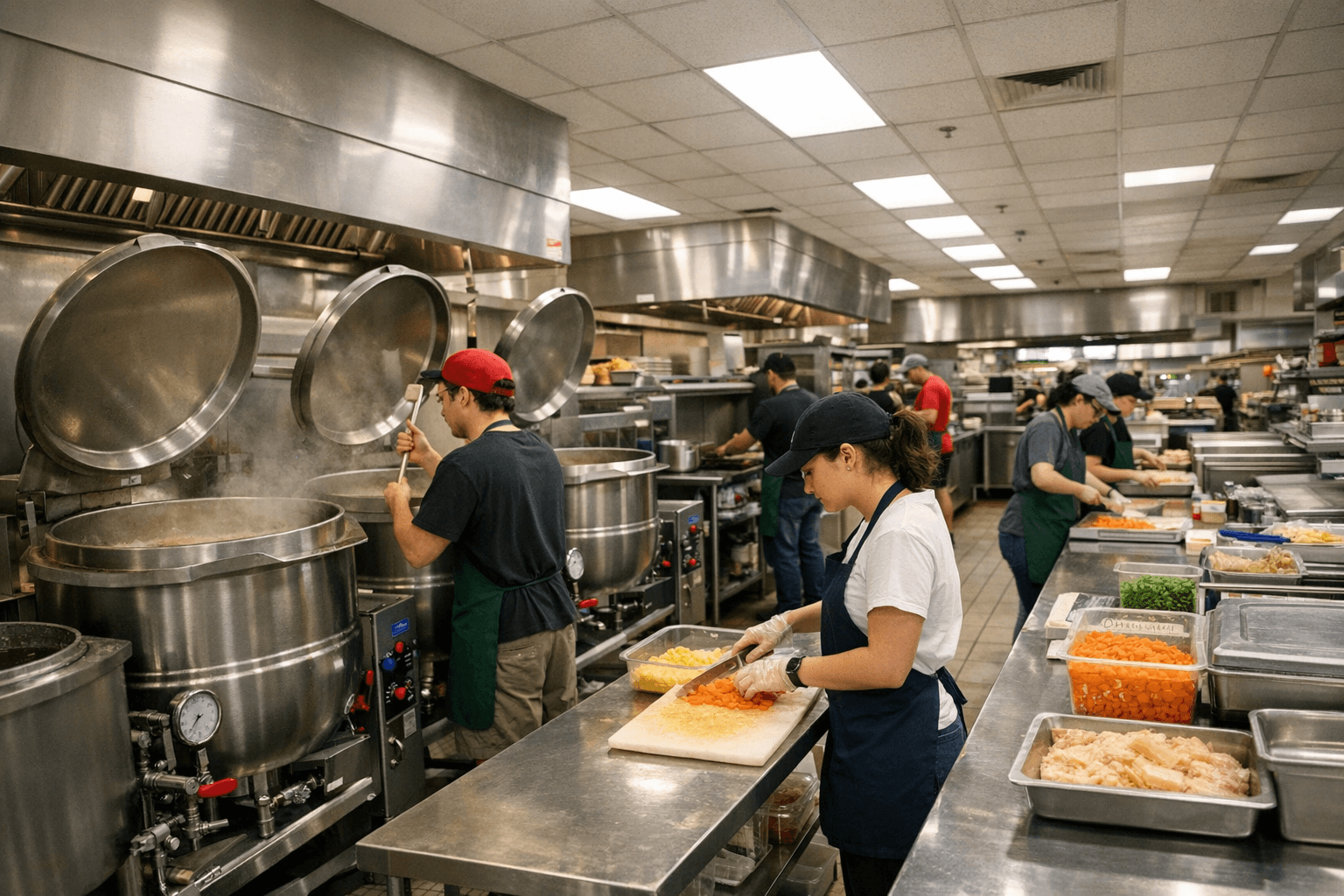
Cooking Oil Collection for Campus Dining, Scheduled Off Your Calendar
Oil Guyz provides used cooking oil pickup and recycling for college and university dining operations in Orange County, Los Angeles, San Diego, the Inland Empire, the Bay Area, and Puget Sound, WA. Call (714) 880-4788. A campus is not one kitchen. It is a residential dining commons, a food court of quick-service counters, game-day concession stands, a faculty club, a catering kitchen, and a scatter of cafes, each frying on its own clock. We map the whole campus, set a cadence per kitchen off your calendar instead of a fixed weekly route, and file a digital manifest after every pull. Free commercial service, month-to-month, a free locked container at each kitchen, and a real person answers the phone 24/7.
Quick Answer
Cooking oil collection for campuses is used cooking oil pickup scheduled across a whole campus at once, the dining commons, the food court counters, concession stands, catering, and satellite cafes on one account instead of a separate vendor per building. The cadence follows the campus calendar rather than a fixed weekday route, pickup is performed by a CDFA-registered transporter, and a digital manifest documents every pull.
Why a Campus Cannot Run on a Restaurant's Pickup Schedule
A campus generates fryer oil the way a small city does, from a dozen unrelated kitchens that answer to different managers. The residential dining commons runs the heaviest fry stations on the campus and turns them over at restaurant volume. The food court is a row of quick-service counters, each with its own unit manager, its own fryer, and its own opinion about whose job the waste oil is. Concession stands cook only when a venue is open. The faculty club, the catering kitchen, and the satellite cafes fry lightly and irregularly and still fill a container eventually. When each building arranges its own vendor, or inherits whoever the last food service contractor used, the account fragments: different service days, different paperwork, and nobody who can say which kitchens are actually covered.
The second mismatch is time. A campus does not fry at a steady rate for twelve months. Output climbs from move-in through the first exam period, peaks again in the last weeks of the semester, then falls off a cliff. Meal contracts end, the commons drops to one servery or closes outright, and what is left through summer is conference catering, camps, and group bookings feeding a fraction of the cover count a full campus produces. A vendor running a fixed weekday route bills a closed campus all summer, then arrives with an empty truck the week every container on the campus fills at once.
Then there is continuity. A unit manager retires, a food service contract goes out to rebid, a new operator takes over the account in July, and the record of what left the campus under the old vendor walks out with them. California requires a manifest documenting chain of custody for every commercial used cooking oil pickup, and a campus is exactly the operator that gets asked to produce those records, for every kitchen, years later. Loose service tickets in a basement desk drawer do not survive a changeover. Records held under the campus account do.
Campus Dining Oil, Off Your Plate
Tell us where your kitchen is. Free locked container, route started this week, no contract or minimum volume.
Dining halls and campus eateries produce serious used-oil volume on an academic rhythm. We scale pickup up during the term and down on breaks, with audit-ready manifests for procurement.
Fill out the form and we'll build a schedule around your campus calendar. Free containers included.
- Truly free. We are paid for the oil, not by you
- No contracts. Cancel anytime
- No minimum volume. Any kitchen size
- Free locked, anti-theft bin
- Compliant digital manifest after every pickup
- Instant confirmation, then a real person calls you
Request your free oil pickup
Free bin · No contract · Cancel anytime. You get an instant confirmation that we got it, then a real person calls to set up your pickup. No spam, no robocalls.
Prefer to talk? Call (714) 880-4788
Every kitchen
on the campus, one commercial account
Your calendar
sets the cadence, not a weekly route
8 regions
served and expanding
How a Campus Buys This: Free Service on a Vendor Agreement
Before the operational detail, the shape of the deal, because it is not what most people expect. This is a commercial recycling service bought like any other back-of-house vendor category: an account held by the campus, serviced on a route by a CDFA-registered transporter, and documented on a transfer record for the regulator. It costs nothing because the material has a downstream buyer. Refiners purchase used cooking oil as feedstock for biodiesel and renewable diesel, so the collection is funded by that market rather than by your operating budget. No service fee, no container rental, no per-stop charge, no fuel surcharge, no auto-renewal clause. Legacy grease vendors built the opposite model, billing a restaurant or a campus per stop for a commodity they then turned around and sold. Procurement, facilities, and compliance each own a piece of this one: a vendor term, a dock and access plan, and a records retention schedule. If your kitchens are producing high volume, ask about a rebate on the gallons.
- A commercial vendor agreement, month-to-month, cancel with no penalty
- No service fee, no container rental, no per-stop charge, no fuel surcharge
- Funded by the feedstock market downstream, not by your operating budget
- Rebate available on the gallons for high-volume campus dining operations
- Clean for procurement: one account, one term, one point of contact
A Campus Is a Dozen Kitchens on a Dozen Different Clocks
Cooking oil collection for campuses starts with an inventory, because almost no campus knows how many fryers it actually owns. The residential commons refills on a cycle closer to a busy restaurant than a school cafeteria, and it is usually the single largest producer on the campus. The food court behaves like a small strip mall: several counters, several unit managers, several opinions about whose job the oil is. Concession stands on the campus sit idle for months and then fry hard for one afternoon. Catering fires in bursts tied to trustee dinners, admitted-visitor days, and graduation weekend. Each satellite cafe barely registers on its own, and they add up fast across a large campus. We walk the campus, log every fryer-equipped location, and set a separate cadence for each one under a single agreement.
- Every fryer-equipped location on the campus logged before the first pickup
- Residential commons on a heavy cadence, satellite cafes on a light one
- Food court counters covered individually, not lumped into one stop
- One commercial agreement for the whole campus, one point of contact
Back of House: Where the Oil Waits Between Pickups
Every kitchen on a campus is a commercial kitchen, and the fry station is the only part of it that concerns us. Spent oil comes out when the vats are done, not when a route day arrives, and it ends up in whatever space the building has: a receiving corridor, a dish room alcove, a fenced pad beside the dock. Where the container sits is what actually decides how a pickup runs, so we size it to the room each kitchen has, an outdoor bin where there is a pad and a compact indoor caddy where there is not. Kitchen crews also turn over heavily, with student workers rotating out every semester, so the handling has to be obvious enough that a new hire in week one gets it right without learning a vendor's procedure. The container is free, it stays locked between pickups, and it is placed where the crew already walks.
- A free locked container per kitchen, outdoor bin or compact indoor caddy
- Placed where the crew already walks: receiving corridor, dish room, dock pad
- Simple enough for a first-week hire, no vendor procedure to memorize
- Spent oil leaves on the kitchen's cycle, not on a route day it did not ask for
- Contained back of house, so housekeeping holds up through an inspection
Your Calendar Sets the Cadence, Not a Weekday Route
We build the schedule off the academic calendar, not off a truck's convenience. Move-in and welcome week put the commons at full output before anyone has thought about waste oil, so the campus gets a sweep before the semester opens rather than a full container in the first busy week. Cadence stays heavy through the fall, dips over the Thanksgiving break, climbs again in the last weeks of the semester, and drops hard over the winter interim when most of the buildings are dark. Spring repeats the same shape. After graduation the operation flips to summer mode: conferences, camps, and group bookings feed a fraction of the term-time cover count out of one or two kitchens. Locations that genuinely close get paused instead of billed for a stop at a locked door, and everything scales back up before the next semester opens.
- Pre-move-in sweep so no kitchen opens the term at capacity
- Heavy cadence through peak weeks, scaled back over breaks
- Summer plan sized to conference, camp, and group-booking volume
- Closed locations paused, not billed for stops at an empty building
- Everything back to full cadence before the campus reopens
Game Days Run on a Season of Their Own
Campus venues keep a calendar that rarely lines up with dining. A football stadium may cook eight or nine Saturdays a year and sit dark the rest of it. A basketball arena cooks on a dense winter schedule that runs straight through the interim, exactly when the commons is closed and the rest of the buildings are quiet. Baseball, softball, and soccer stands run small through spring. Then camps, graduation, and outside rentals put food back into venues that are otherwise shut. Treating those stands as one more dining stop is how a concession ends up storing a whole season of fryer oil in a closet under the bleachers. We schedule them off the venue calendar, pull after heavy home dates, and skip a stand in its off-season.
- Concession stands scheduled off the venue calendar, not the dining one
- Post-event pulls after heavy home dates and tournament weekends
- Off-season stands skipped instead of billed for a padlocked door
- Camps, graduation, and outside rentals covered when venues reopen
Getting a Truck to the Back of a Campus Kitchen
The hard part of a campus pickup is usually access, not oil. Most campuses have a pedestrian core where a service vehicle needs a permit, a posted delivery window, or a bollard key, and the kitchen that produces the most oil often sits right in the middle of it. Campus docks are shared with produce deliveries and custodial routes, and during move-in that same dock belongs to residence life. Card readers control the service corridors, one facilities lead may hold keys for a whole quadrant, and a food court counter can sit two levels above the nearest dock with a single freight elevator in between. We walk the campus before service starts and write the route down: which gate opens on a weekday morning, which permit the truck needs, which door a container actually fits through, and who to call when a card reader refuses. That map is why a pickup does not depend on somebody improvising an escort every time.
- Campus walk-through before service starts, access recorded per location
- Service-vehicle permits, delivery windows, and gate access sorted up front
- Container sizes matched to the doorway each kitchen actually has
- Move-in and event weeks routed around a dock that belongs to someone else
Self-Operated or Contract-Managed: Who Actually Signs
Who owns this decision depends on how the campus runs dining, and guessing wrong costs a month. Where dining is self-operated, the campus runs it in house: the director of dining or auxiliary services owns the vendor relationship, procurement papers it, and facilities or the sustainability office weighs in. Where it is contract-managed, a food service company operates the kitchens under contract, so the resident district manager makes the operational call while the campus contract administrator has to bless anything touching compliance records. Plenty of campuses are both at once: a contractor runs residential dining, the union building operates independently, and the concession stands belong to a third group. All three shapes work here. One agreement can cover the whole campus, or coverage can split by operator with the manifest history still rolling up in one place for the campus.
- Self-operated: dining or auxiliary services signs, procurement papers it
- Contract-managed: the district manager runs it, the institution keeps the records
- Mixed campuses covered under one agreement or split cleanly by operator
- A new concept or renovated building joins by schedule update, no re-papering
Records That Outlive a Food Service Rebid
The compliance question here is not whether a manifest exists. It is whether the campus can still produce one after the people change. Every pull at every kitchen generates a digital manifest with date, gallons, transporter, and the destination it went to, filed in the Filtrate portal under the campus account rather than a contractor's file cabinet. Electronic manifests are explicitly legal under the state rule, and the legal retention minimum is two years; we hold records for two as our own policy. So when a food service contract goes out to rebid, when a unit manager retires, or when a summer changeover swaps out half the kitchen crew, the campus record does not reset. Central staff can pull the full history for one building or for every kitchen at once, and each building manager sees only their own locations.
- Digital manifest after every pull at every kitchen, no paper to chase
- Chain of custody documented to our licensed renderer
- Records held under the campus account, not the operator's
- Two-year legal minimum met; two years retained as company policy
- Export the full history for one building or the whole campus
Numbers a Campus Can Actually Publish
Sustainability offices publish, and a campus that publishes gets asked for its source. A line about recycling the fryer oil does not survive a STARS submission, a climate-action-plan update, or an auditor with a follow-up question. Every gallon collected goes to our licensed renderer and becomes biodiesel and renewable-diesel feedstock, and that destination is recorded on the manifest, so the figure you report is documented gallons rather than an estimate somebody built in a spreadsheet. Waste-feedstock biodiesel and renewable diesel cut lifecycle greenhouse-gas emissions roughly 79% to 86% versus petroleum diesel (Argonne National Laboratory, Environmental Science & Technology, 2022), and renewable diesel averages about a 65% carbon-intensity reduction . Attributed public figures, applied to gallons you can prove.
- Collected gallons reported by building and by campus, not estimated
- Destination documented on every manifest
- Attributed federal figures for STARS and climate-action reporting
- Roughly 79% to 86% lower lifecycle GHG for waste-feedstock biodiesel and renewable diesel (Argonne National Laboratory, Environmental Science & Technology, 2022)
- About a 65% average carbon-intensity cut for renewable diesel (DOE/CARB)
Who on Campus This Is Built For
Dining & Auxiliary Services
Directors running a commons, retail outlets, and catering across one campus or several who want a cadence per kitchen, one agreement, and one number to call when a service day has to move.
Contract Food Service Operators
Resident district managers and unit directors operating the account under contract who need consistent service at every kitchen they run and a records trail the campus is happy to inherit.
Union Building & Retail Counters
Food court counters, library cafes, and branded outlets that each fry on their own clock and need a cadence matched to real volume rather than the commons schedule.
Game-Day Concessions
Stadium, arena, and field concession stands that cook hard on a handful of dates and sit dark in between, plus the camps and rentals that reopen those venues out of season.
Sustainability & ESG Offices
Sustainability teams that need documented gallons and a named destination for STARS submissions, climate-action plans, and public dashboards instead of a general claim.
Procurement & Facilities
Procurement and facilities leaders standardizing the back-of-house vendor stack who want this bought like every other category: one agreement, one record, no auto-renewal trap.
One Campus Account vs. a Vendor Per Building
Schedule
Coverage
Summer
Game days
Records
Contract rebid
Cost
Term
Support
What's Included
Everything you need, nothing you don’t.
- A walk of the campus and a logged inventory of every fryer-equipped location
- Free scheduled used cooking oil pickup at each kitchen, cadence set per location
- A schedule built off your operating and venue calendars
- Pauses over breaks and a summer plan sized to conference and camp volume
- A free locked container at every kitchen, sized to the space it has
- A digital manifest after every pull, documenting chain of custody
- Records held under the campus account in the Filtrate portal
- Role-based access: central staff see the campus, each building sees its own
- Two-year record retention as company policy, meeting the state's legal minimum
- Add a renovated hall or a new outlet by schedule update, no re-papering
- Documented gallons and a named destination for sustainability reporting
- Month-to-month terms, no lock-in, no auto-renewal trap
- A real person on the phone 24/7 for schedule changes
How Restaurant Oil Collection Works In 3 Simple Steps
Set up restaurant oil collection in about five minutes. We confirm your route the same business day and drop a free bin before your first pickup. After that, Oil Guyz handles every used cooking oil pickup on schedule. You never chase a hauler again.
Request Pickup
Fill out a 30-second form or call us. No credit card, no commitment.
Pickup Day Is Pickup Day
Your scheduled window is locked in. A CDFA-registered transporter completes the pickup, pumps your container empty, and we email your digital manifest the moment the work is logged.
Stay Compliant Automatically
Get digital manifests, pickup confirmations, and compliance records, all in your dashboard.
Frequently Asked Questions
Yes, and that is the point of doing it this way. We walk the campus first and log every fryer-equipped location: the residential commons, each counter in the food court, the faculty club, catering, satellite cafes, and the concession stands at your venues. Each one gets its own cadence sized to how fast it actually fills, all under one account with one point of contact. Adding a renovated hall or a new outlet later is a schedule update, not a new contract.
The schedule follows your calendar. Locations that close for the interim or the summer get paused rather than billed for a stop at a locked door. Whatever stays open for conferences, camps, and group bookings runs on a light summer cadence, and everything scales back to full-semester volume with a sweep before move-in so no kitchen opens the fall at capacity. If the calendar shifts, call and a real person answers 24/7.
There is no catch. Used cooking oil is a commodity. Refiners buy it as feedstock for biodiesel and renewable diesel, so the value sits in the oil itself and the collection is paid for downstream, not by you. That is why the pickup, the locked container, and the manifests cost the campus nothing and why the terms stay month-to-month. If your kitchens are producing high volume, ask about a rebate on the gallons.
Either works. Under a contract-managed operation the resident district manager usually makes the operational call and the campus contract administrator signs off on anything touching compliance records; where dining is self-operated it is the dining or auxiliary services director with procurement papering it. Mixed setups are common, where a contractor runs residential dining and the union building or the concession stands run separately. We can write one agreement for the whole campus or split it by operator, with the manifest history still rolling up in one place for the campus.
Yes on both. California requires a manifest documenting chain of custody for every commercial used cooking oil pickup, and electronic manifests are explicitly legal, provided they conform to the state's Uniform Electronic Transactions Act. The legal retention minimum is two years. You get a digital manifest after every pull at every kitchen, and we retain records for two years as our own policy. See the rule: California Code of Regulations Title 3 §1180.24, UCO Manifests
Nothing. That is the reason to hold records at the campus level rather than inside an operator's filing system. Manifests, gallons, and pickup history live under the campus account in the Filtrate portal, so a contractor changeover, a retirement, or a summer staffing turnover does not reset the trail. The incoming operator inherits a working schedule and a complete record instead of starting from zero in July.
Documented gallons, not estimates. Every pull is recorded by location and rolls up by building and by campus, and each manifest names the destination the oil went to. Waste-feedstock biodiesel and renewable diesel cut lifecycle greenhouse-gas emissions roughly 79% to 86% versus petroleum diesel (Argonne National Laboratory, Environmental Science & Technology, 2022), and renewable diesel averages about a 65% carbon-intensity reduction (DOE/CARB: DOE AFDC, Renewable Diesel ). Attributed public figures applied to gallons you can prove is what a STARS submission or a climate-action-plan update needs.
No. Service is month-to-month with no lock-in and no auto-renewal trap. Add a building, drop a closed site, or cancel outright, and your full pickup and manifest history exports with you so the record stays intact either way. The arrangement has to earn the campus business every period.
Call or send the form and you get a callback the same business day. First pickup is typically 3 to 5 business days out once we have walked the site. We serve Orange County, Los Angeles, San Diego, the Inland Empire, the San Francisco Bay Area, and Pierce, King, and Snohomish Counties in Washington, and we are expanding. If your institution has locations outside those regions, tell us where and we will flag them as we expand rather than imply coverage we do not have.
What Our Clients Say

Bryan Baird
Google review
“We are a medium sized institutional kitchen located in San Juan Capistrano. When we needed a certified oil and grease removal partner the Oil Guyz were there. Fantastic customer service, fast, reliable, quick follow up and very efficient. They make it super easy to leave a GREAT review!”See full review

Alex Camacho
Google review
“I'm an up and coming new food vendor and properly disposing of used frying oil was a difficult task. That is until I contacted the Oil Guyz! There webpage made it easy to setup their free service of oil pickup. Within a few days I had a free container to store the used oil until ready for the free pickup. This service is very convenient and Joey has been very accommodating to answer all my questions and facilitate the process.”See full review

Ujwal Chaudhary
Google review
“Great service from Oil Guyz! They came and picked up my full barrel of used cooking oil completely free of charge. The process was easy, quick, and professional. I really appreciate their excellent customer service and reliable pickup. If you have used cooking oil that needs to be collected, I definitely recommend Oil Guyz. Great company and great people! 👍”See full review

Nicholas Saccoccia
Google review
“Excellent experience with Oil Guyz! They got me on the schedule fast, showed up on time, were very professional, and were in and out in no time! I would absolutely use them again.”

LA BREAKFAST CASITA
Google review
“We’ve had a great experience with Oil Guyz! I submitted a quote request through their website for our restaurant, and Joey reached out to us right away. From our first conversation, he has been extremely helpful, patient, and responsive. Joey really made the whole process easy for us. He was willing to work with our team on the best location for the bin, answered all of our questions, and kept in touch to make sure everything was taken care of. I especially appreciate his follow-through and willingness to help without ever making us feel rushed. Good customer service can be hard to find, and Joey has definitely made a great impression on us. We’re very happy we chose Oil Guyz for our used commercial oil pickup service at LA Breakfast Casita in Azusa, CA. Thank you, Joey, for making the process so smooth and for taking such good care of us. We look forward to working with Oil Guyz for a long time!”See full review

Mike Fishman
Google review
“Superb service!”

Celso Bahena
Google review
“I’m in the Santa Ana area great reliable service!”

Myk Espinoza
Oakland Ballers · Oakland, CA · Google review
“These dudes really bailed me out of a tough situation. My previous oil collection service had been really screwing me over. Spent 4 weeks of unanswered phone calls, texts, and empty promises with a company we've been using for two years just to get a used oil recepticle, all to no avail. We were sitting on 6 fryers with of oil I that I had nowhere to put. Called Joey and The Oil Guyz and he got me set up just a few hours later. Used oil container, service agreement, answered all of my questions. We're running a very odd program where our schedule is all over the place, so having a "regular" pick up schedule is out of the question. We worked out a way for quick/easy retrieval in about 5 minutes. Can't recommend these guys enough.”See full review

Maryam Tngrian
Google review
“As a manufacturing bakery, we recently needed a one-time pickup of approximately 3,000 lbs of used donut oil. Unfortunately, there was very little information available regarding the company that had handled this service previously, so I had to start from scratch. I found Oil Guyz online and was impressed from the first conversation. Joey, the owner, was extremely helpful and took the time to walk me through the entire process, making the coordination simple and straightforward. Prior to contacting Oil Guyz, I had attempted to reach other providers and had difficulty getting assistance. Oil Guyz was responsive, accommodating, and easy to work with from start to finish. The pickup was completed within the timeframe communicated, and the team handled the removal seamlessly with no disruption to our operation. Their professionalism and customer service made what could have been a challenging process very easy. We would absolutely use Oil Guyz again and would recommend them to other food manufacturing facilities looking for a reliable used cooking oil recycling partner.”See full review

Kengo Kido
Google review
“Joey took care of our needs quickly, efficiently and professionally. I highly reccoemnd his service to anyone!”

Brenda Wu
Google review
“Prompt response from Joey. Great service with problem solving. Highly recommended!”

Camille Bamford
Google review
“Fast and great to work with!”
Related Resources
Guides
Free Tools
- Grease Trap Calculator
Find your recommended pumping frequency
- Compliance Checker
Check if you meet California grease requirements
Related Solutions
Restaurant Cooking Oil Management
The full program: how scheduled pickup, containers, and compliance fit together across many kitchens.
Learn moreCooking Oil Compliance & Reporting
The manifest and reporting detail, dashboards, role-based access, and audit-ready exports.
Learn moreMulti-Location Cooking Oil Collection
One agreement across many sites, add or drop locations without re-papering, with consolidated reporting.
Learn morePut Every Kitchen on Your Campus on One Account
Tell us which campus, which kitchens fry, and what your operating and venue calendars look like. We will walk the campus, set a cadence per location, and put it on one agreement. Call and a real person answers 24/7, or send the form and you get a callback the same business day. First pickup is typically 3 to 5 business days out. Free, month-to-month, with a free locked container at each kitchen.
Or call (714) 880-4788 and talk to a real person today.