Used Cooking Oil Disposal for California Restaurants, Done Legally
Oil Guyz provides free used cooking oil disposal and recycling pickup for restaurants across California, performed by CDFA-registered transporters with a manifest for every load. Call (714) 880-4788. Cooking oil disposal is a documented transfer of custody, not a waste pickup. This page walks that path end to end: who is allowed to haul the oil, where it is allowed to go, the manifest that proves it happened, and what an inspector asks for when they walk into your kitchen. Oil Guyz runs the whole workflow for free across Orange County, Los Angeles, San Diego, the Inland Empire, the San Francisco Bay Area, and Pierce, King, and Snohomish Counties.
Quick Answer
Cooking oil disposal in California has one legal path: a CDFA-registered transporter collects the oil and delivers it to a licensed rendering facility, with a manifest generated at the moment of pickup. Drain disposal, dumpster disposal, and handing the oil to an unregistered buyer are all violations. The generator copy of that manifest is the record an inspector asks to see.
Get Your Free Pickup Set Up
Tell us where your kitchen is. Free locked container, route started this week, no contract or minimum volume.
- Truly free. We are paid for the oil, not by you
- No contracts. Cancel anytime
- No minimum volume. Any kitchen size
- Free locked, anti-theft bin
- Compliant digital manifest after every pickup
- Instant confirmation, then a real person calls you
Request your free oil pickup
Free bin · No contract · Cancel anytime. You get an instant confirmation that we got it, then a real person calls to set up your pickup. No spam, no robocalls.
Prefer to talk? Call (714) 880-4788
Cooking Oil Disposal Is a Transfer of Custody, and the Transfer Is What Gets Regulated
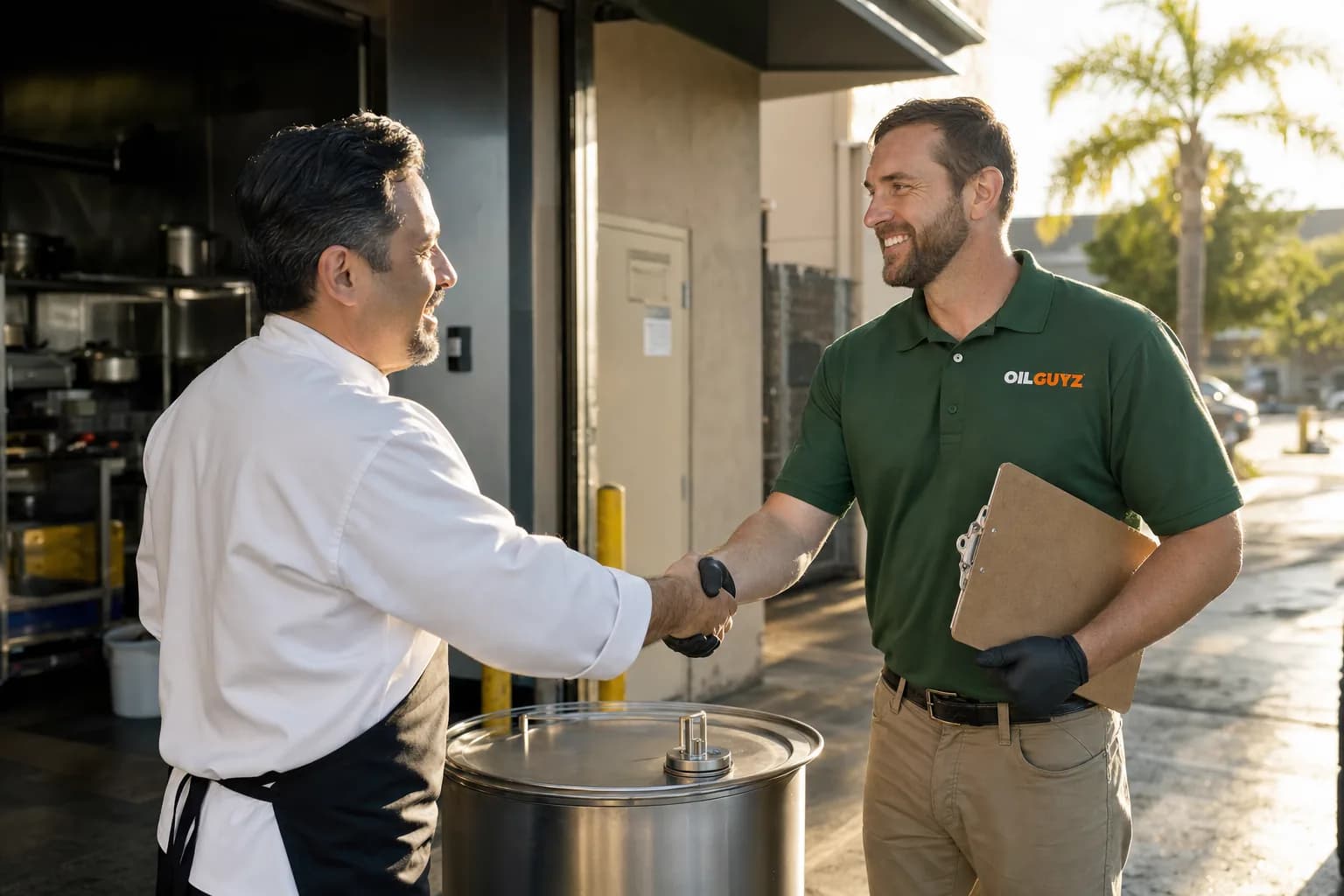
Most kitchens think of cooking oil disposal as getting the barrel emptied. The state thinks of it as something narrower: a custody handoff from your kitchen to a registered carrier, and a second handoff from that carrier to a licensed processing facility. The material even has a legal name, inedible kitchen grease. Under CCR Title 3 Section 1180.20, no vehicle may transport it unless the owner or company in control of that vehicle is registered with the state as a transporter. That registration is visible from your loading dock. Every registered vehicle carries an individually numbered decal for the current calendar year on the windshield or trailer, plus signs on the outside of both front doors showing the business name, the address or carrier ID number, and license plate information. If the truck at your back door has neither, the pickup was never legal, and whatever paperwork follows it is worth nothing.
The shortcuts kitchens fall back on each fail a different test. Pouring fryer oil down a drain, even into a well-maintained interceptor, puts a viscous pollutant into a public treatment system, and federal pretreatment rules at 40 CFR 403.5(b)(3) prohibit solid or viscous pollutants in amounts that will cause obstruction to the flow in a publicly owned treatment works. Every California sanitation agency enforces that locally through a fats, oils, and grease ordinance, which in Orange County is FOG Ordinance OCSD-25 and a wastewater discharge permit for food service establishments. Sealed jugs in the dumpster fail a different way: liquid does not belong in a solid waste stream, and no municipal trash hauler is permitted to receive it. The cash buyer with a pickup truck and a transfer pump fails the simplest test of all, because without state registration there is no manifest, and without a manifest there is no evidence the oil ever left your property lawfully.
What actually goes wrong is almost never a dramatic spill. Bad cooking oil disposal shows up as a documentation gap discovered on a bad day. Under Section 1180.24 the transporter keeps its part of the manifest for two years and the receiving facility keeps its part for two years, and your copy, Part 1, is supposed to be handed to you at the time of collection or delivered within 45 calendar days. Kitchens that never chased that copy find out what it was for when a grease inspector asks how the oil leaves the building. In San Diego, where food facilities operate under a Food Establishment Wastewater Discharge permit, the enforcement ladder starts with a notice of violation plus an administrative fee and climbs through mandated corrective work to permit revocation and termination of sewer service. Losing sewer service closes a kitchen. That is the real downside, and a hauler who hands you paperwork every single time removes it.
1
lawful disposal path
3-Part
manifest, one part is yours
$0
cost, we are paid for the oil
The Legal Cooking Oil Disposal Path, Start to Finish
Compliant cooking oil disposal is a four-link chain, and you can personally verify three of the links. A registered transporter arrives on a scheduled route. The oil is pumped out of your container into the truck. A three-part manifest is generated at the moment of collection, and Part 1 belongs to you. The load is delivered to a licensed receiving facility, which signs its own part and files it. Break any link and the rest stops functioning as evidence. California publishes the registered operators, so the middle of that chain can be checked in about a minute, before you sign anything with anyone.
- Look up the company on the state list of registered commercial IKG transporters
- Check the current-year decal on the windshield and the signage on both front doors
- Confirm the receiving facility is on the state renderer list, not just in a sales pitch
- Take Part 1 of the manifest at pickup, or expect it within 45 calendar days
- Match the gallons written on the manifest to what actually left your container
Prohibited Cooking Oil Disposal, and Why Each Shortcut Fails
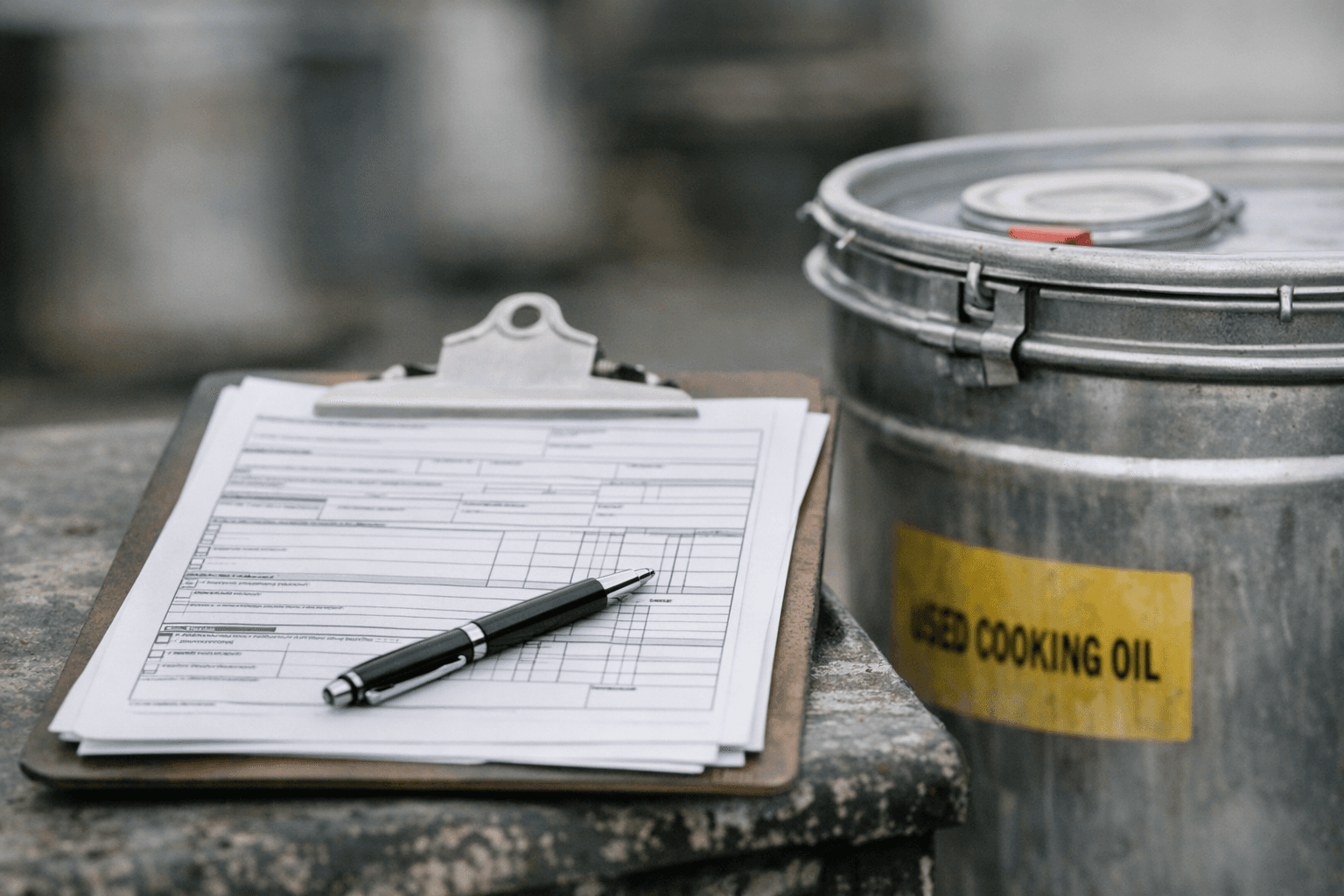
There is no small-volume exemption for a commercial kitchen. Half a drum of fryer oil is regulated exactly like a full tanker, which is why the three common shortcuts all collapse under inspection. Drain disposal is a prohibited discharge under federal pretreatment rules and the local grease ordinance that implements them, interceptor or no interceptor. Dumpster disposal puts a liquid into a solid waste stream nobody is permitted to receive. The unregistered buyer breaks the transport rule before the truck leaves your lot and leaves you with no record at all. In all three cases the party an inspector talks to is the kitchen that generated the oil, not whoever drove away with it.
- Drain disposal: a prohibited discharge even through a maintained grease interceptor
- Dumpster or trash disposal: liquid waste in a solid waste stream, no permitted receiver
- Unregistered cash buyers: no registration, no manifest, no proof the oil left lawfully
- Letting the container overflow: a spill on your property is your cleanup and your report
- No de minimis rule: small volumes from a commercial kitchen follow the same path
Disposal, Recycling, and Rendering Are Three Different Things
Operators use these three words interchangeably, and the difference matters the moment you are reading a service agreement or answering a question you did not expect. Cooking oil disposal, sometimes called fryer oil disposal, is the legal act of moving the material out of your kitchen through an approved channel. Recycling describes what happens to the molecule afterward, which for fryer oil means low-carbon fuel feedstock instead of landfill. Rendering is the licensed facility class that receives the load and does the processing. Here the three collapse into a single workflow, because the only approved destination is a permitted processor. The state regulates a finite number of them: 47 renderers, of which 21 are traditional renderers and 26 handle inedible kitchen grease only.
- Disposal: the regulated handoff, evidenced by a manifest signed at both ends
- Recycling: what the oil becomes, biodiesel and renewable diesel feedstock
- Rendering: the licensed facility that receives, weighs, and processes the load
- Landfill is not a lawful destination for used fryer oil from a commercial kitchen
- Your obligation closes when the documented chain reaches a licensed renderer
What an Inspector Asks For, and How Fast You Can Produce It
A grease inspector, a health inspector, and a franchise auditor all ask a version of the same question: show me how the oil leaves this building. In practice that means dated pickup records naming the transporter and the destination facility, your interceptor service log, and your local grease permit if your agency issues one. Note that the two-year retention rule sits on the transporter and the receiving facility, not on you, which is exactly why a kitchen that has switched haulers three times in five years can rarely reconstruct its own cooking oil disposal history. We keep your records for two years as company policy rather than as a legal requirement, in the Filtrate portal, so you can filter by date and export a PDF while the inspector is still standing in your kitchen.
- A dated manifest for every pickup, with gallons, transporter, and destination
- Transporter credentials on file, checkable against the published state list
- Interceptor service records, kept separately from your oil manifests
- Export to PDF, or share read-only access with a franchisor or landlord
- Two-year retention by company policy, meeting the two-year state minimum

Who Owns the Cooking Oil Disposal Decision
Independent Restaurants
One owner decides, usually after a bad experience with a no-show hauler. What matters is a container that fits the alley, a route that never overflows, and paperwork that shows up without being chased.
Food Processors
Volume changes the math. High-output lines need scheduled bulk removal, accurate gallon counts on every manifest, and destination documentation their EHS team can file without a phone call.
Institutional Kitchens
Correctional, military, and government kitchens buy through procurement. The decision hinges on documented vendor credentials and records that survive an audit years after the pickup happened.
Event Caterers
Oil is generated at venues you do not control. The workable answer is a fixed home base where oil is consolidated and collected, so each event does not create its own disposal problem.
School Cafeterias
District facilities staff decide, not the kitchen. Summer shutdowns and holiday gaps mean the schedule has to flex without leaving a full container sitting behind the building for six weeks.
Hospital Food Service
Nutrition services runs continuously and cannot absorb a missed pickup. Access windows, dock rules, and badge requirements matter as much as the compliance file behind the service.
Compliant Cooking Oil Disposal vs. the Usual Workarounds
Who hauls it
Your proof
Where it ends up
When it goes wrong
Recordkeeping
Cost
Case study
25 Totes From an R&D Project, Picked Up the Next Day
A California food-tech brand finished an R&D project with 25 totes of used cooking oil left over and needed them recycled properly.
The problem
25 totes of used cooking oil were left over from an R&D project. That is far more than a normal kitchen pickup, and it all needed compliant recycling.
The next-day fix
Oil Guyz got out the next day and picked up all 25 totes.
The result
A full CDFA-compliant manifest was provided, and the oil was routed into renewable fuel feedstock.
“Fast and great to work with!”
What's Included
Everything you need, nothing you don’t.
- Scheduled collection on a route sized to how fast you actually fill
- A CDFA-registered transporter, with credentials you can verify yourself
- A digital manifest generated at pickup and stored for you automatically
- A free locked container, delivered, serviced, and swapped at no charge
- Delivery to a licensed renderer, with destination documented on request
- Overflow and off-cycle pickups when a holiday rush breaks the schedule
- A real person on the phone 24/7, and a callback the same business day
- No contract, no disposal fee, no fuel surcharge, no hidden charges
- A named account contact with a direct phone number and email
How Restaurant Oil Collection Works In 3 Simple Steps
Set up restaurant oil collection in about five minutes. We confirm your route the same business day and drop a free bin before your first pickup. After that, Oil Guyz handles every used cooking oil pickup on schedule. You never chase a hauler again.
Request Pickup
Fill out a 30-second form or call us. No credit card, no commitment.
Pickup Day Is Pickup Day
Your scheduled window is locked in. A CDFA-registered transporter completes the pickup, pumps your container empty, and we email your digital manifest the moment the work is logged.
Stay Compliant Automatically
Get digital manifests, pickup confirmations, and compliance records, all in your dashboard.
Frequently Asked Questions
There is one lawful path. A transporter registered with the California Department of Food and Agriculture collects the oil from your kitchen and delivers it to a licensed receiving facility, and a manifest is created at the moment of collection. CCR Title 3 Section 1180.20 (3 CCR §1180.20) states that no vehicle may transport inedible kitchen grease unless the owner or company in control of the vehicle is registered with the Department, and CDFA states plainly that it is unlawful for any person to engage in the transportation of IKG without being registered (CDFA's rendering FAQ). Everything else, the drain, the dumpster, the guy with a truck and no decal, sits outside that path. Our service runs the compliant version for free, drops a locked container, and files your manifest automatically.
Yes. Spent fryer oil is the bulk of what gets collected, along with shortening, pan oil, and grill oil. Cooled oil goes in the locked bin, never a drain or a dumpster, and it is picked up free on a schedule with a digital manifest, performed by a CDFA-registered transporter.
No, and a grease interceptor does not change the answer. Federal pretreatment rules prohibit discharging solid or viscous pollutants in amounts that will cause obstruction to the flow in a treatment works (the EPA's pretreatment standards). Local sanitation agencies enforce that through their own grease programs, which is why Orange County food service establishments operate under FOG Ordinance OCSD-25 and a wastewater discharge permit (OC San's business FOG program), and why the City of San Diego runs its Food Establishment Wastewater Discharge program (San Diego's FEWD program). Bulk oil belongs in a collection container that a registered transporter empties, not in the plumbing.
No. Liquid waste does not belong in a solid waste container, and no municipal trash hauler is permitted to receive used fryer oil from a commercial kitchen. Containers crack under compaction, the oil ends up on the pad and in the storm drain, and the cleanup lands on the property. There is also no small-quantity exception for a food business: a few gallons a week follows the same path as a few hundred. If you are generating oil, you need a container and a registered transporter, even at low volume.
Two checks take about a minute. First, look at the truck. Under CCR Title 3 Section 1180.20 (3 CCR §1180.20) each registered vehicle carries an individually numbered decal for the current calendar year on the windshield or trailer, plus signs on both front doors with the business name, address or carrier ID number, and license plate information. Second, look the company up. CDFA publishes lists of registered inedible kitchen grease commercial transporters, renderers, and collection centers (CDFA's licensed transporter registry). If a company is not on the list and the truck has no decal, no manifest it produces will hold up.
Cooking oil disposal is the legal act: moving the oil out of your kitchen through an approved channel with documentation to prove it. Recycling is what happens to the material afterward, which for used fryer oil means it becomes feedstock for biodiesel and renewable diesel instead of going to landfill. Rendering is the licensed facility class that receives the load and does the processing. The three overlap by design here, because the only approved destination for collected oil is a permitted processor. CDFA regulates 47 renderers statewide, 21 traditional and 26 that handle inedible kitchen grease only (CDFA's rendering FAQ).
The two-year minimum in CCR Title 3 Section 1180.24 (3 CCR §1180.24) applies to the transporter copy and the receiving facility copy of every manifest. Your copy, Part 1, must be given to you at the time of collection or delivered within 45 calendar days. Because the retention duty sits on the hauler rather than on you, operators who have changed vendors a few times often cannot reconstruct their own history. We hold your records for two years, and keep them searchable so a date-range export takes seconds.
Enforcement is local and it escalates. The City of San Diego, for example, investigates food facilities after grease-related sewer blockages and can impose additional requirements on the establishments it identifies as contributors; non-compliance draws a notice of violation with an administrative fee and can lead to permit revocation and termination of sewer service (San Diego's FEWD program). Losing sewer service closes a kitchen. The subtler cost is that you remain the generator of record. If the oil that left your lot never reached a licensed facility, the trail still starts at your address.
Because collected fryer oil has commodity value as renewable fuel feedstock, and we are paid on that side of the transaction rather than by your kitchen. You get scheduled pickups, a free locked container, container servicing, and a manifest after every collection at no cost, with no contract and no minimum term. High-volume kitchens can also qualify for a rebate on the oil itself. Call and a real person picks up, day or night; we call back the same business day and typically run a first pickup within 3 to 5 business days.
What Our Clients Say

Bryan Baird
Google review
“We are a medium sized institutional kitchen located in San Juan Capistrano. When we needed a certified oil and grease removal partner the Oil Guyz were there. Fantastic customer service, fast, reliable, quick follow up and very efficient. They make it super easy to leave a GREAT review!”See full review

Alex Camacho
Google review
“I'm an up and coming new food vendor and properly disposing of used frying oil was a difficult task. That is until I contacted the Oil Guyz! There webpage made it easy to setup their free service of oil pickup. Within a few days I had a free container to store the used oil until ready for the free pickup. This service is very convenient and Joey has been very accommodating to answer all my questions and facilitate the process.”See full review

Ujwal Chaudhary
Google review
“Great service from Oil Guyz! They came and picked up my full barrel of used cooking oil completely free of charge. The process was easy, quick, and professional. I really appreciate their excellent customer service and reliable pickup. If you have used cooking oil that needs to be collected, I definitely recommend Oil Guyz. Great company and great people! 👍”See full review

Nicholas Saccoccia
Google review
“Excellent experience with Oil Guyz! They got me on the schedule fast, showed up on time, were very professional, and were in and out in no time! I would absolutely use them again.”

LA BREAKFAST CASITA
Google review
“We’ve had a great experience with Oil Guyz! I submitted a quote request through their website for our restaurant, and Joey reached out to us right away. From our first conversation, he has been extremely helpful, patient, and responsive. Joey really made the whole process easy for us. He was willing to work with our team on the best location for the bin, answered all of our questions, and kept in touch to make sure everything was taken care of. I especially appreciate his follow-through and willingness to help without ever making us feel rushed. Good customer service can be hard to find, and Joey has definitely made a great impression on us. We’re very happy we chose Oil Guyz for our used commercial oil pickup service at LA Breakfast Casita in Azusa, CA. Thank you, Joey, for making the process so smooth and for taking such good care of us. We look forward to working with Oil Guyz for a long time!”See full review

Mike Fishman
Google review
“Superb service!”

Celso Bahena
Google review
“I’m in the Santa Ana area great reliable service!”

Myk Espinoza
Oakland Ballers · Oakland, CA · Google review
“These dudes really bailed me out of a tough situation. My previous oil collection service had been really screwing me over. Spent 4 weeks of unanswered phone calls, texts, and empty promises with a company we've been using for two years just to get a used oil recepticle, all to no avail. We were sitting on 6 fryers with of oil I that I had nowhere to put. Called Joey and The Oil Guyz and he got me set up just a few hours later. Used oil container, service agreement, answered all of my questions. We're running a very odd program where our schedule is all over the place, so having a "regular" pick up schedule is out of the question. We worked out a way for quick/easy retrieval in about 5 minutes. Can't recommend these guys enough.”See full review

Maryam Tngrian
Google review
“As a manufacturing bakery, we recently needed a one-time pickup of approximately 3,000 lbs of used donut oil. Unfortunately, there was very little information available regarding the company that had handled this service previously, so I had to start from scratch. I found Oil Guyz online and was impressed from the first conversation. Joey, the owner, was extremely helpful and took the time to walk me through the entire process, making the coordination simple and straightforward. Prior to contacting Oil Guyz, I had attempted to reach other providers and had difficulty getting assistance. Oil Guyz was responsive, accommodating, and easy to work with from start to finish. The pickup was completed within the timeframe communicated, and the team handled the removal seamlessly with no disruption to our operation. Their professionalism and customer service made what could have been a challenging process very easy. We would absolutely use Oil Guyz again and would recommend them to other food manufacturing facilities looking for a reliable used cooking oil recycling partner.”See full review

Kengo Kido
Google review
“Joey took care of our needs quickly, efficiently and professionally. I highly reccoemnd his service to anyone!”

Brenda Wu
Google review
“Prompt response from Joey. Great service with problem solving. Highly recommended!”

Camille Bamford
Google review
“Fast and great to work with!”
Related Solutions
Restaurant Grease Pickup
Scheduled grease collection for restaurants with emergency overflow response and full CDFA compliance.
Learn moreCooking Oil Recycling
Turn your waste fryer oil into biodiesel feedstock with documented recycling at no cost.
Learn moreYellow Grease Recycling
Turn your used fryer oil into low-carbon biodiesel feedstock with documented, CDFA-compliant recycling at no cost.
Learn moreCooking Oil Disposal by City
We provide cooking oil disposal to restaurants and commercial kitchens across Orange County, Los Angeles, San Diego, the Inland Empire, the Bay Area, and Pierce, King, and Snohomish Counties in Washington. Every county hub lists the full route coverage.
Cooking Oil Disposal in Tacoma15 cities
See the Tacoma hub below for every community on the route.
See all 15 Tacoma citiesCooking Oil Disposal in King County31 cities
See the King County hub below for every community on the route.
See all 31 King County citiesCooking Oil Disposal in Snohomish County15 cities
See the Snohomish County hub below for every community on the route.
See all 15 Snohomish County citiesSet Up Compliant Cooking Oil Disposal, Free and Month to Month
Tell us your address and how many fryers you run. A real person answers, we call back the same business day, confirm what your local agency expects, drop a free locked container, and run a first pickup in 3 to 5 business days.
Or call (714) 880-4788 and talk to a real person today.