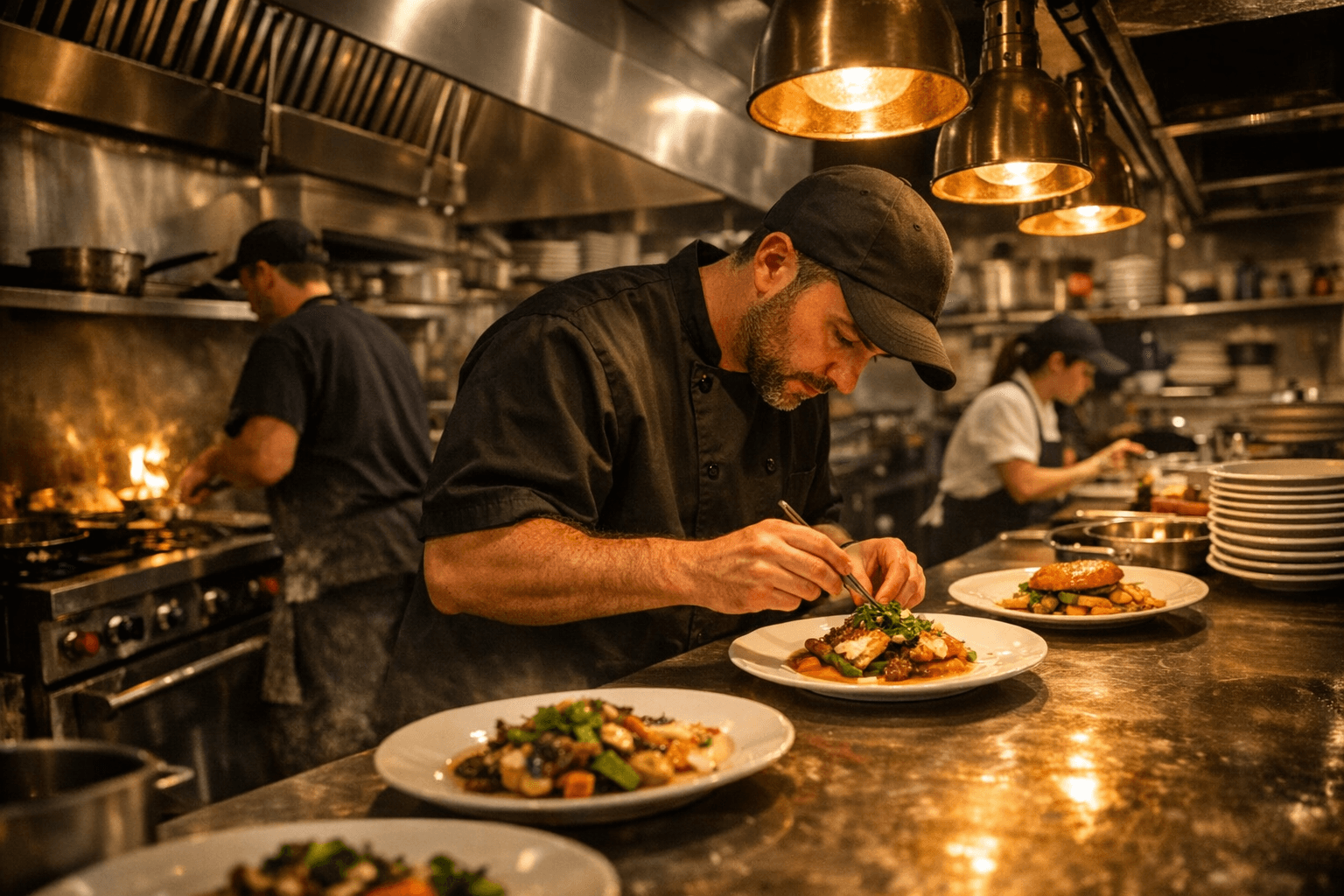
Cooking Oil Collection for Restaurants, One Vat to Twenty
Oil Guyz provides used cooking oil pickup and recycling for independent restaurants and small groups in Orange County, Los Angeles, San Diego, the Inland Empire, the Bay Area, and Puget Sound, WA. Call (714) 880-4788. Free scheduled pickup of used fryer oil, sized to the vats your restaurant actually runs and the alley you actually have. A free locked container by the back door your crew already uses, a digital manifest after every pickup, and month-to-month terms. Phones are answered 24 hours a day by a real person.
Quick Answer
Cooking oil collection for restaurants is scheduled route pickup of used fryer oil from a working restaurant kitchen, sized to vat count and change interval rather than to seats or square footage. Oil Guyz provides it free: a CDFA-registered transporter performs the pickup, the locked container costs nothing, and a digital manifest is generated after every visit. Independent restaurants, small groups, and multi-unit franchisees all run on the same month-to-month terms.
Cooking Oil Is the One Restaurant Vendor Nobody Thinks About Until It Fails
You buy this the way you buy every other food service vendor, linen, pest control, hood cleaning: a supplier, a route, a service agreement, and a compliance record. The difference is that almost nobody has a designated oil person. In an independent restaurant the owner is also the buyer, the closer, and the one who notices the container is over the fill line, usually at 10:40 on a Friday night. In a two-to-five-unit restaurant group there is an operating partner who signs the vendor agreements but has not stood on a back dock in a year, plus a GM at each address who inherited whatever supplier was there when they got the keys. In franchising the split is sharper still: the franchisee owns the P&L and the back door, while the brand may publish an approved supplier list the franchisee is expected to work within. Three ownership shapes, three different people who can actually say yes, and none of them wake up thinking about fryer oil.
So the failure looks the same in almost every restaurant. Nobody notices the schedule slipped until the closing crew is stacking cambros of used oil next to a full container. The rep who took the sales call two years ago has left, and the number on the invoice reaches a queue. The paperwork proving the oil left your building is inconsistent, which matters roughly once a year and matters enormously that once. Layer on a multi-year service agreement with an auto-renewal clause and a financing statement filed against your equipment, and an operator who wants out discovers the exit is far narrower than the entrance was.
What you need back is unglamorous: a container sized to the vats actually in your fry line, a schedule built off your real change interval, a driver who knows your alley, and a compliance record that already exists when someone asks for it. Oil Guyz is that service relationship plus the software behind it. Scheduled collection is free and performed by a CDFA-registered transporter, a free locked container comes with it, and a digital manifest is generated after every single pickup. Terms stay month-to-month. It is free because we are paid for the oil, not by you.
Free Used Oil Pickup for Restaurants
Tell us where your kitchen is. Free locked container, route started this week, no contract or minimum volume.
A busy line means fryer oil adds up fast. Oil Guyz keeps it from backing up with scheduled pickups, a free locked bin, and overflow service when a weekend gets away from you.
Tell us about your restaurant and we'll start your route, first pickup in 3 to 5 business days. No contract, no minimum, manifest after every pickup.
- Truly free. We are paid for the oil, not by you
- No contracts. Cancel anytime
- No minimum volume. Any kitchen size
- Free locked, anti-theft bin
- Compliant digital manifest after every pickup
- Instant confirmation, then a real person calls you
Request your free oil pickup
Free bin · No contract · Cancel anytime. You get an instant confirmation that we got it, then a real person calls to set up your pickup. No spam, no robocalls.
Prefer to talk? Call (714) 880-4788
1 to 20+ vats
sized to the fry line, from a single-fryer cafe to a high-volume restaurant
Every pickup
generates a digital manifest, kept 2 years as company policy
3 to 5 business days
typical wait from setup to your first scheduled pickup
Sizing a Restaurant by Vat Count, Not by Square Footage
The fastest way to size a restaurant wrong is to quote it off the dining room, because seats do not fry. A 40-seat cafe with one fryer, and a commercial vat typically holds 35 to 50 pounds of oil, may change on a one-to-two-week rhythm, so a 45-gallon containers out back would sit half empty between visits. A neighborhood sit-down restaurant with two or three vats lands on a weekly cadence. A wing or fried-chicken concept running six to eight vats full through dinner is a different business entirely and can turn its fry line over twice a week. A high-volume restaurant with twelve to twenty vats, or one line feeding a dining room and a heavy takeout channel at the same time, produces on an industrial cadence and needs equipment it cannot outrun between stops. So we count vats, ask what each one cooks, and ask how often the line filters. Breading and batter shorten the interval, because loose crumbs carbonize and pull the oil down faster than a clean fry does. A dedicated fish or shellfish vat usually gets changed on flavor long before it is chemically spent. A restaurant running a TPM meter or test strips changes on a number instead of on a hunch, which makes the interval unusually easy to schedule against. Disciplined daily filtration stretches all of it out. And if you fry in beef tallow or a solid shortening rather than a liquid blend, the collection job itself changes, because solid fat sets up firm as it cools and does not move like canola on a January morning. Two addresses with identical square footage can sit a month apart on frequency, which is exactly why a default drum is the wrong starting point.
- Sized from vat count and change interval, never from seats or square footage
- One-vat restaurants served, with no gallon minimum to qualify
- Breaded and battered menus scheduled tighter than a straight fry menu
- Daily filtration and TPM testing extend the interval, and the schedule reflects it
- Solid fats and tallow handled differently from liquid frying oil
- Free locked container included, and replaced free if it ever wears
What Actually Happens on a Restaurant Line at Close
None of this works if it does not fit the last twenty minutes of a shift, so it is worth saying out loud what really happens on a restaurant line. The fryer goes off at close and the oil has to come down to a safe handling temperature before anyone moves it, which is the step most collection schedules underestimate. On a filter night the cook drains the vat into a filter machine or a shuttle, cleans the pot, and returns the oil. On a change night that oil goes into a caddy or a stock pot and someone carries it out the back door in the dark, past a wet mat and a step down. That walk is where burns and slick floors come from. It is why the container belongs next to the door your crew already uses instead of wherever the last provider happened to drop it, and why the pour height has to work for a tired closer holding a caddy rather than a shoulder lift. It is also why the routine has to survive turnover, since the person doing this in March is usually not the person who was shown how in January, so at 11pm the correct move has to be the obvious one too. We place the container for the walk your team actually makes and set the cadence so a busy weekend close never runs you into capacity. If it fills early anyway, anybody on the crew can flag it without a purchase order, and phones are answered 24 hours a day by a real person.
- Container placed on the path your closing crew already walks
- Pour height set for a caddy, not a shoulder lift
- Cadence built so a busy restaurant does not hit capacity on a weekend close
- Any crew member can request an extra pickup, no purchase order
- Phones answered 24 hours a day by a real person, never a ticket queue
Back Door, Alley, and Curb Access on a Dense Restaurant Block
Most restaurants do not have a loading dock. They have a back door onto a shared alley, a trash corral split with the tenants on either side, and a curb that belongs to the city. That is a different route-logistics problem from a warehouse stop, and it is exactly why service built for suburban strip centers falls apart on a downtown restaurant row. A shared corral means the cardboard from the tenant next door can end up parked in front of your container overnight. Alley gate codes change when the property manager changes. Street sweeping days and metered hours take out part of the morning on some blocks. Older buildings leave one usable approach on a one-way alley a truck can enter from a single end. A restaurant on the ground floor of a building with parking above it adds a clearance limit that rules out some equipment outright. Mixed-use and historic districts often carry noise ordinances that push the first service of the day later than an operator would like. At setup we record the gate code, the corral position, the sweeping day, the neighbor situation, the clearance, and who holds the back-door key, then build the stop around all of it. We will not promise an arrival window, because on a dense block nobody driving a real route can honor one. What we do commit to is that a blocked container gets reported the same day instead of quietly logged as a skip.
- Gate codes, corral position, and alley approach recorded at setup
- Street sweeping days and metered hours accounted for on the stop
- Shared trash enclosures treated as a known constraint, not a surprise
- Overhead clearance checked before equipment is chosen
- Blocked containers reported the same day, never silently skipped
- No arrival window promised, because on a dense block nobody can honor one
Who Actually Signs: Restaurant Owner, Operating Partner, or Franchisee
The decision moves differently depending on how the business is owned, so we do not run the same motion at all three. In an independent restaurant the owner or GM decides at the table and the only real questions are cost, lock-in, and whether we will actually show up. Setup is one conversation. In a small group of two to five locations the operating partner or director of operations signs once, and the practical requirement is that every address runs identically while each GM keeps day-to-day control of their own site. In franchising the franchisee owns the P&L, the back door, and the vendor relationship, but some brands maintain an approved supplier list a franchisee is expected to work within, and a multi-unit franchisee usually wants every restaurant they own on one set of terms even when those stores sit under different brands. We set terms once at whichever level actually holds procurement authority and keep day-to-day requests down at the restaurant, so a closing manager can move a pickup without emailing a corporate office.
- An independent owner or GM can set this up in one conversation
- Small restaurant groups sign once and roll every address onto the same terms
- Multi-unit franchisees can hold stores from different brands together
- Restaurant-level staff move or add a pickup without corporate approval
- Role-based access, so each location sees only its own records
What This Line Item Actually Costs a Restaurant
Used oil is a small line on the P&L that behaves badly when it gets bundled into the wrong vendor. Bury it inside a general waste agreement and it arrives as a blended invoice: a base service fee, a fuel or environmental surcharge that moves without notice, an equipment rental, and sometimes an administrative charge, none of which map cleanly to what happened out back. Because the total is small, nobody audits it, and it renews on its own for years. There is a second cost that only shows up later. When a lien is filed against your business for collection equipment, it appears on a public UCC search, which is exactly the moment a lender, a landlord, or a buyer is reading your paperwork during a refinance, a lease renewal, or a sale. No operator should complicate any of those over a grease container. So we keep it clean: scheduled pickup is free, the locked container is free, and there is no deposit, no surcharge, no rental, and no lien filed. It works because we are paid for the oil, not by you. High-volume restaurants, roughly 250 gallons a month and up, may qualify for a rebate on top of that.
- No base fee, no fuel or environmental surcharge, no equipment rental
- No lien filed, so nothing surfaces during a refinance, lease renewal, or sale
- Free because we are paid for the oil, not by you
- Rebate review for high-volume restaurants, roughly 250 gallons a month and up
- No requirement to buy fresh cooking oil in exchange for collection
How a Restaurant Switches Collection Providers Mid-Contract
Most restaurant operators who call are already signed with somebody, and the switch is usually less painful than expected once it is sequenced properly. Start by finding the term and the notice window, because many used-oil agreements auto-renew unless written notice lands inside a specific window before the anniversary, and a missed window is what silently buys another year. Send the notice in writing and keep proof of delivery. Check whether a financing statement was filed against your business for the container, since that is a lien on equipment that needs to be released rather than forgotten. Then sequence the physical swap: their container comes out and ours goes in close enough together that your crew never has a night with nowhere to pour, which in practice means scheduling around their removal date instead of racing it. Keep copies of the old pickup records, because a retention clock does not restart when the provider changes. Send us the agreement and we will read it with you and tell you plainly when you can leave. Our own terms are month-to-month with no auto-renewal and no lien, so this is a conversation you have exactly once.
- We read your current agreement and identify the real notice window
- Written notice plus proof of delivery, so a renewal cannot be disputed
- Lien check on the existing container before anything moves
- Removal and placement sequenced so you never lose a pour point
- Our terms: month-to-month, no auto-renewal, no lien, no purchase requirement
What a Health Inspector Actually Asks a Restaurant to Show
Used oil surfaces in a routine restaurant inspection in three predictable ways, none of them exotic. First the physical container: covered, sound, no standing oil or slick at the base, and no pest attraction from a leak. Second the drain: no fryer oil down a sink, a floor drain, or into your grease interceptor, and an interceptor loaded with fryer oil is the quickest way to turn a routine visit into a violation and a sewer-district conversation. Third the paper: a licensed collector, and a record showing the oil left with them. State rules require a manifest for every used cooking oil pickup and set a two-year minimum retention, and electronic manifests are explicitly legal in California under the Uniform Electronic Transactions Act. We generate a digital manifest after every pickup and keep two years of them as company policy, exportable in one click when an inspector, a landlord, an insurer, or a franchisor asks. Many cities layer their own fats, oils, and grease program on top of the state rule, which is why you are better off with the compliance record already assembled than hunting for the last paper copy.
- Digital manifest generated after every pickup, exportable in one click
- Two-year minimum retention under 3 CCR §1180.24, two years kept as our policy
- Documented chain of custody from your kitchen to a CDFA-licensed renderer
- Nothing goes to a sink, a floor drain, or the interceptor, where FOG violations start
- Records ready for an inspector, a landlord, an insurer, or a franchisor
What Goes Wrong in a Working Restaurant, and How We Head It Off
Every recurring failure we see traces back to something physical in the restaurant rather than to a billing dispute. A holiday weekend or a large catering order doubles fry output and the container hits capacity three days early. A closer pours oil that has not cooled. A bin from the business next door lands in front of the container overnight. A remodel moves the back door and nobody tells the service provider, so the driver walks to a wall. A menu change adds one breaded item and quietly shortens the change interval by a third, which no fixed schedule catches on its own. And now and then a well-meaning closer pours the boil-out solution or a bucket of mop water in on top of the oil, which contaminates the whole load. So we compare logged gallons against the schedule instead of waiting for a complaint, raise frequency ahead of a known busy stretch and return it afterward, and treat a blocked stop as an event reported the same day. The container stays locked between visits, which keeps both the oil and the record intact.
- Logged gallons compared against the schedule to catch a fry line outgrowing it
- Known busy stretches scheduled up in advance, then returned to normal
- Overflow and hot-oil problems solved by placement and cadence, not a lecture
- Remodels, door moves, and menu changes updated on the account, not rediscovered
- Crew shown in one sentence what belongs in the container and what does not
- Locked container keeps the oil and the record intact between visits
What We Ask a Restaurant on the First Call
Setting a restaurant up is a short conversation, but it is a specific one, and the answers are what keep the schedule honest six months later. How many vats, and what does each one cook. How often the line changes oil today, and is that a real number or the number somebody guessed. Do you filter daily, and does the crew use a machine or a shuttle. Do you fry in a liquid blend, a solid shortening, or tallow. Where does the closer physically walk with the caddy, and is there a step, a mat, or a gate on that walk. Where can a container sit so it is out of the way of your trash pickup and your neighbors. What is the gate code, who has the back-door key, and what day does the street sweeper come. Are you signed with somebody today, and if so, when does that agreement renew. Who signs, and does that person sit in this restaurant or somewhere else. Any known spikes coming, a holiday stretch, a catering contract, a patio opening. That is the whole intake. Everything else we learn by servicing the stop, and we update the account when it changes instead of discovering it the hard way.
- Vat count, what each vat cooks, and the real change interval
- Filtration routine, oil type, and whether the fry line runs solid fat
- The walk your closer actually makes, and where the container can sit
- Gate code, key holder, sweeping day, and trash pickup timing
- Your current agreement and its renewal date, if you have one
- Who signs, and which upcoming stretches will spike your volume
Restaurants We Serve
Independent Neighborhood Restaurants
One to three vats, an owner who signs at the table, and no corporate hotline standing behind the decision. No gallon minimum, so a single-fryer restaurant qualifies like anyone else.
Wing, Chicken & Fried Concepts
Six to eight vats running full through dinner with breading in the oil, and a change interval measured in days. Sizing is the whole ballgame at this kind of concept.
Chef-Driven & Fine Dining
Low vat count, high standards, and a back of house where a leaking container is not acceptable. Placement matters more than volume here.
Fast Casual & Counter Service
Steady all-day fry output, thin margins, and a closing crew that turns over, so the routine has to be simple enough to survive new staff learning it.
Diners, Breakfast & Late Night
Hash browns, sides, and a long service window that spreads oil production across the whole day instead of concentrating it into one dinner rush.
Restaurant Groups & Multi-Unit Franchisees
Two to twenty restaurants that want one set of terms, one searchable record, and the ability to add an address without renegotiating anything.
Oil Guyz vs. a General Waste Hauler
Contract terms
What the invoice looks like
How your restaurant gets sized
Getting started
Who you reach
Proof of pickup
A blocked or full container
Multi-restaurant path
What's Included
Everything you need, nothing you don’t.
- Free scheduled cooking oil collection sized to the vat count and change interval at your restaurant
- Pickup performed by a CDFA-registered transporter
- A free locked collection container at every restaurant, no deposit and no lien
- Placement on the path your closing crew already walks
- A digital manifest generated after every single pickup
- Documented chain of custody from your restaurant to a CDFA-licensed renderer
- Two years of records kept as company policy, past the two-year legal minimum
- One-click export for an inspector, a landlord, an insurer, or a franchisor
- Proactive outreach before the container fills, plus extra stops on request
- Help reading your existing agreement and sequencing the switch without a gap
- Phones answered 24 hours a day by a real person, callback the same business day
- Month-to-month terms, no auto-renewal, and no fresh-oil purchase requirement
How Restaurant Oil Collection Works In 3 Simple Steps
Set up restaurant oil collection in about five minutes. We confirm your route the same business day and drop a free bin before your first pickup. After that, Oil Guyz handles every used cooking oil pickup on schedule. You never chase a hauler again.
Request Pickup
Fill out a 30-second form or call us. No credit card, no commitment.
Pickup Day Is Pickup Day
Your scheduled window is locked in. A CDFA-registered transporter completes the pickup, pumps your container empty, and we email your digital manifest the moment the work is logged.
Stay Compliant Automatically
Get digital manifests, pickup confirmations, and compliance records, all in your dashboard.
Frequently Asked Questions
Nothing. Scheduled pickup is free and the locked container is free, with no deposit, no setup fee, no surcharge, and no lien filed against your business. It is free because we are paid for the oil, not by you: used fryer oil is a feedstock for renewable fuel and carries real value once collected and processed. The only job your crew has is pouring cooled oil into the container during the normal change routine. High-volume restaurants, roughly 250 gallons a month and up, may qualify for a rebate. Tell us your volumes and we will review them.
Call or send the form and you get a callback the same business day. Once we have the address, the vat count, and where the container will sit, first pickup is typically 3 to 5 business days out. We will not quote an arrival window for a specific truck, because nobody driving a real route can honor one, but we will tell you the day, and your crew will have a container before they need it.
Usually, and it is mostly a sequencing problem. Find the term and notice window first, because many used-oil agreements auto-renew unless written notice arrives inside a set window before the anniversary. Send that notice in writing and keep proof of delivery. Check whether a financing statement was filed against your business for the container, since that is a lien that has to be released. Then we time our placement around their removal so your kitchen never has a night with nowhere to pour. Send us the agreement and we will read it with you and tell you plainly when you can leave.
Cooled cooking oil and frying fat out of the vats, nothing else. Water is the problem that shows up most: rain into an unlidded container, a bucket of mop water, or the boil-out solution poured in after a fryer cleaning. Keep grease interceptor and trap waste out entirely, because that is a separate waste stream with its own handling rules and it does not belong in the same container. Spent filter pads, filter powder, and food debris go in the trash. Never add motor oil, hydraulic fluid, or solvents. A contaminated load is the one thing that turns a free, valuable pickup into a disposal problem, so the version your closing crew can remember is short: cooled cooking oil only, lid closed.
No, and it is worth knowing why they are not the same job. Used fryer oil is a clean, valuable feedstock and leaves your restaurant on a manifest to a licensed renderer. What sits in a grease trap or interceptor is a different waste stream with its own pumping, disposal, and record-keeping rules, and it is handled by a liquid-waste contractor rather than by a used cooking oil collector. Keeping the two separate protects you twice: your interceptor is not carrying fryer oil it was never meant to hold, which is where FOG violations start, and the collection load stays uncontaminated. Keep your interceptor vendor. We take the fryer oil.
Common, and it is mostly a placement and permission question. In a food hall or shared kitchen the container often has to live in a common back-of-house area, which means the property manager or hall operator has a say in where it sits and who can reach it. In a strip center the trash corral is shared with the neighbors, so we need to know which slot is yours and who else is using it. Either way we deal with the building on placement, keep the container locked, and keep the manifest tied to your restaurant rather than to the address in general, so your records stay yours even when the equipment sits in a shared space.
Tell us and we adjust the schedule, at no cost and with no penalty. A restaurant closing for two weeks of remodel work gets the container serviced and then paused, or pulled entirely if the back door is moving. Seasonal operations, a patio-heavy summer, a slow January, or a college-town calendar, get their frequency raised and lowered as the year moves instead of paying for stops that do not need to happen. Because terms are month-to-month with no minimum, none of this costs you anything or triggers a contract conversation.
In practice, three things: a covered container in sound condition with no slick around its base, no fryer oil going into a sink, floor drain, or grease interceptor, and a record showing a licensed collector took the oil. State rules require a manifest for every used cooking oil pickup and set a two-year minimum retention, and electronic manifests are explicitly legal. We generate a digital manifest after every pickup and keep two years of them as company policy, exportable in one click. See the regulation at CCR Title 3 §1180.24, UCO Manifest & Electronic Records and the CDFA Inedible Kitchen Grease program at CDFA Inedible Kitchen Grease (IKG) Program.
No, and there is no gallon minimum. A single-vat restaurant gets a container sized for a single vat, often a compact indoor caddy rather than an outdoor bin, with a schedule matched to a change interval that may run every week or two instead of twice a week. Sizing a small restaurant correctly matters: an oversized drum at a low-volume address sits partly full for too long, which is a problem of its own.
Yes, you are responsible for making sure your collector is properly licensed and provides compliant documentation. The CDFA Inedible Kitchen Grease program licenses used cooking oil transporters and renderers and documents the chain of custody to deter illegal dumping. Pickup is performed by a CDFA-registered transporter, and a digital manifest after every pickup puts the licensing and the chain of custody into your records automatically. Program details are at CDFA Inedible Kitchen Grease (IKG) Program.
No. Terms are month-to-month and you can cancel anytime. There is no auto-renewal window to miss, no equipment lien, and no requirement to buy fresh oil from us in exchange for collection. We earn the account by showing up and proving every pickup with a manifest, not by making the exit narrow.
It is recycled into biodiesel and renewable-diesel feedstock through a CDFA-licensed renderer, which gives even a single-location restaurant an honest sustainability story to tell guests and landlords. Renewable diesel averages roughly a 65% carbon-intensity reduction versus petroleum diesel per DOE and CARB (DOE AFDC, Renewable Diesel), and waste-feedstock biodiesel and renewable diesel deliver about 79 to 86% lower lifecycle greenhouse-gas emissions per a 2022 Argonne National Laboratory lifecycle study in Environmental Science & Technology.
Restaurants in Orange County, Los Angeles, San Diego, the Inland Empire, the San Francisco Bay Area, and Washington's Puget Sound corridor can start service now, each on its own local phone line and route. We do not claim nationwide coverage. Multi-location groups can consolidate the in-region restaurants onto one account today and send the rest as addresses for the expansion list.
Yes. Every restaurant rolls up under our Restaurant Cooking Oil Management program, with one dashboard where you see every site, each manager sees only theirs, and every manifest is stored and searchable across the group. Addresses are added or removed as you open, close, or acquire, with no renegotiation and no penalty maze, and terms stay month-to-month throughout.
What Our Clients Say

Bryan Baird
Google review
“We are a medium sized institutional kitchen located in San Juan Capistrano. When we needed a certified oil and grease removal partner the Oil Guyz were there. Fantastic customer service, fast, reliable, quick follow up and very efficient. They make it super easy to leave a GREAT review!”See full review

Alex Camacho
Google review
“I'm an up and coming new food vendor and properly disposing of used frying oil was a difficult task. That is until I contacted the Oil Guyz! There webpage made it easy to setup their free service of oil pickup. Within a few days I had a free container to store the used oil until ready for the free pickup. This service is very convenient and Joey has been very accommodating to answer all my questions and facilitate the process.”See full review

Ujwal Chaudhary
Google review
“Great service from Oil Guyz! They came and picked up my full barrel of used cooking oil completely free of charge. The process was easy, quick, and professional. I really appreciate their excellent customer service and reliable pickup. If you have used cooking oil that needs to be collected, I definitely recommend Oil Guyz. Great company and great people! 👍”See full review

Nicholas Saccoccia
Google review
“Excellent experience with Oil Guyz! They got me on the schedule fast, showed up on time, were very professional, and were in and out in no time! I would absolutely use them again.”

LA BREAKFAST CASITA
Google review
“We’ve had a great experience with Oil Guyz! I submitted a quote request through their website for our restaurant, and Joey reached out to us right away. From our first conversation, he has been extremely helpful, patient, and responsive. Joey really made the whole process easy for us. He was willing to work with our team on the best location for the bin, answered all of our questions, and kept in touch to make sure everything was taken care of. I especially appreciate his follow-through and willingness to help without ever making us feel rushed. Good customer service can be hard to find, and Joey has definitely made a great impression on us. We’re very happy we chose Oil Guyz for our used commercial oil pickup service at LA Breakfast Casita in Azusa, CA. Thank you, Joey, for making the process so smooth and for taking such good care of us. We look forward to working with Oil Guyz for a long time!”See full review

Mike Fishman
Google review
“Superb service!”

Celso Bahena
Google review
“I’m in the Santa Ana area great reliable service!”

Myk Espinoza
Oakland Ballers · Oakland, CA · Google review
“These dudes really bailed me out of a tough situation. My previous oil collection service had been really screwing me over. Spent 4 weeks of unanswered phone calls, texts, and empty promises with a company we've been using for two years just to get a used oil recepticle, all to no avail. We were sitting on 6 fryers with of oil I that I had nowhere to put. Called Joey and The Oil Guyz and he got me set up just a few hours later. Used oil container, service agreement, answered all of my questions. We're running a very odd program where our schedule is all over the place, so having a "regular" pick up schedule is out of the question. We worked out a way for quick/easy retrieval in about 5 minutes. Can't recommend these guys enough.”See full review

Maryam Tngrian
Google review
“As a manufacturing bakery, we recently needed a one-time pickup of approximately 3,000 lbs of used donut oil. Unfortunately, there was very little information available regarding the company that had handled this service previously, so I had to start from scratch. I found Oil Guyz online and was impressed from the first conversation. Joey, the owner, was extremely helpful and took the time to walk me through the entire process, making the coordination simple and straightforward. Prior to contacting Oil Guyz, I had attempted to reach other providers and had difficulty getting assistance. Oil Guyz was responsive, accommodating, and easy to work with from start to finish. The pickup was completed within the timeframe communicated, and the team handled the removal seamlessly with no disruption to our operation. Their professionalism and customer service made what could have been a challenging process very easy. We would absolutely use Oil Guyz again and would recommend them to other food manufacturing facilities looking for a reliable used cooking oil recycling partner.”See full review

Kengo Kido
Google review
“Joey took care of our needs quickly, efficiently and professionally. I highly reccoemnd his service to anyone!”

Brenda Wu
Google review
“Prompt response from Joey. Great service with problem solving. Highly recommended!”

Camille Bamford
Google review
“Fast and great to work with!”
Related Resources
Guides
Free Tools
- Grease Trap Calculator
Find your recommended pumping frequency
- Compliance Checker
Check if you meet California grease requirements
Related Solutions
Restaurant Cooking Oil Management
The multi-location hub: one account, one dashboard, centralized manifests, and reporting across every restaurant you operate.
Learn moreCooking Oil Compliance & Reporting
How the digital manifest, chain of custody, and the Filtrate portal keep your restaurant inspection-ready for every pickup.
Learn moreMulti-Location Cooking Oil Collection
One agreement across every site for restaurant groups ready to standardize, the contract and master-service-agreement side of the program.
Learn moreGet Cooking Oil Collection for Your Restaurant, Free and Month-to-Month
Send the form or call and a real person picks up, 24 hours a day. Tell us your vat count and where the container can sit, we will call back the same business day, and first pickup is typically 3 to 5 business days out. Free scheduled pickup, a free locked container, and a digital manifest after every visit.
Or call (714) 880-4788 and talk to a real person today.