Cooking Oil Collection for Casinos and Country Clubs, Outlet by Outlet
Oil Guyz provides used cooking oil pickup and recycling for casino and country club kitchens in Orange County, Los Angeles, San Diego, the Inland Empire, the Bay Area, and Puget Sound, WA. Call (714) 880-4788. The casino is not one kitchen, it is a dozen, and they never all stop at the same time. A country club is the opposite: dead all week, then 250 golfers in one morning. So we collect the used cooking oil outlet by outlet instead of once a week for the whole casino, work inside the dock and badge rules you already run on, and document every pull on a digital manifest. Free service, month-to-month, a free locked container at every fryer line, and a real person answers 24/7.
Quick Answer
Cooking oil collection for casinos and country clubs is scheduled outlet by outlet, because the casino is a dozen kitchens under one roof and no two of them fill at the same rate. The casino never closes and the club swings from a dead Tuesday to a 250-golfer morning, so both need used cooking oil collected against a calendar. A CDFA-registered transporter performs it and documents every pull.
Why the Casino Cannot Run on One Weekly Stop at the Back Dock
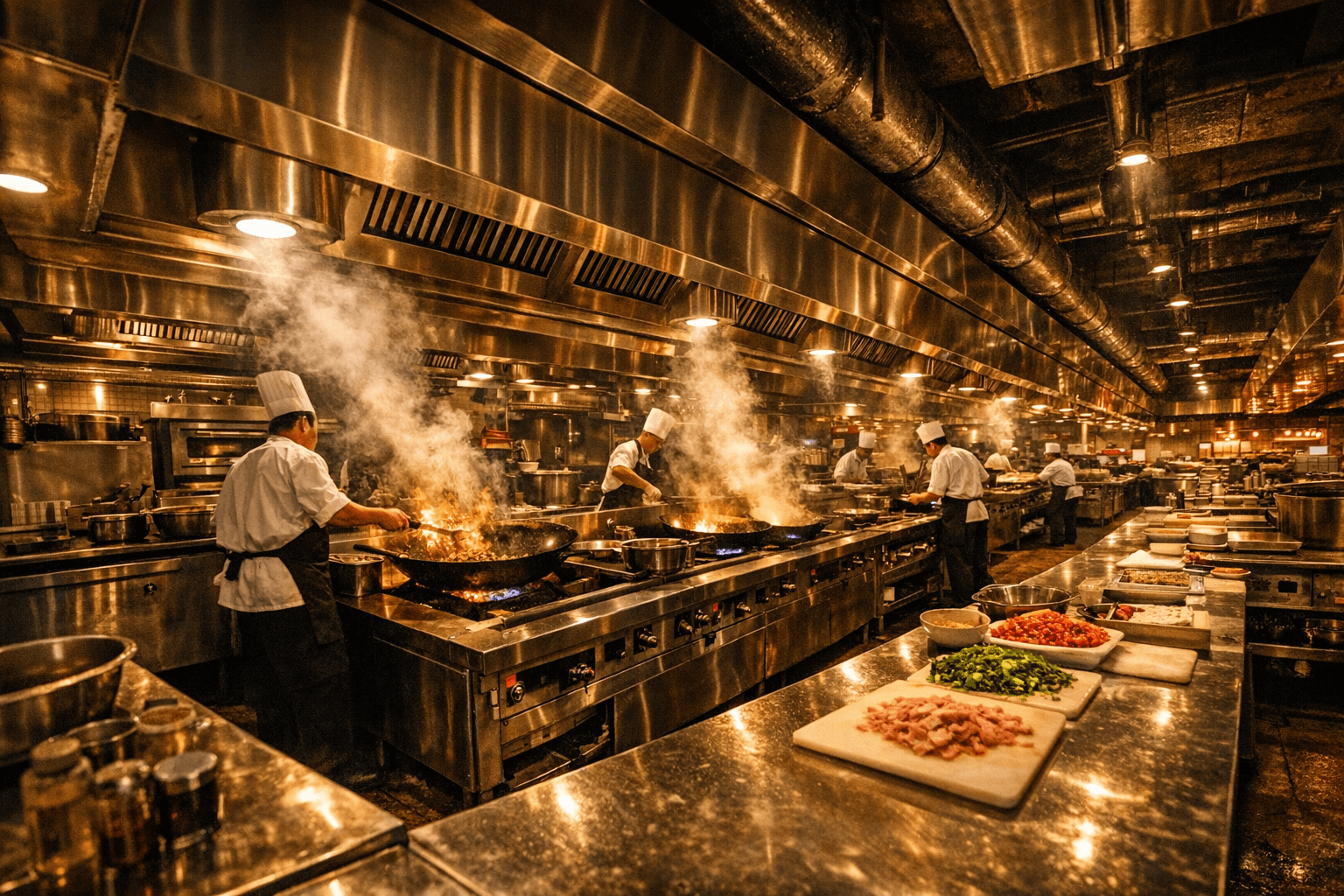
The casino is not one kitchen and never was. A full-size gaming property runs eight to twelve fryer-equipped outlets under one roof, and no two of them make used cooking oil at the same rate. The buffet burns through used cooking oil faster than any other kitchen in the building. The employee dining room, which almost nobody counts, feeds a workforce of several hundred across three shifts and out-fries half the guest outlets. A single weekly stop at the casino dock cannot match any of that, so the buffet overflows on Saturday while the steakhouse bin sits a third full on Wednesday.
The second problem is that the casino does not close. The floor runs 24 hours, so at least one kitchen stays hot 24 hours, and the after-close window a normal restaurant hands a hauler simply does not exist here. The quietest stretch is somewhere around four in the morning, which is exactly when the graveyard cooks are frying for the overnight crowd and stewarding is running fryer boil-outs. Used cooking oil has to leave through the dock, the freight elevator, and the back-of-house corridor, so the schedule gets built around those, not around a closing time the building never has.
Then there is getting in at all. A casino is one of the most access-controlled buildings a service vendor will ever work in. The dock runs on appointments that beverage, linen, and produce claim first. Vendors sign in and badge in, surveillance covers the route, and nothing on wheels crosses the floor. Layer on the California rule that every commercial used cooking oil pickup be documented on a manifest showing chain of custody to a licensed renderer, and a property running three different waste vendors ends up with three sets of paperwork, no single record of what left the building, and a food and beverage office that cannot answer a straight question during an audit.
High-Volume Kitchens, Spotless Service
Tell us where your kitchen is. Free locked container, route started this week, no contract or minimum volume.
Casino floors and club kitchens cook at volume and expect everything behind the scenes to be seamless. We keep used oil moving on a tight schedule with secure, locked containers.
Fill out the form and we'll set a route that matches your covers. Free, no contract, fully documented.
- Truly free. We are paid for the oil, not by you
- No contracts. Cancel anytime
- No minimum volume. Any kitchen size
- Free locked, anti-theft bin
- Compliant digital manifest after every pickup
- Instant confirmation, then a real person calls you
Request your free oil pickup
Free bin · No contract · Cancel anytime. You get an instant confirmation that we got it, then a real person calls to set up your pickup. No spam, no robocalls.
Prefer to talk? Call (714) 880-4788
Per outlet
casino schedules, not one stop for the whole property
Free
pickup, locked containers, and digital manifests
24/7
a real person answers the phone
Inside the Casino: Ten Kitchens, Ten Cadences, One Record
Cooking oil collection for casinos starts with a walk of the building, because the fryer map is never what the org chart suggests. A full-size property typically runs a buffet, a 24-hour cafe, a steakhouse, an Asian or noodle concept, a food court with three or four quick-service counters, a sports bar, a poolside grill in season, and an employee dining room. Each of those gets a bin sized to the used cooking oil that kitchen actually produces and to the doorway it has to fit through, plus its own pickup cadence. The buffet may need service weekly while the steakhouse goes a month between pulls. Every pull posts to one casino record, so food and beverage leadership sees the whole operation in one place and each outlet manager sees only their own kitchen.
- A free locked container at each fryer line, sized to that kitchen instead of to the dock
- Buffet and food court cadences set separately from the steakhouse and the banquet kitchens
- Employee dining counted as a real outlet, because in most buildings it fries like one
- Seasonal outlets like the pool grill added and paused without renegotiating anything
- One record for the whole site, with role-based access for leadership and each outlet manager
A 24-Hour Casino Kitchen Never Has a Quiet Window
Every hauler arrives with the same scheduling assumption borrowed from restaurants: we will come after you close. A casino does not close. The floor runs 24 hours, so the cafe runs 24 hours, the employee dining room runs straight through graveyard, and the buffet is being reset for breakfast while the late crowd is still eating. There is no hour when the building is dark, only hours when the guest count is lower, and those are the same hours stewarding uses for boil-outs and deep cleaning, which is precisely when used cooking oil moves. So we do not schedule against a closing time. We schedule against dock availability, the freight elevator, and the corridor the bin travels, then hold that service day steady so the stewarding lead knows exactly when it goes out.
- Pickup planned around the dock and the corridor, not a closing time the building does not have
- Overnight cafes and graveyard-shift outlets counted in the cadence instead of assumed idle
- Fryer boil-out and filtration cycles factored into when a bin really fills
- A steady service day so stewarding can stage the bin without guessing
- A real person answers 24/7 when an outlet fills early on a swing shift
Casino Access: Badging, Dock Appointments, and Never Crossing the Floor
An operator that has had a bad experience with a waste vendor usually had an access problem, not an oil problem. The dock runs on appointments and gets claimed by the trucks that deliver revenue first. Vendors sign in, badge in, and at some properties get escorted the whole way. Surveillance covers the route. And a bin on wheels is not going across the casino floor, so the path from a food court counter to the dock runs through service corridors and a freight elevator shared with everything else moving that morning. We walk that route with your team before the first pickup and write it down: which door, which appointment window, which elevator, which corridor, and who at security to call. Once that map exists, the service stays invisible to guests and predictable for stewarding instead of getting reinvented every cycle.
- Route walked and documented before the first pickup, not improvised at the dock
- Dock appointments booked into the receiving schedule like any other waste vendor
- Driver sign-in and credentialing handled to the rules security already enforces
- Back-of-house routing only, nothing rolled or hosed through guest or gaming space
- One point of contact so security is not re-briefing someone new every visit
Country Club Seasonality: Tournament Mornings, Wedding Saturdays, and a Slow Winter
A country club produces used cooking oil in a completely different shape than a casino does. Most of the week the grill room is quiet and the fryer barely runs. Then a member-guest or a club championship puts a shotgun start on the tee sheet, and the club kitchen feeds 250 golfers breakfast, runs the halfway house all morning, and plates a dinner the same night. Wedding and banquet season stacks Saturday after Saturday from spring through fall. A holiday brunch or a Thanksgiving service is one day that can out-produce an ordinary month at the club. Then it goes quiet, and how quiet depends entirely on where the club sits: a Pierce County club in January is a different business from an inland desert club in January, where winter is the busy season. We build the club pickup cadence off the actual calendar, scale up through the season, and scale back when the tee sheet empties instead of leaving a full bin sitting through a closure.
- Cadence built off the club calendar: member-guest, club championship, invitationals
- Halfway house and turn-shack fryers counted as their own stop, not lumped into the main kitchen
- Extra pickups around wedding Saturdays and holiday brunch service
- Pool snack bar bins placed in season and pulled when it closes for the year
- Winter scaled down without a contract change, because service is month-to-month
Banquet Spikes That Triple a Normal Week Overnight
The single most common failure at either venue is a banquet nobody told the waste hauler about. A convention plated dinner for a thousand covers, a ballroom wedding, a concert night, or a member gala can put more used cooking oil into one bin in an evening than that outlet produced in the previous three weeks. On a fixed weekly route the bin simply sits full until the next scheduled visit, and that is when the bad workarounds start: oil stacked in jugs beside the bin, a temp steward pouring it down a floor drain and loading the grease interceptor, or a full bin wheeled somewhere it was never supposed to go. We would rather know the date. Send the banquet book and the event calendar, and heavy weeks get an extra pickup scheduled ahead of the event instead of a cleanup after it.
- Banquet, convention, and gala dates scheduled ahead instead of caught after the fact
- Extra pickups for convention weeks, wedding weekends, and back-to-back ballroom bookings
- Bins upsized at no charge when the baseline at a banquet kitchen permanently grows
- No overflow parked in a back-of-house corridor waiting on the next route day
- A real person answers 24/7 when an event gets added late
Who Actually Owns This Decision: F&B, Stewarding, Facilities, or Purchasing
At a large hospitality property the used cooking oil belongs to three people at once. Food and beverage leadership owns the outlets and the guest experience. The executive steward owns the fryers, the filtration, and the person physically rolling the bin. Facilities or engineering owns the dock, the corridor, and the grease interceptor that catches whatever goes down a drain. Purchasing owns the vendor file and the paperwork, and at a tribal gaming enterprise that vendor file may sit with the procurement office rather than with the hotel. At a country club the same job collapses onto fewer people: a general manager or clubhouse manager who signs, a food and beverage director or executive chef who lives with the schedule, and a house or finance committee that will ask what it costs. The short answer for whichever of them is reading first: the service is free, it is month-to-month, there is no capital request, and it does not change the dock rules the building already runs on.
- Food and beverage leadership: a cadence per outlet and no oil moving through guest space
- Executive stewards: a bin at the fryer line, not a haul across the building
- Facilities and engineering: documented dock routing and less grease interceptor exposure
- Purchasing: month-to-month, no contract to route through legal, no line item to approve
- General managers and committees: one record and an audit-ready export whenever it is asked for
One Manifest Per Pickup, One Record for the Whole Casino
Used cooking oil is a regulated commercial waste stream in California, and the state requires a manifest for every pickup, documenting chain of custody from the generator to a licensed rendering plant. Electronic manifests are legal under the California Uniform Electronic Transactions Act. The state minimum retention is two years. We keep two as company policy. The generator keeps a copy of every manifest, so the paperwork has to land somewhere your team can actually find it. At a property with eight fryer outlets that matters far more than it does at a single restaurant, because the question an inspector, an insurer, or an internal auditor asks is never just whether a manifest exists, it is show me everything that left this building last year. Every pickup at every outlet posts a digital manifest to one record you can export by outlet, by date range, or for the whole site. Collection itself is performed by a CDFA-registered transporter under the California Inedible Kitchen Grease program.
- A digital manifest after every pickup at every outlet, on one record for the whole site
- Two-year state minimum retention, two years kept as company policy
- Exports by outlet, by site, or by date range for audits and insurance files
- Chain of custody to a licensed renderer under the Inedible Kitchen Grease program
- Documentation that lines up with the county FOG program the interceptor already falls under
Where the Fryer Oil Ends Up
Used cooking oil is not garbage, it is a commodity, and rendering is an old commercial industry with licensed plants, licensed transporters, and audited weights. Every gallon collected from a commercial kitchen is hauled to a licensed rendering plant and recycled into feedstock for biodiesel and renewable diesel. That is the waste stream your fryer oil enters, and it is the reason the service costs you nothing. Renewable diesel cuts carbon intensity about 65% on average versus petroleum diesel, and waste-feedstock biodiesel and renewable diesel deliver roughly 79% to 86% lower lifecycle greenhouse-gas emissions. The manifest trail is what lets an operator actually claim that in a sustainability report, gallon by gallon and outlet by outlet, instead of estimating.
- Recycled into biodiesel and renewable-diesel feedstock at a licensed rendering plant, never landfilled
- Renewable diesel cuts carbon intensity about 65% on average versus petroleum diesel (DOE/CARB)
- Waste-feedstock fuels run roughly 79% to 86% lower lifecycle GHG emissions (Argonne National Laboratory, Environmental Science & Technology, 2022)
- Gallon-level manifest data behind any figure the operator publishes
- One accountable recycling and waste-hauling chain instead of scattered, untracked disposal
Casino and Country Club Operations We Serve
Casino Buffets
Continuous-fry buffet lines that reset for the next service before the last one clears. Sized for high-capacity bins and the shortest pickup cadence in the building.
Food Courts and Quick Service
Three or four counters sharing one corridor, each with its own fryer and its own manager. A bin per counter, collected on a single trip to the dock.
Steakhouses and Signature Restaurants
Lower-volume signature kitchens that still make used cooking oil and still need it documented, just nowhere near the frequency a buffet needs.
24-Hour Cafes and Employee Dining
The outlets that never stop. Overnight cafes and employee dining rooms feeding a workforce of several hundred across three shifts, counted as real volume instead of an afterthought.
Casino Ballroom and Convention Kitchens
Banquet kitchens whose output triples for a plated dinner or a convention closing night, served with extra pickups scheduled off the event calendar.
Country Club Dining and Halfway Houses
Member grill rooms, main dining rooms, halfway houses, and pool snack bars, on a cadence that follows the tee sheet and the club banquet book.
Oil Guyz vs. a General Waste Hauler at a Casino or Country Club
Bins in the building
Scheduling
24-hour kitchens
Access and credentialing
Event surges
Manifests
Contract
Reaching a person
What's Included
Everything you need, nothing you don’t.
- Free scheduled used cooking oil pickup at every fryer outlet in the building
- A free locked container at each outlet, sized to that kitchen and to its doorway
- A separate pickup cadence per outlet, from the buffet to the halfway house
- Extra pickups scheduled ahead of banquets, conventions, galas, and tournament days
- A documented back-of-house route so nothing crosses guest or gaming space
- Dock appointments and driver sign-in handled to the rules your security office enforces
- A CDFA-compliant digital manifest after every pickup, on one record for the whole site
- Exports by outlet, by site, or by date range for audits and sustainability reporting
- Chain of custody to a licensed renderer under the Inedible Kitchen Grease program
- Container resizing and replacement at no charge as outlets grow or go seasonal
- One Filtrate account with role-based access for leadership and each outlet manager
- Month-to-month service, a real person on the phone 24/7, and no cost to the operator
How Restaurant Oil Collection Works In 3 Simple Steps
Set up restaurant oil collection in about five minutes. We confirm your route the same business day and drop a free bin before your first pickup. After that, Oil Guyz handles every used cooking oil pickup on schedule. You never chase a hauler again.
Request Pickup
Fill out a 30-second form or call us. No credit card, no commitment.
Pickup Day Is Pickup Day
Your scheduled window is locked in. A CDFA-registered transporter completes the pickup, pumps your container empty, and we email your digital manifest the moment the work is logged.
Stay Compliant Automatically
Get digital manifests, pickup confirmations, and compliance records, all in your dashboard.
Frequently Asked Questions
Each fryer outlet in the building gets its own free locked container and its own pickup cadence, because the buffet and the steakhouse do not fill at the same rate. Everything posts to one Filtrate record, so food and beverage leadership sees every outlet in one place and each outlet manager sees only theirs. Outlets get added, paused, or resized without renegotiating anything, because service is month-to-month.
Yes, and it is the normal case. The floor runs 24 hours, so the cafe and the employee dining room run 24 hours, and there is no post-close window to hand a hauler. Used cooking oil leaves through the loading dock, the freight elevator, and the corridor the bin travels, then held on a steady service day so the stewarding lead knows when it goes out. If an outlet fills early on a swing shift, a real person answers the phone.
To the rules you already have, not ours. Before the first pickup we walk the route with your team and document it: which dock, which appointment window, which freight elevator, which corridor, and who at security to call. Drivers sign in and badge in like any other vendor. Nothing gets rolled or hosed across the floor or through guest space. Once that route is written down it does not get reinvented every cycle, which is what makes the service predictable for stewarding and invisible to guests.
Send us the calendar. A ballroom plated dinner, a convention dinner, a member-guest, or a holiday brunch can put more used cooking oil into one bin than that outlet made in the prior three weeks. Those dates get an extra pickup scheduled ahead of the event rather than a cleanup after it, and if the baseline at a banquet kitchen permanently grows, the bin gets upsized at no charge.
It usually starts with food and beverage leadership or the executive steward, facilities weighs in on the dock and the grease interceptor, and purchasing wants the vendor paperwork. At a country club it is typically the general manager or clubhouse manager along with the chef. It rarely has to go higher than that, because there is no cost, no capital request, and no multi-year agreement to route through legal.
Digital manifests are legal in California and Oil Guyz issues one per pickup. State rules require documented chain of custody for every used cooking oil collection to a licensed renderer, and electronic manifests are legal under the California Uniform Electronic Transactions Act with a two-year minimum retention. We retain them for two years as company policy. You get a compliant digital manifest after every pull at every outlet, stored and exportable for audits. See the rule at CDFA Manifest Requirement (3 CCR §1180.24)
Pickup is performed by a CDFA-registered transporter under the California Inedible Kitchen Grease program, which licenses used cooking oil transporters and renderers and documents chain of custody to deter illegal dumping. Oil Guyz places the containers, builds the schedule around your outlets and your events, coordinates access with your security and receiving teams, and makes sure the documentation is complete. You can read about the program at CDFA Inedible Kitchen Grease Program
No contract, and no fee to the operator. Service is month-to-month, the locked containers are free, and the manifests are free. It is free because we are paid for the oil, not by you: used cooking oil has real value as renewable-fuel feedstock, so the pickup funds itself. That is also why there is no reason to lock a property into a multi-year agreement.
Call and a real person answers 24/7, or send the form. You get a callback the same business day, and first pickup is typically 3 to 5 business days out once we have walked the outlets, agreed on where the containers go, and cleared the access route with your security and receiving teams.
Every gallon is recycled through a licensed renderer into feedstock for biodiesel and renewable diesel. Renewable diesel cuts carbon intensity about 65% on average versus petroleum diesel (DOE/CARB: DOE AFDC, Renewable Diesel ), and waste-feedstock biodiesel and renewable diesel deliver roughly 79% to 86% lower lifecycle greenhouse-gas emissions (Argonne National Laboratory, Environmental Science & Technology, 2022). The manifest trail lets the operator report that contribution gallon by gallon.
Oil Guyz serves Orange County, Los Angeles, San Diego, the Inland Empire, the San Francisco Bay Area, and Pierce, King, and Snohomish Counties in Washington. If your venue is outside those markets, tell us your locations and we will notify you as we expand into your area.
What Our Clients Say

Bryan Baird
Google review
“We are a medium sized institutional kitchen located in San Juan Capistrano. When we needed a certified oil and grease removal partner the Oil Guyz were there. Fantastic customer service, fast, reliable, quick follow up and very efficient. They make it super easy to leave a GREAT review!”See full review

Alex Camacho
Google review
“I'm an up and coming new food vendor and properly disposing of used frying oil was a difficult task. That is until I contacted the Oil Guyz! There webpage made it easy to setup their free service of oil pickup. Within a few days I had a free container to store the used oil until ready for the free pickup. This service is very convenient and Joey has been very accommodating to answer all my questions and facilitate the process.”See full review

Ujwal Chaudhary
Google review
“Great service from Oil Guyz! They came and picked up my full barrel of used cooking oil completely free of charge. The process was easy, quick, and professional. I really appreciate their excellent customer service and reliable pickup. If you have used cooking oil that needs to be collected, I definitely recommend Oil Guyz. Great company and great people! 👍”See full review

Nicholas Saccoccia
Google review
“Excellent experience with Oil Guyz! They got me on the schedule fast, showed up on time, were very professional, and were in and out in no time! I would absolutely use them again.”

LA BREAKFAST CASITA
Google review
“We’ve had a great experience with Oil Guyz! I submitted a quote request through their website for our restaurant, and Joey reached out to us right away. From our first conversation, he has been extremely helpful, patient, and responsive. Joey really made the whole process easy for us. He was willing to work with our team on the best location for the bin, answered all of our questions, and kept in touch to make sure everything was taken care of. I especially appreciate his follow-through and willingness to help without ever making us feel rushed. Good customer service can be hard to find, and Joey has definitely made a great impression on us. We’re very happy we chose Oil Guyz for our used commercial oil pickup service at LA Breakfast Casita in Azusa, CA. Thank you, Joey, for making the process so smooth and for taking such good care of us. We look forward to working with Oil Guyz for a long time!”See full review

Mike Fishman
Google review
“Superb service!”

Celso Bahena
Google review
“I’m in the Santa Ana area great reliable service!”

Myk Espinoza
Oakland Ballers · Oakland, CA · Google review
“These dudes really bailed me out of a tough situation. My previous oil collection service had been really screwing me over. Spent 4 weeks of unanswered phone calls, texts, and empty promises with a company we've been using for two years just to get a used oil recepticle, all to no avail. We were sitting on 6 fryers with of oil I that I had nowhere to put. Called Joey and The Oil Guyz and he got me set up just a few hours later. Used oil container, service agreement, answered all of my questions. We're running a very odd program where our schedule is all over the place, so having a "regular" pick up schedule is out of the question. We worked out a way for quick/easy retrieval in about 5 minutes. Can't recommend these guys enough.”See full review

Maryam Tngrian
Google review
“As a manufacturing bakery, we recently needed a one-time pickup of approximately 3,000 lbs of used donut oil. Unfortunately, there was very little information available regarding the company that had handled this service previously, so I had to start from scratch. I found Oil Guyz online and was impressed from the first conversation. Joey, the owner, was extremely helpful and took the time to walk me through the entire process, making the coordination simple and straightforward. Prior to contacting Oil Guyz, I had attempted to reach other providers and had difficulty getting assistance. Oil Guyz was responsive, accommodating, and easy to work with from start to finish. The pickup was completed within the timeframe communicated, and the team handled the removal seamlessly with no disruption to our operation. Their professionalism and customer service made what could have been a challenging process very easy. We would absolutely use Oil Guyz again and would recommend them to other food manufacturing facilities looking for a reliable used cooking oil recycling partner.”See full review

Kengo Kido
Google review
“Joey took care of our needs quickly, efficiently and professionally. I highly reccoemnd his service to anyone!”

Brenda Wu
Google review
“Prompt response from Joey. Great service with problem solving. Highly recommended!”

Camille Bamford
Google review
“Fast and great to work with!”
Related Resources
Guides
Free Tools
- Grease Trap Calculator
Find your recommended pumping frequency
- Compliance Checker
Check if you meet California grease requirements
Related Solutions
Restaurant Cooking Oil Management
The full picture of how scheduled pickup, free locked containers, digital manifests, and the Filtrate portal fit together for any food operation.
Learn moreCooking Oil Compliance & Reporting
How digital manifests, chain of custody, and audit-ready exports keep a multi-outlet operation inspection-ready.
Learn moreMulti-Location Cooking Oil Collection
One record and one dashboard across every site in a portfolio, the model behind property-wide service at a large venue.
Learn moreGet Free Cooking Oil Collection for Your Casino or Country Club
Send us your outlet list and your event calendar. We will walk the building, place a free locked container at each fryer line, and build a pickup schedule around your dock rules and your banquet book. Month-to-month, no contract, a digital manifest after every pickup, and a real person on the phone 24/7.
Or call (714) 880-4788 and talk to a real person today.