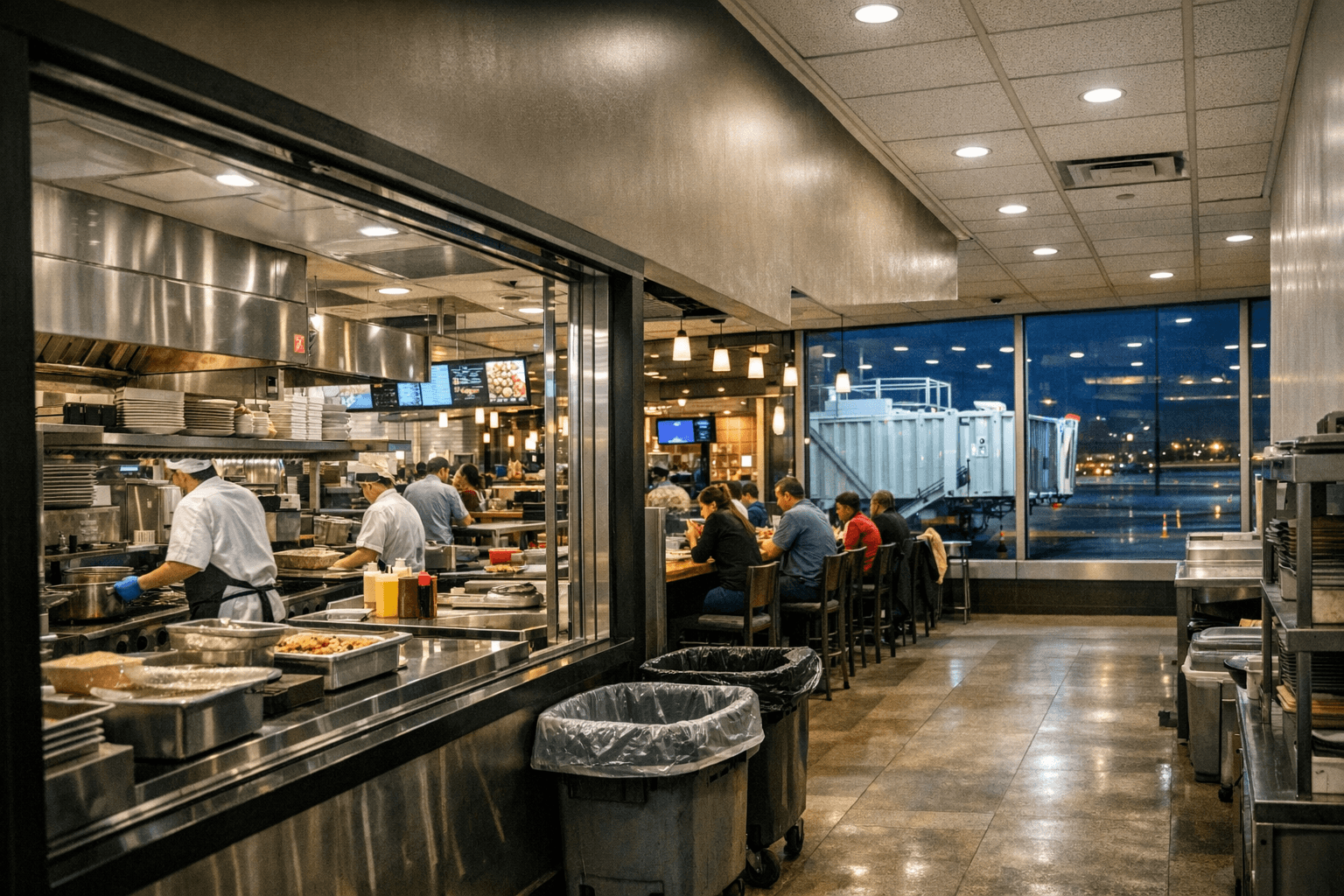
Cooking Oil Collection for Airport Concessions and Airline Catering
Oil Guyz provides used cooking oil pickup and recycling for airport food concessions and airline catering kitchens in Orange County, Los Angeles, San Diego, the Inland Empire, the Bay Area, and Puget Sound, WA. Call (714) 880-4788. Collecting fryer oil at an airport comes with access issues a street-corner restaurant never deals with: the airport decides who gets in, through which door, and when. We settle badging, escort, and dock access before the first visit, size the container to the route your kitchen actually has, and put every concession on one record. Free scheduled pickup, a free locked container, a CDFA digital manifest after each pickup, month-to-month with no contract.
Quick Answer
Cooking oil collection for airport food concessions is scheduled used cooking oil removal and recycling for terminal restaurants, food-court counters, club lounges, and airline catering flight kitchens. Because an airport controls badging, escorts, and dock access, pickups are booked into cleared, repeating windows. Every concession runs on one account, and a CDFA digital manifest documents each pickup.
Why an Airport Is the Hardest Place in Town to Get Fryer Oil Picked Up
An airport is not one restaurant customer. A single mid-size airport can hold dozens of separate commercial kitchens: national restaurant brands operating under a prime concession agreement, local food-court counters, two or three club lounges, a hotel kitchen on the property, and one or more catering kitchens plating meals around the clock. Every one of them fries. Every one of them fills a container with used cooking oil. And most of them buy oil removal separately, so the same airport ends up with a dozen unrelated waste and recycling vendors trying to reach a dozen kitchens through the same badging desk, the same service corridor, and the same shared receiving dock.
An airport controls who reaches the kitchen, and that, not the oil, is the hard part. A driver cannot simply pull up to a gate-side restaurant. Anyone working unescorted on the secure side needs an airport-issued ID badge, which means a fingerprint-based criminal history records check and a security threat assessment, or they have to be escorted the entire visit by a badged employee whose hour is not free. A vehicle crossing onto the airfield needs its own permit and driver training. Kitchens on the landside of the airport are easier, but they still sit behind a receiving window the airport schedules, and many concessions have no back door of their own at all. A vendor who treats an airport like a strip mall either never gets in, or burns someone's badged time on every single visit until the kitchen quietly stops calling.
An airport scatters its own compliance record by design, because every restaurant, counter, and catering kitchen on the property buys services separately and signs its own vendor agreements. The chain of custody for a single airport then lives in a dozen inboxes on a dozen renewal dates, and the authority that holds the lease, answers the health inspector, and writes the diversion report has no single view of what left the property. Serving an airport well is therefore three jobs at once: commercial access that respects the security program, equipment that fits the route the kitchen really has, and one record for the whole airport.
Terminal Kitchens, One Pickup Partner
Tell us where your kitchen is. Free locked container, route started this week, no contract or minimum volume.
Airport concessions run long hours behind security with tight access rules. We coordinate reliable, badged-route pickups across terminals so every kitchen stays clear and compliant.
Fill out the form and we'll map a pickup plan for your concessions. Free locked containers, clean manifests.
- Truly free. We are paid for the oil, not by you
- No contracts. Cancel anytime
- No minimum volume. Any kitchen size
- Free locked, anti-theft bin
- Compliant digital manifest after every pickup
- Instant confirmation, then a real person calls you
Request your free oil pickup
Free bin · No contract · Cancel anytime. You get an instant confirmation that we got it, then a real person calls to set up your pickup. No spam, no robocalls.
Prefer to talk? Call (714) 880-4788
3 to 5
business days to the first airport pickup
One record
every airport concession, one manifest set
8 markets
served, Orange County to Tacoma
How a Pickup Actually Happens Inside an Airport
Every airport runs its own security program, and that program, not our route sheet, decides how the visit works. So we start by asking your airport three questions. Does the driver need an airport ID badge, or will a badged employee escort the visit. Does the vehicle need an airfield permit and driver training to reach the kitchen. And which receiving window is assigned to your unit. Once those three answers exist, the pickup is booked into a cleared, repeating slot instead of being renegotiated at the badging desk every cycle. Collection itself is performed by a CDFA-registered transporter. We do not promise an arrival time at an airport, because the airport controls the gate and we do not; what we commit to is a scheduled, documented visit your operations and security contacts already know about.
- Badge or escort settled before the first airport visit, not at the dock
- Airfield access handled the way the airport's security program requires
- Pickups booked into a repeating cleared window, never a surprise arrival
- Collection performed by a licensed transporter on a set cadence
- Operations and security contacts know each visit is coming
The Badging Process, Step by Step, and What to Actually Expect
Every airport badge starts with a sponsor, not with us. A driver cannot walk into a badging office and apply alone, an airport tenant, your concession, the prime concessionaire, or the airport's own facilities group has to submit the application through an Authorized Signer and vouch for the need. From there the applicant provides two unexpired government photo IDs and sits for a fingerprint appointment, which feeds an FBI-run Criminal History Records Check screening the prior 10 years for a disqualifying conviction. TSA runs a separate Security Threat Assessment on the same application, a name-based check against terrorism and immigration watchlists, and both have to clear before anyone gets unescorted access to a secured area. Only after clearance does a training and testing appointment get scheduled, and the badge is issued once that is complete. Timelines are set by the airport, not by us, and they vary by facility. At Oakland International Airport, one of the airports in our Bay Area market, the badging office publishes a real range: allow 14 to 21 days for the Criminal History Records Check and Security Threat Assessment results, then complete the training appointment within 30 business days of clearance. Where your own staff already carries a badge, none of that sits on the critical path, your escort clears our driver for each visit and the standard pickup schedule applies from day one. A dedicated badge for our driver is worth pursuing only where the visit frequency justifies it, and we run it in parallel with escorted service rather than waiting on it before the first pickup.
- A sponsor initiates every application, no driver can self-badge at any airport
- Two unexpired government photo IDs required at the fingerprint appointment
- FBI fingerprint-based Criminal History Records Check screens the prior 10 years for a disqualifying conviction
- TSA's Security Threat Assessment runs a separate name-based check against terrorism and immigration watchlists
- One published example: Oakland International Airport lists 14 to 21 days for CHRC and STA results, then training within 30 business days of clearance
- Escort access from your badged staff keeps the standard pickup schedule while any driver badge is pursued in parallel
Landside, Post-Security, and the Flight Kitchen Are Three Different Jobs
One airport routinely needs three different service designs. A landside food court on the public side of the building behaves like an ordinary commercial restaurant account: there is usually curb or dock access and no badge involved. A post-security concession at the gates is the opposite, because everything that moves, including an empty container, has to clear the checkpoint or travel an escorted service route, so container size and pickup rhythm get chosen around what can physically be carted, not around what is cheapest per gallon. An airline catering flight kitchen is different again. It usually sits on its own parcel of airport property, fries at industrial volume on a production schedule rather than a lunch rush, and has a real truck dock, which makes it the simplest stop to service and usually the highest-volume account at the airport. We design and schedule the three separately and still report them as one airport.
- Landside food courts: dock or curb access, badge rarely required
- Post-security gate kitchens: container sized to the service route, not the catalog
- Flight kitchens: high volume, own truck dock, industrial production schedule
- Club and lounge kitchens folded into the same visit where access allows
- Three service designs, one airport, one set of records
When an Airport Concession Has No Back Dock of Its Own
A large share of airport concessions have no dock and no back door. The storefront opens onto the concourse, and everything, product in and waste out, moves through a shared receiving area, down a service corridor, and up a freight elevator on a cart, usually inside an off-peak window the airport assigns. That one constraint decides the whole program. It rules out a large outdoor tank. It makes container height, lid seal, and caster quality matter more than raw capacity. And it usually means the right answer is a smaller sealed container emptied more often, rather than one big container that cannot legally or physically make the trip. We size to the elevator and the corridor, then set a service cadence that keeps the container off a cart in a crowded airport at the worst hour of the day.
- Container sized to the freight elevator and service corridor, not a catalog
- Sealed and lidded for a route that crosses public concourse space
- Higher frequency, smaller vessel where a big container cannot travel
- Cadence set around the airport's off-peak receiving windows
- Free locked container at every kitchen, no rental fee and no equipment lien
Twenty Concession Agreements, One Airport Record
Concession leases are individual, and they should stay that way. Each brand or operator at an airport holds its own lease, hires its own service vendors, and keeps its own files, which is exactly why used cooking oil paperwork at an airport ends up scattered. California requires a manifest for every used cooking oil pickup, documenting chain of custody to a licensed renderer, and electronic manifests are explicitly legal under the state's Uniform Electronic Transactions Act. The state minimum retention is two years; we keep every manifest for two as company policy. Each operator still signs its own month-to-month agreement with us, so no lease structure has to change. What changes is the reporting. Every pickup at the airport lands in one Filtrate account, so the authority or prime concessionaire can export the whole property at once while each general manager sees only their own kitchen.
- Each concession keeps its own agreement, no lease restructuring needed
- One rolled-up view of every kitchen at the airport, exportable on demand
- Role-based access: the authority sees all, each GM sees only theirs
- Digital manifest after every pickup, chain of custody to our licensed renderer
- Two-year state minimum retention, two years kept as company policy
An Airport Is a Multi-Location Account With One More Layer
Strip away the badges and the security corridors and an airport authority or a master concessionaire is running the same portfolio problem any multi-site restaurant group runs: many kitchens, one ownership structure that wants a single view, and a different manager watching each storefront. A prime concessionaire holding the food-and-beverage lease across three terminals is not different in kind from a franchise group running fifteen stores across a metro area, they just happen to sit inside one perimeter fence. The multi-location cooking oil collection model built for restaurant groups and franchise portfolios is the same model we run for an airport: one master agreement, one Filtrate dashboard, role-based access so a district or facilities lead sees the whole footprint while each general manager sees only their own kitchen, and consolidated reporting that adds up the property without averaging away any single kitchen's numbers. What an airport adds on top is the access layer covered earlier on this page, badging, escorts, and receiving windows, which a strip-mall multi-location account never has to deal with. A new concession goes onto the same record the week it opens, a closed or relocated terminal unit comes off without unwinding the whole account, and a prime concessionaire adding a second or third airport to the relationship keeps using the same agreement structure. If your food-service footprint already spans more than one terminal, more than one concourse, or more than one airport in our markets, the multi-location page is where the full contract structure, pricing, and consolidated reporting are explained.
- Same model as any multi-site restaurant or franchise portfolio: one master agreement, one dashboard
- Role-based access, a district or facilities lead sees the whole footprint, each GM sees only their own kitchen
- A new concession joins the existing record the week it opens, no new contract to negotiate
- A closed or relocated unit comes off the record without unwinding the whole account
- The one layer an airport adds on top of the standard model: badging, escorts, and receiving windows
The Diversion Numbers an Airport Authority Asks Concessionaires For
Airport authorities commonly ask their concessionaires to report waste diversion as part of a property-wide recycling program, and "we recycle our fryer oil" is not a number. What survives review is a dated record: which kitchen, which date, how much, and where it went. That is what the manifest set produces, without anyone at the airport chasing a dozen recycling vendors at reporting time. The destination matters too. Oil collected at the airport is recycled through our licensed renderer into feedstock for biodiesel and renewable diesel. DOE and CARB data put renewable diesel at roughly 65% lower carbon intensity on average than petroleum diesel, and DOE puts waste-feedstock biodiesel and renewable diesel at roughly 79 to 86 percent lower lifecycle greenhouse-gas emissions. Those are figures an airport sustainability report can cite with a source.
- Dated, per-kitchen records instead of an unverifiable recycling claim
- One export covering every participating concession at the airport
- Oil recycled through our licensed renderer into renewable-fuel feedstock
- Renewable diesel: roughly 65% lower carbon intensity than petroleum diesel (DOE/CARB)
- Waste-feedstock biodiesel and renewable diesel: roughly 79 to 86 percent lower lifecycle GHG (Argonne National Laboratory, Environmental Science & Technology, 2022)
Who Actually Owns the Fryer Oil at an Airport
In a street-level restaurant the general manager owns the fryer oil. At an airport it is almost never that simple. The brand's district manager owns the P&L, the prime concessionaire owns the approved vendor list, the airport's facilities or environmental group owns the loading dock and the diversion report, and airport operations owns the badge that lets anyone touch any of it. Programs stall when no one is named, so we ask for exactly two contacts on day one: an operations or facilities contact at the airport who can confirm access, and one manager per kitchen who can confirm the container is where it should be. Scheduling, manifests, container swaps, and service changes all run off those two names. It is the least glamorous part of starting an airport account and the part that decides whether the program survives its first round of staff turnover.
- Two named contacts, one at the airport, one per kitchen
- Access questions go to facilities or operations, not the fry cook
- Service changes never depend on one person still working there
- Prime concessionaire keeps control of the approved vendor list
- Environmental and facilities groups get the diversion export directly
Free, Month-to-Month, and Here Is Why It Is Free
Collection costs the airport kitchen nothing, because we are paid for the oil, not by you. Used cooking oil is a commodity with real value as renewable-fuel feedstock, and that value covers the cost of collection, so there is no service fee, no monthly minimum, no container rental, and no fresh-oil purchase requirement attached to any location. Procurement gets a short vendor agreement rather than a multi-year waste-hauling contract: month-to-month, no auto-renewal, no equipment lien, and no invoice to approve. That flexibility matters at an airport more than most places, because a concession that goes dark for a terminal renovation or a unit relocation can pause and restart without a penalty, and a new store can be added to the same airport record the week it opens. A real person answers the phone 24 hours a day, a new airport location gets a callback the same business day, and the first pickup is typically 3 to 5 business days out.
- Free because we are paid for the oil, not by you
- No service fee, no monthly minimum, no container rental, no invoice to approve
- Month-to-month vendor agreement, not a multi-year waste-hauling contract
- Cancel anytime, no auto-renewal, no equipment lien on any location
- A real person answers 24/7, callback the same business day
Who We Serve at the Airport
Prime Concessionaires
Operators running multiple branded restaurants and food-court counters across an airport who want one program and one exportable record instead of a different vendor behind every storefront.
Airline Catering & Flight Kitchens
In-flight catering and flight kitchens on airport property that fry at industrial volume against departure banks and need pickup scheduled so it never collides with a catering push.
Terminal Restaurants & Bars
Sit-down restaurants, quick-service counters, and bar kitchens inside the terminal, including the many units with no dock, whose oil has to travel a service corridor and a freight elevator.
Airport Authorities
Airport authorities and aviation departments holding the food-service leases who want one chain-of-custody record across the property and diversion figures they can actually report.
Club & Lounge Operators
Airline clubs and premium lounges with their own kitchens that need discreet, low-traffic collection scheduled inside the same access window as the rest of the airport.
Multi-Terminal & Multi-Airport Groups
Groups operating food service across several terminals, or across more than one airport in our markets, that want every location on one month-to-month program and one rollup.
One Airport Program vs. a Vendor at Every Concession
Access
Container sizing
Post-security kitchens
Airport-wide record
Manifest format
Term
Equipment terms
Where the oil goes
What's Included
Everything you need, nothing you don’t.
- Free scheduled used cooking oil collection at every participating airport kitchen
- Badge, escort, and airfield access requirements settled before the first visit
- Pickups booked into the receiving window the airport assigns
- Container sized to the dock, service corridor, or freight elevator you actually have
- A free locked collection container at each location, no rental fee
- Separate service design for landside, post-security, and flight kitchens
- Every concession on one Filtrate account with one airport-wide view
- Role-based access, the authority sees all, each GM sees only theirs
- A CDFA digital manifest after every pickup, exportable for reporting
- Chain-of-custody documentation to our licensed renderer
- Month-to-month terms, no auto-renewal trap, no equipment lien
- A real person answers 24/7, callback the same business day
How Restaurant Oil Collection Works In 3 Simple Steps
Set up restaurant oil collection in about five minutes. We confirm your route the same business day and drop a free bin before your first pickup. After that, Oil Guyz handles every used cooking oil pickup on schedule. You never chase a hauler again.
Request Pickup
Fill out a 30-second form or call us. No credit card, no commitment.
Pickup Day Is Pickup Day
Your scheduled window is locked in. A CDFA-registered transporter completes the pickup, pumps your container empty, and we email your digital manifest the moment the work is logged.
Stay Compliant Automatically
Get digital manifests, pickup confirmations, and compliance records, all in your dashboard.
Frequently Asked Questions
Before the first visit we settle three things with your operations and security contacts: whether the driver needs an airport ID badge or will be escorted by a badged employee, whether the vehicle needs an airfield permit and driver training to reach the kitchen, and which receiving window your unit is assigned. Once those are set, the pickup runs in a cleared, repeating slot rather than being renegotiated at the badging desk each cycle. Collection is performed by a CDFA-registered transporter. We do not promise an arrival time, because the airport controls the gate; we commit to a scheduled, documented visit your team knows about in advance.
It depends on the airport, because each one runs its own badging office and its own clock. The federal framework is consistent everywhere: an FBI fingerprint-based Criminal History Records Check screening the prior 10 years for a disqualifying conviction, plus a separate TSA Security Threat Assessment checking identity against terrorism and immigration watchlists, both have to clear before anyone gets unescorted access to a secured area (TSA, Disqualifying Offenses and Other Factors). At Oakland International Airport, one of the airports in our Bay Area market, the badging office publishes a real range: allow 14 to 21 days for those results, then complete a training appointment within 30 business days of clearance (Port of Oakland, OAK New Badge Applicant Checklist). We confirm your specific airport's actual timeline before committing to a start date, and where badging a driver does not make sense for how often we are on site, we build the schedule around an escort from your badged staff instead, so credentialing is never what delays the first pickup.
Almost everything. A landside food court usually has curb or dock access and rarely needs a badge, so it behaves like a normal commercial account. A post-security unit at the gates has to move every container, full or empty, through the checkpoint or along an escorted service route, which means the vessel is chosen for what can be carted rather than for capacity, and the cadence is set so the container is not crossing a busy concourse at peak. Both can sit on the same airport account with the same manifest reporting.
Yes, and it is common. Many airport concessions open onto the concourse with no dock and no back door, so oil travels a shared receiving area, a service corridor, and a freight elevator on a cart inside an assigned off-peak window. We size the container to that route, lid seal and height and casters included, and typically run a smaller sealed vessel more often instead of one large container that cannot make the trip. Every location gets a free locked container at no rental cost, with sizes and specifications on our equipment page.
Yes. Branded restaurants, food-court counters, club lounges, and airline catering flight kitchens all report into one Filtrate account, while each operator keeps its own month-to-month agreement, so no lease structure changes. The authority or prime concessionaire sees the whole property in one view and can export it; each general manager sees only their own kitchen through role-based access. That replaces the usual patchwork of a different vendor and login behind every storefront.
Yes. California requires a manifest for every used cooking oil pickup, documenting chain of custody to a licensed renderer, and you get a CDFA digital manifest after every pickup at every location. Electronic manifests are explicitly legal in California, the rule requires only that they conform to the state's Uniform Electronic Transactions Act. The state minimum retention is two years; we keep every manifest for two as company policy. See the rule at California Code of Regulations Title 3 §1180.24, UCO Manifests and the licensing program at CDFA Meat, Poultry & Egg Safety / Inedible Kitchen Grease Program
The manifest set. It gives a dated, per-kitchen record of which location, which date, how much, and where the oil went, exportable for the whole property at once. The oil is recycled through our licensed renderer into feedstock for biodiesel and renewable diesel. DOE and CARB data put renewable diesel at roughly 65% lower carbon intensity on average than petroleum diesel (DOE AFDC, Renewable Diesel), and DOE puts waste-feedstock biodiesel and renewable diesel at roughly 79 to 86 percent lower lifecycle greenhouse-gas emissions (Argonne National Laboratory, Environmental Science & Technology, 2022). Under the federal Renewable Fuel Standard, used cooking oil qualifies as a biomass-based diesel feedstock with at least a 50% lifecycle greenhouse-gas reduction (EPA's Renewable Fuel Standard overview).
We serve airport kitchens in Orange County, Los Angeles, San Diego, the Inland Empire, the San Francisco Bay Area, and Pierce, King, and Snohomish Counties in Washington. If your airport food-service footprint sits in those markets, every kitchen on the property can go onto one account. If you operate at an airport outside them, tell us the locations and we will let you know as we expand. We never imply coverage we do not have.
Possibly. For genuinely high-volume kitchens, generally those producing around 200-gallons or more of used cooking oil per month, a rebate may apply. Flight kitchens are the most likely location at an airport to reach that level. It is handled case by case rather than promised up front, so contact us with your volumes and we will tell you honestly whether it makes sense. Free scheduled pickup, the locked container, and the digital manifest are included regardless of volume.
What Our Clients Say

Bryan Baird
Google review
“We are a medium sized institutional kitchen located in San Juan Capistrano. When we needed a certified oil and grease removal partner the Oil Guyz were there. Fantastic customer service, fast, reliable, quick follow up and very efficient. They make it super easy to leave a GREAT review!”See full review

Alex Camacho
Google review
“I'm an up and coming new food vendor and properly disposing of used frying oil was a difficult task. That is until I contacted the Oil Guyz! There webpage made it easy to setup their free service of oil pickup. Within a few days I had a free container to store the used oil until ready for the free pickup. This service is very convenient and Joey has been very accommodating to answer all my questions and facilitate the process.”See full review

Ujwal Chaudhary
Google review
“Great service from Oil Guyz! They came and picked up my full barrel of used cooking oil completely free of charge. The process was easy, quick, and professional. I really appreciate their excellent customer service and reliable pickup. If you have used cooking oil that needs to be collected, I definitely recommend Oil Guyz. Great company and great people! 👍”See full review

Nicholas Saccoccia
Google review
“Excellent experience with Oil Guyz! They got me on the schedule fast, showed up on time, were very professional, and were in and out in no time! I would absolutely use them again.”

LA BREAKFAST CASITA
Google review
“We’ve had a great experience with Oil Guyz! I submitted a quote request through their website for our restaurant, and Joey reached out to us right away. From our first conversation, he has been extremely helpful, patient, and responsive. Joey really made the whole process easy for us. He was willing to work with our team on the best location for the bin, answered all of our questions, and kept in touch to make sure everything was taken care of. I especially appreciate his follow-through and willingness to help without ever making us feel rushed. Good customer service can be hard to find, and Joey has definitely made a great impression on us. We’re very happy we chose Oil Guyz for our used commercial oil pickup service at LA Breakfast Casita in Azusa, CA. Thank you, Joey, for making the process so smooth and for taking such good care of us. We look forward to working with Oil Guyz for a long time!”See full review

Mike Fishman
Google review
“Superb service!”

Celso Bahena
Google review
“I’m in the Santa Ana area great reliable service!”

Myk Espinoza
Oakland Ballers · Oakland, CA · Google review
“These dudes really bailed me out of a tough situation. My previous oil collection service had been really screwing me over. Spent 4 weeks of unanswered phone calls, texts, and empty promises with a company we've been using for two years just to get a used oil recepticle, all to no avail. We were sitting on 6 fryers with of oil I that I had nowhere to put. Called Joey and The Oil Guyz and he got me set up just a few hours later. Used oil container, service agreement, answered all of my questions. We're running a very odd program where our schedule is all over the place, so having a "regular" pick up schedule is out of the question. We worked out a way for quick/easy retrieval in about 5 minutes. Can't recommend these guys enough.”See full review

Maryam Tngrian
Google review
“As a manufacturing bakery, we recently needed a one-time pickup of approximately 3,000 lbs of used donut oil. Unfortunately, there was very little information available regarding the company that had handled this service previously, so I had to start from scratch. I found Oil Guyz online and was impressed from the first conversation. Joey, the owner, was extremely helpful and took the time to walk me through the entire process, making the coordination simple and straightforward. Prior to contacting Oil Guyz, I had attempted to reach other providers and had difficulty getting assistance. Oil Guyz was responsive, accommodating, and easy to work with from start to finish. The pickup was completed within the timeframe communicated, and the team handled the removal seamlessly with no disruption to our operation. Their professionalism and customer service made what could have been a challenging process very easy. We would absolutely use Oil Guyz again and would recommend them to other food manufacturing facilities looking for a reliable used cooking oil recycling partner.”See full review

Kengo Kido
Google review
“Joey took care of our needs quickly, efficiently and professionally. I highly reccoemnd his service to anyone!”

Brenda Wu
Google review
“Prompt response from Joey. Great service with problem solving. Highly recommended!”

Camille Bamford
Google review
“Fast and great to work with!”
Related Resources
Guides
Free Tools
- Grease Trap Calculator
Find your recommended pumping frequency
- Compliance Checker
Check if you meet California grease requirements
Related Solutions
Restaurant Cooking Oil Management
The full program, how scheduled pickup, locked containers, the portal, and compliance fit together across many kitchens.
Learn moreEquipment & Containers
Container sizes, lids, locks, and placement, delivered, installed, and maintained at no cost to the kitchen.
Learn moreCooking Oil Compliance & Reporting
The Filtrate portal and the CDFA digital manifest detail, dashboards, role-based access, and audit-ready exports.
Learn moreMulti-Location Cooking Oil Collection
One agreement across every terminal and location in your footprint, consolidated reporting and a clean exit.
Learn morePut Every Airport Kitchen on One Cooking Oil Record
Tell us which airport, which terminals, and how many kitchens. We will walk through badging and access, container sizing for the units without a dock, and the CDFA digital manifest after every pickup. Month-to-month, no contract. If a location falls outside our markets we will say so. No pressure.
Or call (714) 880-4788 and talk to a real person today.