Free Used Cooking Oil Pickup and Disposal in Tacoma & the South Sound
Oil Guyz provides free used cooking oil pickup, recycling, and disposal for restaurants in Tacoma, WA. Call (253) 322-7880 to schedule service. Across Pierce County, from Fife and Puyallup to Gig Harbor and the South Sound, you get a free locked bin, a digital service record after every pickup, and no contract to sign.
Pierce County pickup terms at a glance
- Pickup fee
- $0. Free scheduled pickup for restaurants and commercial kitchens
- Minimum volume
- None
- Contract
- None. Month to month, cancel anytime
- Container
- Free locked, anti-theft bin, delivered and placed for you
- Paperwork
- Digital service record after every pickup, 2 years of records
- Schedule
- Weekly or biweekly route, set around your kitchen hours
- Insurance
- Fully insured; oil recycled through licensed renderers
- Phone
- (253) 322-7880 and a real person answers, 24/7.
Quick Answer
The South Sound already has enough moving parts between the rain and the dinner rush. Oil Guyz makes used cooking oil pickup and disposal the fixed one: free collection across Tacoma, Lakewood, Puyallup, and the rest of Pierce County, a locked bin we supply at no cost, and a digital service record from every visit so your FOG file builds itself. When you are ready, the number is (253) 322-7880
5.0 on Google
From real restaurant reviews
Same-business-day callback
A real person answers, 24/7
Free locked bin
Delivered and placed for you
Service record every pickup
Inspection-ready, 2-year records
Free used cooking oil pickup
Free Restaurant Grease Pickup Across Tacoma and the South Sound
Used cooking oil pickup in Tacoma should be the easiest line item you manage, and for most South Sound kitchens it is the flakiest. The hauler stops returning calls, the bin behind the kitchen overflows before the next visit, and when an inspector asks for your grease records you are digging through a drawer of old invoices. We hear the same story from teriyaki shops on South Tacoma Way, seafood spots along Ruston Way, and taco trucks near the Puyallup fairgrounds. Oil Guyz exists to make this boring again: free scheduled pickup for restaurants across Tacoma and the South Sound, no contract, no monthly fee, and a record of every gallon that leaves your kitchen. Used cooking oil disposal for Tacoma kitchens is part of the same free used cooking oil pickup, with a service record after every pickup.
Here is the whole arrangement. We place a free locked bin sized to your volume, right where you store oil today. The driver pumps it out where it sits. We never swap containers, and if you already use barrels or caddies we pump those in place too. After every pickup you get a digital service record logging the date, gallons collected, who collected it, and where the oil went. Those are the exact fields Puyallup's sewer code requires kitchens to keep on file for three years, so the paperwork problem solves itself. The service is free because we are paid for the oil: it goes to a licensed renderer and becomes biodiesel feedstock and animal feed ingredients, with nothing sent to landfill.
Grease rules in the South Sound depend on whose sewer you are on. City of Tacoma Environmental Services enforces the FOG Management Policy for Tacoma and, through interlocal agreements, Fife and neighboring areas. Pierce County's Sewer Division inspects kitchens across its service area, including University Place, and samples discharge against a 100 mg/L grease limit. Gig Harbor will not let a kitchen discharge interceptor effluent without an operational permit. Layer on the Tacoma-Pierce County Health Department, which inspects food establishments one to four times a year, and the fastest way to end any inspection conversation is a clean stack of pickup service records. Seattle, Kent, Federal Way and Auburn kitchens are covered on the Seattle and King County page.
Get Free Pickup in Tacoma
Free locked bin · No contract · No minimum. First pickup in 3 to 5 business days.
Prefer to talk? Call (253) 322-7880
Local compliance
Tacoma and South Sound FOG, Grease Interceptor, and Used Cooking Oil Rules for Restaurants
Verified 2026-07-04FOG enforcement in the South Sound is split across sewer authorities, not one agency. City of Tacoma Environmental Services regulates food service establishments on Tacoma's wastewater system under Tacoma Municipal Code 12.08C.500, including the Fife, Fircrest, and Ruston interlocal areas, while Pierce County, Puyallup, and Gig Harbor each run their own programs. Wherever you cook, the core obligations are the same: keep a properly sized grease interceptor, clean it on the required schedule using qualified vendors, and keep the maintenance and oil collection records your authority demands.
Who regulates grease from your kitchen
City of Tacoma Environmental Services Department
Enforces the FOG Management Policy for all food service establishments on Tacoma's wastewater system, including the Fife, Fircrest, and Ruston interlocal areas
City of Tacoma Environmental Services DepartmentPierce County Planning and Public Works, Sewer Division
Runs the grease interceptor and pretreatment program for the county sewer service area; inspects restaurants and samples discharge against a 100 mg/L local limit
Pierce County Planning and Public Works, Sewer DivisionCity of Puyallup Public Works
City sewer utility; enforces grease interceptor and cooking oil recordkeeping rules under Puyallup Municipal Code ch. 14.06
City of Puyallup Public Works program pageCity of Gig Harbor Wastewater Division
Administers the Grease Ordinance (GHMC ch. 13.30) and issues grease interceptor operational permits for the city-owned treatment system
City of Gig Harbor Wastewater DivisionWhat inspectors expect from Tacoma restaurants
Tacoma's FOG policy covers more than Tacoma
Tacoma Municipal Code 12.08C.500If your kitchen discharges wastewater containing FOG into Tacoma's system, the city's FOG Management Policy applies. That includes restaurants inside Tacoma plus the interlocal agreement areas of Fife, Fircrest, Ruston, and portions of Pierce County. Being outside city limits does not put you outside the program. Source: City of Tacoma FOG Management Policy Clarification Sheet (Jan. 2025)
Clean grease interceptors on Tacoma's schedule
Tacoma Municipal Code 12.08C.500Gravity grease interceptors must be cleaned by a licensed vendor at least twice a year, or sooner once FOG reaches 25 percent of a compartment's capacity. Hydromechanical interceptors get cleaned monthly, and even self-cleaning units need a licensed pumper every three months. Waiting for a backup is not a schedule. Source: City of Tacoma FOG Management Policy Clarification Sheet (Jan. 2025)
Report service within seven days, keep records five years
Tacoma Municipal Code 12.08C.500Tacoma requires food service establishments to document every grease device maintenance activity, submit the report electronically within seven days of service, and keep hard copies on file for five years. If your current hauler leaves no paper trail, that gap is yours to explain, not theirs. Source: City of Tacoma FOG Management Policy Clarification Sheet (Jan. 2025)
Pierce County: interceptors required in the sewer service area
Most commercial food service establishments in Pierce County's sewer service area, restaurants, cafes, and bars included, are required to install a grease interceptor to control the fat, oil, and grease entering the public sewer system. If your building connects to a county sewer, assume this applies to you. Source: Pierce County Grease Interceptor requirements
Puyallup: pump in full every three months, keep three years of records
Puyallup Municipal Code ch. 14.06, Article III (Ord. 2881 § 1, 2007)Puyallup grease interceptors must be pumped in full every three months, or sooner once surface FOG and settled solids reach 25 percent of the unit's liquid depth. All maintenance and compliance records stay on site for at least three years, with a maintenance log posted at each device. Source: City of Puyallup Sewer Use Code excerpt (PMC ch. 14.06)
Puyallup regulates your cooking oil pickup paperwork directly
Puyallup Municipal Code ch. 14.06, Article III (Ord. 2881 § 1, 2007)Puyallup is explicit about used cooking oil: collection and disposal records must be kept on site for at least three years, and each log entry must show the collection date, gallons collected, the company and person who performed the collection, and the disposal method. A pickup with no service record is a compliance hole. Source: City of Puyallup Sewer Use Code excerpt (PMC ch. 14.06)
Gig Harbor: a permit just to discharge interceptor effluent
Gig Harbor Municipal Code 13.30.112Gig Harbor makes it unlawful to discharge grease interceptor effluent to the city's treatment system without a grease interceptor operational permit from the wastewater supervisor. If you are opening or taking over a kitchen in Gig Harbor, the permit belongs at the top of your checklist. Source: Gig Harbor Municipal Code 13.30.112
What TMC 12.08C.500 means in practice
The practical side of this requirement, which disposal routes are legal for a business versus the county's residents-only drop-off sites, is covered in a dedicated guide to Tacoma and Pierce County disposal options. Source: Tacoma and Pierce County disposal options
How the rules differ by city in Pierce County
Puyallup, Gig Harbor, and Lakehaven each layer their own requirements on top of Tacoma's. A full county-by-county breakdown is covered in a dedicated guide to Pierce County grease rules. Source: Pierce County grease rules
Your used cooking oil options, honestly
Free documented pickup service
Best optionThe route Pierce County itself points to: it tells restaurants to work with a hauler who knows local grease rules. A no-cost collection service that leaves a digital service record after every pickup also satisfies the recordkeeping rules in Tacoma and Puyallup without adding a bill.
Tacoma's household drop-off site (10-gallon cap)
Allowed, butA City of Tacoma household drop-off site accepts cooking oil free, up to 10 gallons. It is aimed at households. A kitchen producing 20 to 100 gallons a month cannot realistically run disposal through it, and drop-offs create no paper trail for sewer authority records.
Paying a grease hauler
Allowed, butPaid haulers exist, and for interceptor pumping you need one: Tacoma requires a licensed vendor for interceptor maintenance. For the fryer oil itself, paying is usually unnecessary. The oil has value, which is why collection services will take it at no charge and document every gallon.
What never to do: the drain or the dumpster
NeverPouring fryer oil down the drain risks fines under Tacoma's code, and the Environmental Services Director can suspend wastewater service when a violation poses an environmental risk. A grease-caused backup also triggers mandatory reports: kitchen wastewater backups go to the Tacoma-Pierce County Health Department, and sanitary sewer overflows go to the Washington Department of Ecology.
Which agency covers your city
- Tacoma
- City of Tacoma Environmental Services enforces the FOG Management Policy for city kitchens under Tacoma Municipal Code 12.08C.500.
- Fife
- Fife owns its collection system, but Tacoma Environmental Services is the FOG authority via interlocal agreement (treatment at Tacoma's Portland Avenue plant).
- University Place
- Pierce County's Sewer Division provides most sewer service and applies county grease interceptor rules and the 100 mg/L limit.
- Puyallup
- City of Puyallup Public Works enforces its own Sewer Use Ordinance, PMC ch. 14.06 Article III.
- Gig Harbor
- City of Gig Harbor Wastewater Division administers GHMC ch. 13.30 and requires a grease interceptor operational permit.
Primary sources (last verified 2026-07-04)
- City of Tacoma FOG Management Policy Clarification Sheet (Jan. 2025)
- Pierce County Grease Interceptor requirements
- City of Puyallup Sewer Use Code excerpt (PMC ch. 14.06)
- Gig Harbor Municipal Code 13.30.112 (Grease Ordinance)
Rules change. We re-check these pages on a regular cycle, but your permit, your lease, and your inspector always win. When in doubt, call the agency listed for your city, or call us and we will point you to the right office.
Used Cooking Oil Pickup for Pierce County Kitchens: Five Straight Answers
What is the right used cooking oil pickup schedule for a Pierce County kitchen?
Set the schedule by season as much as by fryer count. A Puyallup kitchen that doubles output during fair weeks does not need the same cadence in the gray months, so we treat frequency as a dial, not a contract term. We start from your estimate, watch the first few fills, and retune until the interval fits. The right rhythm is the one where the bin is never the thing you are thinking about.
How big a bin does a South Sound kitchen need for fryer oil?
Smaller than most kitchens guess, because bin size trades against pickup frequency. We would rather keep a compact container on a shorter interval than leave an oversized one sitting half full through the rainy months. Placement decides as much as gallons: a covered corner behind a Lakewood strip mall and an open pad off South Tacoma Way call for different footprints. Tell us how many fryers you run and the space you can spare, and the bin fits both.
What does it take to get cooking oil collection started in Tacoma?
One call and a bin drop, that is the whole onboarding. Give us the address, a rough weekly fry volume, and where the container should sit, and we fold your stop into the route already working I-5 through Fife into Tacoma. No site survey, no setup fee, and nothing for your crew to relearn. The bin lands on a scheduled pass, and pickups run from that first drop.
What record does each used cooking oil pickup leave behind in Washington?
Every pickup closes with a dated digital service record: the gallons out, the visit logged, the oil's destination with a licensed renderer accounted for. Washington leaves fryer oil oversight to local FOG programs rather than one state system, and those programs live on documentation: the same culture that watches the 25 percent line on an interceptor wants the oil trail written down too. When Tacoma Environmental Services opens your grease file, our records are already doing the answering.
Is free fryer oil pickup real in the South Sound, even across the Narrows?
It is, Gig Harbor included, and the bridge toll is our problem, not yours. Out here, used cooking oil pickup stays free because the value rides in the tank: the truck earns its route from what it carries, not from the kitchens it visits. A loop threading Lakewood, University Place, and the harbor makes every stop worth the miles. Distance moves our routing around. It never moves your bill.
What kitchens say about Oil Guyz
Verbatim Google reviews from the restaurants we serve. On time, genuinely free, and the compliance paperwork is always handled.

Bryan Baird
Google review
“We are a medium sized institutional kitchen located in San Juan Capistrano. When we needed a certified oil and grease removal partner the Oil Guyz were there. Fantastic customer service, fast, reliable, quick follow up and very efficient. They make it super easy to leave a GREAT review!”See full review

Alex Camacho
Google review
“I'm an up and coming new food vendor and properly disposing of used frying oil was a difficult task. That is until I contacted the Oil Guyz! There webpage made it easy to setup their free service of oil pickup. Within a few days I had a free container to store the used oil until ready for the free pickup. This service is very convenient and Joey has been very accommodating to answer all my questions and facilitate the process.”See full review

Ujwal Chaudhary
Google review
“Great service from Oil Guyz! They came and picked up my full barrel of used cooking oil completely free of charge. The process was easy, quick, and professional. I really appreciate their excellent customer service and reliable pickup. If you have used cooking oil that needs to be collected, I definitely recommend Oil Guyz. Great company and great people! 👍”See full review

Nicholas Saccoccia
Google review
“Excellent experience with Oil Guyz! They got me on the schedule fast, showed up on time, were very professional, and were in and out in no time! I would absolutely use them again.”

LA BREAKFAST CASITA
Google review
“We’ve had a great experience with Oil Guyz! I submitted a quote request through their website for our restaurant, and Joey reached out to us right away. From our first conversation, he has been extremely helpful, patient, and responsive. Joey really made the whole process easy for us. He was willing to work with our team on the best location for the bin, answered all of our questions, and kept in touch to make sure everything was taken care of. I especially appreciate his follow-through and willingness to help without ever making us feel rushed. Good customer service can be hard to find, and Joey has definitely made a great impression on us. We’re very happy we chose Oil Guyz for our used commercial oil pickup service at LA Breakfast Casita in Azusa, CA. Thank you, Joey, for making the process so smooth and for taking such good care of us. We look forward to working with Oil Guyz for a long time!”See full review

Mike Fishman
Google review
“Superb service!”

Celso Bahena
Google review
“I’m in the Santa Ana area great reliable service!”

Kengo Kido
Google review
“Joey took care of our needs quickly, efficiently and professionally. I highly reccoemnd his service to anyone!”

Brenda Wu
Google review
“Prompt response from Joey. Great service with problem solving. Highly recommended!”
The typical hauler vs Oil Guyz
Any hauler can sound reliable in August. The South Sound finds out in February.
Why now
Four sewer authorities write the grease rules between Tacoma and Gig Harbor, each with its own idea of what a kitchen's file should hold. Washington adds no state layer on top of them for cooking oil, so the record your collector leaves after a pickup is the only proof of where those gallons went. A hauler who cannot produce a record leaves the gap with you, and closing it takes a switch, not a project.
Get Free Pickup in TacomaFree sizing tool
Right-size your free bin in seconds
Tell us how much oil your kitchen goes through and we will show you the bin and pickup schedule that fits, no overflowing bins, no wasted trips.
Free bin, sized right
What size bin does your kitchen need?
We aim to fill it 75 to 90% in a month, so one monthly pickup keeps it from overflowing.
130-gallon outdoor bin
~83% full each month
A 130-gallon outdoor bin lands around 83% full over a month, so one pickup a month keeps it from ever overflowing.
This is an estimate to get you close. We confirm the right bin when we place it, and if your volume changes we swap you to a better size at no charge.
Free Fryer Oil Pickup in Tacoma: Every Line, No Asterisks
Every part of restaurant grease pickup with us is on this list; the only thing missing from any line is a price.
Costs you nothing
Free pickup, free bin, free paperwork. We are paid for the oil, not by you.
Reliable, on your schedule
Scheduled pickups on the cadence you set. A real person owns your route.
Inspection-proof
A digital service record after every pickup. 2-year records kept.
- Recurring scheduled pickups and collectionWeekly, bi-weekly, or monthly. You set the cadence.Free
- A commercial collection containerDelivered and placed where it works for your kitchen.$150 to buyFree
- Digital service record after every removalEmailed the moment your container is serviced. Inspection-ready.Free
- 2 years of disposal records, kept for youProducing history for an inspection takes seconds.Free
- A real person who answersNo phone-tag, no no-show black hole.Free
- No contract, month to monthCancel anytime. No penalty, no removal fee.Free
Total cost to you
No contract. Cancel anytime.
Typically $150+ to set up elsewhere, plus monthly fees
$0
It's free because we are paid for the oil, not by you. We recycle it into clean fuel, so pickup and the bin cost you nothing.
Recycling Tacoma's Used Cooking Oil Into Renewable Fuel
In Washington, used cooking oil is handled as a recyclable commodity, and that is precisely how the service works here: scheduled collection, a digital service record for every pickup, and delivery to a licensed renderer that processes the oil into biodiesel feedstock and animal feed ingredients.
The recycling value funds the route, which is why Pierce County kitchens get free pickup, and why the route keeps adding stops as more kitchens come on.
Coverage
Used Cooking Oil Pickup Across Tacoma: Cities We Serve
One Tacoma route, 15 cities. The same free used cooking oil pickup, free locked bin, and documented service everywhere on the route.
More Tacoma communities on the route
- Bonney Lake:
- The SR-410 commercial strip carries most of the fryer volume here, and stops along Lake Tapps Parkway and the Sumner-Tapps Highway ride the same scheduled loop, with a free locked bin and documented pickups.
- DuPont:
- Center Drive's village core and Northwest Landing hold most of the commercial kitchens in this planned community, served on the same scheduled south-sound loop that passes between Lakewood and Lacey.
- Fife:
- Truck-stop diners and casino kitchens define this stretch: the 20th Street East corridor, Pacific Highway East, and the Emerald Queen district all sit minutes off the port, on a route built around the Tideflats.
- Gig Harbor:
- Waterfront restaurants along Harborview Drive and the historic downtown blocks near Skansie Brothers Park take their pickups across the Narrows on a scheduled day, with Pioneer Way and Stinson Avenue on the same swing.
- Lacey:
- Hawks Prairie and the Martin Way corridor hold the chain and fast-casual volume, with Marvin Road and College Street stops on the same Thurston County leg that also serves Olympia and Tumwater.
- Lakewood:
- Lakewood Towne Center concentrates the retail dining, while Tillicum and the lake neighborhoods add scattered stops; everything rides one scheduled Pierce County day with documented service.
- Olympia:
- Downtown blocks around the Farmers Market and Capitol Way carry a dense independent dining scene, and the Westside's Harrison and Cooper Point corridors join the same documented Thurston County run.
- Parkland:
- The Pacific Avenue South corridor and the Garfield Street district by the PLU campus produce steady student-driven fryer volume, collected on the same scheduled day as neighboring Spanaway.
- Puyallup:
- Fair weeks around the Fairgrounds District spike oil volume sharply, so cadence flexes with the calendar; downtown's Pioneer Park blocks and the South Hill Mall area hold the year-round stops.
- Spanaway:
- Pacific Avenue South and Mountain Highway East form one long commercial spine here, and the 176th Street strip joins it on a scheduled Pierce County day shared with Parkland.
- Steilacoom:
- A small waterfront dining scene near the ferry terminal and Lafayette Street gets the same free scheduled service as the big cities on the route, locked bin and documentation included.
- Sumner:
- Main Street's historic district keeps a compact core of independent kitchens, while the SR-410 and Valley Avenue corridors carry the drive-through volume, all on one scheduled stop day.
- Tacoma:
- Downtown and the Theater and Brewery Districts, the Sixth Avenue and Proctor strips, Ruston Way's waterfront houses, and the teriyaki and taqueria corridor along South Tacoma Way all ride one Tacoma route with a locked bin and a digital service record at every stop.
- Tumwater:
- The Brewery District and Capitol Boulevard hold the core stops, with Trosper and Israel Road retail pads sharing the same Thurston County leg as Olympia and Lacey.
- University Place:
- U.P. Town Center carries the dining core, and clubhouse kitchens near Chambers Bay add event-driven volume; both take documented pickups on the same west-Pierce day.
Tacoma local line:
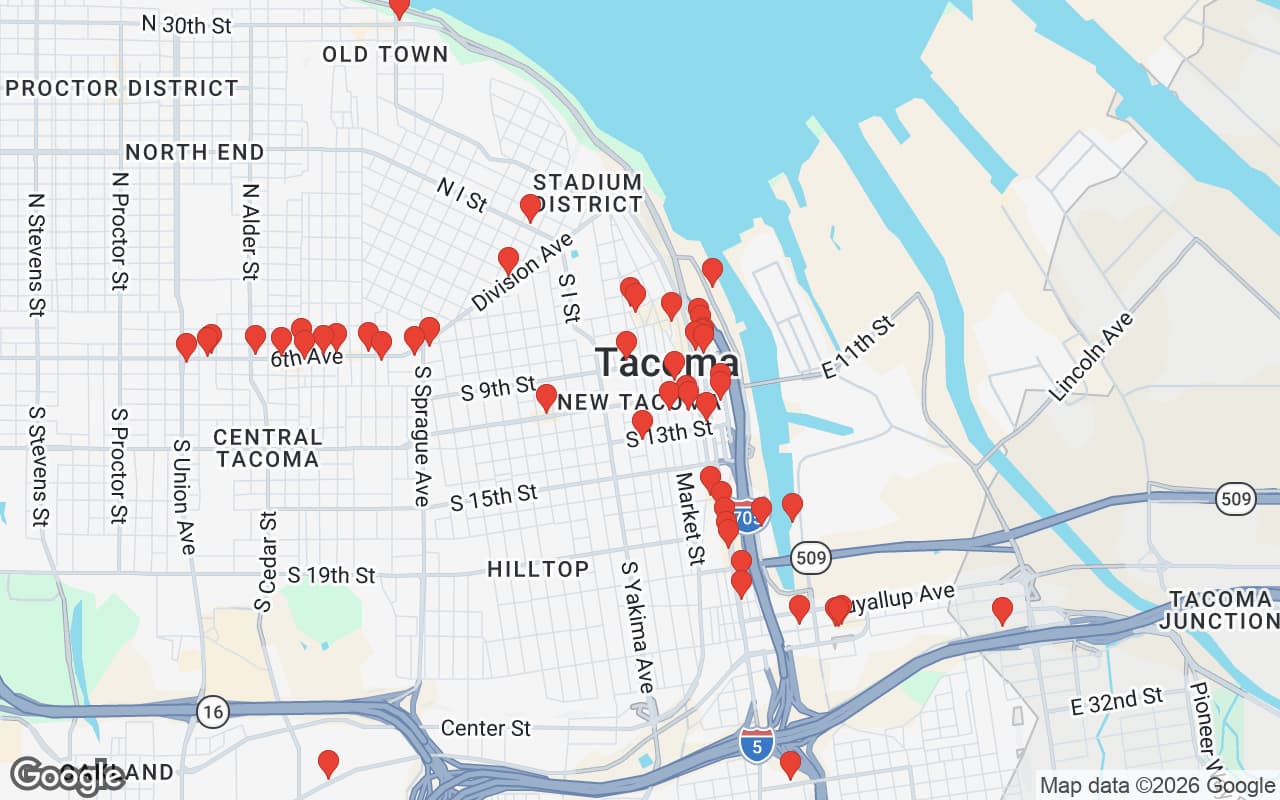
(253) 322-7880Oil Guyz Service Area in Pierce County
We provide free used cooking oil pickup and recycling to restaurants throughout Pierce County and surrounding areas.
Restaurant Outside Tacoma?
Oil Guyz is expanding fast. Drop your state and city and we will email you the moment we light up your area.
No used cooking oil pickup in your area yet?
Tell us your city. We’ll text you the day free pickups reach you.
Answers
Used cooking oil pickup in Tacoma, FAQ
Get Free Used Cooking Oil Pickup. First Stop in 3 to 5 Business Days.
Picture the bin that never overflows and the digital service record already in your inbox. Used cooking oil pickup is free because we are paid for the oil, not by you. Every week you wait is another overflowing bin and another gap in your records. Free locked bin, confirmed the same business day, first pickup in 3 to 5 business days, no contract, cancel anytime. New routes are scheduled in the order they come in, so get on the list today.
Or call (253) 322-7880 and talk to a real person today.