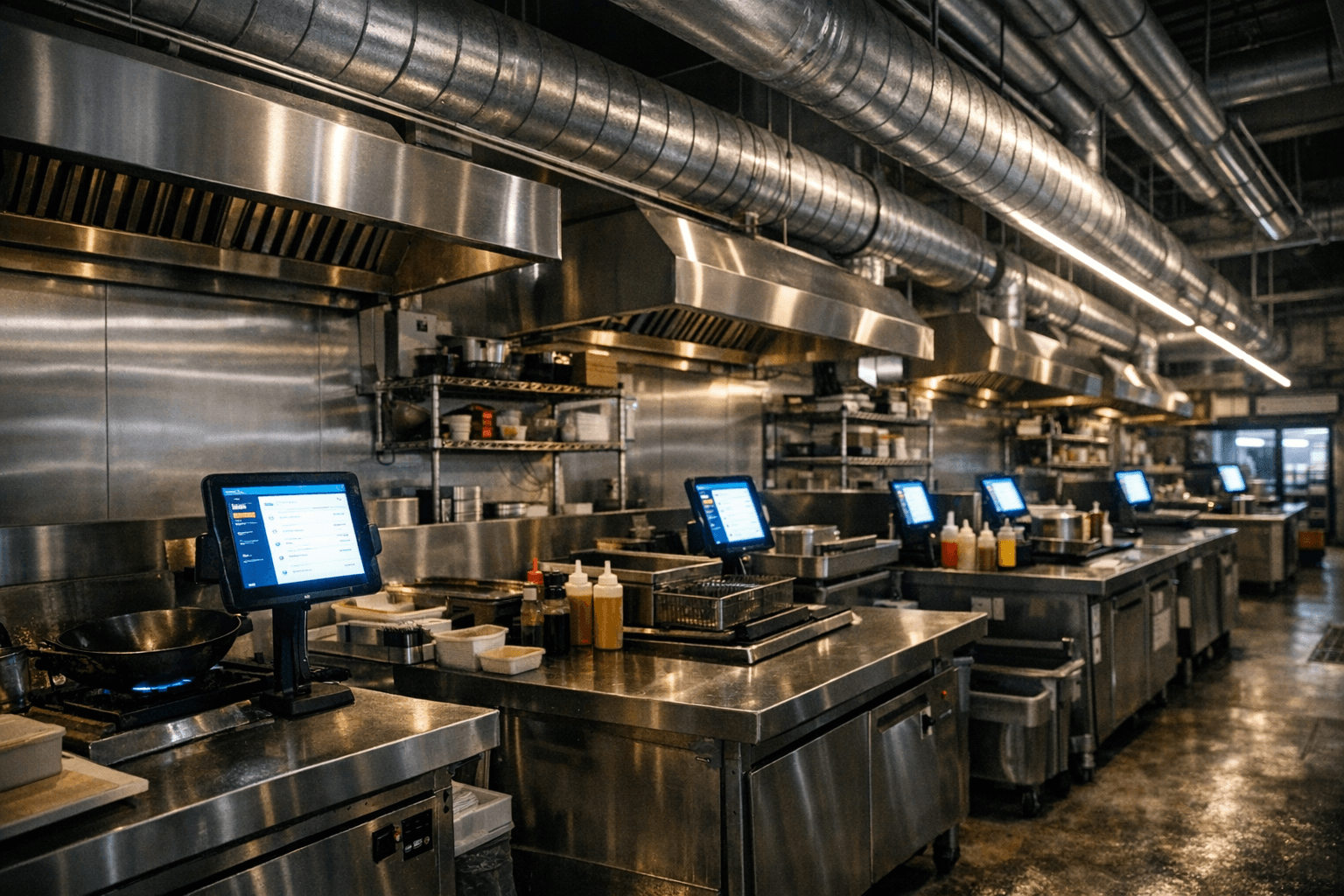
Cooking Oil Collection for Ghost Kitchens Running Many Brands
Oil Guyz provides used cooking oil pickup and recycling for ghost kitchens and delivery-only brands in Orange County, Los Angeles, San Diego, the Inland Empire, the Bay Area, and Puget Sound, WA. Call (714) 880-4788. A vendor account built for a building of shared commercial food service suites, not for a single restaurant. Free scheduled used cooking oil pickup sized to the fryers your ghost kitchen actually runs, never to the number of restaurants on the roster, with a separate record for every operator in the building. Free locked container, a digital manifest after every pickup, month to month with no contract. Call and a real person answers, 24/7.
Quick Answer
Cooking oil collection for ghost kitchens is scheduled pickup of spent fryer oil from a commercial food service building where several delivery-only restaurant operators share one cook line, one loading dock, and usually one used cooking oil container. The hard part is attribution rather than volume, because each restaurant operator generally holds its own health permit and needs a record in its own business name. Oil Guyz sizes the container to the whole building, supplies it free and locked, and issues a CDFA-compliant digital manifest per pickup with per-operator records underneath it.
Why Cooking Oil Collection for Ghost Kitchens Is an Accounting Problem First
Used cooking oil is a commercial waste stream with a real commodity value, so collecting it is a vendor service like linen, pest control, or hood cleaning rather than a cleaning chore. At a standalone restaurant one business owns that vendor account and one business answers for it. In a shared food service building, several independent restaurant companies operate under one roof, one loading dock, and one waste enclosure, and the vendor account has to serve all of them at once without merging their records. Oil Guyz runs that vendor account for restaurant operators and food service businesses in Orange County, Los Angeles, San Diego, the Inland Empire, the San Francisco Bay Area, and Pierce, King, and Snohomish Counties in Washington.
A ghost kitchen is not one restaurant, it is a commercial food service business address full of restaurants. Inside a typical ghost kitchen you find a row of commercial food service suites, each licensed to a different restaurant operator, all sharing a hood system, a walk-in, a dish area, a loading dock, and a waste enclosure. One suite runs a full fry battery for a wing concept, two run a single fryer, and the rest never fry at all. Every gallon of used cooking oil lands in the same container, because there is nowhere on the property to give each tenant its own. The oil is pooled long before anyone asks who generated it.
That pooling is where the trouble starts, because the ghost kitchen itself is not the regulated party. Each restaurant operator inside a ghost kitchen generally holds its own health permit under its own business name, so when an inspector or a franchise licensor asks where the used cooking oil went, the question lands on the operator and not on the landlord. Most haulers work a shared address the way they work a strip mall: one stop, one anonymous receipt made out to the building. California requires a manifest documenting chain of custody for every used cooking oil collection, and a single shared bin with one building-level record leaves every operator in the building holding nothing with its own permit name on it.
Then there is the pace. A ghost kitchen is built for churn. Occupancy agreements are commonly short licenses rather than long restaurant leases, a delivery-only brand can go live in days because it needs a menu on an app instead of signage and a dining room, and a concept that does not work can be gone the same quarter. Traditional cooking oil service is built for the opposite: a fixed site, a multi-year vendor agreement, an auto-renewal nobody tracks, and an equipment lien on a property the ghost kitchen operator may not even own. What this business actually needs is free used cooking oil pickup sized to the whole ghost kitchen, records kept per operator, and terms that let concepts arrive and leave without re-papering the place.
Delivery-Only Kitchens, Covered
Tell us where your kitchen is. Free locked container, route started this week, no contract or minimum volume.
Ghost and commissary kitchens pump out fried orders with little storage for waste oil. We fit a compact locked container and frequent pickups so used oil never slows your line.
Tell us about your kitchen and we'll set up tight, reliable pickup. Free bin, no minimum, no contract.
- Truly free. We are paid for the oil, not by you
- No contracts. Cancel anytime
- No minimum volume. Any kitchen size
- Free locked, anti-theft bin
- Compliant digital manifest after every pickup
- Instant confirmation, then a real person calls you
Request your free oil pickup
Free bin · No contract · Cancel anytime. You get an instant confirmation that we got it, then a real person calls to set up your pickup. No spam, no robocalls.
Prefer to talk? Call (714) 880-4788
Many brands, one bin
per-operator cooking oil records instead of one anonymous ghost kitchen stop
3 to 5 business days
from setup to first pickup, callback the same business day
$0
free service, free locked container, month to month, cancel anytime
The Two Kinds of Ghost Kitchen, and Why the Difference Changes the Service
A ghost kitchen comes in two shapes and they need different things from a cooking oil vendor. In the host model, a facility operator holds the property, subdivides it into commercial food service suites, and licenses them to independent restaurant operators. The facility operator controls the dock, the waste enclosure, the gate, and the shared equipment, while each restaurant business controls its own menu, its own health permit, and its own books. In the single-operator model, one company runs the whole operation itself and puts four or five virtual restaurant brands on the same line, which looks like many businesses to a customer on a food delivery app but is one business with one permit. The first shape needs a building-level container with per-operator cooking oil records underneath it. The second needs one clean record and usually per-concept volume attribution for internal food-cost reporting rather than for a regulator. We ask which shape your ghost kitchen is at survey, because everything downstream follows from the answer: who signs, whose name belongs on each manifest, who gets the portal login, and who we call when the gate code changes. Get it wrong and you end up with a hauler who talks only to the landlord while the restaurant businesses are the ones being asked for paperwork.
- Host model: a ghost kitchen operator licenses commercial food service suites and each restaurant holds its own permit
- Single-operator model: one business runs several virtual brands off one line under one permit
- Hybrid ghost kitchens are common, with some suites licensed out and some concepts run in house
- Which shape you are decides who signs and whose name belongs on each cooking oil manifest
- Captured at survey rather than assumed from the address
The Hood Decides Which Restaurants in a Ghost Kitchen Can Fry at All
Fry volume across a ghost kitchen is never spread evenly among its restaurant businesses, and the reason is the exhaust rather than the menu. The property has a hood and make-up air system engineered for a fixed set of appliances, so a suite can only add a fryer if the shared system and the local mechanical code can carry it. A property full of restaurant businesses may have only a few that fry, and one of those doing most of it. A wing or fried chicken concept in a single suite can out-produce every other restaurant on the property combined, and it will keep doing that whether or not the suites beside it change hands. This is exactly why sizing used cooking oil service from a roster count is wrong. We size from the fryers that are actually installed, the vat capacity in each, and how often each one gets dumped, then leave headroom, because a fry-capable suite is the one a facility operator re-leases fastest when it comes open. Adding one more fryer to the shared hood changes the cooking oil volume of the whole operation far more than adding three restaurant tenants that bake.
- A shared hood and make-up air system cap how many restaurant businesses on one property can run a fryer
- Volume concentrates: one fried chicken or wing concept can out-fry every other tenant combined
- Sized from installed fryers and vat capacity, never from how many restaurants are on the roster
- Adding a fryer changes the cooking oil load more than adding three tenants that do not fry
- Tell us when a suite adds fry equipment, because that is the trigger to re-check cadence
App Demand, Not Dine-In Covers, Sets the Fry Volume in a Ghost Kitchen
A restaurant with a dining room forecasts from a reservation book and a cover count. A ghost kitchen cannot, because every order arrives through a marketplace app and the curve belongs to the platform as much as to the cooks. Three things move fry volume here that would never move it in a dine-in restaurant. First, promotions: a platform-funded discount or a marketplace campaign on a fried item can lift the ticket count for one concept over the length of a run and drop it back the day the run ends. Second, weather: a rainy evening lifts app orders across the whole property at once, so every fryer in the building spikes together instead of one at a time. Third, concept stacking: a restaurant operator can add a fourth or fifth virtual brand without adding a single appliance, because the new menu runs on the same fryer, so the roster grows while the equipment does not. The shape of the day is different too. Many ghost kitchens have almost no lunch, a hard dinner peak, and a long late-night tail on weekends, which means the used cooking oil comes out at hours a route built for restaurants was never designed to cover. Send us the promo windows before they open. Cadence goes up for the run and back down after, at no cost, because nothing here is billed by the gallon or by the stop.
- Marketplace promotions lift the fry load for one concept over a run, then it falls back
- Rain lifts app orders across every fryer in the ghost kitchen at the same time
- A new virtual brand can add orders without adding a fryer, so the roster is a poor volume proxy
- Little lunch, a hard dinner peak, and a weekend late-night tail change when vats get dumped
- Send promo windows ahead of time: frequency rises for the stretch and drops back after, free
Sizing One Cooking Oil Container for an Entire Ghost Kitchen
The arithmetic is the same as at any restaurant, it just runs across several businesses instead of one. Take each fryer on the property, divide the vat capacity in pounds by 7.6 to get gallons, and multiply by how many times a week that vat gets dumped. Commercial fryers are sold by oil weight and commonly run 30, 40, 50, 70, and 100 lb. For a reference point, a single fast-food restaurant averages roughly 35 pounds of used cooking oil a day, close to 4.6 gallons, and a fry-forward restaurant running delivery-only volume can sit anywhere from a fraction of that to comfortably above it depending on how it is performing on the apps. Add the fryers together, then size so a full service interval lands between about 75 and 90 percent full. Here we deliberately size toward the lower end of that band, because the roster will not be the same in six months and headroom is far cheaper than an emergency. Cooking oil containers run 45 and 60 gallons indoors and 70 to 200 gallons outdoors. When the math for one address runs past the largest container, we shorten the interval instead of pretending a bigger vessel exists, and if the first size turns out wrong we swap it at no charge.
- Vat capacity in pounds divided by 7.6 gives gallons, multiplied by weekly dumps, then added up
- Sized so a full interval on site lands between about 75 and 90 percent full
- Deliberately toward the lower end of that band, because the tenant roster will change
- 45 and 60 gallons indoors, 70 to 200 gallons outdoors, matched to the real fry load
- Wrong size on the first try gets swapped free, with no penalty and no re-quote
Getting a Spent Vat Across Somebody Else's Business
The volume math is the easy half. The hard half is a walk that crosses other companies. Commercial fryers run at roughly 325 to 375 degrees, so the oil has to cool before anyone moves it, which pushes the job to the end of a shift that in these operations often ends near midnight. Then a cook wheels or carries a spent vat down a shared corridor, past other restaurant operators still working, through a dish area that belongs to everybody, and out to a dock or waste enclosure the facility operator controls. In a standalone restaurant that walk crosses one kitchen and a spill is a mop. In a ghost kitchen it crosses businesses that belong to other companies, so a trail of used cooking oil down the corridor becomes a neighbor-relations problem and a complaint to the landlord. It is also why container placement at a shared address is decided by the facility operator rather than by whichever restaurant fries the most. We place the cooking oil container on the shortest safe path from the fryers to the dock, confirm whether the enclosure stays unlocked through service hours, and confirm who holds the key or fob at 11pm rather than only at 9am. A property that closes late and locks its enclosure at six is how jugs end up stacked in a shared corridor by morning.
- Oil at fry temperature has to cool first, so the job lands at the end of a late close
- The walk crosses shared corridors and other restaurant operators still working, not one restaurant kitchen
- Placement is a facility operator decision, on the shortest safe path from the fryers
- Enclosure access confirmed for the closing hour, not just the opening one
- A locked or full container at midnight is what turns into jugs in a shared corridor
Courier Traffic Decides When a Truck Can Reach the Dock
The hardest part of servicing a ghost kitchen is not the oil, it is the parking. These are usually flex or light-industrial properties with a single loading area, and through the dinner peak that area is a continuous stream of couriers arriving, idling, and leaving with stacked bags. A pump truck with a hose run parked across it does not slow one restaurant down, it stalls order handoff for every restaurant on the property at once, and the operators will hear about it from the platforms before they hear about it from anyone else. So the constraint goes on the account instead of living in the head of a driver. We record the hours your site cannot take a truck, where the courier lane runs, the gate code or fob, the roll-up door hours, whether a property manager controls the dock separately from the facility operator, and how far a driver can run a hose from a legal spot to a container that may sit inside an enclosure. Those notes ride with the stop. We do not promise a clock time. We do plan around the hours you block off, and phones are answered around the clock by a real person when they change, which at a property whose gate code rotates with turnover happens more often than anyone expects.
- Blackout hours for the dinner peak recorded on the account, not left to the driver
- Courier lane, gate code, fob, and roll-up door hours captured at setup
- Hose reach from a legal spot to a container inside an enclosure confirmed before the first pickup
- Property-manager sign-off captured when the dock sits above the facility operator
- No promised clock time, and phones answered 24/7 by a real person when access changes
Per-Operator Cooking Oil Records When One Bin Serves the Whole Ghost Kitchen
This is the part built specifically for a shared ghost kitchen. Most run one container, so the record has to do the work the container cannot. Every pickup produces a CDFA-compliant digital manifest documenting chain of custody from your ghost kitchen to our licensed renderer, and in the Filtrate portal that record is held at the building level and attributed per operator underneath it, so each delivery-only brand has cooking oil documentation in its own business name for its own permit and its own books. Role-based access means a restaurant business sees only its own records while the facility operator sees the whole site, which matters because concepts down the same corridor are frequently competitors. Where a suite runs a dedicated container, attribution is direct. Where one bin is shared, we attribute from what is actually evidenced, meaning the installed fryers, the vat capacity in each, and a logged dump count, rather than inventing a split nobody can defend. Being straight about that distinction matters more than a tidy number, because a figure an operator cannot support in an audit is worse than no figure at all. What every restaurant operator gets either way is a dated used cooking oil record tied to its own operator name, which is the thing that was missing.
- One building-level manifest per pickup with per-operator cooking oil records underneath it
- Role-based access so a restaurant business sees only its own data, never a competitor down the corridor
- A dedicated container means direct attribution, and a shared bin is attributed from evidence
- Attribution comes from installed fryers, vat capacity, and a logged dump count
- Every restaurant business gets a dated cooking oil record in its own operator name, not under a landlord name
The Inspector Asks the Restaurant, Not the Ghost Kitchen
At most ghost kitchens each restaurant operator holds its own health permit under its own business name, which means the property is not the regulated party for the waste that restaurant business produces. A county health inspector inspects the permit holder. A franchise licensor auditing a virtual restaurant concept audits the licensee. A commissary agreement covering a food truck or a caterer names the operator, not the landlord. So when the question is where the used cooking oil went, a building-level receipt in the name of the facility operator does not answer it for the restaurant operator being asked. California requires a manifest documenting chain of custody for every used cooking oil collection, and electronic manifests are legal under the state Uniform Electronic Transactions Act. The state minimum retention is two years, and we keep records for two as company policy, which comfortably covers the audit windows most licensors and lenders ask about. One thing worth separating clearly: the grease interceptor and the local FOG rules are a facility operator obligation and a different thing entirely. Used cooking oil collection does not satisfy a FOG requirement, and a grease trap service does not produce a cooking oil manifest. Food service operations get written up when they assume one covers the other.
- A restaurant health permit makes the operator, not the landlord, the party being questioned
- A manifest is required for every used cooking oil collection in California
- Electronic manifests are legal under the state Uniform Electronic Transactions Act
- Two-year state minimum retention, two years kept as our own company policy
- Grease trap and FOG duties sit with the property and are separate from the cooking oil record
Where Cooking Oil Sits in the Ghost Kitchen Vendor Stack
The vendor list at a ghost kitchen is split in a way it never is at a standalone restaurant, and used cooking oil falls straight through the crack. The facility operator normally bundles building services into the license fee: hood and duct cleaning on the fire-code interval, pest control, the grease interceptor, solid waste and recycling, often janitorial and dish. The restaurant business buys its own food distribution, its own point-of-sale and delivery-platform integrations, its own smallwares, and its own insurance. Cooking oil collection looks like waste, so restaurant operators assume the license fee covers it, and it produces a regulated record in the restaurant business name, so the facility operator assumes the restaurant arranged it. That assumption gap is why so many of these buildings have an overflowing container and nobody with an answer. Three services get confused constantly. Grease trap and interceptor pumping is plumbing under the sinks, a separate trade with its own local rules, and we do not sell it. The compactor or solid-waste hauler takes trash and generally will not accept liquid oil at all. Used cooking oil is its own regulated stream with its own paperwork, which is why it needs its own vendor account, one named contact, and a service history any restaurant operator can pull without calling the landlord, the waste company, and the plumber to piece it together.
- License fees often bundle hood cleaning, pest control, solid waste, and the grease interceptor
- Cooking oil falls in the gap: restaurant operators assume it is included, facility operators assume the restaurant handled it
- Grease trap and interceptor pumping is a different trade with its own local rules, and we do not sell it
- Compactor and solid-waste haulers generally will not accept liquid cooking oil
- Its own vendor account, one named contact, and a service history any operator can pull on demand
Ghost Kitchen Operator or Delivery-Only Brand: Who Actually Signs
In a ghost kitchen the party that feels the problem and the party that can fix it are often two different companies. The facility operator controls the dock, the waste enclosure, the gate, and where a container is allowed to sit, so the building-level arrangement belongs to them. But each delivery-only restaurant controls its own permit and its own cooking oil records, and the restaurant business is the one an inspector questions. We work both ends without playing them against each other. The ghost kitchen operator signs for placement, access, and cadence. Any restaurant business that wants its own documentation gets its own record and its own login without needing a separate container, a separate stop, or a separate negotiation. We never ask a restaurant business to commit the building, and we never ask a facility operator to warrant what a restaurant does inside its own suite. Where a property manager or landlord sits above the operator, we get sign-off on dock placement before delivering anything, because a container that has to move a month later disrupts every business on the property instead of one. In a single-operator ghost kitchen the whole conversation collapses to one owner or operations director, which is faster and worth confirming at survey.
- The facility operator signs for container placement, building access, and cadence
- Individual tenants get their own cooking oil records and logins without a separate container
- A tenant is never asked to commit the ghost kitchen, and the reverse holds too
- Landlord or property-manager sign-off obtained on dock placement before delivery
- A single-operator site collapses to one decision maker, which we confirm at survey
A New Restaurant Should Not Mean a New Negotiation
Turnover is designed into the ghost kitchen model, and a cooking oil vendor has to move at that speed instead of fighting it. Occupancy agreements are frequently short licenses rather than multi-year restaurant leases, and a delivery-only brand can be taking orders within days of getting keys because it needs a menu on an app rather than a dining room, a sign permit, and a build-out. When a new concept lands in an operation already on service, it folds into the existing schedule and starts generating cooking oil records in its own operator name right away, with no new container, no new stop, and no fresh negotiation. If that restaurant fries and the one it replaced did not, that is the trigger to re-check cadence, because the real load just changed even though the roster count did not. There is no opening-week scramble to line up a hauler, which is a genuine risk in this model, since a new concept is often already selling on three platforms before anyone thinks about the container out back. Bringing a whole site on for the first time is the same story from the other side. Callback comes the same business day, and first pickup lands in 3 to 5 business days.
- A new restaurant folds into the existing site schedule with no new negotiation
- New operators start generating cooking oil records in their own name from the first pickup
- A fry-capable restaurant replacing one that did not fry triggers a cadence re-check
- No opening-week scramble while a concept is already live on the delivery apps
- Callback the same business day, first pickup in 3 to 5 business days
When a Restaurant Business Exits the Ghost Kitchen Mid-Term
Concepts fail fast in this model, and a clean exit should be part of the service rather than an argument about it. When a restaurant business leaves a ghost kitchen, the cooking oil record closes with a final manifest, the full history exports in one click, and the account detaches from the building without interrupting service for anyone else. The departing operator keeps documentation covering the exact period it held the permit, which is what it needs if a question arrives months after the suite is empty. The incoming operator starts a clean record instead of inheriting gallons generated by somebody else, which is the single most common records problem at a shared address. And the cadence gets re-checked, because a departing fry-forward restaurant can take a large share of the load with it and leave a container that no longer needs the same interval. Service stays month to month for everyone involved: no long contract, no auto-renewal trap, and no equipment lien filed against a property the facility operator may be leasing rather than owning. That last point matters more here than almost anywhere, because a lien on a building nobody in the deal owns is how a vendor agreement becomes a landlord problem.
- A departing restaurant record closes with a final manifest and a one-click history export
- The incoming operator starts clean instead of inheriting gallons from the last concept
- Cadence re-checked when a fry-forward restaurant leaves, because the load just dropped
- Month to month, cancel anytime, no auto-renewal trap and no early-termination maze
- No equipment lien filed against a property the facility operator may not own
What Goes Wrong in a Shared Waste Enclosure
Almost every failure at a ghost kitchen traces back to one thing: the container sits in shared space, and shared space has no owner. Nobody is individually responsible for the lid, so it stays open. Somebody pours boil-out water, a failed sauce batch, or fryer cleaner into it because the container is right there and it is not their equipment. A contaminated load of cooking oil is worth less as renewable-fuel feedstock and can be rejected outright, and at a shared address that consequence lands on every restaurant in the building rather than on the one who did it. In a mixed-use property, businesses that are not restaurants at all find the container and use it. A restaurant that runs out of room stacks spent jugs beside it and the next inspection finds them. Turnover makes all of it worse, because the on-site manager who knew the arrangement leaves and the gate code goes with them. None of this is fixed by a memo taped to the wall. It is fixed by a container that is locked, placed where the fryers can actually reach it, sized with headroom for the restaurant nobody has signed yet, and serviced on a cadence that never leaves a cook at midnight with nowhere to pour.
- Shared space has no owner, so lids stay open and nobody escalates a full container
- Water, cleaner, and food waste poured in can get a cooking oil load rejected for everyone at once
- Non-restaurant businesses in a mixed-use property will use an unlocked container
- Manager turnover takes the gate code with it, so we re-confirm access rather than assume it
- Free locked container, placed on the path from the fryers, sized with headroom for the next tenant
A Digital Cooking Oil Manifest After Every Ghost Kitchen Pickup
After each stop at your ghost kitchen you get a CDFA-compliant digital manifest showing the date, gallons, transporter, and the licensed renderer that received the load, stored in the Filtrate portal instead of on a paper ticket taped to an enclosure wall where the next restaurant operator will never find it. Collection and transport of the used cooking oil are performed by a CDFA-registered transporter, and the load moves to our licensed renderer under a documented chain of custody. Records export in one click, either per restaurant operator for its own inspection file or building-wide for the facility operator.
- Digital manifest generated for every cooking oil pickup, with date, gallons, and receiving renderer
- Collection performed by a CDFA-registered transporter, chain of custody to our licensed renderer
- One-click export per operator or for the entire site
- Nothing depends on a paper ticket surviving a change of tenants
- Free locked container included, delivered and serviced at no cost
Recycled Into Cleaner Fuel, Not Poured Down a Drain
The used cooking oil that leaves your ghost kitchen becomes feedstock for biodiesel and renewable diesel. Waste-feedstock fuels cut lifecycle greenhouse-gas emissions by roughly 79 to 86 percent versus petroleum diesel per Argonne National Laboratory, Environmental Science & Technology, 2022, and renewable diesel reduces carbon intensity by about 65 percent on average. If a delivery-only brand or a facility operator reports on waste diversion, the cooking oil manifest history is the documentation, per operator or building-wide.
- Recycled into biodiesel and renewable-diesel feedstock rather than landfilled
- Cooking oil manifest history doubles as waste-diversion documentation for any tenant
Which Ghost Kitchen Operations This Service Is Built For
Ghost Kitchen Facility Operators
Operators in the food service business who license commercial food service suites to independent restaurants and need one container, one cadence, and per-operator cooking oil records so every business in the ghost kitchen can answer for its own oil.
Delivery-Only Brands in a Shared Suite
Restaurant concepts running delivery-only inside a ghost kitchen somebody else operates who need a used cooking oil manifest in their own operator name, because the health permit on the wall belongs to them, not to the landlord.
Single-Operator Virtual Brand Groups
One business running four or five virtual restaurant brands off a single line, where fryer count stays flat while order volume grows and food-cost reporting still wants per-concept attribution.
Commissaries and Shared-Use Food Service Sites
Shared commissaries prepping for food trucks, caterers, and packaged-food makers, where each member operator needs a cooking oil record it can take to its own inspection and its own books.
Fry-Forward Concepts in a Cloud Kitchen
Wing, fried chicken, and fried fish concepts that quietly produce more used cooking oil than every other restaurant business on the property combined, and therefore set the cadence for the whole building.
Multi-Site Ghost Kitchen Groups
Groups running several ghost kitchen locations across our regions who want every building and every restaurant business in one Filtrate dashboard, with role-based access from headquarters down to a single suite.
Oil Guyz vs. a General Waste Hauler at a Ghost Kitchen
Whose name is on the record
How the schedule is set
Promotion and weather spikes
Courier peak at the dock
A new tenant arrives
A tenant exits mid-term
Term and equipment
Cost
What's Included
Everything you need, nothing you don’t.
- Free scheduled cooking oil collection for ghost kitchens, at any volume
- Container sized from the vat capacity and dump frequency of every installed fryer
- Free locked container delivered, serviced, and swapped free if the size is wrong
- Per-operator cooking oil records under one manifest, in each restaurant business name
- Role-based access so a restaurant business sees only its own data and never a competitor
- CDFA-compliant digital manifest after every pickup, chain of custody to our licensed renderer
- Courier lane, gate code, fob, roll-up door hours, and blackout windows kept on the account
- Frequency raised for a promotion window and dropped back after, at no cost
- New restaurant operators onboarded into the existing schedule with no re-papering of the whole address
- Clean exit for a departing concept: final manifest and one-click cooking oil history export
- Coverage in Orange County, Los Angeles, San Diego, the Inland Empire, the San Francisco Bay Area, and Pierce, King, and Snohomish Counties in Washington
- Recycled into biodiesel and renewable-diesel feedstock
- Month to month, no long contract, no setup fees, no equipment lien, cancel anytime
How Restaurant Oil Collection Works In 3 Simple Steps
Set up restaurant oil collection in about five minutes. We confirm your route the same business day and drop a free bin before your first pickup. After that, Oil Guyz handles every used cooking oil pickup on schedule. You never chase a hauler again.
Request Pickup
Fill out a 30-second form or call us. No credit card, no commitment.
Pickup Day Is Pickup Day
Your scheduled window is locked in. A CDFA-registered transporter completes the pickup, pumps your container empty, and we email your digital manifest the moment the work is logged.
Stay Compliant Automatically
Get digital manifests, pickup confirmations, and compliance records, all in your dashboard.
Frequently Asked Questions
We service the ghost kitchen as one stop, with free scheduled used cooking oil pickup sized to the fryers that are actually installed, then hold the records the way you operate. Every pickup produces a CDFA-compliant digital manifest at the building level, and in the Filtrate portal that record is attributed per operator underneath it, so each delivery-only brand has documentation in its own business name for its own permit and its own books. Role-based access means a restaurant business sees only its own data while the facility operator sees the whole ghost kitchen.
Each restaurant can, and in most of these operations that is the entire point. The restaurant operator usually holds its own health permit, so it is the party a county inspector or a franchise licensor questions, and a receipt in the name of the facility operator does not answer for it. California requires a manifest documenting chain of custody for every used cooking oil collection, and electronic manifests are legal under the state Uniform Electronic Transactions Act with a two-year minimum retention. We keep records for two years as company policy. See the rule: California Code of Regulations Title 3 §1180.24, UCO Manifests
From evidence, not from guesswork. Where a suite runs its own dedicated container the attribution is direct. Where one bin is shared, we attribute from the installed fryers, the vat capacity in each, and a logged dump count, and we say plainly that it is an evidenced estimate rather than a meter reading. A number an operator cannot defend in an audit is worse than no number, so what every restaurant gets regardless is a dated record tied to its own business name and to the manifest for that pickup.
We size from the fryers rather than from how many restaurants are on the roster, because a shared hood limits how many restaurants in the building can fry at all and one wing concept can out-produce everyone else combined. Take each vat capacity in pounds, divide by 7.6 for gallons, multiply by weekly dumps, and add the fryers together. We then target the lower end of a 75 to 90 percent fill band on purpose, so there is headroom for the restaurant you have not signed yet. Containers run 45 and 60 gallons indoors and 70 to 200 gallons outdoors, and a wrong first size gets swapped at no charge.
The facility operator signs the building-level arrangement, because they control the dock, the waste enclosure, the gate, and where a container is allowed to sit. Individual restaurant businesses do not need to sign anything to get their own cooking oil records and their own login. We never ask a restaurant business to commit the building, and we never ask a facility operator to warrant what a restaurant does inside its own suite. Where a property manager or landlord sits above the operator, we get dock placement approved before anything is delivered.
Immediately, if the ghost kitchen is already on service. The new operator folds into the existing schedule and starts generating cooking oil records in its own name from the first pickup, with no new container, no new stop, and no fresh negotiation. If that restaurant fries and the one it replaced did not, we re-check the cadence, because the real load changed even though the roster count did not. For an address coming on for the first time, you get a callback the same business day and first pickup in 3 to 5 business days.
The record for the departing operator closes with a final manifest and the full history exports in one click, so it keeps documentation covering the exact period it held the permit. The account detaches from the site without interrupting service for any other restaurant business, and the incoming operator starts a clean record instead of inheriting gallons from the last concept. Service is month to month for everyone, with no auto-renewal trap and no equipment lien filed against a property the facility operator may be leasing rather than owning.
That constraint goes on the account. Most ghost kitchens have a single loading area that turns into a continuous courier lane through the dinner peak, and a truck parked across it stalls order handoff for every restaurant at once. Tell us the hours you cannot take a truck, where couriers stage, the gate code or fob, roll-up door hours, whether a property manager controls the dock, and how far a driver can run a hose from a legal spot. Those notes ride with the stop. We do not promise a clock time, but we plan around the hours you block off, and a real person answers the phone 24/7 when they change.
Yes, it is free, and there is no long contract. Scheduled service is free at any volume and includes a free locked container that we deliver, service, and replace at no cost. It works this way because we are paid for the oil, not by you: spent fryer oil has real value as renewable-fuel feedstock. Terms are month to month with no setup fees, no auto-renewal trap, and no equipment lien, which matters in a model where the roster can turn over in a quarter.
Ghost kitchen buildings in Orange County, Los Angeles, San Diego, the Inland Empire, the San Francisco Bay Area, and the Seattle-to-Tacoma corridor are on the route. An operator with buildings in more than one of those regions sees every building and every restaurant in one Filtrate dashboard with role-based access. Outside that footprint, tell us where and we let you know as service opens.
It becomes feedstock for biodiesel and renewable diesel rather than going to a landfill or a drain. Renewable diesel cuts carbon intensity by about 65 percent on average versus petroleum diesel (DOE AFDC, Renewable Diesel), and waste-feedstock fuels deliver roughly 79 to 86 percent lower lifecycle greenhouse-gas emissions (Argonne National Laboratory, Environmental Science & Technology, 2022). Your manifest history doubles as waste-diversion documentation, per operator or building-wide.
What Our Clients Say

Bryan Baird
Google review
“We are a medium sized institutional kitchen located in San Juan Capistrano. When we needed a certified oil and grease removal partner the Oil Guyz were there. Fantastic customer service, fast, reliable, quick follow up and very efficient. They make it super easy to leave a GREAT review!”See full review

Alex Camacho
Google review
“I'm an up and coming new food vendor and properly disposing of used frying oil was a difficult task. That is until I contacted the Oil Guyz! There webpage made it easy to setup their free service of oil pickup. Within a few days I had a free container to store the used oil until ready for the free pickup. This service is very convenient and Joey has been very accommodating to answer all my questions and facilitate the process.”See full review

Ujwal Chaudhary
Google review
“Great service from Oil Guyz! They came and picked up my full barrel of used cooking oil completely free of charge. The process was easy, quick, and professional. I really appreciate their excellent customer service and reliable pickup. If you have used cooking oil that needs to be collected, I definitely recommend Oil Guyz. Great company and great people! 👍”See full review

Nicholas Saccoccia
Google review
“Excellent experience with Oil Guyz! They got me on the schedule fast, showed up on time, were very professional, and were in and out in no time! I would absolutely use them again.”

LA BREAKFAST CASITA
Google review
“We’ve had a great experience with Oil Guyz! I submitted a quote request through their website for our restaurant, and Joey reached out to us right away. From our first conversation, he has been extremely helpful, patient, and responsive. Joey really made the whole process easy for us. He was willing to work with our team on the best location for the bin, answered all of our questions, and kept in touch to make sure everything was taken care of. I especially appreciate his follow-through and willingness to help without ever making us feel rushed. Good customer service can be hard to find, and Joey has definitely made a great impression on us. We’re very happy we chose Oil Guyz for our used commercial oil pickup service at LA Breakfast Casita in Azusa, CA. Thank you, Joey, for making the process so smooth and for taking such good care of us. We look forward to working with Oil Guyz for a long time!”See full review

Mike Fishman
Google review
“Superb service!”

Celso Bahena
Google review
“I’m in the Santa Ana area great reliable service!”

Myk Espinoza
Oakland Ballers · Oakland, CA · Google review
“These dudes really bailed me out of a tough situation. My previous oil collection service had been really screwing me over. Spent 4 weeks of unanswered phone calls, texts, and empty promises with a company we've been using for two years just to get a used oil recepticle, all to no avail. We were sitting on 6 fryers with of oil I that I had nowhere to put. Called Joey and The Oil Guyz and he got me set up just a few hours later. Used oil container, service agreement, answered all of my questions. We're running a very odd program where our schedule is all over the place, so having a "regular" pick up schedule is out of the question. We worked out a way for quick/easy retrieval in about 5 minutes. Can't recommend these guys enough.”See full review

Maryam Tngrian
Google review
“As a manufacturing bakery, we recently needed a one-time pickup of approximately 3,000 lbs of used donut oil. Unfortunately, there was very little information available regarding the company that had handled this service previously, so I had to start from scratch. I found Oil Guyz online and was impressed from the first conversation. Joey, the owner, was extremely helpful and took the time to walk me through the entire process, making the coordination simple and straightforward. Prior to contacting Oil Guyz, I had attempted to reach other providers and had difficulty getting assistance. Oil Guyz was responsive, accommodating, and easy to work with from start to finish. The pickup was completed within the timeframe communicated, and the team handled the removal seamlessly with no disruption to our operation. Their professionalism and customer service made what could have been a challenging process very easy. We would absolutely use Oil Guyz again and would recommend them to other food manufacturing facilities looking for a reliable used cooking oil recycling partner.”See full review

Kengo Kido
Google review
“Joey took care of our needs quickly, efficiently and professionally. I highly reccoemnd his service to anyone!”

Brenda Wu
Google review
“Prompt response from Joey. Great service with problem solving. Highly recommended!”

Camille Bamford
Google review
“Fast and great to work with!”
Related Resources
Guides
Free Tools
- Grease Trap Calculator
Find your recommended pumping frequency
- Compliance Checker
Check if you meet California grease requirements
Related Solutions
Restaurant Cooking Oil Management
The full program, and how scheduled pickup, locked containers, and compliance fit together for any cooking operation.
Learn moreCooking Oil Compliance & Reporting
The Filtrate portal and digital manifest detail: dashboards, role-based access, and audit-ready per-operator exports.
Learn moreMulti-Location Cooking Oil Collection
One arrangement across every building when you run delivery-only brands at several addresses, with consolidated reporting and a clean exit.
Learn moreGet Cooking Oil Collection Built for a Ghost Kitchen
Send the form or call and tell us how many fryers your ghost kitchen runs, what the vats hold, and who controls the dock. A real person answers 24/7, you get a callback the same business day, and first pickup lands in 3 to 5 business days. Free service, free locked container, per-operator cooking oil records, month to month. If an address is outside our regions we will say so and let you know as we expand.
Or call (714) 880-4788 and talk to a real person today.