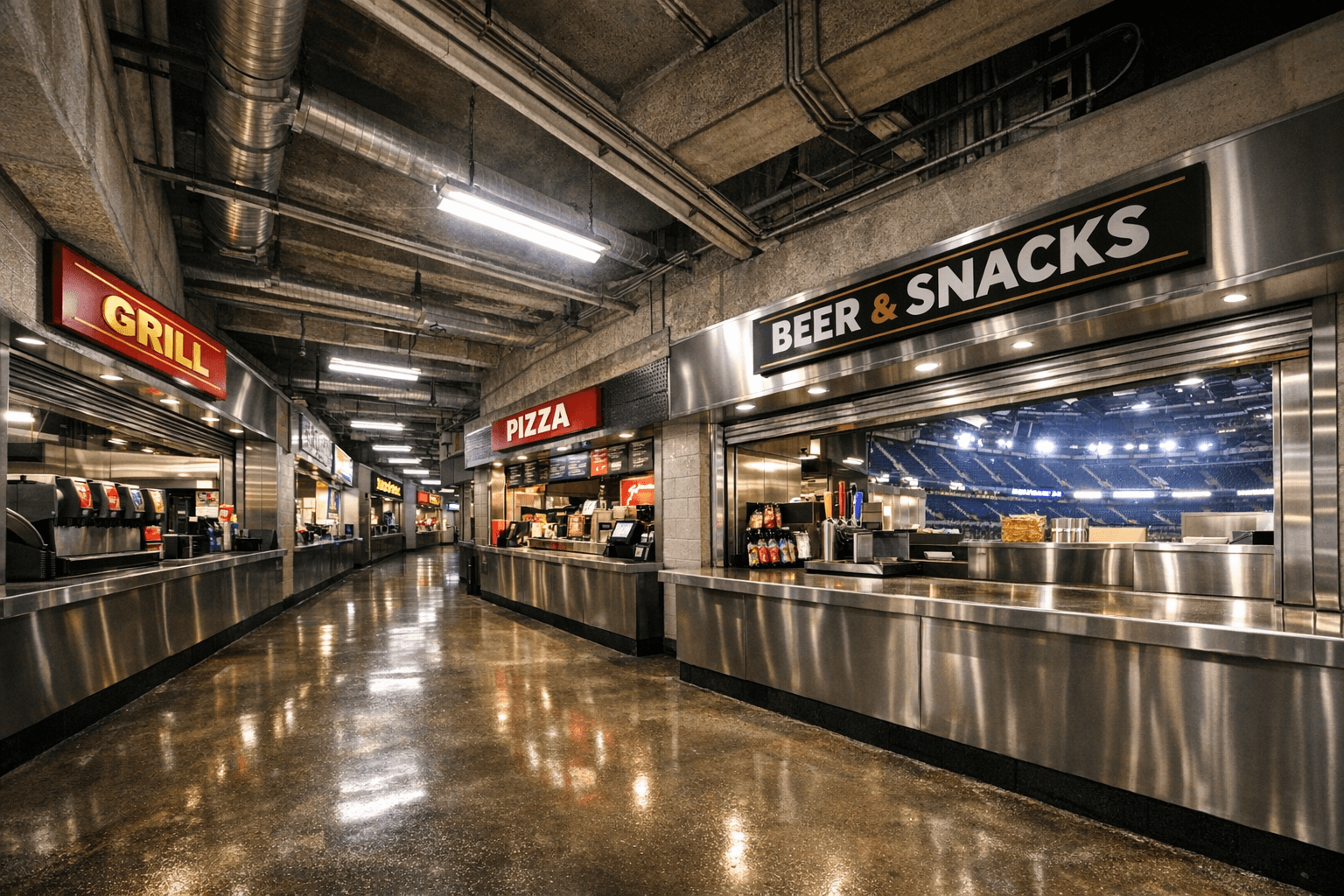
Cooking Oil Collection and Recycling for Stadiums and Arenas
Oil Guyz provides used cooking oil pickup and recycling for stadium and arena concessions in Orange County, Los Angeles, San Diego, the Inland Empire, the Bay Area, and Puget Sound, WA. Call (714) 880-4788. A stadium fries in bursts. Every fry station in the building runs hard for about four hours on event night, then the stadium sits dark for days. We schedule cooking oil collection, removal, and recycling off the stadium calendar instead of a fixed weekly route, cover every concession in the stadium, and issue a digital manifest after each pull. Free, month-to-month, free locked containers, and a real person answers the phone 24/7.
Quick Answer
Cooking oil collection for stadiums is pickup scheduled against the stadium's event calendar instead of a fixed weekly route. A stadium makes fryer oil in a four-hour burst across dozens of concessions, then sits idle for days. Pickup is performed by a CDFA-registered transporter, every concession rolls into one stadium record, and a digital manifest documents each pull.
Why a Stadium Cannot Run on a Restaurant's Pickup Schedule
A stadium does not make used oil on a curve, it makes it in a spike. Gates open a couple of hours before the event, every fry station on every concourse fires at once, and the heaviest frying in the stadium is compressed into roughly four hours. Then the stadium goes dark. An arena may cook again the next night; a football stadium may not cook again for two weeks. Industry data puts one high-volume fast food location at roughly 35 pounds of used oil per day, and a stadium can run dozens of fryer-equipped concessions at that intensity in the same moment, with all of it landing in a single evening. A hauler on a fixed Tuesday route meets full containers after a Saturday game at the stadium and empty ones the week the stadium is closed.
The second problem is that nobody at the stadium obviously owns the oil. Concessions are usually run by a national food-service contractor, the club levels and suites by a premium caterer, and the stadium itself by the team or a stadium authority that signs the sustainability report. Ask three people in the stadium who handles fryer oil and you get three answers: the concessions director assumes facilities has it, facilities assumes it belongs to the concessionaire's vendor, and the sustainability lead learns at year end that nobody kept the paperwork. Meanwhile the oil sits in a closet behind a concourse window because that is where it fit.
Access is the third problem, and the one most haulers underestimate. A stadium loading dock belongs to whoever is loading in. On event day the bays are staged for team trucks, production trailers, beverage deliveries, and merchandise pallets, and a grease truck is not getting one. On a dark morning the dock is wide open, but the concourse gates are locked and a single engineer may hold keys for the whole stadium. Layer on California's rule that every commercial used cooking oil collection be documented on a manifest showing chain of custody to a licensed renderer, and a stadium running five food vendors ends up with five sets of paperwork and no single record of what actually left the stadium.
Event-Day Oil, Cleared Fast
Tell us where your kitchen is. Free locked container, route started this week, no contract or minimum volume.
Game days and concerts spike used-oil volume in hours, then go quiet. We schedule around your event calendar and provide overflow pickups so concourse kitchens never back up.
Tell us your venue and schedule and we'll build pickup around your events. Free bins, no minimum.
- Truly free. We are paid for the oil, not by you
- No contracts. Cancel anytime
- No minimum volume. Any kitchen size
- Free locked, anti-theft bin
- Compliant digital manifest after every pickup
- Instant confirmation, then a real person calls you
Request your free oil pickup
Free bin · No contract · Cancel anytime. You get an instant confirmation that we got it, then a real person calls to set up your pickup. No spam, no robocalls.
Prefer to talk? Call (714) 880-4788
Event-calendar
stadium pickups, not a fixed weekly route
Free
service, locked containers, and manifests
8 regions
served and expanding
How a Stadium Pickup Runs: Empty Before Doors, Pull After the Event
Cooking oil collection for stadiums works on two moves per event, not one weekly stop. The pre-event empty is scheduled ahead of the event, so no concession in the stadium starts a sold-out night at capacity. The post-event pull is scheduled off that same date, when the stadium still holds the oil but no longer holds a crowd. Both come off your calendar, not a weekday slot. In between, the stadium is never storing a full night of fryer oil through a dark stretch, which is what produces the odor, the slip risk, and the pest complaints in a back-of-house corridor. Send us the dates and we build around them. When a date moves, a real person answers 24/7 and the schedule moves with it.
- Pre-event empty so no concession opens a sold-out night at capacity
- Post-event pull scheduled off the event date, not a fixed weekday
- Extra pulls for back-to-back events, playoff runs, and festival weekends
- Dark stretches scale down instead of paying for stops at a closed stadium
Reading the Stadium Calendar: 81 Home Dates or Eight
No two stadium calendars produce the same cadence, so we plan against yours. A ballpark runs 81 regular-season home dates grouped into homestands: a cluster of heavy nights, then a road trip with the stadium closed. An NBA or NHL arena runs 41 home dates plus concerts, family shows, and college games, so the calendar is dense, irregular, and rarely leaves a clean gap. A football stadium runs eight or nine regular-season home dates and fills the rest of the year with concerts, one-off bookings, and long silence. A fairground or convention center swings on a booking calendar with no season at all. The real scheduling question at a stadium is not gallons per week, it is how many fryer-hours sit between now and the next dark stretch.
- Homestand clusters planned as one block, not as separate weekly stops
- Arena calendars cover concerts and family shows beside the sports schedule
- Football stadiums covered through a long off-season of occasional bookings
- Cadence set by fryer-hours ahead, not by a default weekly frequency
Stadium Access: Dock Windows, Freight Elevators, and Concourse Kitchens
The hard part of cooking oil removal for stadiums is rarely the oil, it is reaching it. Most concessions sit on a concourse with no vehicle access, so the container travels by service corridor and freight elevator to a dock, or the driver runs a hose. We walk the stadium before the first pickup and write the route down: which concessions share a corridor, which elevator carries the load, which gate is unlocked on a non-event morning, who holds the keys, and what the dock looks like when nothing is loading in. That access map is what makes a dark-day pull possible at all, and it is why the pickup does not depend on a security escort improvising it every time. A concourse kitchen that cannot reach a dock gets a container sized to fit the door it actually has.
- Stadium walk-through before the first pickup, access recorded per location
- Service corridor, freight elevator, and gate notes stored with each kitchen
- Dark-day scheduling around dock staging for load-in and load-out
- Container sizes matched to concourse doorways and tight footprints
Who Owns the Oil Inside the Stadium
A stadium is many kitchens under many operators, and the program breaks when each one hires its own hauler. We set it up so every food-service operator keeps its own locations, contacts, and service history, while the stadium sees all of it in one place. Role-based access means the concessions contractor sees its concourse kitchens, the premium caterer sees the club and suite kitchens, and stadium operations sees the whole map. That matters most at renewal and at audit: when a concessions contract changes hands, the stadium's collection history does not leave with the outgoing vendor. It matters for reporting too, because the diversion figure a stadium publishes should cover the whole stadium, not just whichever operator happened to keep records.
- Each concessionaire and caterer keeps its own locations, contacts, and history
- Stadium operations sees everything, each operator sees only its own kitchens
- Service history stays with the stadium when a concessions contract changes
- One chain-of-custody record for the stadium instead of one per vendor
The Point of Contact Is Split in Two, and Neither Half Sees the Whole Stadium
A single restaurant has one manager who owns the fryer schedule, the pickup relationship, and the compliance paperwork, all in one person. A stadium splits that job across two roles that answer to different chains of command, and neither one owns the whole picture. The facilities director, or a VP of stadium operations, controls the physical plant: dock schedules, loading-zone staging, freight elevator access, and who holds keys to a concourse gate on a dark morning. Day-to-day frying sits under a different reporting line entirely. The concessions operator's on-site manager runs the fry stations across every concourse, but that manager reports up through the concessionaire's own regional office, not through the stadium, because the job is running food service, not tracking a building-wide oil total. Ask either one alone how many fryers the stadium runs or where last month's oil went, and neither has that number, because keeping it was never part of either job. What actually works is one point of contact assigned on the stadium side, usually the sustainability lead or an operations coordinator, who can pull a single consolidated report across every concession stand no matter which contractor's payroll runs it. We build the service around that one contact instead of asking either job to also carry the reporting.
- Facilities director or VP of operations owns dock access, keys, and the physical plant
- Concessions operator's on-site manager runs fry stations but reports to the contractor, not the stadium
- Neither role alone tracks stadium-wide oil volume; that was never either job's function
- One assigned stadium-side contact gets one consolidated report across dozens of stands
One Manifest Trail for the Whole Stadium
Every pull generates a digital manifest documenting chain of custody from the stadium dock to our licensed renderer, and pickup is performed by a CDFA-registered transporter. California's minimum retention for those records is two years; we keep two as company policy. The value at a stadium is consolidation: every kitchen reports into one stadium record, so the manifests are not spread across five vendors' file cabinets. When a league sustainability audit, a city green-building program, or a sponsor asks who moved the oil and where it went, the stadium exports one continuous trail covering every location and every date.
- Digital manifest after every pull, at every kitchen in the stadium
- Pickup performed by a CDFA-registered transporter to our licensed renderer
- Two-year California minimum met, two years kept as company policy
- One exportable stadium record instead of a hunt across vendors
Diversion Numbers a Stadium Can Actually Publish
A stadium publishes waste-diversion figures for leagues, certifications, sponsors, and city commitments, and estimates do not survive scrutiny. Because every gallon leaving the stadium is recorded against one record and recycled into renewable-fuel feedstock, the number the stadium publishes is a measured total with manifests behind it. Export volume by location, by month, or by full season, and the sustainability lead stops calling five vendors in October to piece the year together.
- Measured diversion totals for the stadium, not estimates
- Used cooking oil recycled into renewable-fuel feedstock
- Export by location, by month, or by full season
- Manifest backup behind every figure the stadium publishes
What a Stadium Pays, and Why It Is Free
Cooking oil recycling for stadiums costs nothing. It is free because we are paid for the oil, not by you. No service charge, no container rental, no fuel surcharge, no minimum volume per location, and no charge for manifests. Every fryer-equipped kitchen in the stadium gets a free locked container sized to its footprint, from a compact indoor caddy to a full outdoor unit at the dock, with sizes and specs on our equipment page. Terms are month-to-month with no auto-renewal and no equipment lien on the stadium, and if you leave, your complete pickup and manifest history exports with you. Call and a real person picks up 24/7, we call back the same business day, and first pickup lands in 3 to 5 business days.
- Free service, free locked containers, free manifests, no minimum volume
- Free because we are paid for the oil, not by you
- Month-to-month, no auto-renewal, no equipment lien on the stadium
- Real person 24/7, callback same business day, first pickup in 3 to 5 business days
Stadiums, Arenas, and Event Venues We Set Up
Ballparks & Baseball Stadiums
An 81-date home season arriving in homestand clusters, then long road trips with the stadium closed. Pulls grouped to the homestand rather than smeared across a weekly route.
Football Stadiums
Eight or nine regular-season home dates, a concert season, and months with no cooking at all. Coverage that surges for a game weekend and drops to nothing while the stadium is dark.
Arenas & Indoor Venues
Basketball, hockey, concerts, and family shows on a dense irregular calendar, with concourse kitchens, club levels, and suite catering all frying on back-to-back nights.
Concessions & Food-Service Contractors
National operators working several stadiums who want one service record per stadium and one rollup across the portfolio instead of a different hauler at every site.
Premium Club & Suite Catering
Club-level and suite kitchens with their own fryers, staff, and access routes, served under the stadium's record while seeing only their own locations.
Fairgrounds & Convention Centers
Surge food service tied to a booking calendar with no season, where a multi-day event fills every container at once and the next booking may be a month away.
Event-Calendar Collection vs. a Fixed Weekly Grease Route
Pickup timing
Event-day surge
Dark stretches
Concourse access
Multiple operators
Manifests
Diversion reporting
Cost and term
What's Included
Everything you need, nothing you don’t.
- Collection scheduled off your stadium's event calendar
- Pre-event empties and post-event pulls planned around each date
- Extra pulls for back-to-back events, playoff runs, and festival weekends
- A stadium walk-through with access notes recorded for every location
- Free locked containers sized to each kitchen's footprint
- Concourse caddies where there is no truck access, dock units where there is
- Role-based access so each operator sees only its own locations
- One consolidated service record for the whole stadium
- A digital manifest after every pull, chain of custody to our licensed renderer
- Pickup performed by a CDFA-registered transporter
- Exportable diversion totals by location, by month, or by full season
- Month-to-month terms, no auto-renewal, no equipment lien, full data export
- A real person on the phone 24/7 and a callback the same business day
How Restaurant Oil Collection Works In 3 Simple Steps
Set up restaurant oil collection in about five minutes. We confirm your route the same business day and drop a free bin before your first pickup. After that, Oil Guyz handles every used cooking oil pickup on schedule. You never chase a hauler again.
Request Pickup
Fill out a 30-second form or call us. No credit card, no commitment.
Pickup Day Is Pickup Day
Your scheduled window is locked in. A CDFA-registered transporter completes the pickup, pumps your container empty, and we email your digital manifest the moment the work is logged.
Stay Compliant Automatically
Get digital manifests, pickup confirmations, and compliance records, all in your dashboard.
Frequently Asked Questions
It is planned as two moves around each event rather than one weekly stop. The pre-event empty is scheduled ahead of the event, so no concession in the stadium starts a sold-out night at capacity. After the event, a post-event pull is scheduled off that same date, when the stadium still holds the oil but no longer holds a crowd. Back-to-back events, playoff runs, and festival weekends get extra pulls, and dark stretches scale down. When a date moves, a real person answers 24/7 and the schedule moves with it.
Either can, and inside the stadium it is often unclear, which is the root of most of the trouble. Concessions are usually run by a food-service contractor, club and suite kitchens by a premium caterer, and the stadium itself by the team or a stadium authority that owns the sustainability report. We set the program up so each operator keeps its own locations and contacts while the stadium sees every one of them in a single view. If a concessions contract changes hands, the collection history stays with the stadium instead of leaving with the outgoing vendor.
It depends on how many fryer-equipped concessions run on event day, and the whole amount arrives at once. Industry data puts one high-volume fast food location at roughly 35 pounds of used oil a day, about 12,775 pounds a year, and a stadium can run dozens of concessions at that intensity inside a four-hour window. One documented example shows what that looks like at NFL scale: Philadelphia's Lincoln Financial Field runs roughly 195 fryers across 42 concession stands, and a single Monday-morning pickup after one nationally televised game brought in about 1,400 pounds of oil, with the stadium recycling around 150,000 pounds over a full season. That is why fryer-hours between events, rather than gallons per week, is the number that should set a stadium's schedule. Sources: Frontline International, Cooking Oil Collection for Fast Food and The Philadelphia Inquirer, how much oil Lincoln Financial Field recycles each year
Yes, and it is planned before the first pickup rather than solved on the spot. We walk the stadium and record how each location is reached: which service corridor it shares, which freight elevator carries the container, which gate is unlocked on a non-event morning, and who holds the keys. A kitchen out on a concourse gets a container sized to fit through the door it actually has and to ride an elevator, while a location near a dock can take a full outdoor unit. Dock timing is scheduled around load-in and load-out, because on event day the bays belong to the show.
Yes. Every pull generates a digital manifest documenting chain of custody from the stadium dock to our licensed renderer, and pickup is performed by a CDFA-registered transporter. California's minimum retention for those records is two years; we keep two as company policy. Because every kitchen reports into one stadium record, the manifests consolidate into a single exportable trail instead of sitting with several vendors. See the rule at California Code of Regulations Title 3 §1180.24, UCO Manifests and the program at CDFA Meat, Poultry & Egg Safety / Inedible Kitchen Grease Program
Yes, with measured numbers instead of estimates. Every gallon leaving the stadium is recorded against one record and recycled into feedstock for biodiesel and renewable diesel, which the U.S. Department of Energy reports deliver roughly 79 to 86 percent lower lifecycle greenhouse-gas emissions than petroleum diesel. Export the stadium's volume by location, by month, or by season, with the manifest trail attached behind it. Sources: DOE's renewable diesel data
It is genuinely free, and no. It is free because we are paid for the oil, not by you: no service charge, no container rental, no fuel surcharge, no minimum volume per location, and no charge for manifests. Terms are month-to-month with no auto-renewal and no equipment lien on the stadium, and your complete pickup and manifest history exports cleanly if you leave. Call and a real person picks up 24/7, we call back the same business day, and first pickup lands in 3 to 5 business days.
Stadiums, arenas, and ballparks in Orange County, Los Angeles, San Diego, the Inland Empire, the San Francisco Bay Area, and the Puget Sound corridor are on the current route map, with event-week scheduling built around the venue calendar. Every concession in a covered venue rolls into one service record. Venues outside the footprint are noted for expansion, never promised.
What Our Clients Say

Bryan Baird
Google review
“We are a medium sized institutional kitchen located in San Juan Capistrano. When we needed a certified oil and grease removal partner the Oil Guyz were there. Fantastic customer service, fast, reliable, quick follow up and very efficient. They make it super easy to leave a GREAT review!”See full review

Alex Camacho
Google review
“I'm an up and coming new food vendor and properly disposing of used frying oil was a difficult task. That is until I contacted the Oil Guyz! There webpage made it easy to setup their free service of oil pickup. Within a few days I had a free container to store the used oil until ready for the free pickup. This service is very convenient and Joey has been very accommodating to answer all my questions and facilitate the process.”See full review

Ujwal Chaudhary
Google review
“Great service from Oil Guyz! They came and picked up my full barrel of used cooking oil completely free of charge. The process was easy, quick, and professional. I really appreciate their excellent customer service and reliable pickup. If you have used cooking oil that needs to be collected, I definitely recommend Oil Guyz. Great company and great people! 👍”See full review

Nicholas Saccoccia
Google review
“Excellent experience with Oil Guyz! They got me on the schedule fast, showed up on time, were very professional, and were in and out in no time! I would absolutely use them again.”

LA BREAKFAST CASITA
Google review
“We’ve had a great experience with Oil Guyz! I submitted a quote request through their website for our restaurant, and Joey reached out to us right away. From our first conversation, he has been extremely helpful, patient, and responsive. Joey really made the whole process easy for us. He was willing to work with our team on the best location for the bin, answered all of our questions, and kept in touch to make sure everything was taken care of. I especially appreciate his follow-through and willingness to help without ever making us feel rushed. Good customer service can be hard to find, and Joey has definitely made a great impression on us. We’re very happy we chose Oil Guyz for our used commercial oil pickup service at LA Breakfast Casita in Azusa, CA. Thank you, Joey, for making the process so smooth and for taking such good care of us. We look forward to working with Oil Guyz for a long time!”See full review

Mike Fishman
Google review
“Superb service!”

Celso Bahena
Google review
“I’m in the Santa Ana area great reliable service!”

Myk Espinoza
Oakland Ballers · Oakland, CA · Google review
“These dudes really bailed me out of a tough situation. My previous oil collection service had been really screwing me over. Spent 4 weeks of unanswered phone calls, texts, and empty promises with a company we've been using for two years just to get a used oil recepticle, all to no avail. We were sitting on 6 fryers with of oil I that I had nowhere to put. Called Joey and The Oil Guyz and he got me set up just a few hours later. Used oil container, service agreement, answered all of my questions. We're running a very odd program where our schedule is all over the place, so having a "regular" pick up schedule is out of the question. We worked out a way for quick/easy retrieval in about 5 minutes. Can't recommend these guys enough.”See full review

Maryam Tngrian
Google review
“As a manufacturing bakery, we recently needed a one-time pickup of approximately 3,000 lbs of used donut oil. Unfortunately, there was very little information available regarding the company that had handled this service previously, so I had to start from scratch. I found Oil Guyz online and was impressed from the first conversation. Joey, the owner, was extremely helpful and took the time to walk me through the entire process, making the coordination simple and straightforward. Prior to contacting Oil Guyz, I had attempted to reach other providers and had difficulty getting assistance. Oil Guyz was responsive, accommodating, and easy to work with from start to finish. The pickup was completed within the timeframe communicated, and the team handled the removal seamlessly with no disruption to our operation. Their professionalism and customer service made what could have been a challenging process very easy. We would absolutely use Oil Guyz again and would recommend them to other food manufacturing facilities looking for a reliable used cooking oil recycling partner.”See full review

Kengo Kido
Google review
“Joey took care of our needs quickly, efficiently and professionally. I highly reccoemnd his service to anyone!”

Brenda Wu
Google review
“Prompt response from Joey. Great service with problem solving. Highly recommended!”

Camille Bamford
Google review
“Fast and great to work with!”
Related Resources
Guides
Free Tools
- Grease Trap Calculator
Find your recommended pumping frequency
- Compliance Checker
Check if you meet California grease requirements
Case study
A Ballpark Concessions Operation Sat on Six Fryers of Oil With Nowhere to Put It
The Oakland Ballers, a professional baseball club, run a ballpark concessions operation with multiple fryers on a schedule set by game dates, not a fixed weekly route.
The problem
Their previous oil collection service stopped answering the phone. Four weeks of calls and texts never produced a container, and oil from a multi-fryer concessions stand kept piling up with nowhere to go.
The same-day fix
They called Oil Guyz, and the team moved that same afternoon: a service agreement signed, a large locked container placed on site, the backlog of oil pumped out, and a CDFA-compliant manifest handed over. Because a ballpark schedule runs on game dates instead of a route day, the pickup plan was built around it rather than forcing a fixed weekly stop.
The result
Container placed, backlog gone, manifest in hand, schedule solved, and a 5-star Google review posted that same night.
“Called Joey and The Oil Guyz and he got me set up just a few hours later. Used oil container, service agreement, answered all of my questions.”
Related Solutions
Equipment & Containers
Locked container sizes and specs, from compact indoor caddies for a concourse kitchen to full outdoor units at the dock.
Learn moreRestaurant Cooking Oil Management
The full program behind the stadium model, how scheduled pickup, containers, and compliance fit together across many kitchens.
Learn moreCooking Oil Compliance & Reporting
The dashboards and digital-manifest detail, role-based access and audit-ready exports for every location in the stadium.
Learn moreMulti-Location Cooking Oil Collection
One agreement across many sites, built for concessionaires and caterers working several stadiums.
Learn morePut Every Concession in Your Stadium on One Pickup Schedule
Tell us the stadium, how many fryer-equipped locations you run, and who operates them. We will build collection around your event calendar with pre-event empties and post-event pulls, free locked containers everywhere they are needed, and one consolidated manifest record for the stadium. Free, month-to-month, clean exit. A real person answers 24/7 and calls back the same business day. Outside our regions? Tell us and we will note it as we expand.
Or call (714) 880-4788 and talk to a real person today.