Cooking Oil Collection for Grocery Store Deli and Hot-Bar Programs
Oil Guyz provides used cooking oil pickup and recycling for grocery store deli and hot-bar programs in Orange County, Los Angeles, San Diego, the Inland Empire, the Bay Area, and Puget Sound, WA. Call (714) 880-4788. Free scheduled cooking oil collection for every grocery store you run: the deli fry station, the hot bar, the rotisserie line, and the in-store kitchen. A free locked container at each grocery store, a digital manifest after every pickup, and one Filtrate dashboard that rolls every grocery location up for corporate. Month-to-month, a real person answers, and no grocery store gets quietly skipped.
Quick Answer
Cooking oil collection for grocery stores is scheduled pickup of used fryer oil from a supermarket deli, hot bar, rotisserie line, and in-store kitchen. Oil Guyz provides the grocery account and the software behind it: free pickup performed by a CDFA-registered transporter, a free locked container at every grocery store, a digital manifest each visit, and one dashboard across every store and banner.
Cooking Oil Collection at a Grocery Store Is Four Jobs, Not One
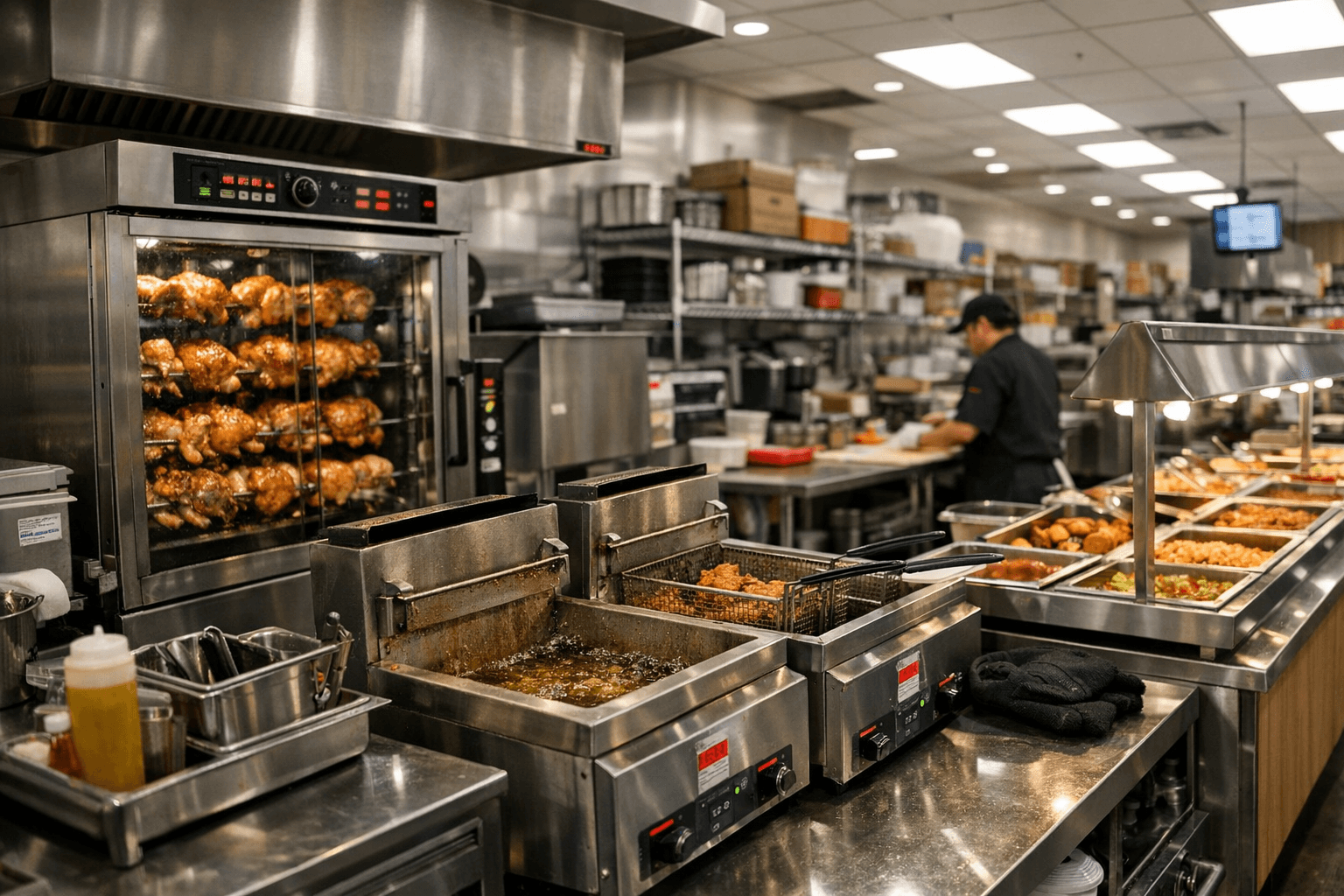
A grocery store does not have a fryer, it has a small network of them, and each one fills a container on its own clock. The deli fry station turns over comparatively clean fryer oil on a set change interval. The hot bar adds fried chicken, potato wedges, egg rolls, corn dogs, and tempura, and pushes breading and batter solids into the same stream. The rotisserie line renders heavy chicken fat that stiffens in cold weather and behaves nothing like fryer oil in a pump hose. Bigger grocery stores stack an in-store kitchen, a sushi or wok counter, or a fuel-stop kitchen on the same lot on top of all that. One grocery store can be four generators wearing a single address, and a hauler that quotes it like a one-fryer taqueria sizes the container wrong on day one.
The second problem is ownership. Nobody in a grocery store wakes up owning the cooking oil. The deli manager watches the container fill and has no authority to call anyone. The store director owns the back dock but did not sign the agreement. The chain facilities or procurement team signed it and sits three levels away from the fryer. The sustainability lead needs the gallons at quarter end and has never walked the receiving dock. Oil falls into the gap between those four people, which is why a grocery store usually learns it has a problem when there is a slick on the dock rather than when the container started getting full.
What a grocery operator needs is the opposite of a patchwork: one account covering every fryer at every grocery store under one set of terms, treating a 15-gallon deli exactly like a 200-gallon flagship, working around the receiving window instead of fighting it, and leaving a clean record corporate can pull without phoning the store. Oil Guyz is that account plus the software behind it. Scheduled collection is free and performed by a CDFA-registered transporter, a digital manifest is generated after every single pickup, and the Filtrate dashboard rolls every grocery store up so a regional or sustainability lead sees the whole portfolio while each store manager sees only their own location. It is free because we are paid for the oil, not by you.
Deli & Hot-Bar Oil, Handled
Tell us where your kitchen is. Free locked container, route started this week, no contract or minimum volume.
Grocery delis and hot bars generate steady used cooking oil that's easy to overlook until it overflows. We keep it on a schedule with a free locked bin and clean documentation.
Tell us about your store and we'll set up dependable pickup. No contract, no minimum volume.
- Truly free. We are paid for the oil, not by you
- No contracts. Cancel anytime
- No minimum volume. Any kitchen size
- Free locked, anti-theft bin
- Compliant digital manifest after every pickup
- Instant confirmation, then a real person calls you
Request your free oil pickup
Free bin · No contract · Cancel anytime. You get an instant confirmation that we got it, then a real person calls to set up your pickup. No spam, no robocalls.
Prefer to talk? Call (714) 880-4788
~35 lb/day
used cooking oil from a high-volume fry program, the sizing benchmark for a busy grocery deli (Frontline II)
Every pickup
at every grocery store gets a digital manifest
8 regions
served, with every grocery store on one account
Four Oil Sources Inside One Grocery Store, Sized Separately
Grocery oil is not one stream, and that mix is exactly why a standard route hauler struggles with grocery. Deli fryers give up the cleanest oil in the building on a predictable change interval. The hot bar sends over batter and breading solids that settle and thicken at the bottom of a container. The rotisserie line renders fat with a much higher melting point, so it can read as a full drum in January and still pump slowly. An in-store kitchen, wok station, or sushi counter runs a fifth pattern on top of that. We walk the grocery store, look at what each program actually produces, and size the container and the frequency to that combination instead of dropping the same drum at every address. The deli crew never has to decide what to do with a full container, they keep cooking.
- Container sized to the store's real mix, not a default drum
- Deli fryer oil, hot-bar solids, and rotisserie fat handled in one container
- Frequency set from each location's actual fryer change interval
- Cold-weather rotisserie fat accounted for so a slow drum is not a missed stop
- Free locked container at every grocery store, including the smallest deli
Why Grocery Fried-Food Programs Don't Run Like a Restaurant Kitchen
A single-concept restaurant has one kitchen, one general manager, and one P&L, so whoever owns the fryer also owns whatever leaves it. A grocery store is not built that way. The deli or prepared-foods department is usually specified, staffed, and measured against a fresh or perishables category plan set at the division or corporate level, a program written by people who have never seen your receiving dock. The bakery department runs its own separate reporting line and its own equipment standards, and at stores where the bakery fries rather than only bakes, that fryer answers to bakery category leadership, not to the deli. A hot bar or rotisserie program is frequently a company-wide format decision, the same equipment, the same oil, the same change interval at every store in the banner, set once at headquarters and then executed by whichever crew happens to be on shift that day. Three fryers, three separate corporate reporting chains, and none of them was ever built with a fourth job in mind: arranging for what the fryer leaves behind. That gap is also getting wider, not smaller. Retail deli-prepared foods captured 28 percent of the share of diners who choose deli over a restaurant meal in 2025, more than double the 12 percent share in 2017, and retail foodservice dollar sales rose 1.6 percent to $52.1 billion over the past year, according to FMI, The Food Industry Association. As more grocery banners lean into fried and prepared programs to capture that growth, the oil volume behind the deli case keeps climbing at exactly the stores where nobody was ever assigned to manage it.
- Deli and prepared foods reports through a fresh or perishables category plan set above the store, not the store's own P&L
- Bakery fry programs, where they exist, answer to a separate bakery category chain with its own equipment standards
- Hot bar and rotisserie formats are often specified company-wide at headquarters, then simply run by whichever crew is on shift
- Three fried-food sources can sit on three separate corporate reporting lines inside a single store
- Retail deli-prepared foods grew from a 12% to a 28% share of diners choosing deli over restaurants, 2017 to 2025 (FMI)
- None of those reporting lines was ever built with a fourth job in mind: arranging for the oil the fryer leaves behind
Why Grocery Store Oil Volume Is Steady Instead of Spiky
A restaurant's oil production swings with the dinner rush and the weekend. A grocery store's does not, and that single difference changes how the route should be built. A supermarket deli fries to a par sheet and a hot-case hold time, so it drops roughly the same product volume Monday as it does Saturday. The rotisserie line runs a fixed spit schedule from morning set to close. Fryer oil is changed on a written interval rather than by feel. The result is a flatter, more predictable week than almost any restaurant produces, and a fixed schedule holds at a grocery store far longer before it drifts. What moves grocery volume is the calendar, not the clock: Thanksgiving, Super Bowl Sunday, holiday party trays, and back to school all pull the hot bar hard for a defined stretch. We set the base schedule off your real change interval and add the peak visits to the calendar in advance instead of waiting for a store to call in an overflow.
- Base schedule built from each store's documented change interval
- Flat weekday-to-weekend production means the schedule drifts less
- Known grocery peaks scheduled ahead, not handled as emergencies
- Holiday and game-day frequency raised for the stretch, then returned to normal
- No flat gallon minimum, so a small deli is never told it does not qualify
Scheduling a Grocery Pickup Around the Receiving Dock
At a grocery store the container almost never sits near the deli. It sits on the receiving dock or the compactor pad, sharing space with the baler, the cardboard bunker, pallet jacks, and a queue of DSD vendors. That creates constraints a restaurant stop simply does not have. A dock door cannot be blocked during a bread, dairy, or direct-store-delivery window. Some grocery stores share a dock with the pharmacy or with a beverage drop. Many shopping centers carry a noise ordinance that pushes the first service of the day later than the store would like. A compactor pad is often reachable from exactly one approach angle. On setup we record the grocery store's receiving hours, its blackout windows, gate or bollard access, and the name of the receiving lead, and the stop is routed around all of it. We will not promise a 30-minute arrival window at your dock, because nobody actually driving a route can honor one. Phones are answered 24 hours a day by a real person, so when a dock is blocked or a container is full early, somebody hears about it immediately.
- Receiving hours and blackout windows recorded per store at setup
- Routed around DSD, bread, dairy, and beverage delivery windows
- Gate codes, bollards, and compactor-pad approach noted on the stop
- Named receiving contact on the account so the driver is not hunting
- Phones answered 24 hours a day by a real person, never a ticket queue
Who Actually Owns Cooking Oil Inside a Grocery Store
The reason grocery oil gets orphaned is that the person who sees the problem and the person who can fix it are never the same person. Grocery deli managers see the container first and have no vendor authority. Store directors own the dock but inherited the agreement. Chain facilities or procurement holds the contract and rarely hears about a single store until it escalates. Sustainability needs gallons at quarter end and has no line into the back room. We build the account to match that reality instead of pretending it away: terms are set once at the chain or ownership level, and day-to-day requests move at the grocery store level. A deli manager or night closer can flag a full container or request an extra pickup from the mobile app without a purchase order, an email chain, or a call to corporate, and corporate still sees every request in the same dashboard.
- Agreement signed once at the chain or ownership level, not store by store
- Deli and hot-bar staff can request a pickup without corporate approval
- Store-level requests visible to corporate in the same dashboard
- A named human contact instead of a rotating call center
- Role-based access, so each store sees only its own location
Rolling One Oil Program Across Every Grocery Banner
A multi-banner grocery rollout fails in predictable places, so we run it in a fixed order. First a container survey at each grocery store: what equipment is there now, who legally owns it, where it sits relative to the compactor, and what the current change interval is. Next a staggered cutover by district rather than a single chain-wide switch date, so the outgoing provider's equipment is pulled before ours lands and no store is left with two drums or none. Then the reporting is wired up by banner and by region so each operating group sees its own stores. New grocery stores join by a schedule update and inherit your existing terms on day one, which is what keeps a new store from opening with no oil account for its first two months. Closed or sold stores come off the account cleanly, with no penalty maze and a full data export.
- Container survey per store before anything is scheduled
- Staggered district cutover so no store ends up with two drums or none
- Reporting split by banner and region for each operating group
- New grocery store openings inherit chain terms on day one
- Closed or sold stores removed cleanly, no penalty maze, full data export
What Goes Wrong at Grocery Stores, and How We Head It Off
Every recurring grocery failure we see traces back to something physical in the back room. A baler or a stack of pallets gets parked in front of the container and the driver cannot reach it, so the stop is logged as blocked instead of quietly skipped and the store hears about it the same day. A closing crew pours hot oil into a container that is already at capacity. A cold snap thickens rotisserie fat so a drum reads full while pumping slowly. A remodel moves the receiving door and nobody tells the service provider. Back-dock shrink is real in grocery, so every container we place is locked, which protects both your volume and the accuracy of your record. A grocery store that changes fryer oil more often after a menu change quietly outgrows its schedule, which is why we compare logged gallons against the schedule instead of waiting for a complaint.
- Blocked containers logged and reported, never silently skipped
- Locked container at every location, which also protects the record
- Cold-weather rotisserie fat handled as a known condition, not a surprise
- Logged gallons compared against the schedule to catch a store outgrowing it
- Remodels, door moves, and menu changes updated on the account, not rediscovered
One Manifest and One Dashboard for Every Grocery Store
California requires a manifest for every commercial used cooking oil pickup, documenting chain of custody to a licensed renderer, and a grocery deli is not exempt because it is small. A digital manifest is generated the moment a pickup is complete, for a 15-gallon deli exactly as for a 200-gallon flagship. Electronic manifests are explicitly legal under the state Uniform Electronic Transactions Act, the legal minimum retention is two years, and we keep ours for two as company policy. All of it lands in Filtrate, where every grocery store's pickups, schedules, containers, and manifest history sit in one place with role-based access. Pull an audit-ready export for a single grocery store, a district, or the whole chain in a couple of clicks, so a health inspector asking about deli grease, a corporate auditor, or a landlord inquiry is answered from one searchable archive instead of a binder nobody can find.
- Digital manifest generated after every pickup at every store
- Documented chain of custody from each store to a licensed renderer
- Same documentation for a low-volume deli as a high-volume hot-bar store
- Two-year legal minimum retention, two years kept as company policy
- Audit-ready export for one store, a district, or the entire chain
Grocery Deli Oil as a Number You Can Actually Report
Every gallon collected from your grocery delis, hot bars, and rotisserie lines is recycled through our licensed renderer into biodiesel and renewable-diesel feedstock, which makes it a measurable line for a corporate sustainability report rather than a vague claim. The published figures behind it are worth stating once: renewable diesel cuts carbon intensity by about 65% on average versus petroleum diesel, and waste-feedstock used cooking oil fuels deliver roughly 79 to 86 percent lower lifecycle greenhouse-gas emissions. What makes it reportable for a grocery operator is the bookkeeping underneath. Gallons are documented per grocery store and rolled up by banner, so a diverted-oil figure for a district or the whole chain carries a manifest trail instead of an estimate.
- Grocery deli oil recycled into biodiesel and renewable-diesel feedstock
- ~65% average carbon-intensity reduction versus petroleum diesel (DOE/CARB)
- ~79-86% lower lifecycle GHG from waste-oil fuels (Argonne National Laboratory, Environmental Science & Technology, 2022)
- Documented gallons per store, rolled up by banner and district
- A manifest trail standing behind every sustainability figure
Built for Every Kind of Grocery and Hot-Food Operation
Grocery Chains and Supermarket Banners
Regional and national grocery operators standardizing cooking oil collection across every store: one account, consolidated reporting, and chain-wide status instead of a separate hauler relationship at each location.
Independent and Ethnic Grocery Markets
Family-owned grocers and Asian, Latin, and Middle Eastern markets running large hot food counters, wok stations, and deep fryers that produce restaurant-level oil volume from a grocery footprint.
Deli, Hot-Bar and Rotisserie Programs
Grocery stores running fry stations, hot bars, and rotisserie chicken lines that need a container sized for a mix of fryer oil and rendered fat, serviced before a holiday weekend overruns it.
Convenience and Fuel-Stop Stores
C-stores and fuel-stop kitchens running roller grills and small fryers: low volume that most haulers refuse, with the same documentation requirement as any commercial kitchen.
Grocery Sustainability and Facilities Teams
Environmental, ESG, and facilities leads who need documented diverted-oil gallons per store and chain-wide, exportable for reporting and for audits, without calling each location.
Multi-Banner Grocery Operators
Operators running several grocery formats or banners who want one program across every concept under consistent terms, with each store seeing only its own location.
Grocery-Ready Oil Collection vs. a General Waste Hauler
Low-volume grocery deli
Container sizing
Receiving-dock access
Manifest
Chain reporting
Container security
Term
Equipment terms
What's Included
Everything you need, nothing you don’t.
- Free scheduled cooking oil collection for grocery deli, hot-bar, and rotisserie programs
- A free locked collection container sized to each grocery store's oil mix
- Pickup frequency set from each store's real change interval, no flat gallon minimum
- Receiving hours, blackout windows, and dock access recorded per grocery store
- Pickup performed by a CDFA-registered transporter
- A digital manifest generated after every pickup at every location
- The Filtrate portal: one dashboard covering every grocery store you run
- Role-based access, so corporate sees all stores and each manager sees theirs
- A mobile app so deli staff can request a pickup or flag a full container
- Audit-ready exports for one grocery store, a district, or the whole chain
- Documented diverted-oil gallons for corporate sustainability reporting
- Month-to-month terms, no lock-in, clean data export on exit
- A real person who answers, with a callback the same business day
How Restaurant Oil Collection Works In 3 Simple Steps
Set up restaurant oil collection in about five minutes. We confirm your route the same business day and drop a free bin before your first pickup. After that, Oil Guyz handles every used cooking oil pickup on schedule. You never chase a hauler again.
Request Pickup
Fill out a 30-second form or call us. No credit card, no commitment.
Pickup Day Is Pickup Day
Your scheduled window is locked in. A CDFA-registered transporter completes the pickup, pumps your container empty, and we email your digital manifest the moment the work is logged.
Stay Compliant Automatically
Get digital manifests, pickup confirmations, and compliance records, all in your dashboard.
Frequently Asked Questions
Yes. We do not set a gallon minimum that shuts grocery delis or convenience stores out. A deli producing 15 gallons a week gets the same fixed schedule, the same digital manifest, and the same locked container as a high-volume hot-bar store. Many general haulers treat low-volume grocery accounts as unprofitable and simply refuse them; we route grocery and convenience stops efficiently so the store is covered rather than skipped.
It depends on the program, but the benchmark is useful: a single high-volume fry operation generates roughly 35 pounds of used cooking oil per day, about 12,775 pounds a year. A grocery deli with a couple of fryers and a rotisserie line usually falls below that, while a market with a large hot food bar and wok stations can match or beat it. Rather than guess, we set the container size and the frequency from your documented fryer change interval and the logged gallons over the first several visits. Source: Cooking Oil Collection for Fast Food, Frontline II
Retail deli-prepared foods captured 28% of the share of diners choosing deli over a restaurant meal in 2025, up from 12% in 2017, and retail foodservice dollar sales rose 1.6% to $52.1 billion over the past year, according to FMI, The Food Industry Association. As grocery banners expand fried and hot-food programs to capture that growth, the oil volume behind the deli case rises fastest at exactly the stores that were never organized to manage a waste stream, since the deli, the bakery, and the hot bar typically report through separate corporate category structures rather than one kitchen. Source: FMI, The Power of Foodservice at Retail 2025
At setup we record the grocery store's receiving hours, its delivery blackout windows, gate or bollard access, compactor-pad approach, and the name of the receiving lead, and the stop is routed around them so we are not competing with a bread, dairy, or DSD delivery for the same dock door. What we will not do is promise a 30-minute arrival window, because nobody actually running a route can honor one. If a container is blocked when the driver arrives, it is logged as blocked and reported rather than quietly skipped, and phones are answered 24 hours a day by a real person if a store needs to reach us.
Almost nobody, which is the point. Terms are set once at the chain or ownership level. After that, a deli manager, hot-bar attendant, or night closer can flag a full container or request an extra pickup from the mobile app without a purchase order or a call to corporate, and corporate still sees every request in the same dashboard. The only per-store information we need up front is the receiving contact, the dock hours, and the current fryer change interval.
Yes. One account covers every grocery store and banner, with consolidated reporting and a single point of contact. We start with a container survey at each store, cut over district by district so no location ends up with two drums or none, and split the reporting by banner and region. New grocery stores join by a schedule update and inherit your terms on day one; closed or sold stores drop off cleanly with no penalty maze. Pricing is structured against your combined volume instead of each store bargaining alone.
Yes. California requires a manifest for every commercial used cooking oil pickup, documenting the chain of custody to a licensed renderer, and that applies to a grocery deli exactly as it does to a restaurant. You get a digital manifest after every pickup at every store, and electronic manifests are explicitly legal in California when they conform to the state Uniform Electronic Transactions Act. The legal minimum retention is two years; we keep ours for two as company policy. See the rule at California Code of Regulations Title 3 §1180.24, UCO Manifests and the program at CDFA Meat, Poultry & Egg Safety / Inedible Kitchen Grease Program
Call or send the form and you get a callback the same business day. Once the store is set up, the first pickup is typically 3 to 5 business days out, and the container is placed at or before that first visit. For a multi-store rollout we sequence it by district rather than switching every grocery store on the same date, so the outgoing provider's equipment is pulled before ours arrives.
Every gallon leaves the grocery store and is recycled through our licensed renderer into biodiesel and renewable-diesel feedstock. Renewable diesel reduces carbon intensity by about 65% on average versus petroleum diesel (DOE AFDC, Renewable Diesel), and waste-feedstock used cooking oil fuels deliver roughly 79 to 86 percent lower lifecycle greenhouse-gas emissions (Argonne National Laboratory, Environmental Science & Technology, 2022). Gallons are documented per grocery store, so the diverted-oil figure you report carries a manifest trail behind it.
Because we are paid for the oil, not by you. Used cooking oil is a commodity feedstock, so the value of the material covers the service, which is why scheduled pickup, the locked container, the manifest, and the dashboard cost a grocery store nothing. There is no sole-provider clause, no fresh-oil purchase requirement, and no equipment lien filed against any location. For genuinely high-volume operations, generally around 250+ gallons per month at a store or across a consolidated chain, a rebate may apply; that is handled case by case rather than promised up front, so tell us your store count and volume and we will look at it honestly.
We serve grocery stores in Orange County, Los Angeles, San Diego, the Inland Empire, the San Francisco Bay Area, and Pierce, King, and Snohomish Counties in Washington, and we are expanding. If your grocery stores sit inside those regions, the whole chain can go on one account. If you have locations outside the current footprint, tell us where they are and we will let you know as we expand; we never imply coverage we do not have.
What Our Clients Say

Bryan Baird
Google review
“We are a medium sized institutional kitchen located in San Juan Capistrano. When we needed a certified oil and grease removal partner the Oil Guyz were there. Fantastic customer service, fast, reliable, quick follow up and very efficient. They make it super easy to leave a GREAT review!”See full review

Alex Camacho
Google review
“I'm an up and coming new food vendor and properly disposing of used frying oil was a difficult task. That is until I contacted the Oil Guyz! There webpage made it easy to setup their free service of oil pickup. Within a few days I had a free container to store the used oil until ready for the free pickup. This service is very convenient and Joey has been very accommodating to answer all my questions and facilitate the process.”See full review

Ujwal Chaudhary
Google review
“Great service from Oil Guyz! They came and picked up my full barrel of used cooking oil completely free of charge. The process was easy, quick, and professional. I really appreciate their excellent customer service and reliable pickup. If you have used cooking oil that needs to be collected, I definitely recommend Oil Guyz. Great company and great people! 👍”See full review

Nicholas Saccoccia
Google review
“Excellent experience with Oil Guyz! They got me on the schedule fast, showed up on time, were very professional, and were in and out in no time! I would absolutely use them again.”

LA BREAKFAST CASITA
Google review
“We’ve had a great experience with Oil Guyz! I submitted a quote request through their website for our restaurant, and Joey reached out to us right away. From our first conversation, he has been extremely helpful, patient, and responsive. Joey really made the whole process easy for us. He was willing to work with our team on the best location for the bin, answered all of our questions, and kept in touch to make sure everything was taken care of. I especially appreciate his follow-through and willingness to help without ever making us feel rushed. Good customer service can be hard to find, and Joey has definitely made a great impression on us. We’re very happy we chose Oil Guyz for our used commercial oil pickup service at LA Breakfast Casita in Azusa, CA. Thank you, Joey, for making the process so smooth and for taking such good care of us. We look forward to working with Oil Guyz for a long time!”See full review

Mike Fishman
Google review
“Superb service!”

Celso Bahena
Google review
“I’m in the Santa Ana area great reliable service!”

Myk Espinoza
Oakland Ballers · Oakland, CA · Google review
“These dudes really bailed me out of a tough situation. My previous oil collection service had been really screwing me over. Spent 4 weeks of unanswered phone calls, texts, and empty promises with a company we've been using for two years just to get a used oil recepticle, all to no avail. We were sitting on 6 fryers with of oil I that I had nowhere to put. Called Joey and The Oil Guyz and he got me set up just a few hours later. Used oil container, service agreement, answered all of my questions. We're running a very odd program where our schedule is all over the place, so having a "regular" pick up schedule is out of the question. We worked out a way for quick/easy retrieval in about 5 minutes. Can't recommend these guys enough.”See full review

Maryam Tngrian
Google review
“As a manufacturing bakery, we recently needed a one-time pickup of approximately 3,000 lbs of used donut oil. Unfortunately, there was very little information available regarding the company that had handled this service previously, so I had to start from scratch. I found Oil Guyz online and was impressed from the first conversation. Joey, the owner, was extremely helpful and took the time to walk me through the entire process, making the coordination simple and straightforward. Prior to contacting Oil Guyz, I had attempted to reach other providers and had difficulty getting assistance. Oil Guyz was responsive, accommodating, and easy to work with from start to finish. The pickup was completed within the timeframe communicated, and the team handled the removal seamlessly with no disruption to our operation. Their professionalism and customer service made what could have been a challenging process very easy. We would absolutely use Oil Guyz again and would recommend them to other food manufacturing facilities looking for a reliable used cooking oil recycling partner.”See full review

Kengo Kido
Google review
“Joey took care of our needs quickly, efficiently and professionally. I highly reccoemnd his service to anyone!”

Brenda Wu
Google review
“Prompt response from Joey. Great service with problem solving. Highly recommended!”

Camille Bamford
Google review
“Fast and great to work with!”
Related Resources
Guides
Free Tools
- Grease Trap Calculator
Find your recommended pumping frequency
- Compliance Checker
Check if you meet California grease requirements
Related Solutions
Restaurant Cooking Oil Management
The program backbone: how scheduled pickup, containers, manifests, and the dashboard fit together across many locations.
Learn moreContainers & Equipment
The locked containers, caddies, and pumps we place on a grocery store's receiving dock, including sizing for a deli and rotisserie mix.
Learn moreMulti-Location Cooking Oil Collection
One agreement across every store and banner, add or remove locations without re-papering, consolidated billing, month-to-month.
Learn moreGet Every Grocery Store's Deli and Hot-Bar Oil on One Account
Tell us how many grocery stores you run, where they are, and what the deli, hot-bar, and rotisserie programs look like. You get a callback the same business day, and a first pickup typically 3 to 5 business days out. Free scheduled collection, a locked container at every store, a manifest after every visit, and one Filtrate dashboard chain-wide, month-to-month with a clean exit. Stores outside our regions? We will note them and tell you as we expand.
Or call (714) 880-4788 and talk to a real person today.