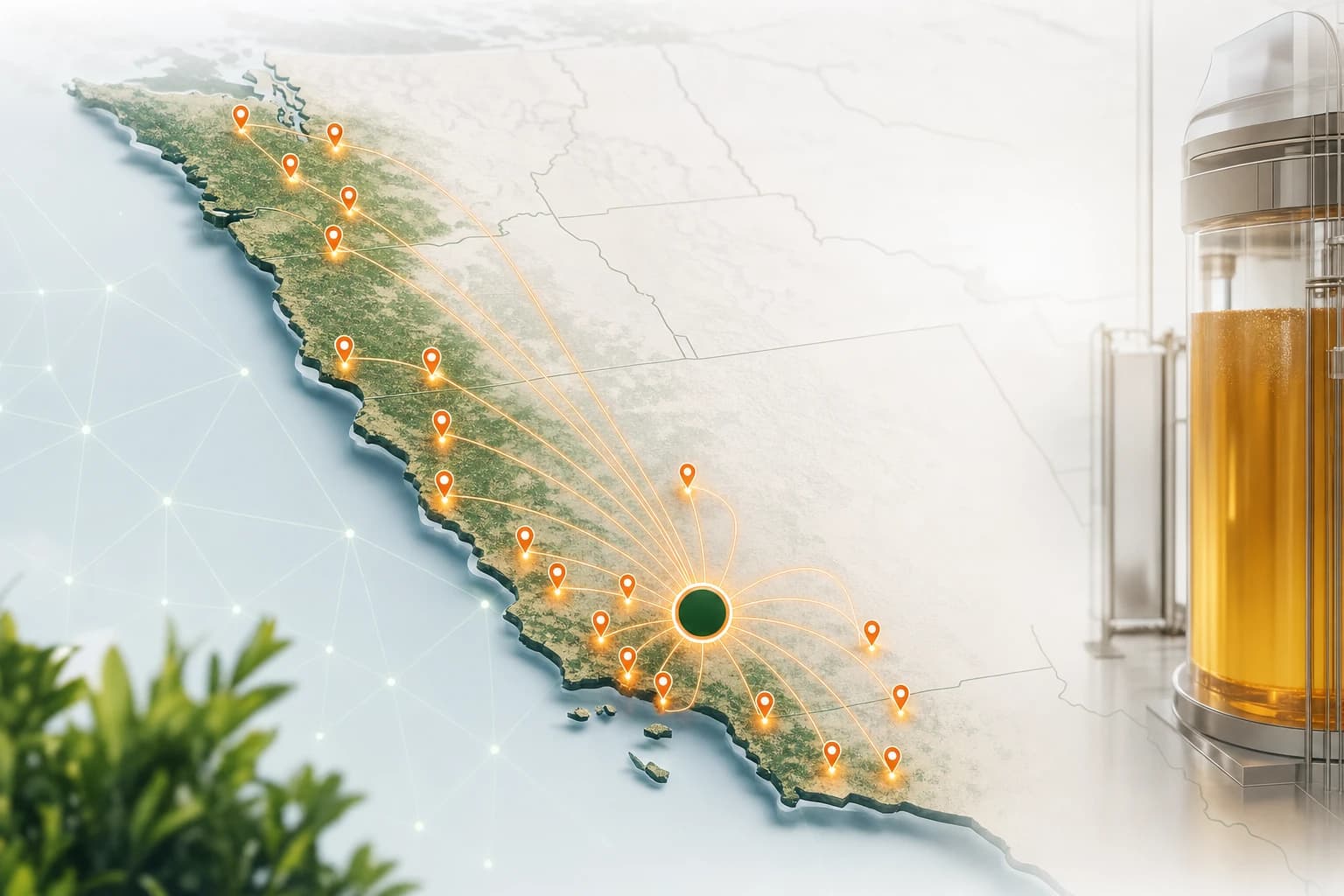
Restaurant Cooking Oil Management: One Program Across Every Location
Oil Guyz runs oil management for restaurant groups across six West Coast markets. Call (714) 880-4788 to schedule service. Free scheduled pickup, a free locked container at each kitchen, a digital manifest after every visit, and one dashboard your whole company logs into. Month-to-month, and the phone is answered 24/7 by a real person.
Quick Answer
Restaurant cooking oil management means running used oil pickup, documentation, and reporting for every location under one vendor and one system instead of a separate hauler at each site. Real oil management gives you free scheduled pickup, a free locked container per kitchen, a digital manifest after each visit, and a dashboard corporate and unit managers share.
Get Your Free Pickup Set Up
Tell us where your kitchen is. Free locked container, route started this week, no contract or minimum volume.
- Truly free. We are paid for the oil, not by you
- No contracts. Cancel anytime
- No minimum volume. Any kitchen size
- Free locked, anti-theft bin
- Compliant digital manifest after every pickup
- Instant confirmation, then a real person calls you
Request your free oil pickup
Free bin · No contract · Cancel anytime. You get an instant confirmation that we got it, then a real person calls to set up your pickup. No spam, no robocalls.
Prefer to talk? Call (714) 880-4788
Most Restaurant Groups Do Not Have Oil Management, They Have Twelve Separate Hauler Relationships
Almost nobody buys used oil collection the way they buy everything else. Linens, produce, dry goods, and the point-of-sale stack get negotiated centrally, with one vendor record and one accounts-payable touchpoint. Grease stays whatever the opening manager arranged at the back door, and it stays that way for years. Multiply that by twenty-five kitchens and you are administering something nobody owns: a different collector per site, a different schedule, a different way of proving a pickup happened.
The cracks show at the worst moments. A district manager is chasing a pickup that silently stopped at one site while a general manager two counties away cannot produce last quarter's paperwork for a health inspection. Operators describe the same pattern with the big national haulers again and again: multi-year terms with auto-renewal, financing statements filed against the operating entity, calls that route to a center where nobody has ever seen the kitchen, and invoices nobody can reconcile. The contract created the appearance of consolidation while the service stayed exactly as fragmented as before.
Oil management fixes both problems at once, because it is two things bolted together: an accountable service relationship, and software that makes the service provable. Free scheduled pickup performed by a CDFA-registered transporter, a digital manifest generated the moment each pickup completes, and one dashboard where corporate sees every site, each general manager sees theirs, and an inspector request is answered from a single searchable archive. One account, one real person who answers, month-to-month terms. It is free because we are paid for the oil, not by you. See what this looks like for a single restaurant kitchen before scaling it across a group.
6 regions
served, and expanding
Month-to-month
no long-term contract
Every pickup
digital manifest
One Account, One Named Contact, Every Location
Your whole group runs on a single account with one real person who knows your sites, not a call center and not a different owner per territory. Add or remove a kitchen as you open, close, or acquire, without renegotiating anything. When a site needs a pickup moved or a container swapped, one message reaches someone who already knows that address. That is the service side of oil management, and it stays month-to-month, so we earn every location by showing up rather than by locking you in.
- One account and one named contact across every location you run.
- Phones answered 24/7 by a real person, and we call back the same business day.
- Add or remove locations as you grow, with no new contract.
- Month-to-month, cancel anytime, no liens, no fresh-oil purchase requirement.
- Proactive outreach before a container fills, and no location is ever quietly dropped.
The Filtrate Dashboard: Every Site in One View
The software side of oil management is what makes twenty-five kitchens manageable. Every location's pickups, schedule, container, manifests, and history live in one place, with role and hierarchy access so corporate sees all sites while each general manager sees only theirs. Pull audit-ready exports for one address, a region, or every site at once. Each location also gets its own mobile app, so the person standing next to the fryer can request an off-cycle pickup without routing it through corporate.
- Pickups, schedule, container, and service history for every location.
- Role and hierarchy access, corporate sees all sites, each GM sees theirs.
- Audit-ready exports by location, by region, or across the group.
- Per-location mobile apps so each kitchen can request service directly.
- Every digital manifest stored and searchable in one archive.
Proof of Service: A Digital Manifest After Every Pickup
A manifest is required for every collection and delivery of inedible kitchen grease, and ours is generated the moment a pickup completes rather than reconstructed in an office later. That difference matters more than it sounds. A record created at the kitchen carries a contemporaneous gallon count and signature, so a disputed pickup becomes a lookup instead of an argument. Every manifest documents chain of custody from that kitchen to a licensed renderer.
- A compliant digital manifest generated at the kitchen after every pickup.
- Documented chain of custody from each site to a licensed renderer.
- State minimum retention is two years; we hold manifests two years as company policy.
- One-click export for inspectors, insurers, and franchise audits.
- Electronic manifests are explicitly permitted under 3 CCR 1180.24, provided the record and signatures conform to the California Uniform Electronic Transactions Act.
Free Pickup, a Free Locked Container, a Schedule Sized to the Kitchen
Every location gets free scheduled pickup and a free locked collection container, with no equipment deposit and no lien filed against your business. The schedule is set from the kitchen, not from a route sheet: fryer count, vat capacity, and how often that menu actually forces an oil change. A wing concept and a salad-forward concept in the same square footage are not the same account, and oil management that ignores the difference produces either overflow or half-empty trucks. It is all free because we are paid for the oil we collect, not by you.
- Free scheduled pickup at every location, no charge to the site.
- Free locked container per kitchen, no deposit and no lien.
- Schedule set from fryer count, vat capacity, and menu, then corrected on real fill data.
- Honest, readable invoicing, with no surprise sensor or install charges.
- Fast, free onboarding whenever you add a location.
The Oil Management Scorecard: Seven Questions and What Each Answer Reveals
Most operators evaluate on one question, what does it cost, and then discover the real differences a year in. Run a short scorecard against every vendor instead. Each question below was chosen because the answer exposes how the operation works rather than how the pitch deck reads, and none of them can be answered well by a company that does not already do the thing. Ask the same seven of everyone and write the answers down. Vendors that look identical on price separate almost immediately, and they separate before you have committed a single kitchen. Contract structure and group pricing get their own full treatment on the multi-location contract page.
- Ask to see a real manifest from a pickup that happened this week. Reveals where the record is created. If producing one takes days, the paperwork is assembled after the fact, the gallon figures are estimates, and a disputed pickup has no contemporaneous proof.
- Ask who physically performs the pickup in each of your markets, by name, then check that name against the state register of licensed grease transporters. Reveals whether accountability survives a county line. A different owner or subcontractor per territory means the standard you agreed to gets renegotiated every time the map changes.
- Ask to log into the dashboard before you sign, with real data in it. Reveals whether the software exists. A live system and a monthly PDF emailed to one person both get called a portal, and only one of them answers a question you did not think to ask in advance.
- Ask what happens the day a pickup is missed at site 47. Reveals whether there is an exception process at all. Real oil management names the human, the notification, and the recovery window. A hauler offers a general phone number and hopes you call it.
- Ask how long manifests are kept, who can pull them, and whether you get them if you leave. Reveals whose records they are. Two years is the state floor, so a vendor sitting exactly at the floor leaves you thin the first time an audit or an insurer reaches back further.
- Ask whether corporate sees every site in one view while each general manager sees only their own. Reveals whether the product was built for one restaurant or for a group. Without role scoping, twenty locations means twenty logins and a spreadsheet somebody maintains by hand.
- Ask exactly what leaving looks like: notice period, equipment liens, sole-provider language, and whether you get a full export of your own history. Reveals how much of the relationship depends on you being unable to leave.
Real Oil Management vs. a Hauler With a Spreadsheet
A hauler sells you a truck visit. Oil management sells you a documented, queryable record of every truck visit across every kitchen you run. At one location the difference is invisible, because a single general manager can simply remember whether the driver came. At twelve locations it is the entire job. The question stops being did the truck come and becomes can I prove, for any site and any date range, that it came and where the oil went. Pickup is performed by a CDFA-registered transporter either way, so the truck is not what you are choosing between. You are choosing between having a record and not having one.
- A hauler's proof of service is a paper ticket or a line on an invoice. A program's proof is a digital manifest created at the moment of pickup.
- A hauler answers whether site 47 was serviced last Tuesday with a call to dispatch. A program answers it with a filter.
- A hauler onboards a new store when someone remembers to call. A program has the site, its container, its schedule, and its own archive live from day one.
- A hauler's records live wherever the hauler keeps them. Yours are yours, exportable by location, by region, or across the group.
- A hauler scales by adding trucks. Oil management scales by adding sites to a system that already knows how to report on them.
Six Numbers That Tell You Oil Management Is Working
Once the program is running, you keep it honest by watching a handful of operational numbers instead of waiting for a general manager to complain. Each is visible per location, per region, or across every site, so you are never asking a vendor to send you a report that grades its own work. Each also tells you something different. Two flag a schedule that does not fit the kitchen, two flag an access or compliance gap, and one is often the first sign that oil is leaving a site through a route nobody approved.
- Manifest completeness. A manifest is required for every pickup, so the target is 100%, and anything short of it is a compliance gap rather than a paperwork gap.
- Container fill level at pickup. Routinely half empty means the schedule is tighter than the kitchen needs. Routinely at capacity means the opposite, and that is where spills and overflow start.
- Missed and rescheduled pickups by site. One location with a repeating pattern is almost always an access problem, a gate code, a blocked enclosure, or a delivery window, and not a driver problem.
- Gallons collected per site per month, compared against fryer count and sales volume. A kitchen producing far less than its peers is either losing oil or sending it down a drain, which is precisely what local fats, oils, and grease ordinances exist to prevent.
- Actual days between visits versus the published schedule. That drift is the earliest warning that a route is under strain, and it appears well before a pickup is missed.
- Share of sites with a locked container in service. A container that is missing, damaged, or left unlocked is the most common reason a site's gallons stop matching its fryer count.
Where Oil Management Breaks in Month Four
Programs rarely fail in week one, because the first visit is always the strongest one a vendor will ever deliver. Oil management tends to break later, and it breaks in a small number of predictable ways. Knowing the failure modes in advance is most of what separates an operator who runs a program from one who is administered by a vendor, so put each of these on someone's job description before rollout rather than after the first overflow.
- The container was sized to the proposal instead of the kitchen. It overflows in December and sits half empty in February, and the fix is a schedule adjustment on fill data, not a louder complaint.
- Access changed and nobody told the driver. A gate code rotates, a remodel moves the container indoors, a new tenant padlocks the enclosure. This reads as a missed pickup and gets blamed on the vendor, when the resolution lives at the site.
- Acquisitions bring their own contracts. Buy eight stores and you inherit eight legacy agreements. Unless somebody reconciles the vendor list against the new account, two of those trucks keep rolling and keep billing for months alongside yours.
- Closures and remodels stay on the schedule. A truck rolls to a dark kitchen, the route absorbs the cost, and the site still shows service activity in a report nobody reads closely.
- Manifests get re-keyed in an office. Once the record is created away from the kitchen, the gallon count is somebody's recollection, and the compliance value of the whole program quietly evaporates.
- Franchisees are asked instead of sold. A franchisor can standardize terms but usually cannot compel a franchisee onto a vendor, so adoption depends on the corporate deal being obviously better at the unit level.
- Seasonality is ignored. Stadium, campus, and resort-market kitchens can multiply their output in a season, and a schedule that fit in April becomes a spill risk in October.
Pilot Three to Five Locations Before You Roll Out
You do not have to move a hundred kitchens at once to learn whether a vendor is real, and you should not. Pilot oil management first, and choose the pilot sites so the test is honest. Take your highest-volume kitchen, your hardest-access location, and a site in a second region if you operate across more than one of ours. Easy sites prove nothing, because almost any vendor can service a clean loading dock on a quiet street. Write the pass bar down before the first pickup so you judge the pilot against a standard rather than a feeling.
- Pick 3 to 5 sites deliberately: highest volume, hardest access, and a second region if you have one.
- Run it 60 to 90 days, so you see several full cycles per site instead of one good first visit.
- A fair pass bar: 100% manifest completeness, no missed pickup without a documented exception, no container at capacity on arrival, and the same named contact answering every time.
- Getting each pilot site live takes a call back the same business day and a first pickup in 3 to 5 business days.
- Judge the pilot on gallons collected and manifest history against what those sites did before, not on impressions.
- Expand in waves by region, adding locations to the same account and the same dashboard as you go.
Who Owns Oil Management: Corporate, Regional, and Unit Managers
Oil management fails in the gaps between roles more often than it fails on service. Split ownership three ways and write it down, because the most common cause of a stalled program is a problem every level assumed a different level was handling. One rule resolves nearly every case: anything visible at one site belongs to the unit manager, anything repeating across sites belongs to the region, and anything contractual belongs to corporate. Role and hierarchy access mirrors that split, so each person sees exactly the scope they are accountable for.
- Corporate owns vendor selection, the terms, the compliance archive, and reporting, and holds the account-wide view. Corporate also owns the exit: notice period, lien check, and the data export.
- The regional and district level owns schedule fit. It watches missed pickups and fill levels, escalates the pattern rather than the one-off, and onboards new stores in its territory.
- Unit and general managers own the kitchen: container locked and accessible on service day, an off-cycle pickup requested from the location's own app when volume spikes, and the pickup confirmed while a wrong gallon count can still be corrected that same week.
- Finance and accounts payable own one vendor record and reconciliation, and every invoice line ties back to the manifest for that pickup.
- Nobody owns chasing a call center, which is the entire point of a single named contact.
Built for Multi-Location Food Service Operators
Fast Food & Quick Service
High-volume brands needing a consistent schedule, a locked container at every drive-thru, and every unit visible in one view.
Restaurant Groups
Multi-concept groups consolidating onto one account, with centralized manifests and reporting across every concept.
Franchise Systems
Franchisors and franchisees ending the per-territory patchwork, with one accountable team and one dashboard across the system.
Grocery & Deli
Supermarket prepared-foods and deli programs generating steady fryer oil that needs documented, secured collection.
Convenience & Fuel
Convenience chains with hot-food kitchens that need a reliable schedule and clean records across many small sites.
Stadiums & Venues
Arenas, parks, and event venues with many food points and big seasonal swings that need surge-ready, documented collection.
Oil Guyz vs. National Haulers
Who you reach
Service relationship
Proof of pickup
Cross-site visibility
Reliability
Container
Billing
What's Included
Everything you need, nothing you don’t.
- A single account covering every location you run.
- One named point of contact, a real person, phones answered 24/7.
- Free scheduled used cooking oil pickup at every site.
- A free locked collection container per kitchen.
- A compliant digital manifest generated after every single pickup.
- Documented chain of custody from each kitchen to a licensed renderer.
- Two-year manifest retention as company policy, meeting the state minimum.
- The Filtrate dashboard, every location in one view.
- Role and hierarchy access, so corporate sees all sites and each GM sees theirs.
- Audit-ready exports by location, by region, or across the group.
- Per-location mobile apps for in-kitchen pickup requests.
- Month-to-month terms with no liens and no fresh-oil purchase requirement.
How Restaurant Oil Collection Works In 3 Simple Steps
Set up restaurant oil collection in about five minutes. We confirm your route the same business day and drop a free bin before your first pickup. After that, Oil Guyz handles every used cooking oil pickup on schedule. You never chase a hauler again.
Request Pickup
Fill out a 30-second form or call us. No credit card, no commitment.
Pickup Day Is Pickup Day
Your scheduled window is locked in. A CDFA-registered transporter completes the pickup, pumps your container empty, and we email your digital manifest the moment the work is logged.
Stay Compliant Automatically
Get digital manifests, pickup confirmations, and compliance records, all in your dashboard.
Frequently Asked Questions
Every location runs on a single account with one real point of contact and one shared dashboard. Pickups, schedule, container, and digital manifests for each site live in one place, with role-based access so corporate sees all sites while each general manager sees only theirs. You add or remove locations as you grow without renegotiating a contract, and terms stay month-to-month.
Scheduled pickup is free and the locked container at each location is free, with no equipment deposit and no lien filed against your business. It is free because we are paid for the oil we collect, not by you. Invoicing is honest and readable, with none of the surprise sensor or install charges operators describe with some national haulers. For very high-volume sites, roughly 250 or more gallons per month, a rebate may apply, so contact us and we will review your volumes.
Do not take it on trust. Commercial transporters of inedible kitchen grease must be registered with the California Department of Food and Agriculture, and CDFA publishes a searchable register you can check yourself at CDFA Register of Licensed IKG Transporters Ask for the legal name of the company whose truck will actually service your kitchens, then look that name up before you sign anything. If the sales entity and the hauling entity are different, that is not automatically a problem, but you should know it going in rather than discovering it during an audit.
A hauler performs the pickup. Oil management performs the pickup and produces the record, the reporting, and the access control a multi-site operator needs to prove it happened. At a single location the two look identical. Across twelve or a hundred, oil management is what lets corporate confirm whether one specific site was serviced last Tuesday, pull a quarter of manifests for a whole region in one export, and see which kitchens are drifting off schedule. Pickup is performed by a CDFA-registered transporter either way. The difference is the single account, the documentation, and the dashboard built around it.
Yes. A manifest is required for every collection and delivery of inedible kitchen grease, and electronic manifests are explicitly permitted when the record and signatures conform to the California Uniform Electronic Transactions Act. We generate a compliant digital manifest after every pickup and keep it for two years as company policy, against a two-year regulatory minimum, exportable for any inspector or audit. See the regulation at CCR Title 3 §1180.24, UCO Manifest & Electronic Records.
No. The relationship is month-to-month and you can cancel anytime. There are no UCC equipment liens, no auto-renewal traps, no sole-provider clause, and no requirement to buy fresh oil from us in exchange for collection. We earn each location by showing up reliably and proving every pickup with a digital manifest, not by making you hard to lose.
Six markets: Orange County, Los Angeles, San Diego, the Inland Empire, the San Francisco Bay Area, and Tacoma and Pierce County, Washington. We are actively expanding and we do not claim nationwide coverage. If some of your locations sit outside these markets, tell us where they are and we will notify you as we expand. We can still consolidate your in-market sites onto one account today. The FTC requires advertising to be truthful and non-deceptive, including honest disclosure of limits like geographic coverage: FTC, Advertising FAQs: A Guide for Small Business.
Onboarding is fast and free. Send your contact the new site details, we place a free locked container, set the schedule from that kitchen's fryer count and menu, and the location appears in the dashboard on day one with its own manifest archive. There is no setup fee, no equipment deposit, and no new contract, because locations are added under your existing month-to-month account.
It is recycled through a licensed renderer into feedstock for biodiesel and renewable diesel, which gives your brand a reportable sustainability line rather than a vague claim. Renewable diesel reduces carbon intensity by an average of 65% compared with petroleum diesel, per the U.S. Department of Energy's Alternative Fuels Data Center: DOE AFDC, Renewable Diesel.
What Our Clients Say

Myk Espinoza
Oakland Ballers · Oakland, CA · Google review
“These dudes really bailed me out of a tough situation. My previous oil collection service had been really screwing me over. Spent 4 weeks of unanswered phone calls, texts, and empty promises with a company we've been using for two years just to get a used oil recepticle, all to no avail. We were sitting on 6 fryers with of oil I that I had nowhere to put. Called Joey and The Oil Guyz and he got me set up just a few hours later. Used oil container, service agreement, answered all of my questions. We're running a very odd program where our schedule is all over the place, so having a "regular" pick up schedule is out of the question. We worked out a way for quick/easy retrieval in about 5 minutes. Can't recommend these guys enough.”See full review

Maryam Tngrian
Google review
“As a manufacturing bakery, we recently needed a one-time pickup of approximately 3,000 lbs of used donut oil. Unfortunately, there was very little information available regarding the company that had handled this service previously, so I had to start from scratch. I found Oil Guyz online and was impressed from the first conversation. Joey, the owner, was extremely helpful and took the time to walk me through the entire process, making the coordination simple and straightforward. Prior to contacting Oil Guyz, I had attempted to reach other providers and had difficulty getting assistance. Oil Guyz was responsive, accommodating, and easy to work with from start to finish. The pickup was completed within the timeframe communicated, and the team handled the removal seamlessly with no disruption to our operation. Their professionalism and customer service made what could have been a challenging process very easy. We would absolutely use Oil Guyz again and would recommend them to other food manufacturing facilities looking for a reliable used cooking oil recycling partner.”See full review

Kengo Kido
Google review
“Joey took care of our needs quickly, efficiently and professionally. I highly reccoemnd his service to anyone!”

Brenda Wu
Google review
“Prompt response from Joey. Great service with problem solving. Highly recommended!”

Camille Bamford
Google review
“Fast and great to work with!”

John Kim
Google review
“Fast efficient service”

Olivia Valdivia
Google review
“Oil Guyz are A+++!! We had 14 containers of used frying oil from our little league snack bar. They helped us on our last day to meet and pick up our containers. They made it easy, and we will be looking to use them for our next season!! Thanks Joey!!”See full review
Related Solutions
Multi-Location Cooking Oil Collection
The contract side, consolidating every site onto one agreement with group pricing.
Learn moreCooking Oil Compliance
The manifest, retention, and audit-response side in detail, including what an inspector actually asks for.
Learn moreRestaurant Grease Pickup
Single-location service for operators not yet at multi-location scale, with a simpler setup.
Learn moreRestaurant Cooking Oil Management by City
We provide restaurant cooking oil management to restaurants and commercial kitchens across Orange County, Los Angeles, San Diego, the Inland Empire, the Bay Area, and the Tacoma area. Every county hub lists the full route coverage.
Restaurant Cooking Oil Management in San Diego18 cities
See the San Diego hub below for every community on the route.
See all 18 San Diego citiesRestaurant Cooking Oil Management in Tacoma24 cities
See the Tacoma hub below for every community on the route.
See all 24 Tacoma citiesPut Every Location on One Oil Management Program
Tell us about your locations and we will set up one account, place free locked containers, and show you the dashboard. Month-to-month, no long-term contract, and a real person answers. Call or send the form and we will call you back the same business day.
Or call (714) 880-4788 and talk to a real person today.