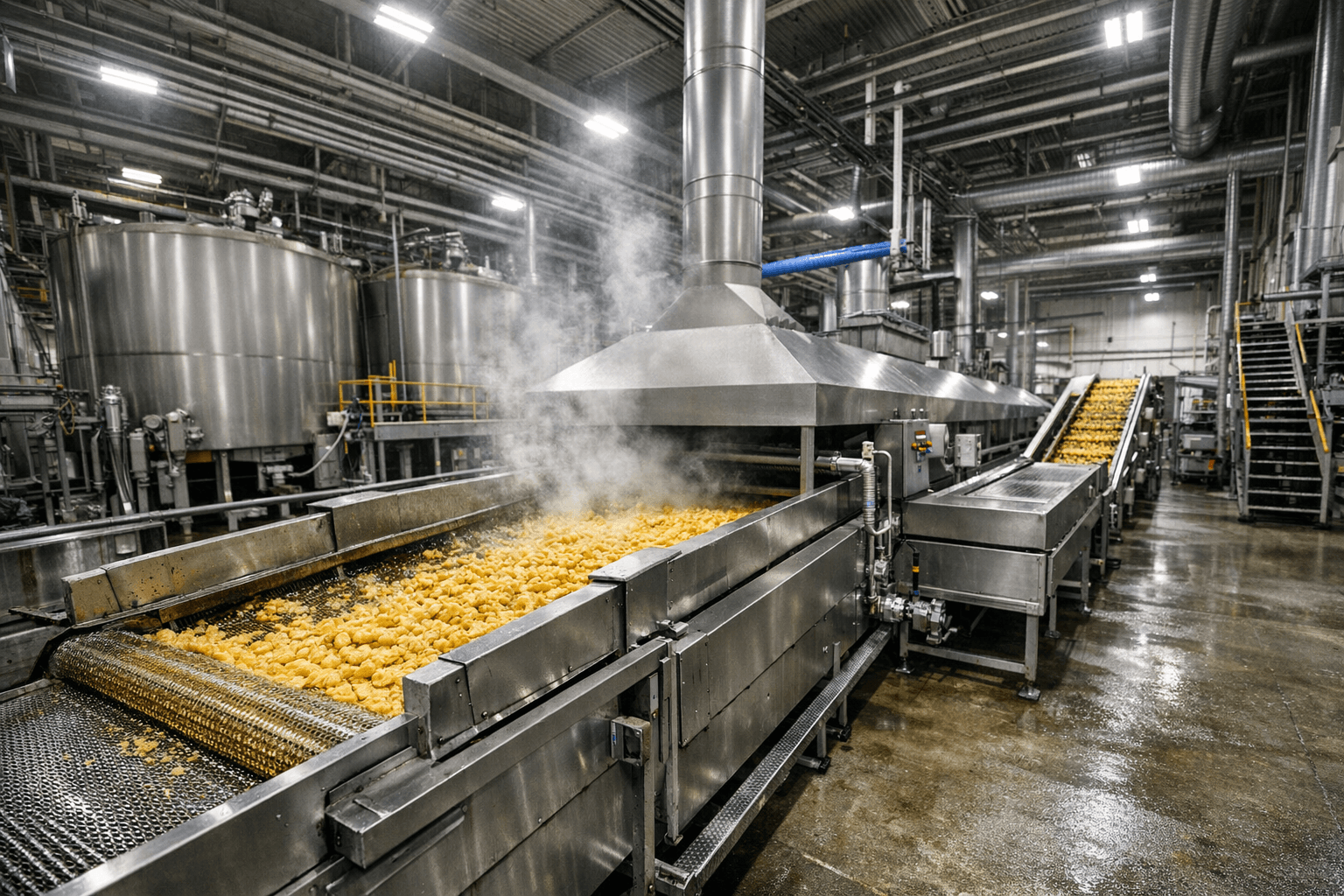
Bulk Cooking Oil Collection for Food Processors, by Tote or Tanker
Oil Guyz provides used cooking oil pickup and recycling for food processors and manufacturing plants in Orange County, Los Angeles, San Diego, the Inland Empire, the Bay Area, and Puget Sound, WA. Call (714) 880-4788. Food processors fill a tank, not a bin. We handle bulk used cooking oil the way a plant actually generates it, pumped out on a cadence set against your run schedule instead of a fixed route day, with a digital manifest after every pull and clean chain of custody to a licensed renderer. Month-to-month, no long-term contract, and a real person answers the phone 24/7.
Quick Answer
Cooking oil collection for food processors is bulk used cooking oil pickup handled by tote, fixed tank, or direct tanker pump-out rather than a wheeled bin. Food processors get a cadence set against production runs, a digital manifest after every pull, and documented chain of custody to a licensed renderer. Month-to-month, no long-term contract.
Food Processors Fill a Tank, Not a Bin, and That Changes the Whole Job
Food processors do not set used cooking oil out at the curb. A restaurant's oil leaves in a container a driver wheels away; a food processor's oil leaves through a hose. Spent oil from a continuous fryer line is dumped hot into a day tank or a holding tank, cooled, and then pumped, so the service depends on details a restaurant never thinks about: what the tank holds, where it sits relative to a spot a tractor-trailer can legally park, what fitting is on the outlet, how long the hose run has to be, and whether the oil is still thin enough to move when the truck arrives. Get any one of those wrong and the driver leaves without the load.
Food processors also do not fill at a tidy weekly rate. A plant runs campaigns: a heavy pack week, a changeover, a seasonal item that doubles output for six weeks and then stops. Oil turnover follows the run, not the calendar. On top of that, the hours a truck can actually be on your dock are narrow. Mornings belong to inbound receiving, the last shift ends and the wet clean-down crew takes the floor, and a driver who arrives in the middle of either one waits or gets turned around. A fixed route day is simply the wrong unit of scheduling for a plant.
Food processors carry a third problem restaurants never see: the load has a grade, and you have to prove where it went. Rendered oil is priced on condition, and a tank quietly taking on wash-down water, condensate, or rain is worth less than the same oil kept sealed and settled. Meanwhile your own quality system needs a record for every tote and tanker load that left the site, tied to a date and a destination, and it has to hold up across three shifts and more than one line. Oil Guyz is built for that version of the job: containment sized to how you actually store the oil, a cadence set against your run schedule, a digital manifest after every pull, and clean chain of custody to a licensed renderer.
Bulk Used Oil, Routed to Biodiesel
Tell us where your kitchen is. Free locked container, route started this week, no contract or minimum volume.
Food manufacturing produces used cooking oil at scale. We run high-frequency or bulk tanker pump-outs from your existing holding tanks, sending every gallon on to become biodiesel and logging it all for compliance.
Fill out the form and we'll design a collection schedule matched to your tank and output. Reliable, compliant, free.
- Truly free. We are paid for the oil, not by you
- No contracts. Cancel anytime
- No minimum volume. Any kitchen size
- Free locked, anti-theft bin
- Compliant digital manifest after every pickup
- Instant confirmation, then a real person calls you
Request your free oil pickup
Free bin · No contract · Cancel anytime. You get an instant confirmation that we got it, then a real person calls to set up your pickup. No spam, no robocalls.
Prefer to talk? Call (714) 880-4788
Tote, tank, tanker
bulk handling, not a wheeled bin
Every pull
digital manifest issued
8 markets
served and expanding
Totes, a Fixed Tank, or a Direct Tanker Pull
Food processors get containment sized to how they actually generate. A smaller plant or a co-packer running one fryer line usually works out of bulk totes on pallets, moved by forklift and swapped full for empty. A plant with steady daily output goes to a fixed outdoor tank near the fence line with a pump-out fitting the driver can reach without ever entering the production area. The highest-volume sites skip intermediate storage and get pulled straight to a tanker. What matters more than the vessel is the connection: a standard cam-and-groove quick-connect the driver already carries a match for, a hose run that actually reaches from the outlet to where a tractor-trailer can legally sit, a sight gauge or level sensor so nobody is guessing how full the tank is, and secondary containment underneath the outlet. In cold months, tank heat or an insulated line keeps the oil thin enough to pump on the first attempt. We walk the yard and look at the outlet before the first collection instead of discovering the problem with a truck idling in your lot.
- Bulk totes, a fixed outdoor tank, or a direct tanker pull, sized to your output
- Standard cam-and-groove quick-connect fittings, no adapter hunt at the dock
- Outlet reachable from where a tractor-trailer can legally park
- Level indication and secondary containment so a fill level is never a guess
- Tank heat or an insulated line where cold weather thickens the oil
Cadence Set Against Your Production Calendar and Sanitation Window
The schedule gets built from your run plan, not from whatever day a truck is already nearby. Tell us the shape of your year, the weeks you run heavy, the changeovers, the seasonal pack that doubles volume, and collection is planned so the tank never climbs to the level where a fryer line has to wait on us. Just as important is the window inside the day. Most plants can only take a truck during one specific stretch: after receiving clears the dock and before wet sanitation owns the floor, or on a weekend day when the lines are down. You name the window and we hold it. When your schedule changes, and it will, a real person picks up 24/7 and moves the pull instead of routing you into a queue. Callbacks come the same business day, and a new account is typically collecting within 3 to 5 business days.
- Cadence built from your run schedule, campaigns, and changeovers
- Pulls held inside the window you name, around receiving and sanitation
- Weekend and off-shift collections where that is the only clean window
- Cadence re-cut when a seasonal pack or a new item changes your fill rate
- A real person answers 24/7, and callbacks come the same business day
Keeping Separate Oil Streams Separate
Plenty of food processors run more than one oil, and the moment those streams merge into a single tank you lose the ability to answer a question about any of them. A peanut or sesame line held away from the allergen-free line. A kosher or halal certified run. Beef tallow kept apart from vegetable oil. An organic campaign that has to stay traceable to a customer. Each of those can be given its own container and its own pickup record, so what leaves the site is documented stream by stream instead of as one anonymous pool. Physical layout matters just as much: the collection point sits outside the production envelope, so a pull never puts a hose, a driver, or outside equipment into a food-contact zone. Plants certified under a GFSI-recognized scheme such as SQF or BRCGS keep records on approved outside vendors and on material leaving the site, and a manifest per pull is exactly what fills that line in the file.
- Separate containers and separate records for streams that must stay apart
- Allergen, certified, and species-segregated runs documented independently
- Collection point kept outside the production envelope
- No outside hose or equipment entering a food-contact zone
- A per-pull record your quality team can hand an auditor without a search
Load Quality: Why a Clean Tank Is Worth More
Rendered oil is graded, and the three things that move the grade are free fatty acid, moisture, and insoluble solids. Each one has a plant-floor cause. Free fatty acid climbs with fry time, oil temperature, and how long the oil sits hot before it is dumped. Moisture arrives from wet product going into the fryer, from condensate, from wash-down water finding an open fill point, or from rain into a tank that is not truly sealed. Insolubles are the breading fines, batter, crumb, and carbon that settle to the bottom. The single most common way a good load turns into a discounted one is water: a tank that took on sanitation runoff or a wet week of weather can drop the grade on oil that was perfectly clean when it left the fryer. The fixes are cheap and mechanical, a sealed lid and a covered fill point, a screen on the transfer, and leaving the settled fines undisturbed rather than stirring the tank right before a pull. We tell you how your loads are grading and what changed, because a clean stream is worth more to both sides.
- Grade moves on free fatty acid, moisture, and insoluble solids
- Water is the usual reason a good load comes back downgraded
- Sealed lid and covered fill point keep wash-down runoff and rain out
- Settled fines stay settled; the tank is not stirred right before a pull
- Feedback on how your loads are grading, not silence until it costs you
Who Owns This Decision Inside the Plant
Used cooking oil sits in an awkward spot on the org chart, which is a real reason bad service survives for years at a food processor. Nobody owns it end to end, so nobody fixes it. In practice five people each hold one piece. The plant manager owns uptime and cares about exactly one thing: the tank never gets full enough to slow a line. The quality or food safety manager owns the paper trail and the segregation rules and has to produce a record on demand. Maintenance and engineering own the tank, the fitting, the heat trace, and the containment pad. Procurement owns the terms and wants to know about auto-renewal and whether any equipment carries a lien against the facility. Sustainability owns the tonnage number and where the oil ends up. One account serves all five, and each of them can pull what they need without going through the others.
- Plant manager: a cadence that never lets a full tank slow a line
- Quality and food safety: a per-pull record plus stream segregation
- Maintenance: fittings, pump-out access, and containment settled up front
- Procurement: month-to-month terms, no auto-renewal, no equipment lien
- Sustainability: volume collected and a documented end use to report
What Goes Wrong at Manufacturing Volume
Failures at a food processor look nothing like a missed restaurant pickup. The tank overfills mid-run because the cadence was set against last quarter's output and nobody re-cut it after a new item launched. A truck arrives with a fitting that does not match the outlet and leaves without the oil. A cold snap thickens the tank, the pump cavitates, and the pull gets pushed. A rainy week plus an open fill point puts water in the tank and downgrades a load that was clean when it left the fryer. A collection lands on top of sanitation, gets bumped a week, and by then the tank is at the ceiling. Or the quietest failure of them all: second shift hands off a load, no record gets made, and three months later quality cannot show where it went. Every one of these is preventable with information we ask for before the first collection instead of after the first problem.
- Cadence re-cut when output changes, not left on last quarter's numbers
- Fittings confirmed in advance so a truck never leaves your yard empty
- Cold-weather pumpability planned for, not discovered at the outlet
- Sealed fill points so weather and wash-down never reach the oil
- Every pull recorded automatically, including off-shift collections
A Digital Manifest After Every Pull
California requires a manifest for every used cooking oil collection, and at plant volume that record is the only thing that proves a load left legally and shows where it went. Every pull generates a digital manifest tied to the date, the site, and the destination, so there is no binder in one plant office to reconcile against a second location. State law sets a two-year minimum on retention; Oil Guyz holds records for two years as company policy, which is longer than the rule requires and long enough for most customer and certification audits. Electronic manifests are legal in California under the Uniform Electronic Transactions Act. Pickup is performed by a CDFA-registered transporter and the load is delivered to a licensed renderer, where it becomes biodiesel and renewable-diesel feedstock.
- Digital manifest generated automatically after each collection
- Tied to date, site, and destination; no paper binder to chase per plant
- Two-year state minimum on retention; we hold two years as company policy
- Pickup performed by a CDFA-registered transporter, delivered to a licensed renderer
- Records pulled in seconds when quality, a customer, or an auditor asks
One View Across Every Plant You Run
Multi-site food processors need one place to see all of it. The Filtrate portal shows pickup history, schedules, containers, and the manifest from every collection across each facility, with per-location access so a plant sees its own activity while corporate sees the whole footprint. Volume rolls up for quality, compliance, and sustainability reporting, and you can add or drop a site without re-papering an agreement.
- One dashboard across every plant and line
- Per-location access with role-based visibility
- Volume and manifests roll up for compliance and ESG reporting
- Add or remove a site without a new contract
Food Processors We Serve
Snack and Chip Plants
Continuous fryer lines running tortilla chips, potato chips, and extruded snacks, where oil turnover is fast and a full tank stops the line.
Protein and Further Processing
Breaded chicken, par-fried protein, and prepared-meat plants where species and allergen segregation of the oil stream is not optional.
Frozen and Prepared Foods
Frozen appetizer, egg roll, and prepared-meal facilities on campaign schedules, with holding tanks that fill on the run rather than the calendar.
Industrial Bakeries and Donut Plants
High-output fried dough, donut, and churro lines with steady daily oil turnover and a tight sanitation window every night.
Oil Refiners, Blenders, and Repackagers
Cooking oil refiners and repackagers generating off-spec material and tank bottoms that need documented collection, not an unrecorded haul-off.
Co-Packers and Contract Manufacturers
Contract plants frying for several brand owners at once, where each client's run needs its own clean, separable record.
Oil Guyz vs. a General Waste Hauler
Built for
How the oil moves
Scheduling unit
Stream segregation
Load quality
Records
Multi-plant
Contract
Support
What's Included
Everything you need, nothing you don’t.
- Bulk collection sized to your output: totes, a fixed tank, or a direct tanker pull
- Free containment, including a locked container where a tote is the right fit
- Pump-out access, fittings, and hose run confirmed before the first collection
- A cadence set against your production calendar, not a fixed route day
- Pulls held inside the window you name, around receiving and sanitation
- Separate containers and separate records for segregated oil streams
- Pickup performed by a CDFA-registered transporter
- A digital manifest after every pull, retained two years as company policy
- Documented chain of custody from your outlet to a licensed renderer
- Oil recycled into biodiesel and renewable-diesel feedstock
- The Filtrate portal, one dashboard across every plant you run
- Volume and manifest records that roll up for compliance and ESG reporting
- Month-to-month terms, no long-term contract, no auto-renewal
- No equipment to buy and no lien filed against your facility
- A real person on the phone 24/7 when a run changes
How Restaurant Oil Collection Works In 3 Simple Steps
Set up restaurant oil collection in about five minutes. We confirm your route the same business day and drop a free bin before your first pickup. After that, Oil Guyz handles every used cooking oil pickup on schedule. You never chase a hauler again.
Request Pickup
Fill out a 30-second form or call us. No credit card, no commitment.
Pickup Day Is Pickup Day
Your scheduled window is locked in. A CDFA-registered transporter completes the pickup, pumps your container empty, and we email your digital manifest the moment the work is logged.
Stay Compliant Automatically
Get digital manifests, pickup confirmations, and compliance records, all in your dashboard.
Frequently Asked Questions
A restaurant's oil goes out in a container a driver wheels to the curb. A food processor's oil is pumped. We service plants through bulk totes, a fixed outdoor tank with a pump-out fitting, or a direct pull to a tanker, and we confirm the outlet, the fitting, the hose run, and where a tractor-trailer can legally sit before the first collection. Cadence is set from your production calendar rather than a route day, and pulls are held inside the window you name.
Yes, and that is the whole point. Tell us your run plan, your changeovers, and the stretch of the day a truck can actually be on your dock, usually after receiving clears and before wet sanitation takes the floor, and collection is planned to fit it. Weekend and off-shift pulls are normal at plants where that is the only clean window. When a seasonal pack or a new item changes your fill rate, call and we re-cut the cadence. A real person answers 24/7 and callbacks come the same business day.
Yes. Streams that have to stay apart get their own container and their own pickup record, so a peanut line, a kosher or halal run, or tallow held away from vegetable oil is documented separately instead of disappearing into one pool. The collection point also sits outside the production envelope, so no outside hose or equipment enters a food-contact zone.
It does. Rendered oil is graded on free fatty acid, moisture, and insoluble solids, and water is the usual culprit behind a downgraded load: wash-down runoff or rain reaching an open fill point. A sealed lid, a covered fill point, and leaving settled fines undisturbed before a pull protect the value of oil you have already produced. Plants running high monthly volume are welcome to contact us about a rebate on the oil.
California requires a manifest for every used cooking oil pickup, and you get a digital one after each collection, tied to the date, the site, and the destination. Electronic manifests are legal in California under the Uniform Electronic Transactions Act. The state minimum for retention is two years; Oil Guyz holds records for two years as company policy. See the regulation: CCR Title 3 §1180.24, UCO Manifest Requirements
Pickup is performed by a CDFA-registered transporter under California's Inedible Kitchen Grease program, which licenses transporters and renderers and documents chain of custody from the generator to the destination. Your load is delivered to our licensed renderer and recycled into biodiesel and renewable-diesel feedstock. Program details: CDFA Meat, Poultry & Egg Safety / IKG Program
Volume collected, the date and destination of every load, and the documented end use. Waste-feedstock biodiesel and renewable diesel cut lifecycle greenhouse-gas emissions by roughly 79% to 86% (Argonne National Laboratory, Environmental Science & Technology, 2022), and renewable diesel delivers about a 65% average carbon-intensity reduction (DOE and CARB). Under the EPA Renewable Fuel Standard, biomass-based diesel must show at least a 50% lifecycle GHG reduction, and used cooking oil qualifies. Sources: DOE AFDC, Renewable Diesel
Yes. The Filtrate portal gives you one dashboard across every facility with pickup history, schedules, containers, and the manifest from each collection, plus per-location access so a plant sees its own activity while corporate sees the whole footprint. You can add or drop a site without re-papering an agreement.
No cost to you and no long-term contract. Service is month-to-month with no auto-renewal, containment is provided free, and no lien is filed against your facility. It works this way because used cooking oil has commodity value as biodiesel feedstock, so we are paid for the oil rather than by you.
Bulk collection by tote, tank, or tanker is available to plants in Orange County, Los Angeles, San Diego, the Inland Empire, the San Francisco Bay Area, and the Puget Sound corridor in Washington. Send the plant address and monthly volume and we confirm the route before anything is scheduled.
What Our Clients Say

Bryan Baird
Google review
“We are a medium sized institutional kitchen located in San Juan Capistrano. When we needed a certified oil and grease removal partner the Oil Guyz were there. Fantastic customer service, fast, reliable, quick follow up and very efficient. They make it super easy to leave a GREAT review!”See full review

Alex Camacho
Google review
“I'm an up and coming new food vendor and properly disposing of used frying oil was a difficult task. That is until I contacted the Oil Guyz! There webpage made it easy to setup their free service of oil pickup. Within a few days I had a free container to store the used oil until ready for the free pickup. This service is very convenient and Joey has been very accommodating to answer all my questions and facilitate the process.”See full review

Ujwal Chaudhary
Google review
“Great service from Oil Guyz! They came and picked up my full barrel of used cooking oil completely free of charge. The process was easy, quick, and professional. I really appreciate their excellent customer service and reliable pickup. If you have used cooking oil that needs to be collected, I definitely recommend Oil Guyz. Great company and great people! 👍”See full review

Nicholas Saccoccia
Google review
“Excellent experience with Oil Guyz! They got me on the schedule fast, showed up on time, were very professional, and were in and out in no time! I would absolutely use them again.”

LA BREAKFAST CASITA
Google review
“We’ve had a great experience with Oil Guyz! I submitted a quote request through their website for our restaurant, and Joey reached out to us right away. From our first conversation, he has been extremely helpful, patient, and responsive. Joey really made the whole process easy for us. He was willing to work with our team on the best location for the bin, answered all of our questions, and kept in touch to make sure everything was taken care of. I especially appreciate his follow-through and willingness to help without ever making us feel rushed. Good customer service can be hard to find, and Joey has definitely made a great impression on us. We’re very happy we chose Oil Guyz for our used commercial oil pickup service at LA Breakfast Casita in Azusa, CA. Thank you, Joey, for making the process so smooth and for taking such good care of us. We look forward to working with Oil Guyz for a long time!”See full review

Mike Fishman
Google review
“Superb service!”

Celso Bahena
Google review
“I’m in the Santa Ana area great reliable service!”

Myk Espinoza
Oakland Ballers · Oakland, CA · Google review
“These dudes really bailed me out of a tough situation. My previous oil collection service had been really screwing me over. Spent 4 weeks of unanswered phone calls, texts, and empty promises with a company we've been using for two years just to get a used oil recepticle, all to no avail. We were sitting on 6 fryers with of oil I that I had nowhere to put. Called Joey and The Oil Guyz and he got me set up just a few hours later. Used oil container, service agreement, answered all of my questions. We're running a very odd program where our schedule is all over the place, so having a "regular" pick up schedule is out of the question. We worked out a way for quick/easy retrieval in about 5 minutes. Can't recommend these guys enough.”See full review

Maryam Tngrian
Google review
“As a manufacturing bakery, we recently needed a one-time pickup of approximately 3,000 lbs of used donut oil. Unfortunately, there was very little information available regarding the company that had handled this service previously, so I had to start from scratch. I found Oil Guyz online and was impressed from the first conversation. Joey, the owner, was extremely helpful and took the time to walk me through the entire process, making the coordination simple and straightforward. Prior to contacting Oil Guyz, I had attempted to reach other providers and had difficulty getting assistance. Oil Guyz was responsive, accommodating, and easy to work with from start to finish. The pickup was completed within the timeframe communicated, and the team handled the removal seamlessly with no disruption to our operation. Their professionalism and customer service made what could have been a challenging process very easy. We would absolutely use Oil Guyz again and would recommend them to other food manufacturing facilities looking for a reliable used cooking oil recycling partner.”See full review

Kengo Kido
Google review
“Joey took care of our needs quickly, efficiently and professionally. I highly reccoemnd his service to anyone!”

Brenda Wu
Google review
“Prompt response from Joey. Great service with problem solving. Highly recommended!”

Camille Bamford
Google review
“Fast and great to work with!”
Related Resources
Guides
Free Tools
- Grease Trap Calculator
Find your recommended pumping frequency
- Compliance Checker
Check if you meet California grease requirements
Case study
A La Habra Bakery Had 24 Hours to Move 3,000 Pounds of Donut Oil
A large contract bakery in La Habra, California that produces for major supermarket chains. One of its lines runs donuts, and a single fryer oil changeover takes roughly 3,000 pounds off that line at once.
The problem
The oil was due off the line within 24 hours, and once it came off it had to be gone within another 24. The manager arranging it had recently joined the company and found no record of who had handled the last pickup, so she started from scratch. She called two of the largest nationwide recyclers in the business. Neither one picked up, and neither one called back.
The pickup
Oil Guyz answered on the first call. Rather than fit a plant into an existing route, we built the pickup around the production schedule. The line discharged into a large rolling tank, plant staff walked the tank out to the loading dock, and we met it there on August 7, 2026 to pump it out and clean the area down.
The result
3,000 pounds gone inside the window, a full CDFA manifest for the plant records, and no interruption to the line. She posted a 5-star review five days later.
“The pickup was completed within the timeframe communicated, and the team handled the removal seamlessly with no disruption to our operation.”
Related Solutions
Restaurant Cooking Oil Management
The complete picture of scheduled used cooking oil pickup, containment, digital manifests, and recycling, the hub for how Oil Guyz manages cooking oil end to end.
Learn moreCooking Oil Compliance & Reporting
How the digital manifest, chain of custody, and the Filtrate portal turn every collection into audit-ready records for quality and compliance teams.
Learn moreMulti-Location Cooking Oil Collection
One used cooking oil agreement across every plant and site, add or remove locations without re-papering, with consolidated reporting and month-to-month terms.
Learn moreGet Bulk Collection Built for Your Plant, Free Containment, No Long-Term Contract
Send us your output, your tote or tank setup, and your plant locations. We will size the containment, confirm the pump-out access, and set a cadence against your production schedule. Callback the same business day, first collection typically in 3 to 5 business days, and a real person answers 24/7.
Or call (714) 880-4788 and talk to a real person today.