Used Cooking Oil Compliance for California Restaurants
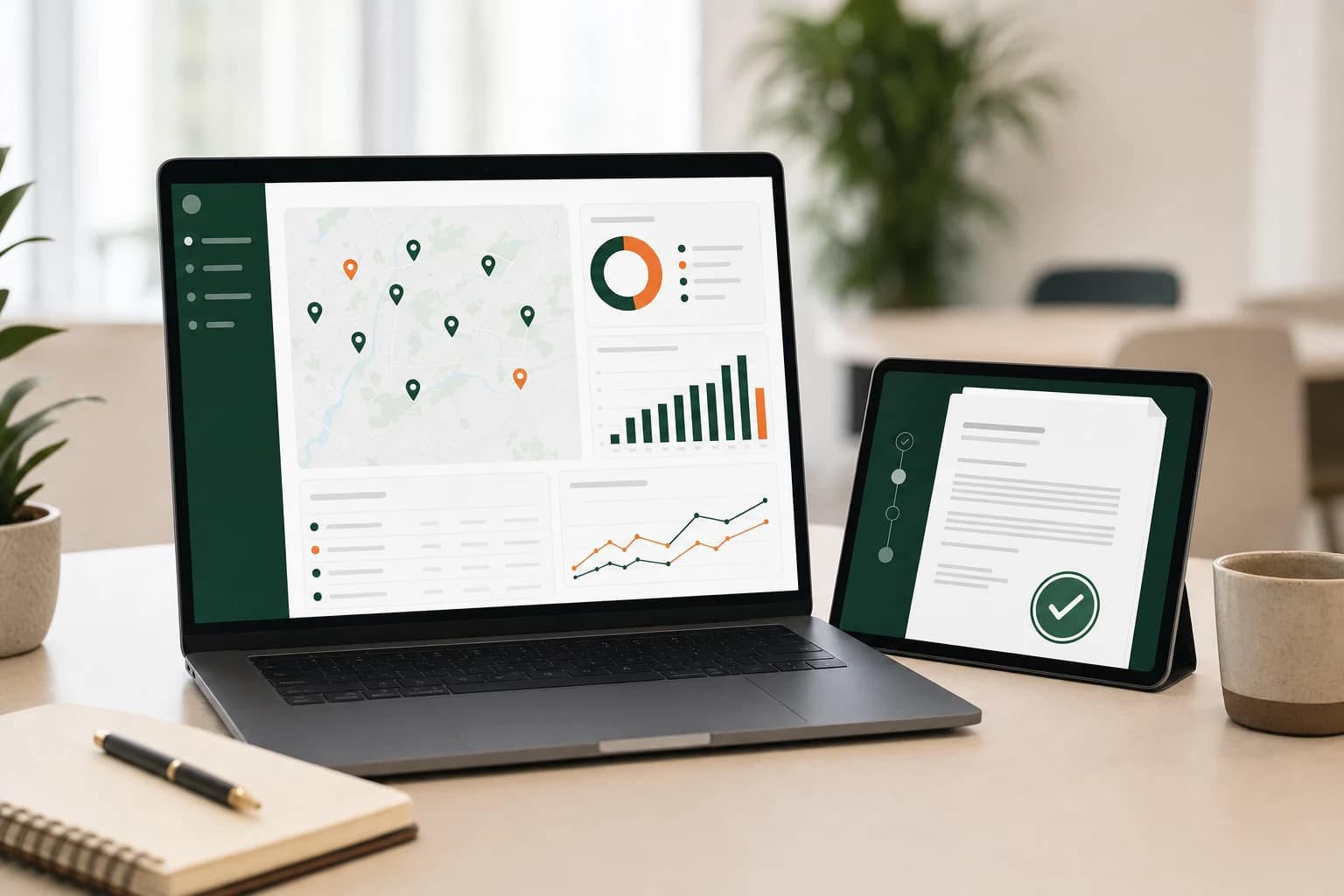
Oil Guyz documents every used cooking oil pickup for California restaurants with a CDFA-compliant digital manifest, the record 3 CCR 1180.24 and local FOG inspectors ask for, and keeps two years of records in one portal. Call (714) 880-4788. The Filtrate portal turns used cooking oil pickup into documented, audit-ready compliance. Every collection generates a CDFA-compliant digital manifest with full chain of custody, stored centrally and searchable across every location you run, no paper tickets, no shared drive nobody maintains, no scramble when an inspector calls.
Quick Answer
Cooking oil management software for multi-unit restaurants centralizes used cooking oil pickups, schedules, containers, and CDFA-compliant digital manifests in one cloud portal. The Filtrate portal records each pickup's chain of custody, date, time, gallons, transporter, and destination renderer, gives role-based access from corporate down to each site, and produces audit-ready exports on demand.
Get Your Free Pickup Set Up
Tell us where your kitchen is. Free locked container, route started this week, no contract or minimum volume.
- Truly free. We are paid for the oil, not by you
- No contracts. Cancel anytime
- No minimum volume. Any kitchen size
- Free locked, anti-theft bin
- Compliant digital manifest after every pickup
- Instant confirmation, then a real person calls you
Request your free oil pickup
Free bin · No contract · Cancel anytime. You get an instant confirmation that we got it, then a real person calls to set up your pickup. No spam, no robocalls.
Prefer to talk? Call (714) 880-4788
Paper Tickets and Scattered Records Turn a Routine Pickup Into a Compliance Liability
For a single restaurant, a paper grease ticket in a drawer is survivable. For an operator running ten, fifty, or two hundred kitchens, it is a liability waiting to surface. California's Department of Food and Agriculture requires a manifest for every used cooking oil pickup, documenting the chain of custody from the kitchen to a licensed renderer. When each location handles that paperwork its own way, a carbon ticket here, a photographed slip there, a spreadsheet a former GM stopped updating, the compliance posture of the entire company is only as strong as its worst-documented site. There is no single place to look, and no fast way to prove what left the building.
That gap becomes expensive the moment someone asks for records. A health inspector, an insurance underwriter, a CDFA auditor, or a buyer doing diligence on an acquisition can request the manifest history for one location or all of them. With paper and no portal, fulfilling that request means emailing district managers, chasing down a dispatcher, and reconstructing a year of pickups from memory and partial slips. Meanwhile the records exist to do real work: the CDFA's inedible kitchen grease manifest system is designed to document chain of custody, deter grease theft, and prevent illegal dumping, but only if the documentation is actually captured and retained.
The fix is not more paperwork, it is software that captures the manifest automatically and keeps it. That is what the Filtrate portal does. Every pickup at every location produces a CDFA-compliant digital manifest the moment the collection is complete, stored centrally and searchable by location, date, and gallons. Corporate compliance sees the whole portfolio, each regional manager sees their territory, and each general manager sees their own site. When records are requested, you export them in one click instead of one week. The result is proof, not promises: a documented chain of custody from your kitchen to a CDFA-licensed renderer, retained for two years, far beyond the regulatory minimum.
Every pickup
CDFA digital manifest generated
6 regions
served and expanding
Month-to-month
no long-term contract
The Filtrate Portal: One Dashboard Across Every Location
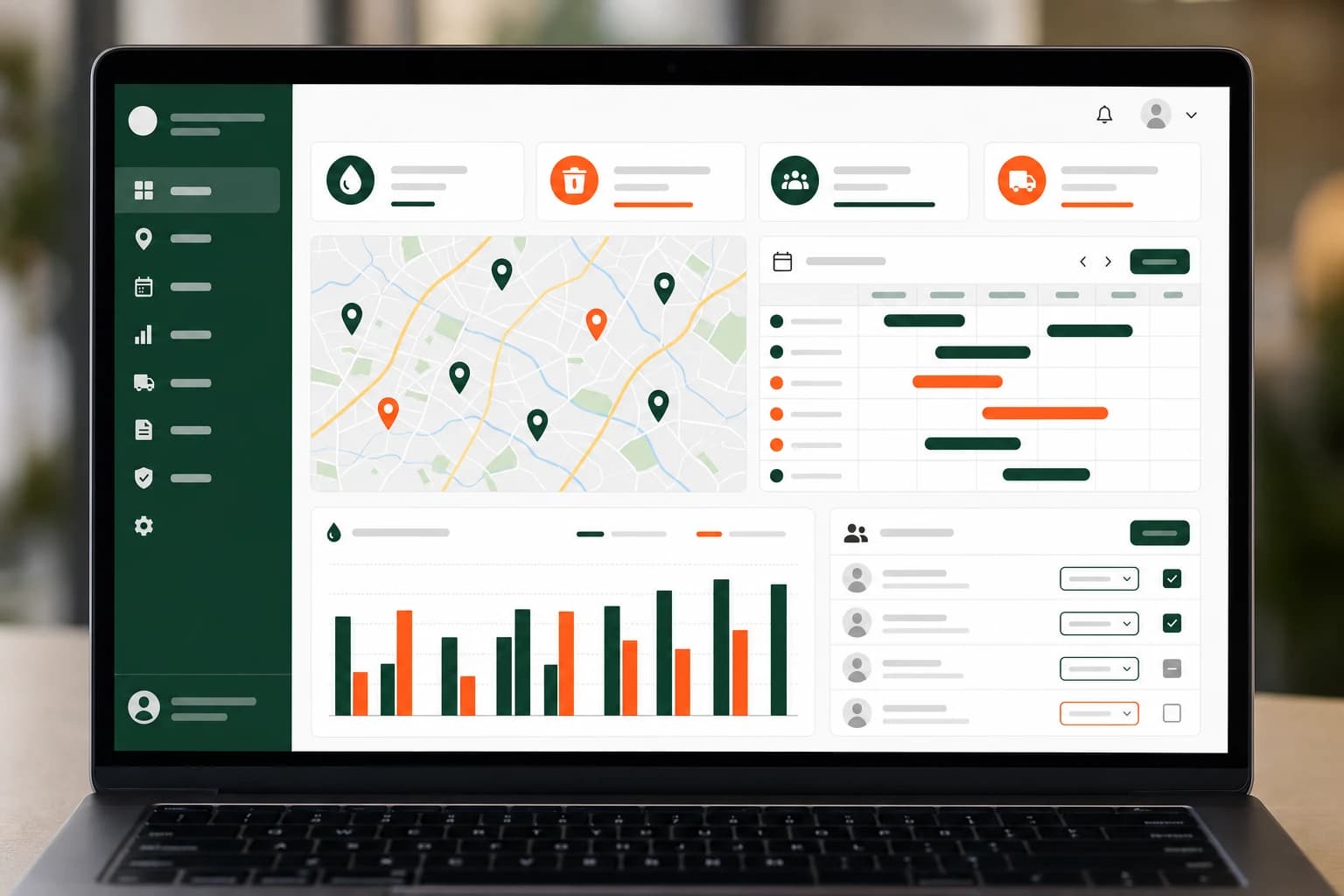
The Filtrate portal is the system of record for your entire cooking oil program. A regional manager logs in and sees every site in their territory at a glance, upcoming pickups, container status, recent gallons collected, and the full manifest history for each kitchen. Corporate compliance sees all of it across the portfolio; each general manager sees only their own location. Nothing lives in a drawer or a personal inbox. Every pickup, schedule change, and document is captured in one place that survives staff turnover.
- One dashboard spanning every location, every region you operate
- Live view of pickups, schedules, container status, and gallons by site
- Role and hierarchy access, corporate sees all, each GM sees theirs
- Complete pickup and manifest history retained per location
- Per-location mobile apps so on-site staff can act from the floor
What's in Every CDFA-Compliant Digital Manifest
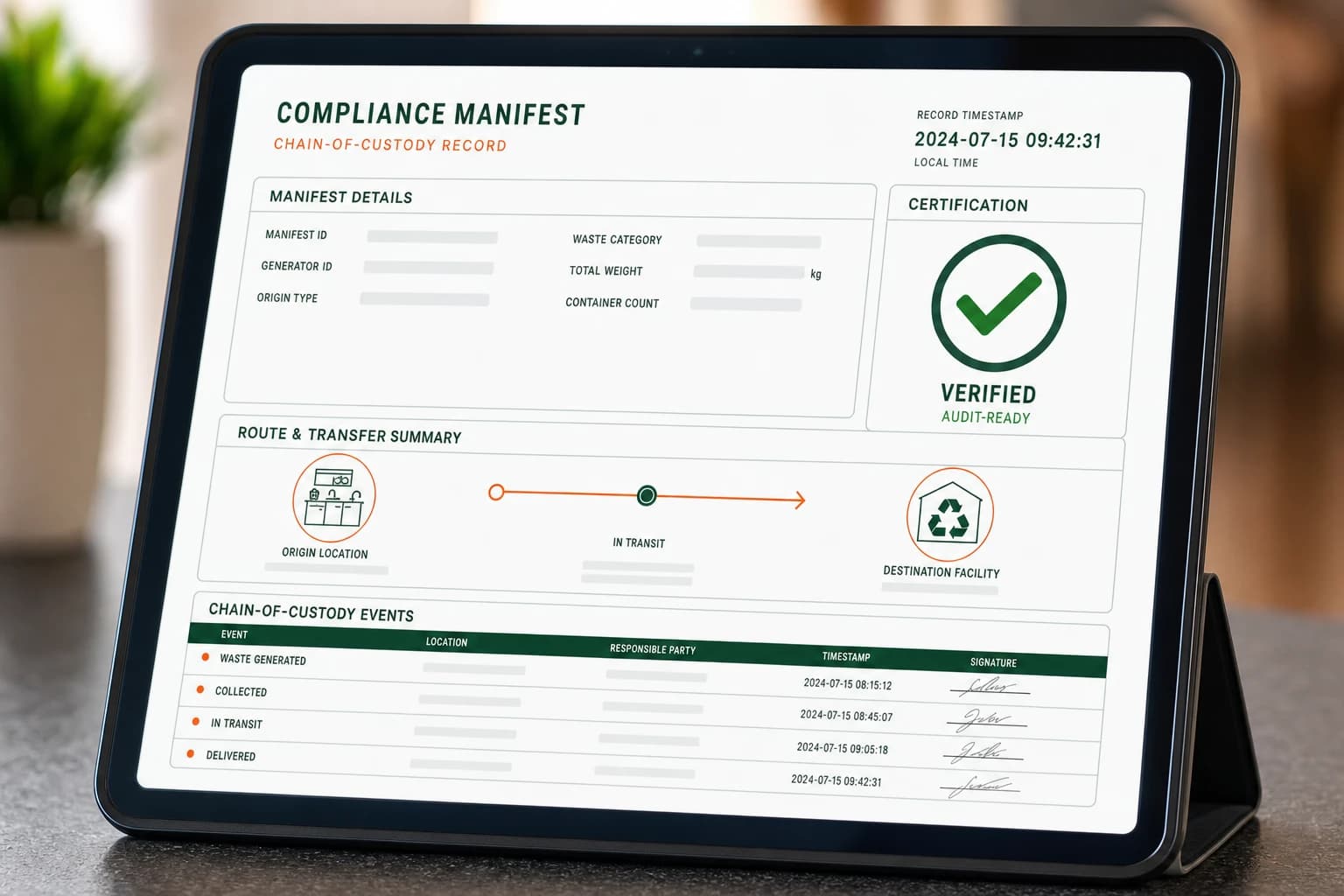
Each pickup generates a digital manifest the instant the collection is finished, no carbon ticket, no later data entry. The manifest records the chain of custody the CDFA's inedible kitchen grease program is built to document: the date and time, the gallons collected, the container serviced, the registered transporter and licensed renderer who performed the collection, and the destination, a CDFA-licensed renderer. Electronic manifests are explicitly permitted in California, so a digital record carries the same weight as paper while being far easier to find, share, and prove.
- Date and time of every pickup, captured automatically
- Gallons collected and the container serviced
- Registered transporter performing the collection on file
- Destination: a CDFA-licensed renderer, named on the record
- Legally valid electronic format under 3 CCR 1180.24
Chain of Custody From Your Kitchen to a Licensed Renderer
Compliance is not just having a ticket, it is being able to show where the oil went and who handled it. The Filtrate portal links each pickup to the pickup before and after it, so the documented chain of custody runs unbroken from your back-of-house container to a CDFA-licensed renderer. That is exactly the purpose of the state's IKG manifest system: to document custody, deter grease theft, and prevent illegal dumping. With a complete record per location, a disputed pickup becomes a lookup instead of an argument.
- Unbroken custody trail from kitchen container to licensed renderer
- Renderer destination named on every manifest, not a black box
- Records that help deter grease theft and document legitimate handling
- Disputed or missed pickups resolved by the record, not by memory
- Built around the CDFA IKG manifest system's chain-of-custody purpose
Audit-Ready Exports and Reporting on Demand
When an inspector, underwriter, or auditor asks for records, you produce them from one screen. The Filtrate portal filters by location, date range, or gallons and exports a clean, one-click audit package, every manifest, organized and retained. We keep records for two years, meeting the CDFA's two-year minimum, so an inspection request is never a scramble. Reporting rolls volumes up by site and region, giving corporate the picture without the noise of chasing separate paper slips from every location.
- One-click export of manifests for any location and date range
- Records retained two years, far past the 2-year CDFA minimum
- Volume reporting rolled up by site and region
- Read-ready packages for inspectors, underwriters, and auditors
- No reconstructing a year of pickups from partial paper tickets
The Recycling Payoff Your Sustainability Report Can Cite
The oil your kitchens produce does not disappear, it becomes feedstock. Collected used cooking oil is recycled into biodiesel and renewable-diesel feedstock through a CDFA-licensed renderer, and the Filtrate portal documents that destination on every manifest. That gives a corporate sustainability or ESG team sourced, defensible numbers to work with: waste-feedstock biodiesel and renewable diesel cut lifecycle greenhouse-gas emissions roughly 79–86% versus petroleum diesel (DOE AFDC), and renewable diesel averages about a 65% carbon-intensity reduction (DOE/CARB). Honest figures, attributed to their sources, backed by your own manifest trail.
- Collected oil becomes biodiesel / renewable-diesel feedstock
- Licensed renderer destination documented on each manifest
- Sourced GHG figures for ESG and sustainability reporting
- ~65% average carbon-intensity reduction for renewable diesel (DOE/CARB)
- 79–86% lower lifecycle GHG for UCO-based fuel (DOE AFDC)
Built for the Teams Who Have to Answer for Every Location
Multi-Unit Restaurant Groups
Operators running multiple concepts or many locations who need one compliance picture instead of a different grease ticket system at every site.
Corporate Compliance & Risk
Compliance and risk teams who must produce CDFA manifest history on demand, for inspectors, underwriters, or acquisition diligence, without chasing field staff.
Franchise Systems
Franchisors and multi-unit franchisees standardizing chain-of-custody documentation across owners and territories under one consistent portal.
Institutional Food Service
University dining, hospital cafeterias, and contract food-service operators needing centralized, audit-ready records across every kitchen they run.
Operations & Finance Leaders
Directors who want pickups, gallons, and compliance rolled up by site and region in one dashboard, not reconstructed from separate haulers' paperwork.
Sustainability & ESG Teams
Teams that need a documented, sourced recycling trail, used oil to biodiesel feedstock via a licensed renderer, for honest emissions reporting.
Software-Backed Compliance vs. Paper Tickets and No Portal
Where records live
Manifest capture
Chain of custody
Multi-location view
Audit / inspector request
Record retention
On-site access
Contract
What's Included
Everything you need, nothing you don’t.
- The Filtrate portal: one dashboard across every location you run
- CDFA-compliant digital manifest generated automatically at every pickup
- Each manifest records date, time, gallons, transporter, and licensed-renderer destination
- Documented chain of custody from kitchen container to licensed renderer
- Role and hierarchy access, corporate sees all sites, each GM sees theirs
- One-click audit-ready exports by location, date range, or gallons
- Record retention of two years, far beyond the 2-year CDFA minimum
- Per-location mobile apps for on-site staff
- Free locked, anti-theft collection container at each location
- Free scheduled used cooking oil pickup, month-to-month, cancel anytime
- Volume reporting rolled up by site and region
- Documented recycling into biodiesel / renewable-diesel feedstock via a licensed renderer
How Restaurant Oil Collection Works In 3 Simple Steps
Set up restaurant oil collection in about five minutes. We confirm your route the same business day and drop a free bin before your first pickup. After that, Oil Guyz handles every used cooking oil pickup on schedule. You never chase a hauler again.
Request Pickup
Fill out a 30-second form or call us. No credit card, no commitment.
Pickup Day Is Pickup Day
Your scheduled window is locked in. A CDFA-registered transporter completes the pickup, pumps your container empty, and we email your digital manifest the moment the work is logged.
Stay Compliant Automatically
Get digital manifests, pickup confirmations, and compliance records, all in your dashboard.
Frequently Asked Questions
Yes. The CDFA requires a manifest for every used cooking oil (inedible kitchen grease) pickup, electronic manifests are permitted, and records must be kept for a two-year minimum. The Filtrate portal generates a CDFA-compliant digital manifest at every pickup and retains records for two years, meeting that minimum. See 3 CCR 1180.24: 3 CCR § 1180.24, CA Inedible Kitchen Grease Manifest Rule
Every manifest records the date and time of the pickup, the gallons collected, the container serviced, the registered transporter performing the collection, and the destination, a CDFA-licensed renderer. Together these document the chain of custody the CDFA's inedible kitchen grease program is designed to capture. Program details: CDFA Meat, Poultry & Egg Safety / IKG Program
Instead of a different paper system at every site, the Filtrate portal centralizes pickups, schedules, containers, and manifests for your whole portfolio in one dashboard. Access is role-based: corporate compliance sees every location, each regional manager sees their territory, and each GM sees their own site. When records are requested for one location or all of them, you export them in one click rather than chasing field staff.
The CDFA's inedible kitchen grease manifest system exists to document chain of custody, deter theft, and prevent illegal dumping. A complete, retained record proves where your oil went and who handled it, which turns a disputed or missed pickup into a quick lookup. Program background: CDFA Meat, Poultry & Egg Safety / IKG Program
The CDFA sets a two-year minimum retention for used cooking oil manifests. We retain records for two years in the Filtrate portal, so a request that reaches back further than your own files, for an inspector, an insurer, or acquisition diligence, is still easy to fulfill with a one-click export. Retention rule: 3 CCR § 1180.24, CA Inedible Kitchen Grease Manifest Rule
Collected used cooking oil is recycled into biodiesel and renewable-diesel feedstock through a CDFA-licensed renderer, and that destination is named on every manifest. For reporting, the honest, sourced figures are: renewable diesel averages about a 65% carbon-intensity reduction (DOE/CARB, DOE AFDC, Renewable Diesel), and waste-feedstock biodiesel/renewable diesel cuts lifecycle GHG roughly 79–86% versus petroleum diesel (DOE AFDC, DOE AFDC, Biodiesel Production & Lifecycle GHG).
It is both the service relationship and the software. We arrange free scheduled pickup performed by a CDFA-registered transporter and provide the locked anti-theft container, and every pickup flows into the Filtrate portal as a digital manifest with full chain of custody. You get reliable collection and audit-ready documentation in one place, month-to-month with no long-term contract.
We currently serve Orange County, Los Angeles, San Diego, the Inland Empire, the Bay Area, and Tacoma/PNW, and we are expanding. If some of your locations sit outside that footprint, tell us where they are and we will notify you as we reach them. We do not claim coverage we do not have, honest geographic disclosure is an FTC requirement: the FTC's advertising guidance for small business
What Our Clients Say

Myk Espinoza
Oakland Ballers · Oakland, CA · Google review
“These dudes really bailed me out of a tough situation. My previous oil collection service had been really screwing me over. Spent 4 weeks of unanswered phone calls, texts, and empty promises with a company we've been using for two years just to get a used oil recepticle, all to no avail. We were sitting on 6 fryers with of oil I that I had nowhere to put. Called Joey and The Oil Guyz and he got me set up just a few hours later. Used oil container, service agreement, answered all of my questions. We're running a very odd program where our schedule is all over the place, so having a "regular" pick up schedule is out of the question. We worked out a way for quick/easy retrieval in about 5 minutes. Can't recommend these guys enough.”See full review

Maryam Tngrian
Google review
“As a manufacturing bakery, we recently needed a one-time pickup of approximately 3,000 lbs of used donut oil. Unfortunately, there was very little information available regarding the company that had handled this service previously, so I had to start from scratch. I found Oil Guyz online and was impressed from the first conversation. Joey, the owner, was extremely helpful and took the time to walk me through the entire process, making the coordination simple and straightforward. Prior to contacting Oil Guyz, I had attempted to reach other providers and had difficulty getting assistance. Oil Guyz was responsive, accommodating, and easy to work with from start to finish. The pickup was completed within the timeframe communicated, and the team handled the removal seamlessly with no disruption to our operation. Their professionalism and customer service made what could have been a challenging process very easy. We would absolutely use Oil Guyz again and would recommend them to other food manufacturing facilities looking for a reliable used cooking oil recycling partner.”See full review

Kengo Kido
Google review
“Joey took care of our needs quickly, efficiently and professionally. I highly reccoemnd his service to anyone!”

Brenda Wu
Google review
“Prompt response from Joey. Great service with problem solving. Highly recommended!”

Camille Bamford
Google review
“Fast and great to work with!”

John Kim
Google review
“Fast efficient service”

Olivia Valdivia
Google review
“Oil Guyz are A+++!! We had 14 containers of used frying oil from our little league snack bar. They helped us on our last day to meet and pick up our containers. They made it easy, and we will be looking to use them for our next season!! Thanks Joey!!”See full review
Related Solutions
Restaurant Cooking Oil Management
The full restaurant cooking oil management program this portal powers, pickup, containers, billing, and compliance across your operation.
Learn moreMulti-Location Cooking Oil Collection
Consolidate every site onto one collection relationship, the service side of the same centralized compliance backbone.
Learn moreCooking Oil Disposal
The basics of compliant used cooking oil disposal, what the rules require and what happens to your oil after pickup.
Learn moreCooking Oil Compliance & Reporting by City
We provide cooking oil compliance & reporting to restaurants and commercial kitchens across Orange County, Los Angeles, San Diego, the Inland Empire, the Bay Area, and the Tacoma area. Every county hub lists the full route coverage.
Cooking Oil Compliance & Reporting in San Diego18 cities
See the San Diego hub below for every community on the route.
See all 18 San Diego citiesCooking Oil Compliance & Reporting in Tacoma24 cities
See the Tacoma hub below for every community on the route.
See all 24 Tacoma citiesSee Your Whole Cooking Oil Program in One Compliant Portal
Tell us about your locations and we will show you how the Filtrate portal centralizes every pickup, manifest, and chain-of-custody record, audit-ready, month-to-month, with a real person to call. No long-term contract, no pressure.
Or call (714) 880-4788 and talk to a real person today.