Free Used Cooking Oil Collection for San Francisco Restaurants
Oil Guyz provides free used cooking oil pickup and recycling for San Francisco, CA restaurants. Call (415) 319-7606 to schedule service.
Chinatown alley stops, Mission Street windows, and North Beach kitchens, worked around city traffic and tight loading zones.
San Francisco pickup terms at a glance
- Pickup fee
- $0. Free scheduled pickup for restaurants and commercial kitchens
- Minimum volume
- None
- Contract
- None. Month to month, cancel anytime
- Container
- Free locked, anti-theft bin, delivered and placed for you
- Paperwork
- CDFA-compliant digital manifest after every pickup, 2 years of records
- Schedule
- Weekly or biweekly route, set around your kitchen hours
- Insurance
- Fully insured; pickups performed by registered transporters, oil recycled through licensed renderers
- Phone
- (415) 319-7606 and a real person answers, 24/7.
5.0 on Google
From real restaurant reviews
Same-business-day callback
A real person answers, 24/7
Free locked bin
Delivered and placed for you
Manifest every pickup
Inspection-ready, 2-year records
Quick Answer
San Francisco restaurants get used cooking oil collected at no charge. Oil Guyz runs a scheduled route from the Chinatown back-alleys along Ross and Spofford through North Beach, the Mission, and SoMa out to the Richmond on Clement Street and the Sunset, dropping a free locked bin and pumping it on your schedule, with early-morning windows for Fisherman's Wharf. Each pickup is logged on a CDFA-compliant digital manifest (California Title 3, Section 1180), built to stand up to the SFPUC FOG program, which enforces aggressively because grease drives combined-sewer overflows into the Bay. No contract, no minimum, and multi-location accounts make Oil Guyz the reliable citywide choice. Call (415) 319-7606; a real person answers, 24/7, and first pickups land within 3 to 5 business days.
San Francisco Used Cooking Oil Pickup: Free Weekly Service for City Restaurants
Run a dim sum counter or noodle shop along Stockton Street or Grant Avenue in Chinatown, and you know the used cooking oil problem here is different. Back-of-house space is tight, alley access is shared with the whole block along Ross Alley or Spofford Alley, and a leaking drum or unsecured jug sitting out back is a liability nobody wants to explain to the health inspector or the landlord.
Oil Guyz picks up your used cooking oil in San Francisco at no cost, on a route timed to your kitchen, not a call center schedule. We drop off a free, locked, anti-theft container so oil never grows legs in a shared alley, and we email a CDFA-compliant digital manifest after every pickup, ready for your SFPUC FOG Program file. No contract, no fee, no minimum, and a real person answers the phone. Your oil comes back as clean biodiesel, not a dump fee.
Fill out the form on this page to request pickup, and a real person calls you back the same business day, not next week. Whether you're tucked into a Chinatown alley, running the line in North Beach, or serving tourists near Fisherman's Wharf, most San Francisco kitchens land on a dependable route within the week. No paperwork marathon, just a call and a container.
Why Grease Pickup Is Harder in San Francisco Than Anywhere Else We Run
San Francisco has the highest restaurant density per capita of any major city in the United States, with roughly 5,000 active food service operators packed into 49 square miles and distributed across more than two dozen neighborhood commercial districts that each carry their own culinary identity. Chinatown along Stockton Street, Grant Avenue, and Pacific Avenue is the largest historic Chinese commercial district in North America and houses one of the densest restaurant clusters in the city, with Cantonese seafood houses, dim sum parlors, hand-pulled noodle shops, roast meat counters, and bakeries operating in tight ground-floor storefronts that share back-alley pickup access along Ross Alley, Spofford Alley, and Walter U. Lum Place. North Beach along Columbus Avenue carries the city's historic Italian dining cluster alongside a newer wave of small-plate and bar-driven restaurants, while Fisherman's Wharf and the surrounding Embarcadero blocks anchor the high-volume seafood and tourist-driven operators producing heavy weekly fryer output.
South of Market through SoMa and the surrounding blocks along Folsom, Howard, and Mission Streets carries the convention-center and weekday-lunch volume of Moscone Center and the financial district workforce, with food-hall operators, hotel kitchens, and the catering commissaries that feed the downtown office towers all producing significant daily oil volume. The Mission District along Mission Street, Valencia Street, and 24th Street is one of the most cuisine-diverse stretches in the country, with Salvadoran pupuserias, Mexican taquerias and mariscos counters, Peruvian rotisserie chicken houses, Yucatecan kitchens, and a dense modern dining wave along Valencia, all of which run heavy fryers, plancha lines, and rotisserie equipment that produce steady used cooking oil. The Castro, Hayes Valley, and the surrounding blocks of upper Market add another set of established neighborhood operators with bistro and brunch volume, while the Marina, Cow Hollow, and the Chestnut and Union Street corridors carry brunch, sushi, and small-plate clusters.
On the west side of the city, the Richmond District along Clement Street and Geary Boulevard houses the city's second major Chinese restaurant cluster alongside Russian bakeries, Burmese and Vietnamese restaurants, and the dim sum and seafood houses that anchor the inner and outer Richmond. The Sunset District along Irving Street, Noriega Street, and Taraval Street carries another dense cluster of Chinese, Vietnamese, and Korean operators along with the Japantown-adjacent kitchens along Geary. The Tenderloin holds the city's densest Vietnamese pho cluster along with West African, Thai, and Indian operators, while the Financial District anchors the high-end steakhouse and hotel-restaurant clusters. Our San Francisco route is built around the geography and access constraints that actually matter for these kitchens. We cover everything from the Embarcadero and Fisherman's Wharf through Chinatown, North Beach, Russian Hill, and Nob Hill, west through Pacific Heights, the Marina, and Cow Hollow, south through Hayes Valley, the Mission, the Castro, and Noe Valley, and out west through the Richmond and the Sunset to the ocean. We schedule around your kitchen's busiest hours so used cooking oil pickup never interrupts service, and we time each stop around the alley access in Chinatown, the loading-zone restrictions in SoMa and the Financial District, the tight curb-side windows in the Mission and the Castro, and the early-morning starts Fisherman's Wharf operators need.
Get Free Pickup in San Francisco
Free locked bin · No contract · No minimum. First pickup in 3 to 5 business days.
Prefer to talk? Call (415) 319-7606
Cooking Oil Compliance for San Francisco Commercial Kitchens
San Francisco restaurants answer to the San Francisco Department of Public Health Environmental Health Branch for routine food facility inspections, and to the San Francisco Public Utilities Commission (SFPUC) for the city's Fats, Oils, and Grease (FOG) Source Control Program tied to the city's combined sewer system. SFPUC FOG inspectors actively cite operators for missing used cooking oil manifests, overflowing exterior containers in the back-alley clusters of Chinatown and North Beach, and unsealed lids that draw pests behind the Mission, Castro, and Richmond restaurant strips. SFPUC takes FOG enforcement more seriously than most California utilities because grease that enters the combined sewer system contributes directly to overflow events into San Francisco Bay during wet weather. Having a reliable scheduled pickup with digital manifests on file gives your kitchen instant documentation when an SFDPH sanitarian or an SFPUC FOG inspector arrives. The CDFA-compliant manifest issued after each pickup under California Code of Regulations Title 3 Section 1180 carries the license details the Inedible Kitchen Grease program requires and slots directly into the recordkeeping SFDPH and SFPUC expect during routine and complaint-driven inspections.
SFPUC Runs the Grease Rules in San Francisco
In San Francisco the sewer authority itself, the SFPUC, publishes both the used cooking oil disposal guidance and the FOG Control program that inspects grease equipment. The standard is explicit: fryer oil never enters a drain, it is stored covered, and it leaves with a collection service that can document the chain.
Every San Francisco pickup generates a CDFA-compliant digital manifest naming the licensed renderer destination, which is precisely the documentation the FOG Control program expects a kitchen to produce.
What Your San Francisco Restaurant or Commercial Kitchen Gets
- Fixed weekly or biweekly pickups timed to the Chinatown alley and Mission Street service windows
- Locked, sealed containers at no charge, picked to fit tight SF service corridors
- Digital manifests emailed after every pickup for SFDPH and SFPUC FOG records
- Coverage from Chinatown and Fisherman's Wharf to the outer Richmond and Sunset
- Early-morning service windows for Fisherman's Wharf and the Embarcadero
- City-traffic-aware overflow response through Chinatown, SoMa, and the Mission when a bin fills early
What Bay Area kitchens say about Oil Guyz
Verbatim Google reviews from the restaurants we serve. On time, genuinely free, and the compliance paperwork is always handled.

Myk Espinoza
Oakland Ballers · Oakland, CA · Google review
“These dudes really bailed me out of a tough situation. My previous oil collection service had been really screwing me over. Spent 4 weeks of unanswered phone calls, texts, and empty promises with a company we've been using for two years just to get a used oil recepticle, all to no avail. We were sitting on 6 fryers with of oil I that I had nowhere to put. Called Joey and The Oil Guyz and he got me set up just a few hours later. Used oil container, service agreement, answered all of my questions. We're running a very odd program where our schedule is all over the place, so having a "regular" pick up schedule is out of the question. We worked out a way for quick/easy retrieval in about 5 minutes. Can't recommend these guys enough.”See full review

Bryan Baird
Google review
“We are a medium sized institutional kitchen located in San Juan Capistrano. When we needed a certified oil and grease removal partner the Oil Guyz were there. Fantastic customer service, fast, reliable, quick follow up and very efficient. They make it super easy to leave a GREAT review!”See full review

Alex Camacho
Google review
“I'm an up and coming new food vendor and properly disposing of used frying oil was a difficult task. That is until I contacted the Oil Guyz! There webpage made it easy to setup their free service of oil pickup. Within a few days I had a free container to store the used oil until ready for the free pickup. This service is very convenient and Joey has been very accommodating to answer all my questions and facilitate the process.”See full review

Ujwal Chaudhary
Google review
“Great service from Oil Guyz! They came and picked up my full barrel of used cooking oil completely free of charge. The process was easy, quick, and professional. I really appreciate their excellent customer service and reliable pickup. If you have used cooking oil that needs to be collected, I definitely recommend Oil Guyz. Great company and great people! 👍”See full review

Nicholas Saccoccia
Google review
“Excellent experience with Oil Guyz! They got me on the schedule fast, showed up on time, were very professional, and were in and out in no time! I would absolutely use them again.”

LA BREAKFAST CASITA
Google review
“We’ve had a great experience with Oil Guyz! I submitted a quote request through their website for our restaurant, and Joey reached out to us right away. From our first conversation, he has been extremely helpful, patient, and responsive. Joey really made the whole process easy for us. He was willing to work with our team on the best location for the bin, answered all of our questions, and kept in touch to make sure everything was taken care of. I especially appreciate his follow-through and willingness to help without ever making us feel rushed. Good customer service can be hard to find, and Joey has definitely made a great impression on us. We’re very happy we chose Oil Guyz for our used commercial oil pickup service at LA Breakfast Casita in Azusa, CA. Thank you, Joey, for making the process so smooth and for taking such good care of us. We look forward to working with Oil Guyz for a long time!”See full review

Mike Fishman
Google review
“Superb service!”

Celso Bahena
Google review
“I’m in the Santa Ana area great reliable service!”

Kengo Kido
Google review
“Joey took care of our needs quickly, efficiently and professionally. I highly reccoemnd his service to anyone!”
San Francisco Used Cooking Oil Pickup FAQ
Free pickup for your San Francisco kitchen
Same-business-day callback. First pickup in 3 to 5 business days. No contract, cancel anytime.
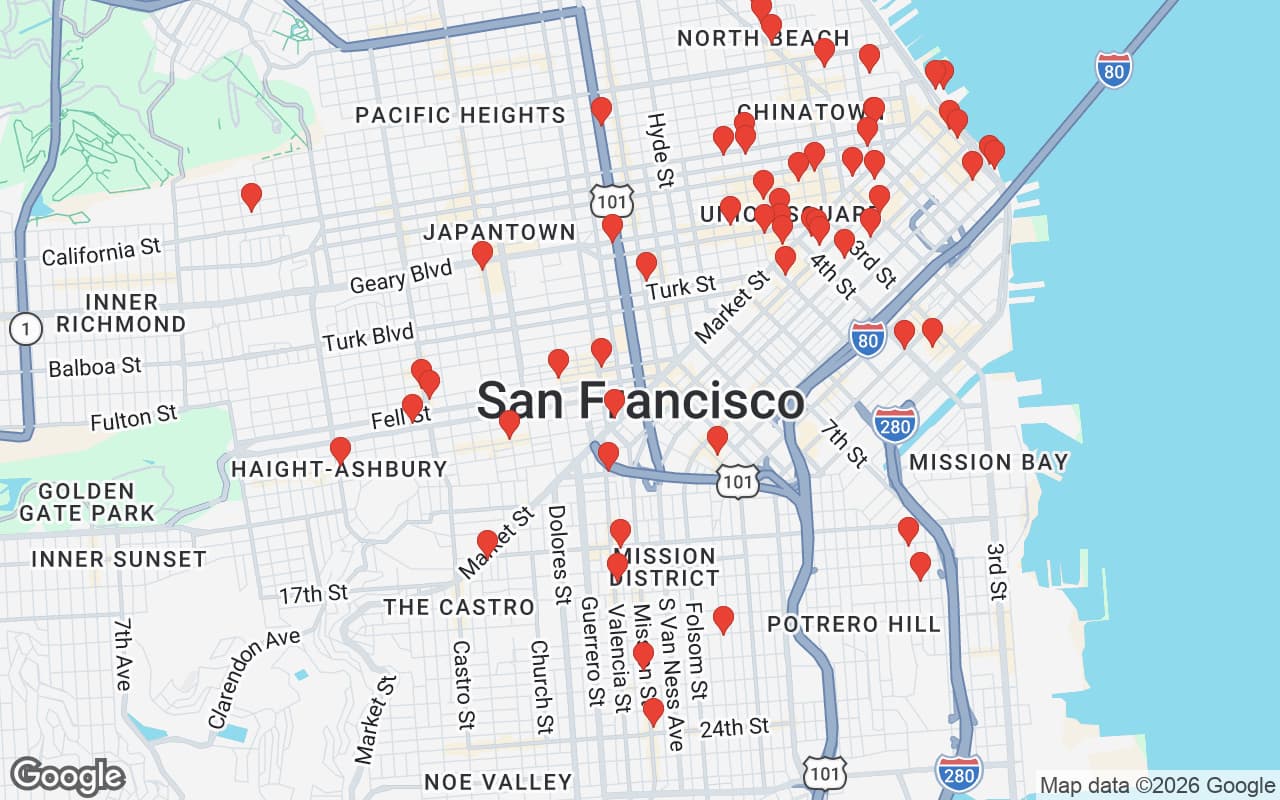
Oil Guyz Service Area in San Francisco
We provide free used cooking oil pickup and recycling to restaurants throughout San Francisco and surrounding areas.