
**TL;DR, ** Airport used cooking oil pickup covers two distinct worlds inside one secured perimeter: terminal concessions (food courts, franchise brands, sit-down restaurants, lounges) and airline catering kitchens (the high-volume flight kitchens that plate thousands of meals a day). Both fry at scale, both sit behind access control, and both need the same three things: a locked anti-theft container, a recurring schedule that works within airport badging and dock rules, and a CDFA-compliant digital manifest after every collection. The hard part isn't the oil, it's coordinating secured access and keeping documentation unbroken across many operators. The fix is one account that rolls every participating kitchen up to a single dashboard while each kitchen keeps its own pickup, its own container, and its own manifest. Oil Guyz coordinates the schedule, the secured access, and the paperwork; the collection itself is performed by a CDFA-registered transporter, and the oil is recycled into biodiesel and renewable-diesel feedstock.
Airport cooking oil pickup is two jobs, not one
When people picture an airport, they picture gates. When you run food at an airport, you see fryers, a lot of them, in two very different operating environments.
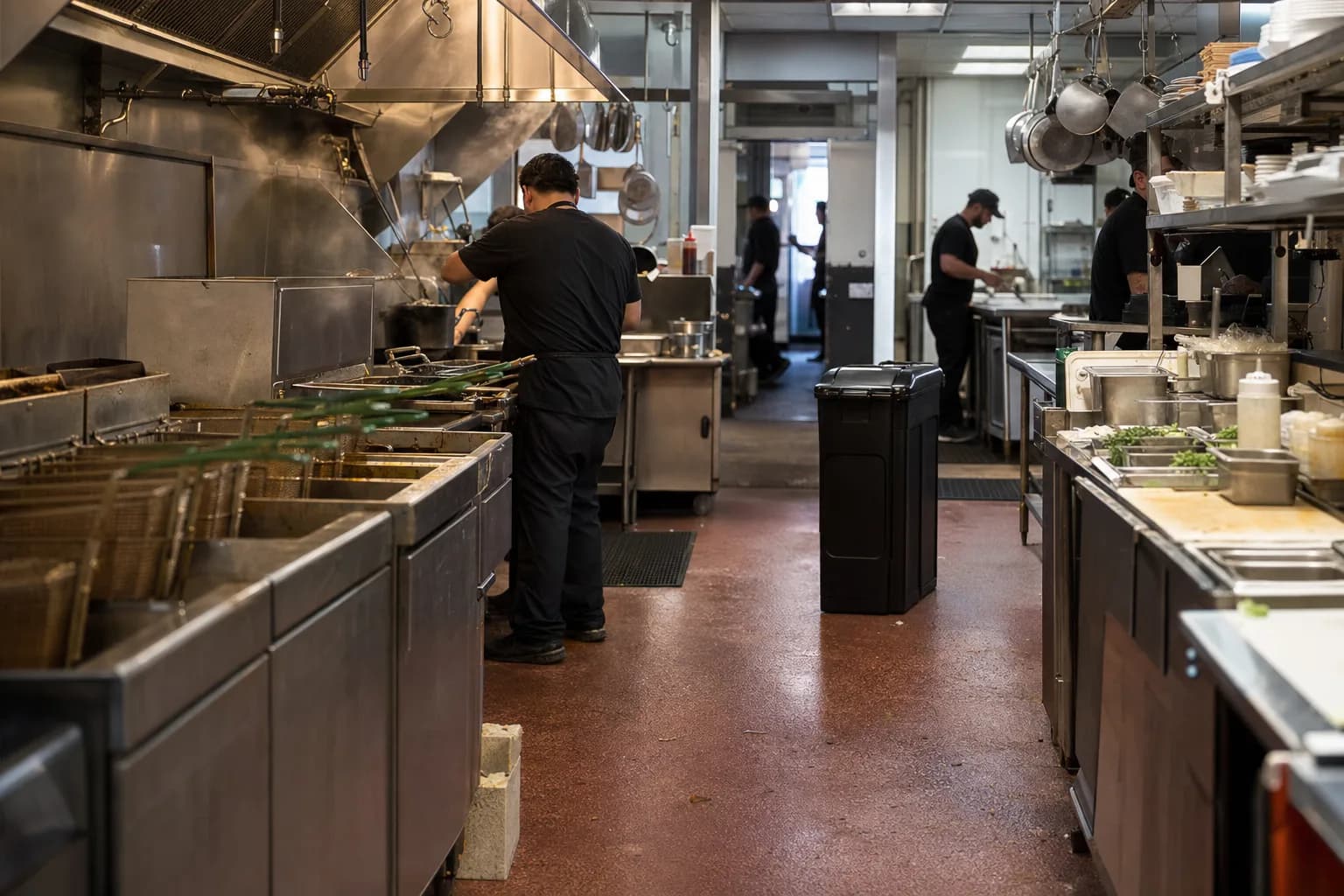
Terminal concessions are the kitchens travelers see: food-court counters, national franchise brands, full-service restaurants past security, and the food-and-beverage programs inside airline lounges. These look a lot like any busy commercial kitchen, except they live behind a security checkpoint, share loading docks with dozens of other tenants, and operate on tight, peak-driven hours.
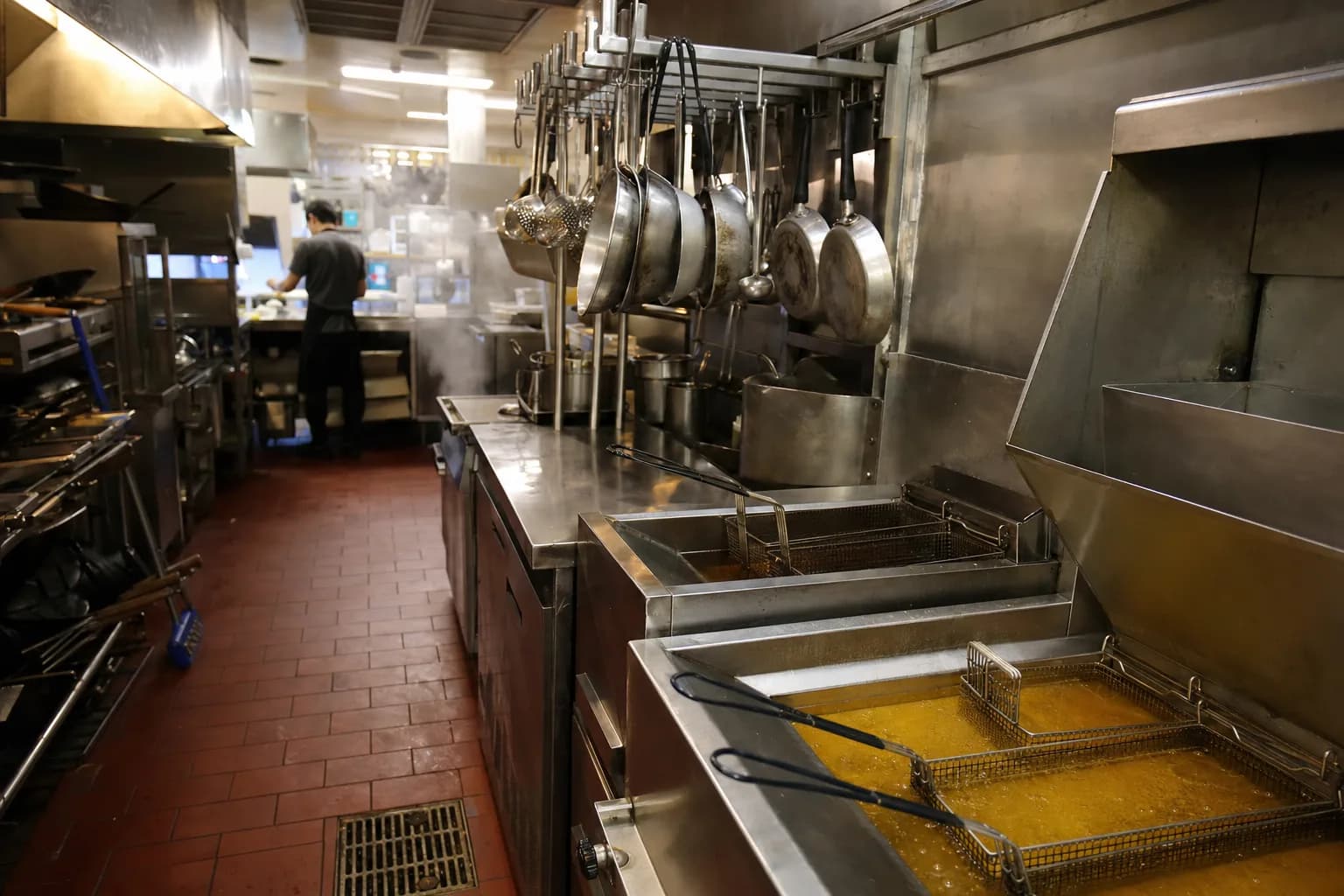
Airline catering kitchens (flight kitchens) are a different animal. They're high-throughput production facilities, often on the airfield side or in a dedicated catering building, assembling meals for many departures a day. The frying volume is industrial, the access rules are stricter, and a missed pickup creates a back-of-house pileup fast.
Both produce used cooking oil (yellow grease). Both need it gone on a reliable cadence. And both sit inside an access-controlled environment where you can't just have a truck show up. That's what makes airport pickup its own category, not the oil, the coordination.
Quick definition: used cooking oil (UCO), also called yellow grease, is the spent frying oil drained from fryers. It's collected, not poured down a drain, and it's a valuable recycling feedstock, which is exactly why it's worth securing.
The secured-access problem (and why it shapes everything)
Most airports control access to terminal back-of-house, loading docks, and the airfield. Any recurring vendor, including used cooking oil collection, has to work inside that access process. In practice that usually means:
- An approved vendor cleared to operate on the property.
- Cleared personnel and vehicles that satisfy the airport's badging requirements.
- Designated docks or service corridors rather than ad-hoc curbside access.
- Approved pickup windows that avoid peak operations and don't conflict with other tenants' deliveries.
The operational lesson is simple: you want the same recurring slot, the same cleared process, every time. Ad-hoc service is the enemy here, each one-off pickup risks a fresh access headache, an escort scramble, or a pickup that simply can't happen because nobody is badged that day.
Oil Guyz handles this by coordinating the recurring schedule and the documentation to the airport's process, with the collection performed by a CDFA-registered transporter. You set the cadence once; the badging and dock coordination become routine instead of a recurring fire drill.
One airport, many operators, one dashboard
Here's what trips up airport food programs: a single terminal can have dozens of fryer-using kitchens run by different companies. A concessions developer manages the master program; individual franchise brands run their own counters; an airline's catering kitchen runs separately; lounge F&B is its own operation again. Left alone, that becomes a mess of separate vendors, separate invoices, and separate (or missing) paperwork, with no single view of who's compliant and who isn't.
The cleaner model is one account, many pickup points:
- Each kitchen keeps its own locked container and its own scheduled pickup.
- Every kitchen produces the same digital manifest after every collection.
- All of it rolls up to one dashboard so a concessions director or facilities team sees the whole picture.
With Oil Guyz, in-footprint locations share the Filtrate portal, one dashboard across every location, plus a per-location mobile app for the on-site team. A facilities lead can see, in one place, which kitchens were serviced, when the next pickups are, and the manifest for each one. That's the difference between managing a program and chasing twelve vendors. For the full structure of running many kitchens under one program, see Multi-Location Cooking Oil Collection, and for the broader operating playbook, the hub guide on Restaurant Cooking Oil Management.
What a clean airport program actually includes
A program that holds up across concessions and flight kitchens has a short, non-negotiable feature list:
| Feature | Why it matters at an airport |
|---|---|
| Free locked, anti-theft container | Shared docks and busy service corridors make unsecured drums an easy theft target. |
| Scheduled, secured-access pickup | Recurring badged windows beat ad-hoc service that re-triggers access hassles. |
| CDFA digital manifest every time | A manifest is required for every California pickup; electronic manifests are legal. |
| Chain of custody to a licensed renderer | Proves where the oil went, critical across many operators and a busy facility. |
| One dashboard for every kitchen | Concessions + airline catering visible in a single Filtrate view. |
| Month-to-month, no long contract | No multi-year lease to untangle when a tenant or operator changes. |
| A real person answers | When a pickup window shifts or a kitchen fills early, you need a human, not a ticket. |
Notice what's not on that list: long-term equipment leases, fresh-oil purchase requirements, or removal fees. Airport tenant rosters change, brands rotate, leases turn over, airlines re-bid catering, so a program that locks each kitchen into a multi-year obligation works against you. Month-to-month terms keep the program flexible as the facility changes around it.
Compliance and documentation: the part that can't have gaps
Airports are high-visibility, multi-operator environments, which makes documentation the load-bearing wall of the whole program.
In California, the rules are specific:
- A manifest is required for every used cooking oil pickup, every kitchen, every collection.
- Electronic manifests are legal under California's adoption of UETA.
- Records must be retained for a minimum of two years.
(See the CDFA regulation: https://www.law.cornell.edu/regulations/california/3-CCR-1180.24.)
For an airline flight kitchen serving dozens of daily departures, or a concessions program with a dozen fryer kitchens, that paperwork is the chain-of-custody proof that collected oil went to a licensed renderer and wasn't diverted or dumped. CDFA's inedible kitchen grease (IKG) program exists precisely to register transporters and license renderers and document that chain of custody, a deliberate guard against theft and illegal dumping (https://www.cdfa.ca.gov/AHFSS/MPES/).
The practical takeaway: standardize on a provider that issues the same digital manifest after every pickup, retained in one place. With many operators under one roof, a single consistent manifest record is the only way a facilities team can prove the whole program is compliant, not just spot-check it kitchen by kitchen. For how that reporting works end to end, see Cooking Oil Compliance & Reporting.
Grease theft: a quiet tax on busy docks
Used cooking oil is worth real money, and that makes it a target. Industry estimates put the value of stolen grease around $75 million a year, and the USDA values roughly 100 lb of used grease near $25. At an airport, busy shared docks, lots of foot traffic, multiple tenants, an unsecured drum is low-hanging fruit, and any rebate a high-volume kitchen would otherwise earn can quietly walk off the dock.
Two things defend against it:
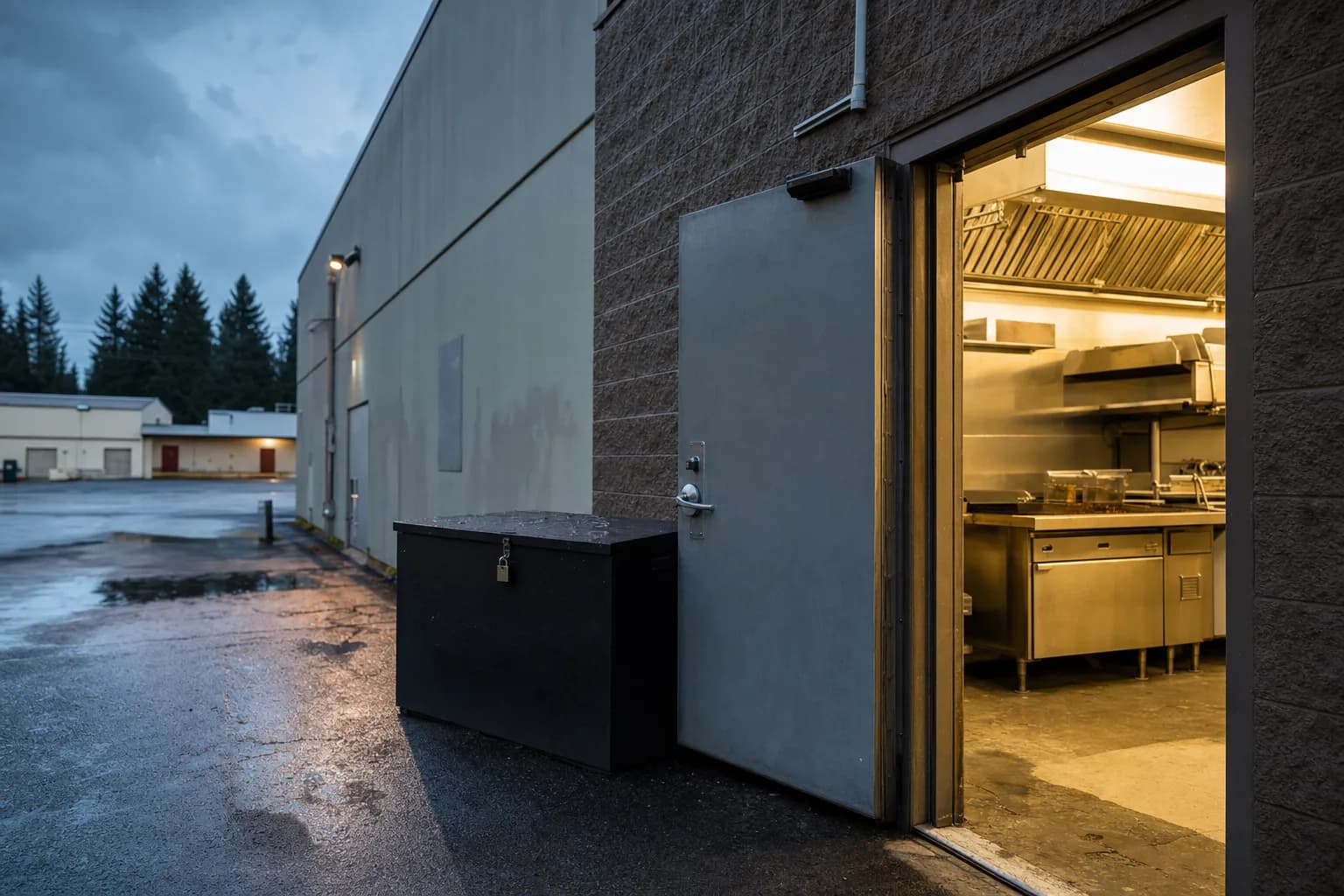
- A free locked, anti-theft container at every kitchen, so the oil can't simply be siphoned.
- A licensed chain of custody, so collected oil is traceable through a CDFA-licensed renderer rather than vanishing into an informal market (https://www.cdfa.ca.gov/AHFSS/MPES/).
For a venue type that fries at high volume, and a busy flight kitchen plating thousands of meals a day certainly does, securing the container isn't optional. It's the difference between keeping the value of your oil and donating it to a thief.
Where the oil goes: the clean-loop payoff
The most satisfying part of an airport program is what happens after the truck leaves. Used cooking oil is a primary feedstock for biodiesel and renewable diesel, the low-carbon fuels increasingly used in heavy transportation.
The numbers are well-sourced:
- Renewable diesel reduces carbon intensity by an average of about 65% versus petroleum diesel (DOE/CARB, https://afdc.energy.gov/fuels/renewable-diesel).
- Waste-feedstock biodiesel and renewable diesel deliver roughly 79 to 86% lower lifecycle greenhouse-gas emissions than petroleum diesel (Argonne National Laboratory, Environmental Science & Technology, 2022).
- Under the federal Renewable Fuel Standard, biomass-based diesel must achieve at least a 50% lifecycle GHG reduction, and used cooking oil qualifies (EPA, https://www.epa.gov/renewable-fuel-standard/overview-renewable-fuel-standard-program).
For an airport, a place defined by fuel, that's a genuinely clean loop: the oil that fried the food becomes feedstock for low-carbon transportation fuel, with a single consistent sustainability story you can report across every kitchen on the property.
Switching providers without disrupting operations
Facilities teams often hesitate to change cooking oil providers because they imagine a disruption. At an airport there are really only two things to protect during a switch:
- Access coordination, the new provider has to clear the airport's badging process before the first pickup.
- Documentation continuity, your manifest record needs to stay unbroken so chain of custody never has a gap.
A month-to-month program with no equipment lease makes the rest trivial. Oil Guyz is month-to-month, no long contract, no lease, no UCC lien, no fresh-oil purchase requirement, and cancel-anytime, and every pickup produces a CDFA digital manifest in the Filtrate portal. That means a facilities team can move concessions and flight kitchens onto one program without untangling a multi-year obligation and without a paperwork gap.
How to get airport kitchens onto one program
A simple rollout sequence for a concessions or facilities team:
- List the fryer kitchens in scope, concessions, franchise counters, lounges, and any airline catering kitchen you manage or coordinate.
- Confirm the footprint. Oil Guyz serves Orange County, LA, San Diego, the Inland Empire, the Bay Area, and Tacoma/PNW, and is expanding. In-footprint kitchens can start now.
- Coordinate access once. Set the recurring badged windows and dock routing so every pickup uses the same cleared process.
- Place a free locked container at each kitchen and set each one's cadence to its frying volume.
- Roll everything up to Filtrate, one dashboard for every kitchen, with each location's digital manifest in one place.
- Report it as one story, compliance and sustainability across the whole airport program, not a patchwork.
If some of your airports fall outside our current regions, tell us where your locations are and we'll notify you as we expand, and we can still set up your in-footprint kitchens today. For the deeper context on terminal concessions and the per-venue picture, see our airports industry page.
Sources
- CDFA used cooking oil manifest + electronic-manifest rules (2-year retention): https://www.law.cornell.edu/regulations/california/3-CCR-1180.24
- CDFA Inedible Kitchen Grease program (registered transporters/licensed renderers, chain of custody): https://www.cdfa.ca.gov/AHFSS/MPES/
- Renewable diesel ~65% average carbon-intensity reduction (DOE/CARB): https://afdc.energy.gov/fuels/renewable-diesel
- Waste-feedstock biodiesel/renewable diesel ~79 to 86% lower lifecycle GHG (Argonne National Laboratory, Environmental Science & Technology, 2022)
- EPA Renewable Fuel Standard (biomass-based diesel ≥50% lifecycle GHG reduction; UCO qualifies): https://www.epa.gov/renewable-fuel-standard/overview-renewable-fuel-standard-program