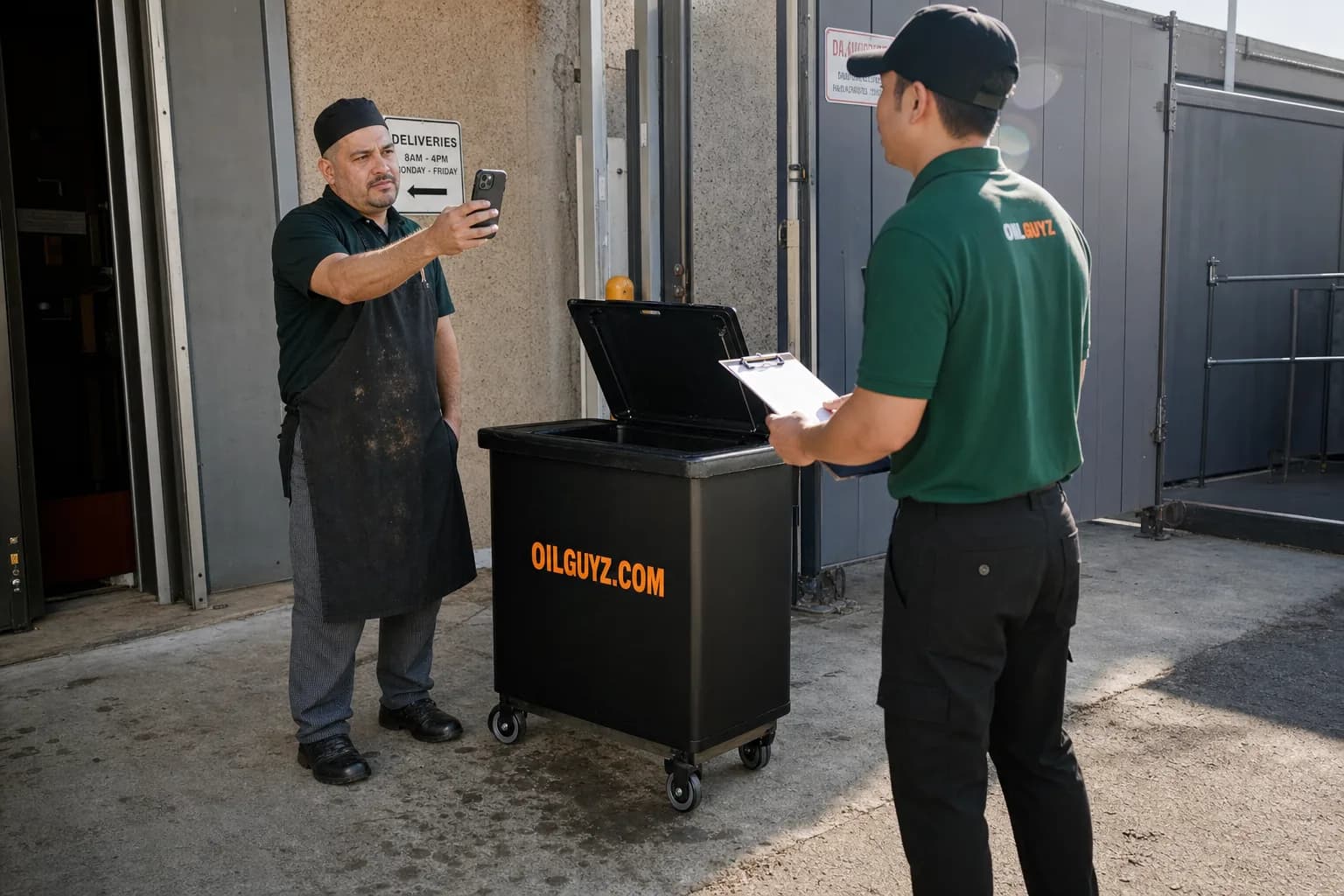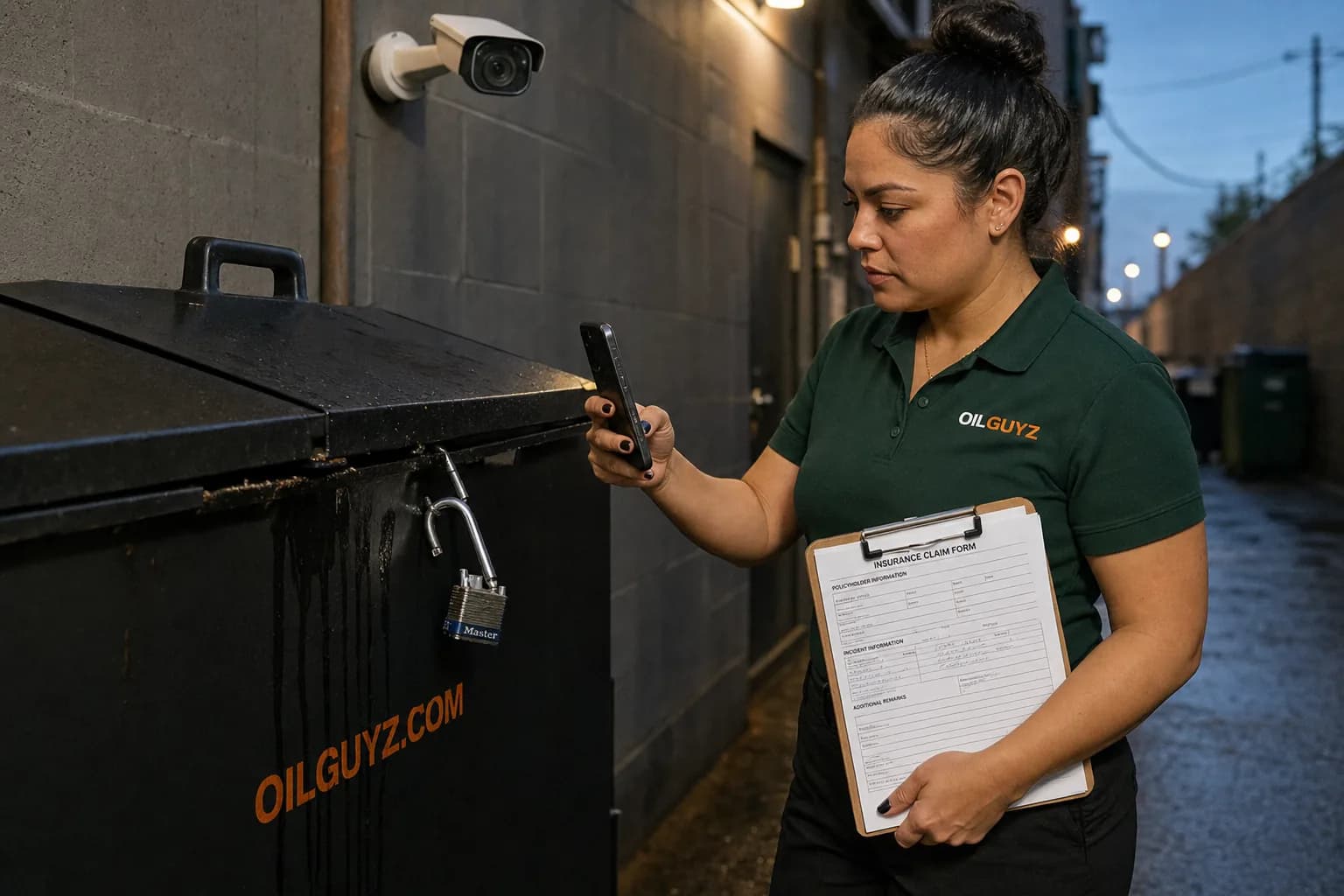

If your used cooking oil container turned up empty or noticeably lighter than it should be, the insurance question comes right after the CDFA question: will a policy actually pay for this? The honest answer is that commercial property and crime policies can cover cooking oil theft, but most of them are written to pay for a provable crime, not for missing volume. Whether a claim goes anywhere depends on evidence you may or may not have, exclusions you probably have not read, and math that often does not favor filing at all.
This is the follow-up question that a lot of theft-prevention advice skips. Locking your container and adding a camera matters for stopping the next theft. Knowing how a claim actually gets evaluated, before you are staring at a claim form and a deductible, puts you in a much stronger position if it happens.
The Short Answer: Insurance Covers Theft, Not Just a Shortage
Commercial property and crime policies generally define "theft" as property taken through a criminal act, and they expect you to demonstrate that a crime happened. That distinction matters more than it sounds like it should, because an oil container sitting outside your building, pumped dry overnight with no broken lock and no witness, does not automatically look like theft to an insurer. It can look like an unexplained shortage, and unexplained shortages are frequently excluded.
The Insurance Information Institute's guide to filing a business insurance claim lays out a process built around contacting your insurer promptly, preparing an inventory of what was lost, and submitting proof of loss, all steps that assume the loss itself is documented as a specific, provable event rather than a volume discrepancy you noticed a few days later. If the paperwork you can produce does not clear that bar, the claim can be denied before an adjuster ever debates the dollar value.
Theft vs. "Mysterious Disappearance": The Distinction That Decides Your Claim
This is the single most important concept to understand before you file. Most commercial property and crime policies distinguish between two very different scenarios:
| Scenario | How insurers typically treat it |
|---|---|
| Container lock is cut or the enclosure is visibly forced, and you have footage or a witness | Treated as theft. Coverage is more likely if the policy includes theft/crime coverage. |
| Container is simply lighter than expected, no visible tampering, no footage, discovered days later | Often treated as an unexplained or "mysterious" disappearance. Frequently excluded outright. |
Pacific Specialty Insurance's explainer on the mysterious disappearance clause describes it as a loss where an item is gone with no concrete proof indicating how or why it vanished, no forced entry, no witness, no evidence of a crime, as opposed to a provable theft. Their own policy language is blunt about the result: they do not cover mysterious disappearances at all. That is not a quirk of one insurer. It is a standard structure across commercial property and crime forms, because insurers have no way to distinguish an actual theft from an inventory error, a measurement mistake, or a legitimate pickup nobody logged, without some form of independent evidence.
An unlocked outdoor cooking oil container, drained overnight with no camera and no forced entry, sits squarely in the excluded category for a lot of policies. A locked container with a cut padlock, camera footage of a truck pulling up, and a police report sits in the covered category. The prevention measures that stop theft in the first place, a locked steel enclosure, an anchor point, a camera aimed at the container, are the same measures that turn your next incident into a claim an adjuster can actually process instead of one they can deny on sight.
Why an Outdoor Oil Bin Is a Harder Claim Than a Break-In
Most restaurant owners picture "theft coverage" as the thing that pays out when someone breaks into the building. A cooking oil container sitting behind the restaurant, in the parking lot or service alley, is a different fact pattern, and it works against you in a claim in a few specific ways:
- No breach of the building itself. Classic burglary coverage often centers on forced entry into insured premises. An outdoor container that gets pumped without anyone touching a door or window does not fit that picture as cleanly.
- No inventory record most insurers recognize. You likely do not have a formal inventory system tracking oil volume the way you would track equipment or stock. Without a documented "before" number, an adjuster has nothing to compare against the "after" number.
- Negligent security arguments. Voss Law Firm's guide to commercial vandalism and theft claims notes that inadequate security measures, such as failing to maintain locks, alarms, or lighting, are a common reason insurers push back on or deny theft claims. An unlocked, unlit container in a dark corner of a lot is exactly the setup that argument targets.
- Delayed discovery. Oil volume often drops gradually or gets discovered days after the fact, once a scheduled pickup comes up short. That gap between the likely theft window and your discovery weakens the evidence trail an insurer wants to see.
None of this rules out a payout. It means the version of your restaurant that gets paid is the one that can point to a specific incident with evidence, a cut lock, footage, a report, rather than the one that simply noticed a lighter container sometime this week.
What an Adjuster Wants vs. What CDFA Wants
Restaurant operators frequently conflate the documentation a hauler needs for compliance with the documentation an insurer needs for a payout. They are not the same list, and mixing them up is a common reason claims stall.
| Document or evidence | Does CDFA want this? | Does an insurance adjuster want this? |
|---|---|---|
| Photos of the container, lock, or damage | Helpful, but not required | Yes, central to the claim |
| Police report | Not required by CDFA | Often required; some insurers deny without one |
| Security camera footage of the incident | Helpful for CDFA investigations if theft is widespread | Yes, strongest form of evidence |
| Manifest history showing volume before/after | Yes, this is the compliance record | Only useful as supporting context, not primary proof |
| Hauler's written variance note | Yes, protects your compliance file | Not typically sufficient on its own for a claim |
| Itemized value of the loss (gallons x market rate) | Not applicable | Yes, needed to establish the dollar amount |
| Proof of ownership/purchase of the container itself (if damaged) | Not applicable | Yes, if you are claiming container damage separately |
A registered transporter can log a variance note in your manifest history when the volume collected does not match what was expected, and that note is genuinely useful for keeping your cooking oil disposal compliance file coherent under 3 CCR 1180.24. What it is not is proof of a crime. Voss Law Firm's guide is direct about this gap: a police report is invaluable to a claim, and insurers may outright deny coverage without one. A separate breakdown of denied theft claims makes the same point from the storage-industry side, without signs of forced entry, security footage, or an incident report on file, insurers may treat a loss as an unexplained shortage rather than theft. Your manifest paperwork answers the CDFA question. It does not answer the insurance question.
The Filing Process, Step by Step
If you have real evidence, forced entry, footage, or a police report, here is the sequence that gives a claim its best chance:
- Document the scene before anything is moved. Photograph the container, the cut lock or forced access point, and the surrounding area, with a visible date and time if your camera supports it.
- File a police report immediately. Do this even if the dollar value feels small. Voss Law Firm's guide describes the police report as invaluable to a commercial theft claim, and some insurers will not proceed without one on file.
- Pull your security footage. Identify the vehicle, license plate, and time window if you have camera coverage. This is the strongest form of evidence an adjuster can act on.
- Contact your insurer promptly. The Insurance Information Institute's process starts with notifying your insurance professional and insurer as soon as possible so an inspection and next steps can be arranged.
- Prepare an inventory and value estimate. Calculate gallons lost against a reasonable market rate for yellow grease, and be ready to submit that as your proof of loss.
- Submit proof of loss within the insurer's deadline. Insurers commonly require proof of loss within a set window after they request it, so do not let this step slip.
- Ask your registered transporter for a manifest variance note in parallel. This runs alongside the insurance process, not in place of it, and it keeps your CDFA compliance file consistent for the period in question. A quick pass through the compliance checker is a fast way to confirm nothing else in your paper trail needs attention while you are at it.
The Real Math: Is Filing Even Worth It?
This is the step most guides skip, and it is the one that actually determines what you should do. A typical cooking oil theft drains somewhere in the range of 50 to 200 gallons, which translates to roughly $100 to $600 in commodity value depending on the yellow grease market at the time. Compare that to the deductible on a typical small business property or crime policy, and the math often does not favor filing.
Insureon's guide to business insurance deductibles lays out the general rule plainly: if the cost of the loss is close to your deductible, paying out of pocket instead of filing usually comes out ahead. Their own example involves a cleaning business with a $1,500 deductible facing $1,700 in damage, where filing barely clears the deductible and still creates a claims-history entry. A stolen oil load worth $100 to $600 falls well short of most commercial property deductibles entirely, which means for a huge share of cooking oil theft incidents, there is no scenario where filing produces a net payout at all. You would be paying to report a loss you are not going to be reimbursed for, while also creating a claims-history record an underwriter may factor into your renewal.
That changes the calculus in a useful way. For a single, moderate-volume theft with a loss under your deductible, the strongest response is usually the non-insurance path: document it, file the police report for the pattern data it contributes to, get the manifest variance note logged, and fix the physical vulnerability. That combination protects your compliance file and your security posture without spending time on a claim the math will not support. Filing a formal claim earns its place when losses are large, repeated, or bundled with other damage, container destruction, break-in damage to the building itself, or a pattern clear enough that accepting the claims-history impact makes sense.
Strengthen Your Position Before There Is a Next Time
The gap between "this is covered" and "this gets denied" is mostly decided before the theft happens, not after. A locked steel enclosure around the pump access point, a physical anchor securing the container, and a camera with a direct line of sight on the bin turn a vague shortage into an incident with forced-entry evidence and footage, which is the exact fact pattern insurers are built to process. The full breakdown of how cooking oil theft happens in California and what stops it covers container hardening and camera placement in more detail.
Getting your container and camera setup right does two jobs at once. It reduces how often you are dealing with theft in the first place, and on the incidents that still happen, it is what determines whether you are filing a claim an adjuster can act on or documenting a shortage a policy was written to exclude.
The Bottom Line
Cooking oil theft insurance claims are not automatic, and treating a missing container the same way you would treat a break-in is a mistake that gets claims denied. Insurers distinguish sharply between provable theft, forced entry, footage, a police report, and an unexplained shortage, which many policies exclude by name. A CDFA manifest variance note protects your compliance file, but it is not the evidence an adjuster is looking for. And for the typical $100 to $600 loss from a single incident, the deductible math often means filing is not worth doing at all. The better return on your time is usually documentation, a police report, a manifest variance note, and a hardened container so the next incident either does not happen or is one you can actually prove.