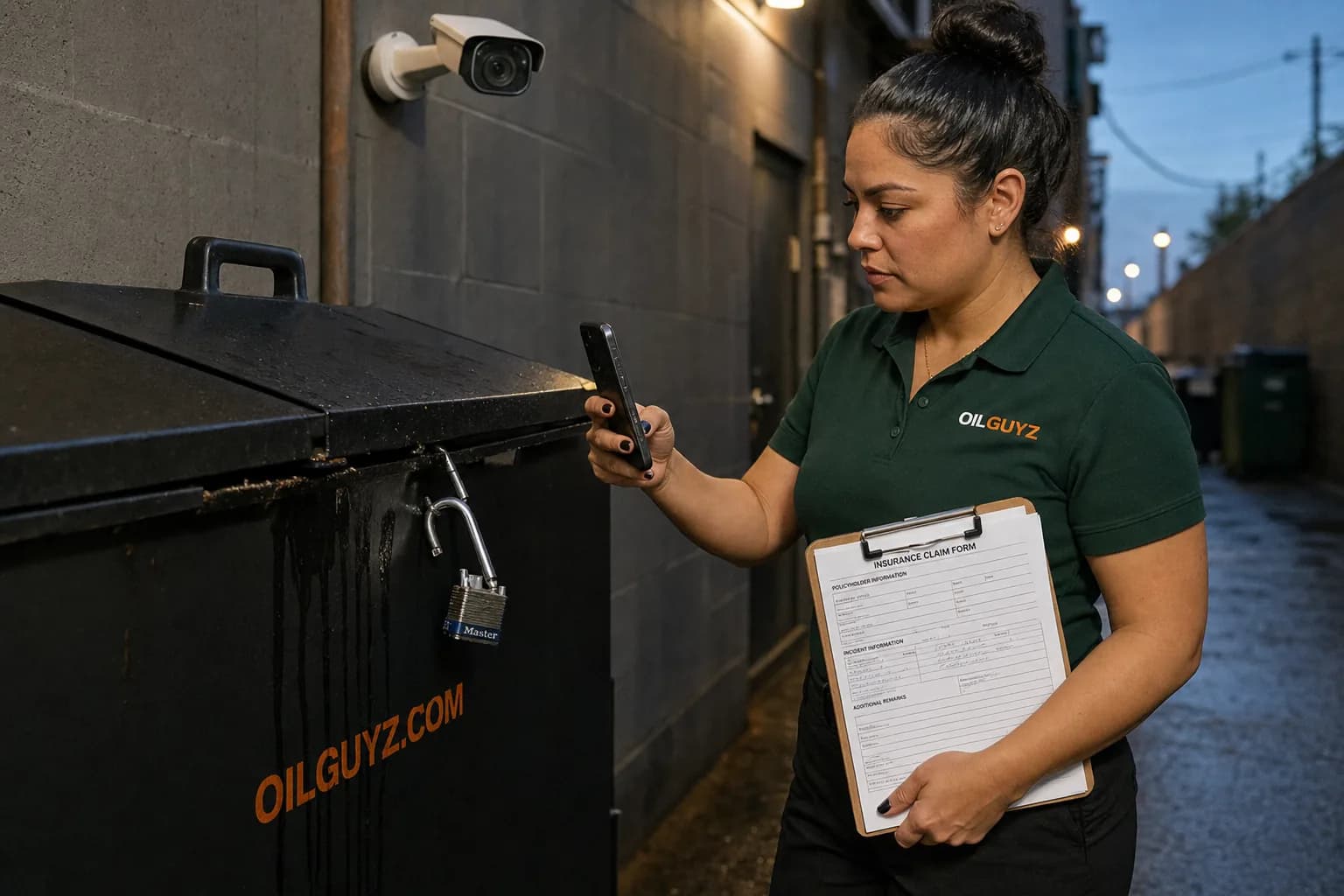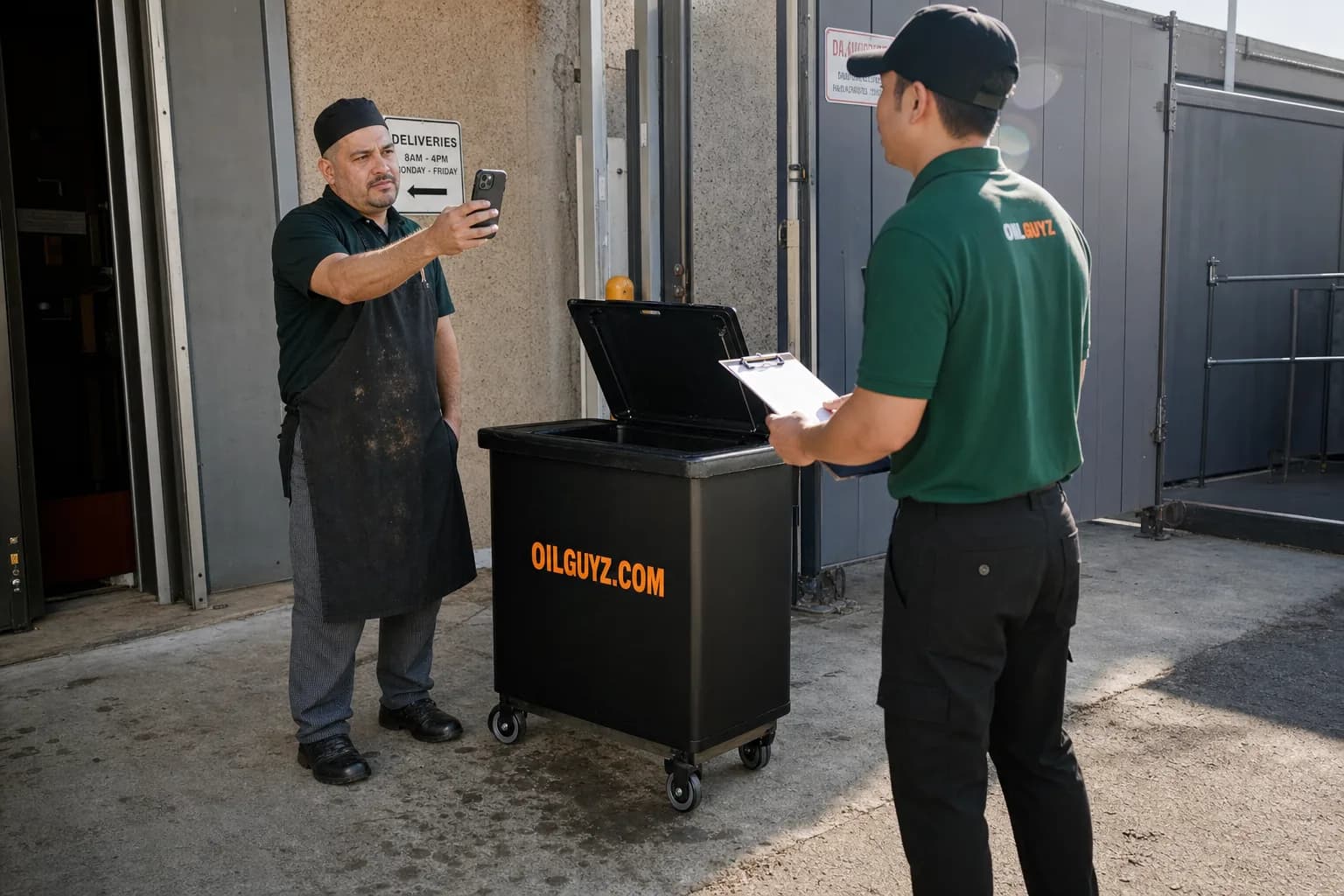

A cooking oil pickup scam usually does not look like a break-in. It looks like a delivery. Someone in a plausible uniform walks up to your back door in the middle of a shift, says they are your hauler or a new company taking over the account, and asks a cook or a dishwasher to unlock the container or sign something. The oil is gone before a manager ever sees the visitor. The fix is a short verification script any employee near the container can run in under a minute, and knowing which two or three answers in the conversation mean it ends immediately.
That is the short version. The rest of this guide covers why a cooking oil pickup scam targets staff instead of owners, the exact questions to ask, the red flags that show up in the conversation itself, and what to do if someone already got access.
Why a Cooking Oil Pickup Scam Targets the Kitchen, Not the Owner
Covert cooking oil theft happens at 2 a.m. A cooking oil pickup scam happens at 2 p.m. That difference is the whole strategy.
An overnight thief needs an unlocked container and an empty lot. A cooking oil pickup scam needs neither. It needs a busy kitchen during lunch prep, a back door propped open for airflow, and a line cook or dishwasher who has never actually met your regular driver and has no reason to question a stranger wearing a shirt with a logo on it. The visitor does not need to break a lock. They only need someone to open it for them.
This is a documented pattern, not a hypothetical one. Mahoney Environmental's 2025 grease theft prevention guide describes operators who work by "blending in with actual recycling service providers," and recommends staff learn the branded trucks and uniforms of their real collector well enough to spot a mismatch on sight. Federal prosecutors have brought cases against organized cooking oil theft operations that ran routes across multiple restaurants using box trucks, in one Western District of New York case, six men were charged with conspiracy to steal and resell restaurant cooking oil after deputies encountered them actively pumping oil at multiple locations. The tactics vary, some crews work covertly overnight, others work in daylight by simply walking up and asking, but the daylight version specifically exploits the fact that most kitchen staff have never been told what a real verification conversation sounds like.
Your restaurant's existing container lock and camera setup, if you have one, help against the overnight version. They do very little against a person who talks a cook into opening the compartment voluntarily. That gap is what this guide addresses.
The Verification Script: Three Questions Before Anyone Touches the Container
Give every employee who might encounter someone at the container a script simple enough to use mid-shift without slowing down. Three questions cover almost every legitimate-versus-scam distinction that matters.
- "What's the name on our account, and who's your dispatcher?" A real driver on a real route knows your restaurant's account name and can name their own dispatcher or office without hesitating or asking you to supply the answer.
- "Can I call our office contact to confirm before you access the container?" This is the question that matters most. A legitimate hauler expects this and will wait. Someone running a scam wants to avoid exactly this delay.
- "Can I see ythe CDFA registration of the transporter number and the decal on your truck?" Every vehicle transporting inedible kitchen grease in California must be registered with the California Department of Food and Agriculture and display a Department-issued decal, along with door lettering at least two inches high showing the company name and address, under Title 3, California Code of Regulations, Section 1180.20. A real transporter produces this without a beat of hesitation. Note the correct term: CDFA registers transporters, it does not issue them a "license," so a legitimate driver will talk about registration, not a license.
If the person answers all three cleanly, that is a strong sign this is a legitimate visit. If any answer stalls, deflects, or gets defensive, that is the signal to stop and get a manager involved before anything else happens.
Red Flags in the Conversation Itself
Some warning signs show up before you even ask a question. Others only surface once you start the verification script above. Either way, these are the signals that mean the conversation should end without container access.
| What you notice | Legitimate hauler | Impersonation warning sign |
|---|---|---|
| Vehicle | Marked truck matching your usual route and driver | Unmarked van, personal vehicle, or a truck with signage that doesn't match your records |
| Registration | Produces CDFA registration number and vehicle decal without hesitation | Vague, evasive, or claims the decal is "in the shop" |
| Account knowledge | Knows your account name and pickup day unprompted | Asks you to tell them your schedule or account details |
| Response to a phone check | Waits while you call to confirm | Pressures you to skip the call, claims they're "already running late" |
| Container access | Uses their own key or code, doesn't ask staff to unlock it | Asks a cook or dishwasher to open the locked compartment for them |
| Paperwork | Offers a receipt or explains the digital manifest will follow by email | Pushes a form for a kitchen employee to sign on the spot, with no manager present |
| Framing | Confirms a scheduled or previously arranged visit | Claims to be a "new company" taking over the account, when no one at the restaurant arranged a switch |
That last row matters because a genuine provider transition does happen sometimes, a broker changes subcontractors, or a restaurant group switches vendors at the corporate level. The difference is that a real transition gets arranged with an owner or manager ahead of time, with a confirmed start date, not announced for the first time by a stranger standing at the container mid-shift asking for a signature. If your restaurant is intentionally changing providers, switching UCO pickup providers without downtime covers how that handoff should actually work, with overlap scheduling arranged by management, not a walk-up conversation with whoever is closest to the back door.
What a Legitimate Hauler Can Always Show You
Beyond the three-question script, it helps for staff to know what proof actually exists so a confident-sounding stranger cannot bluff past a vague ask. Under 3 CCR 1180.20, a properly registered Inedible Kitchen Grease transporter in California must be able to produce:
- A current CDFA registration number, tied to the individually numbered decal on the vehicle windshield or trailer.
- Door signage on both sides of the vehicle, at least two inches high, showing the company name and address or a CHP Carrier Identification Number.
- Knowledge of your restaurant's actual pickup arrangement, your account name, your usual pickup day, and often your regular driver's name.
None of this requires a manager to look anything up in the moment. It only requires staff to know these three things exist and to ask for them before opening anything. If someone cannot produce a registration number, has door signage that does not match what they claim, or gets irritated at being asked, that is enough reason to decline access and call a manager, no further judgment call needed.
For the deeper pre-contract version of this check, the kind an owner runs before signing with a hauler rather than the kind staff runs at the back door, see how to verify your grease hauler is properly registered in California.
If Staff Already Let Someone Access the Container
If this already happened at your restaurant, the goal now is documentation and a fast call, not panic. Most incidents of this kind are a single stolen load, not an ongoing break-in, and acting methodically in the next hour protects both your compliance file and any police report you file.
- Capture the details while memory is fresh. Time of day, a description of the vehicle and any plate number, exactly what the person said, and whether anything was signed or handed over.
- Photograph the container and note the fill level if anyone remembers what it was before the visit.
- Call your actual hauler immediately and ask whether your account was serviced that day. If their dispatch records show no scheduled or completed visit, that confirms the pickup was unauthorized.
- Treat any signed paperwork as void pending manager review. A form signed by a kitchen employee with no authority to change vendor arrangements typically does not bind the restaurant, but get it in front of an owner or manager the same day rather than letting it sit.
- File a police report, even for a small-dollar load. A single report may feel like a minor administrative step, but it is exactly the kind of pattern data that has historically helped investigators connect incidents across multiple restaurants into a larger case.
- Tell your registered hauler about the pattern. If a stranger specifically knew your pickup day or timing, your hauler and CDFA's Inedible Kitchen Grease program benefit from knowing that, since it may indicate a crew scouting routes in your area.
Building the Habit Into Your Kitchen Without Slowing Down Service
A verification script only works if it survives a busy lunch rush, which means it needs to be simple enough that nobody has to think hard to use it.
- Post a laminated card near the container with your actual hauler's name, a description of their truck, and the phone number to call to confirm. Staff should not have to remember this from memory during service.
- Make "call to confirm" the default, no exceptions. The two minutes it costs to verify are cheaper than an unauthorized pickup and the paperwork that follows one.
- Restrict who opens the container. Only a manager or a designated employee handles the key or lock code, never whoever happens to be closest to the back door when someone walks up. This pairs directly with the container hardware side of theft prevention, locked, anchored containers make a walk-up con harder to pull off even if a staff member hesitates on the verification questions.
- Cover this specifically during onboarding. General "don't let strangers in" guidance does not prepare a new hire for a confident-sounding person in a branded-looking shirt asking for two minutes of their time. Name the scenario directly.
The Bottom Line
A cooking oil pickup scam works because it targets the person least equipped to make a judgment call under pressure, a kitchen employee mid-shift, not the owner who signed the service agreement. The counter to that is not more hardware, it is a script simple enough that any employee can run it in under a minute: ask for the account name and dispatcher, ask to call the office before anything opens, and ask to see the CDFA registration number and decal. A legitimate driver answers all three without friction. Anyone who cannot is a reason to call a manager before a single gallon moves.