
Fast food cooking oil recycling turns the spent fryer oil from your kitchen into renewable transportation fuel, and a single drive-thru location produces enough of it to matter. The grease that comes out of your fryers isn't waste to throw away; it's a feedstock that becomes biodiesel and renewable diesel, cuts lifecycle carbon emissions by up to 79 to 86%, and is tracked from your back door to a CDFA-licensed renderer by a legal chain-of-custody manifest. This guide walks the whole chain, fryer to fuel, and shows what makes it legitimate.
TL;DR
- A typical fast food location generates about 35 lb of used cooking oil per day, roughly 12,775 lb a year, so the volume is real, steady, and worth recycling properly. (Source)
- The recycling chain is simple: fryer → locked collection container → CDFA-licensed renderer → biodiesel / renewable-diesel feedstock, with a digital manifest issued after every pickup.
- Renewable diesel delivers about a 65% average carbon-intensity cut versus petroleum diesel; for waste feedstocks like used cooking oil the lifecycle GHG reduction is about 79 to 86%. (Renewable diesel, [Biodiesel production](Argonne National Laboratory, Environmental Science & Technology, 2022))
- What makes it legitimate, and protects you, is the manifest and chain of custody. California (CDFA) requires a manifest for every UCO pickup, and electronic manifests are legal with a 2-year minimum retention. (Source)
- Oil Guyz manages the service, the compliance, and the Filtrate portal where you track every location. The pickup itself is performed by a CDFA-registered transporter, we don't own trucks.
Why fast food fryer oil is worth recycling
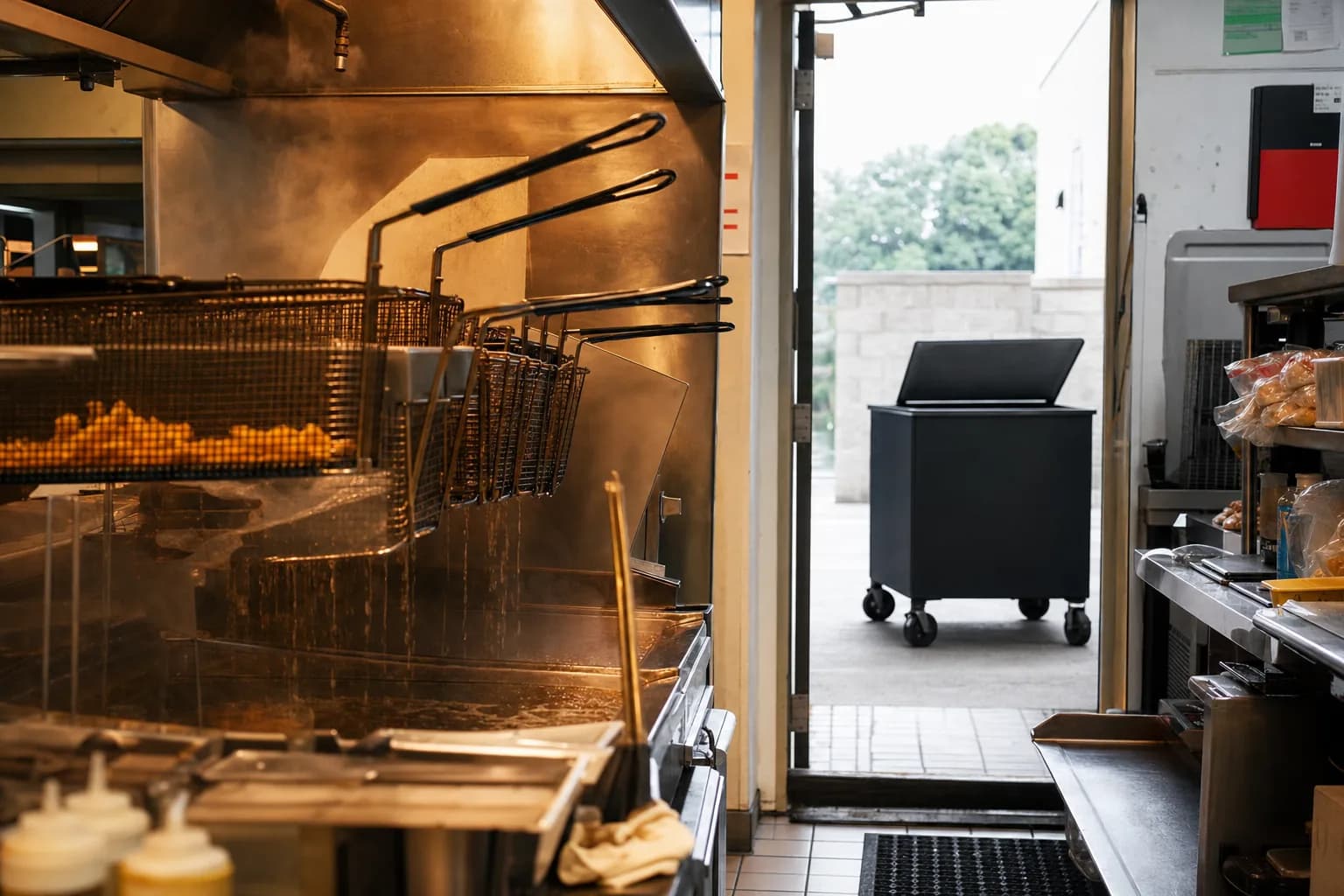
Fast food kitchens run their fryers hard. High throughput means a lot of oil gets cooked, filtered, and eventually cycled out, far more than a sit-down restaurant of the same square footage. That single fact is why fast food cooking oil recycling is its own category of service.
Put a number on it. A fast food location generates roughly 35 lb of used cooking oil every day, which adds up to about 12,775 lb a year (Frontline). Multiply that across a region of locations and you have a serious, predictable stream of renewable-fuel feedstock, which is exactly why renewable-fuel producers want it and why the collection service is free to the operator.
There's also a downside to ignoring it. Used cooking oil is a commodity with cash value, and that makes it a theft target. Industry estimates put grease theft at around $75 million a year, and the USDA values roughly 100 lb of UCO at about $25 (industry reporting). Oil poured down a drain clogs grease interceptors and triggers FOG (fats, oils, and grease) violations. Oil stolen from an unlocked container breaks your chain of custody. Proper recycling closes both gaps.
The recycling chain: fryer to renewable fuel
Here's the full path your oil takes, step by step.
Step 1, Your fryer and the locked container
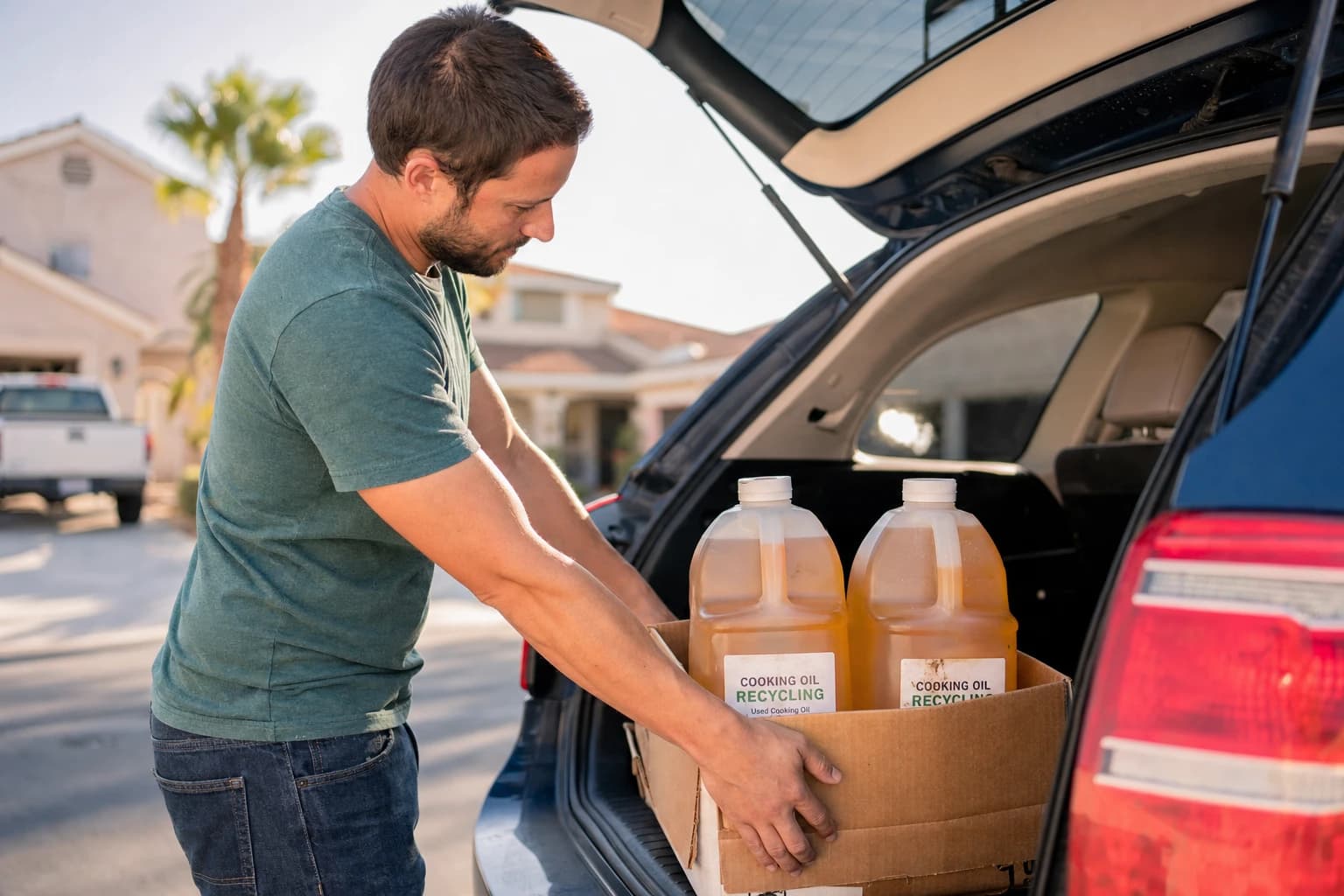
When you cycle oil out of the fryer, it goes into a sealed collection container, for Oil Guyz accounts, a free locked anti-theft container sized to your volume. The lock matters: it keeps your oil secured and your chain of custody intact until pickup. No drain, no dumpster, no unsecured drum out back.
Step 2, Scheduled pickup by a licensed renderer
On a set schedule, a driver from our CDFA-licensed renderer pumps the container into a collection tank. (To be clear: Oil Guyz does not own trucks or perform the haul, we manage the service, the schedule, and the compliance; the licensed renderer does the physical pickup and processing.) The CDFA Inedible Kitchen Grease (IKG) program registers these transporters and licenses these renderers and documents the chain of custody specifically to deter theft and illegal dumping (CDFA).
Step 3, The digital manifest (the part that makes it legal)
After every pickup, a digital manifest is generated recording what left your kitchen, how much, and where it went. This is not optional paperwork, California's CDFA requires a manifest for every used cooking oil pickup, electronic manifests are legal under California's Uniform Electronic Transactions Act, and the record must be kept for at least two years (3 CCR §1180.24). The manifest is your proof of compliant disposal and your audit trail. With Oil Guyz it lands automatically in the Filtrate portal so you can pull it up for any location, any pickup, in seconds.
Step 4, Cleaning and pre-processing at the renderer
At the renderer, collected oil from many accounts is consolidated and cleaned:
- Water removal, restaurant oil carries moisture; it's settled and heated out because water lowers fuel energy content.
- Solids removal, breading, food particles, and debris are filtered out.
- Quality grading, the oil is tested for free fatty acid (FFA) content and contaminants, which sets its grade (clean "yellow grease" is the premium tier).
Step 5, Conversion into renewable fuel
Clean used cooking oil then becomes fuel by one of two pathways:
| Pathway | Process | End product | Notes |
|---|---|---|---|
| Biodiesel | Transesterification (fats + alcohol + catalyst) | FAME biodiesel (e.g. B100, B20 blends) | Glycerin byproduct reused in soaps/cosmetics |
| Renewable diesel | Hydroprocessing (hydrogen, heat, pressure) | Drop-in diesel-equivalent fuel (R99 / HVO) | Chemically identical to petroleum diesel; any blend ratio |
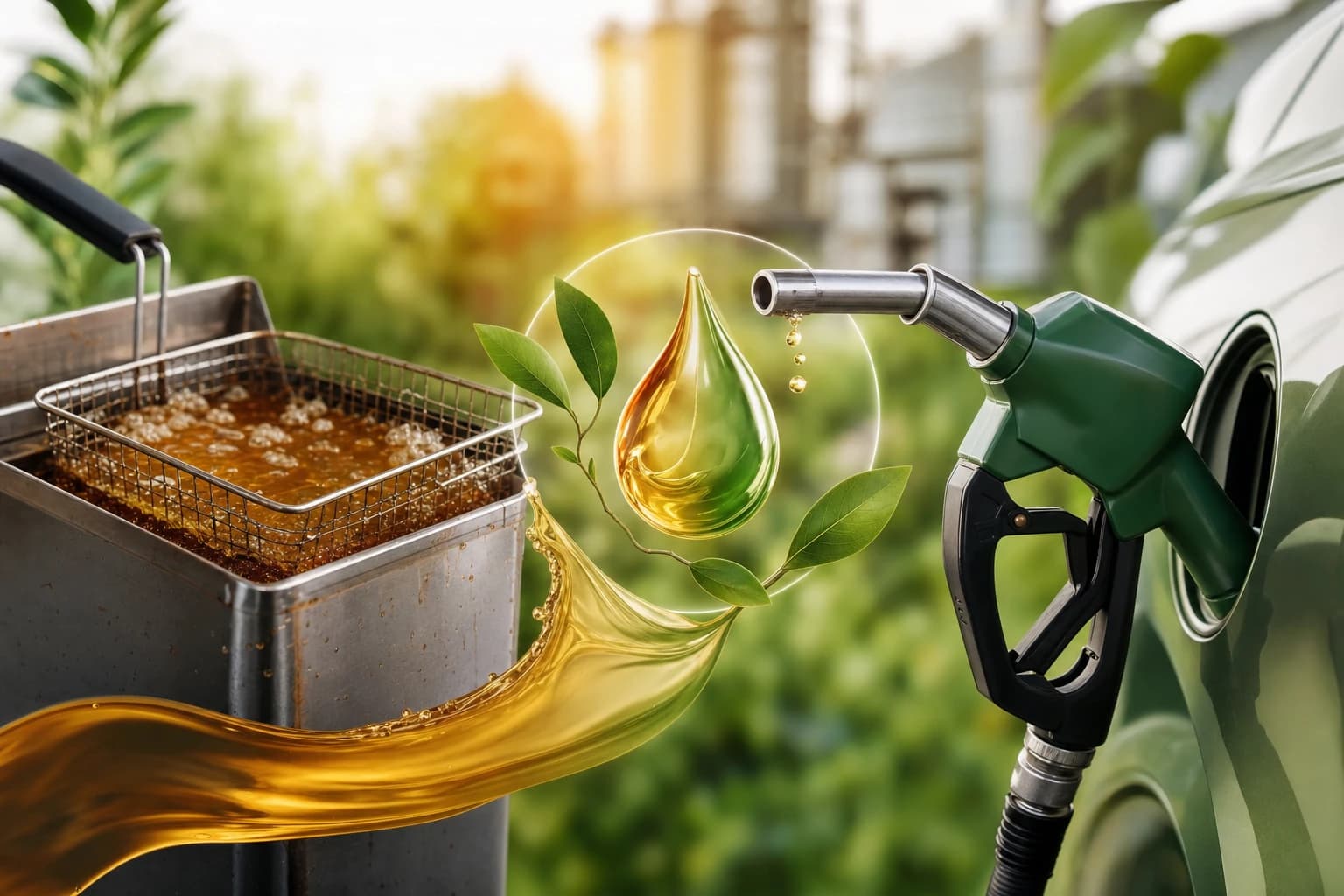
Both run in existing diesel engines. Renewable diesel is the faster-growing pathway because it's a true drop-in fuel and scores exceptionally well on carbon.
The carbon payoff, with real numbers
This is the part worth getting precise about, because the numbers are genuinely strong.
- Renewable diesel cuts carbon intensity by about 65% on average versus petroleum diesel (DOE/CARB, AFDC).
- When the feedstock is a waste oil like used cooking oil, the lifecycle greenhouse-gas reduction climbs to about 79 to 86% lower than petroleum diesel for both biodiesel and renewable diesel (Argonne National Laboratory, Environmental Science & Technology, 2022).
- Under the federal Renewable Fuel Standard, biomass-based diesel must achieve at least a 50% lifecycle GHG reduction to qualify, and UCO-derived fuel clears that easily (EPA RFS).
For a fast food brand with sustainability commitments, that's reportable impact. Your collection volume converts directly into a measurable lifecycle-emissions reduction, and Oil Guyz can provide per-location collection data for ESG and franchisor reporting.
What makes it legitimate vs. just "hauled away"
Plenty of operations will take your oil. Far fewer give you proof it was handled legally. The difference between real recycling and a liability is documentation:
- A licensed renderer, CDFA IKG-registered transport and licensed processing, not an unverified pickup.
- A digital manifest after every pickup, the legal chain-of-custody record, retained per CDFA rules.
- A locked container, keeps the oil yours until it's logged, defeating theft.
- One dashboard, the Filtrate portal shows every pickup and manifest across every location.
Skip any of those and "recycling" is just a truck driving off with your oil and no paper trail.
How Oil Guyz fits the chain
Oil Guyz sits at the front of this supply chain as the service and software layer, not a trucking company:
- Free scheduled pickup and a free locked anti-theft container, month-to-month, cancel anytime.
- A CDFA-compliant digital manifest after every pickup, generated automatically.
- The Filtrate portal, one dashboard for every location plus per-location mobile apps.
- A real person answers the phone, not a queue.
- Pickup and processing performed by our CDFA-licensed renderer, so your oil reaches a licensed facility and enters the biodiesel / renewable-diesel pipeline.
If you run more than one location, the compliance and tracking is where most operators lose time. That's the whole point of the platform.
Where to go next
- New to managing it across a chain? Start with the hub: Restaurant Cooking Oil Management.
- Worried about audits and manifests? See Cooking Oil Compliance & Reporting.
- Running many sites under one agreement? See Multi-Location Cooking Oil Collection.
- Specifically a fast food operator? See the fast food cooking oil pickup page.
- Comparing providers? Read Best Cooking Oil Management for Multi-Location Restaurants.
Coverage today spans Orange County, Los Angeles, San Diego, the Inland Empire, the Bay Area, and Tacoma/PNW, and we're expanding. Operate somewhere we haven't named yet? Tell us your locations and we'll notify you as we reach your area.
Sources
- Frontline II, Cooking oil collection for fast food (volume per location): https://nwbiofuel.com/blog/cooking-oil-recycling-in-fast-food-chains-setting-industry-standards/
- California 3 CCR §1180.24, manifest requirement, electronic manifests, retention: https://www.law.cornell.edu/regulations/california/3-CCR-1180.24
- CDFA Meat, Poultry & Egg Safety / IKG program, licensing & chain of custody: https://www.cdfa.ca.gov/AHFSS/MPES/
- DOE AFDC, Renewable diesel (~65% carbon-intensity cut): https://afdc.energy.gov/fuels/renewable-diesel
- Waste-feedstock lifecycle GHG reduction of ~79 to 86% (Argonne National Laboratory, Environmental Science & Technology, 2022)
- EPA, Renewable Fuel Standard overview (≥50% lifecycle GHG, UCO qualifies): https://www.epa.gov/renewable-fuel-standard/overview-renewable-fuel-standard-program