
TL;DR: Where you take used cooking oil in Southern California depends on which county and which city you live in, and most people get sent to the wrong program. In Orange County, check your organics cart first (some cities allow it, most do not say), then use one of the four free county Household Hazardous Waste centers. In Los Angeles, use the City of LA S.A.F.E. Collection Centers, open weekends. Do not use the "used oil recycling" centers you find first, because those are for motor oil. From November 27 to December 27, 2026, there is also a free holiday drop-off in Placentia and South Gate.
You have a jug of cold fryer oil on the counter and no idea where it goes. You search, and the first result is a "used oil recycling center" two miles away. You drive over, and they turn you away, because that program is for motor oil.
That is the core problem with recycling cooking oil in Southern California. The information exists, but it is scattered across county waste agencies, individual city haulers, and automotive programs that use nearly identical wording. This guide puts the verified options in one place.
The 60-Second Answer
Find your situation in the table below, then read the section for your county.
| Your situation | Where it goes |
|---|---|
| Small amount of pan grease or bacon fat | Cool, solidify, seal in a container, then household trash |
| A few quarts of used cooking oil, Orange County | Check your city's organics cart rules first, then a county HHW center |
| A few quarts of used cooking oil, Los Angeles | A City of LA S.A.F.E. Collection Center, open weekends |
| 3 to 5 gallons of turkey-fryer oil, Nov 27 to Dec 27 | The free Oil Guyz holiday drop-off, Placentia or South Gate |
| Any amount from a restaurant or commercial kitchen | Free scheduled pickup, not a residential drop-off |
| Motor oil, transmission fluid, or anything automotive | A certified used-oil center, never a cooking-oil drop-off |
The Trap: "Used Oil Recycling" Almost Always Means Motor Oil
This is the part that wastes the most trips, so it is worth being blunt about.
The OC Regional Used Oil Recycling Program run through the Orange County Health Care Agency covers used motor oil and used oil filters. Cooking oil is not mentioned anywhere in the program. Its certified collection centers are set up for automotive lubricants, and its warnings are about heavy metals and groundwater contamination from vehicle oil.
The same confusion exists statewide. CalRecycle's used-oil recycling incentive and its network of certified collection centers are built for motor oil. Do not take fryer oil to a certified used-oil center expecting them to take it, and definitely do not expect a per-gallon payment.
The rule to remember: if a program mentions oil filters, engines, or a per-gallon incentive, it is automotive. Cooking oil lives in a completely separate lane.
Never mix the two, either. A jug of cooking oil contaminated with motor oil is no longer recyclable as either one.
Orange County: Where to Take Used Cooking Oil
Orange County residents have three real options, and the first one surprises people.
Option 1: Your organics cart, but only if your city says so
Some Orange County cities let residents put used cooking oil directly into the organics recycling cart. The Costa Mesa Sanitary District states it plainly: used cooking oil can be placed in your Organics Recycling Cart along with food waste and green waste, and CR&R recycles those materials into compost and renewable natural gas.
That is genuinely the easiest option if you have it. But it is set city by city and hauler by hauler, not countywide.
Plenty of other Orange County cities publish organics-cart guides that list food scraps, food-soiled paper, and yard waste with no mention of cooking oil or grease at all. Silence is not permission. Pouring oil into a cart that is not set up for it can contaminate an entire load.
Before you use this route, check your own city's "What Goes Where" guide or call your hauler. It takes two minutes and saves a contaminated load.
Option 2: The four county Household Hazardous Waste centers
Orange County operates four free Household Hazardous Waste Collection Centers for county residents:
| Center | Address |
|---|---|
| Anaheim | 1071 N. Blue Gum Street, Anaheim, CA 92806 |
| Huntington Beach | 17121 Nichols Lane, Gate 6, Huntington Beach, CA 92647 |
| Irvine | 6411 Oak Canyon, Irvine, CA 92618 |
| San Juan Capistrano | 32250 Avenida La Pata, San Juan Capistrano, CA 92675 |
All four are open Tuesday through Saturday, 9 a.m. to 3 p.m., and close on major holidays and during rain. Proof of Orange County residence may be requested. Business waste is not accepted.
Two limits matter for a big fryer batch:
- Maximum 15 gallons or 125 pounds per vehicle per trip, a Department of Transportation requirement. Exceeding it is illegal.
- Containers larger than five gallons will not be accepted. Split a large batch into smaller jugs.
Because cooking oil is not technically a hazardous waste, acceptance can vary by site. Call 714-834-4000 to confirm before you load the car.
Option 3: The free holiday drop-off in Placentia
From November 27 through December 27, 2026, there is a free, self-serve used cooking oil drop-off at:
506 Fee Ana St, Placentia, CA 92870 Monday through Saturday, 9 a.m. to 4 p.m., closed Sundays
There is no attendant, no appointment, and no charge. Pour your cooled oil into the clearly marked container and go. Full details are on the holiday drop-off page.
Los Angeles: Where to Take Used Cooking Oil
Los Angeles is more centralized than Orange County, and the county says so directly.
Los Angeles County Public Works confirms that while cooking oil is not classified as hazardous waste, residents can dispose of it at the County's weekly household hazardous waste collection events or through the City of Los Angeles S.A.F.E. Centers.
The S.A.F.E. Collection Centers
S.A.F.E. stands for Solvents, Automotive, Flammables, Electronics. The centers are free, open weekends, and serve City and County of Los Angeles residents:
| S.A.F.E. Center | Address | Hours |
|---|---|---|
| Randall Street | 11025 Randall St., Sun Valley, CA 91352 | Sat and Sun, 9 a.m. to 3 p.m. |
| Hyperion | 7660 W. Imperial Hwy., Gate B, Playa Del Rey, CA 90293 | Sat and Sun, 9 a.m. to 3 p.m. |
| Gaffey Street | 1400 N. Gaffey St., San Pedro, CA 90731 | Sat and Sun, 9 a.m. to 3 p.m. |
| Washington Blvd. | 2649 E. Washington Blvd., Los Angeles, CA 90021 | Reported temporarily closed |
You will be asked for your address at the gate, and centers cannot accept waste from residents who do not provide one. Business waste is not accepted at any S.A.F.E. center.
Check the official S.A.F.E. Centers page for current status before you drive, since the Washington Boulevard site has been reported as temporarily closed.
County roundups and permanent centers
Los Angeles County also runs weekly weekend HHW roundup events that rotate across the county, plus two permanent centers: the Antelope Valley Environmental Collection Center in Palmdale and the EDCO Recycling and Transfer Center in Signal Hill. The permanent centers do not list cooking oil on their accepted materials, so the roundups and S.A.F.E. centers are the more reliable route. County limits are 15 gallons or 125 pounds per trip.
Current schedules are posted on the CleanLA collection centers page.
The free holiday drop-off in South Gate
From November 27 through December 27, 2026, the Los Angeles County drop-off site is:
4570 Ardine St, Gate C, South Gate, CA 90280 Monday through Saturday, 9 a.m. to 4 p.m., closed Sundays
Same setup as Placentia: self-serve, no appointment, no charge.
How to Prep Your Oil So It Actually Gets Accepted
Getting turned away is almost always a container problem, not an oil problem.
- Cool it completely. For three to five gallons, leave it covered overnight. Hot oil burns, and it can warp or crack a plastic jug.
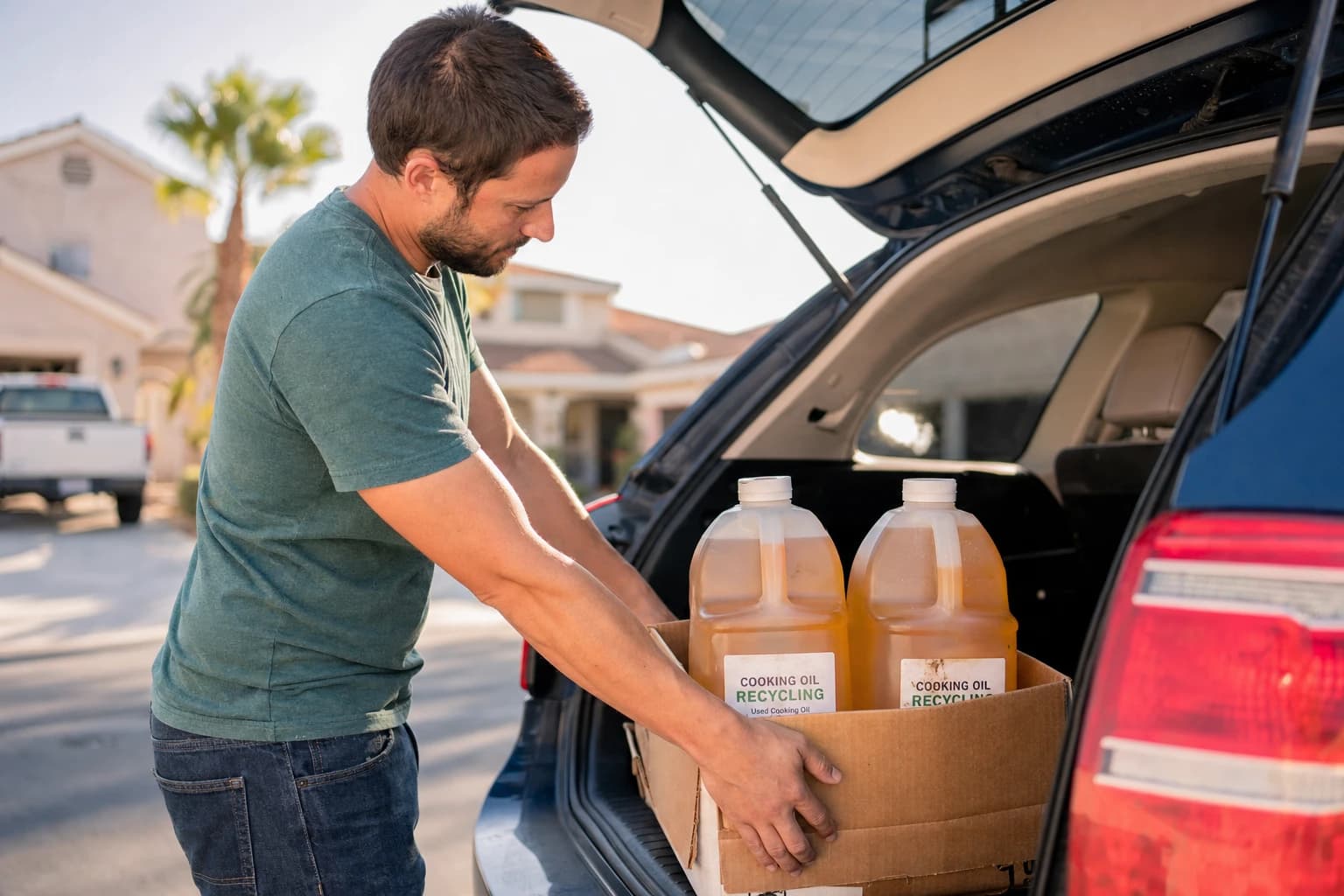
- Use sealable plastic. The original oil jug is perfect. An empty milk or juice jug works. Buckets are fine if they have a tight lid.
- Never use glass. It breaks in a trunk or at a drop-off and causes injuries. Most sites reject it outright.
- Keep it clean. No water, no food scraps, no chemicals, and never any automotive fluid. Contamination can make the batch unrecyclable.
- Transport it upright. Stand jugs in a box or a bag in your trunk so a tip does not become an oil slick.
You do not need to strain or filter it for recycling. The processor filters it downstream.
What Not to Do
Never pour it down a drain. Oil looks liquid going down, then cools and hardens inside the pipe, catching everything that follows. Hot water and dish soap do not change that; they just move the problem a few feet further along. Fats, oils, and grease are a leading cause of sewer blockages nationwide, and the resulting overflows are expensive and, near the coast, occasionally close beaches.
Never pour it in the yard or a storm drain. Storm drains in Southern California mostly flow untreated to the ocean.
Do not dump a large batch in the trash loose. Small amounts of solidified grease sealed in a container are fine. Three gallons of liquid oil in a kitchen bag is a leak waiting to happen.
Printable Drop-Off Guide
If you want something to stick on the fridge, hand out at a community event, or post at a city facility, there is a one-page printable version of this guide with all the locations, hours, and container rules:
Download the printable LA and OC cooking oil drop-off guide (PDF)
Cities, HOAs, and community groups are welcome to print, post, and share it.
Thanksgiving: The One Week This Really Matters
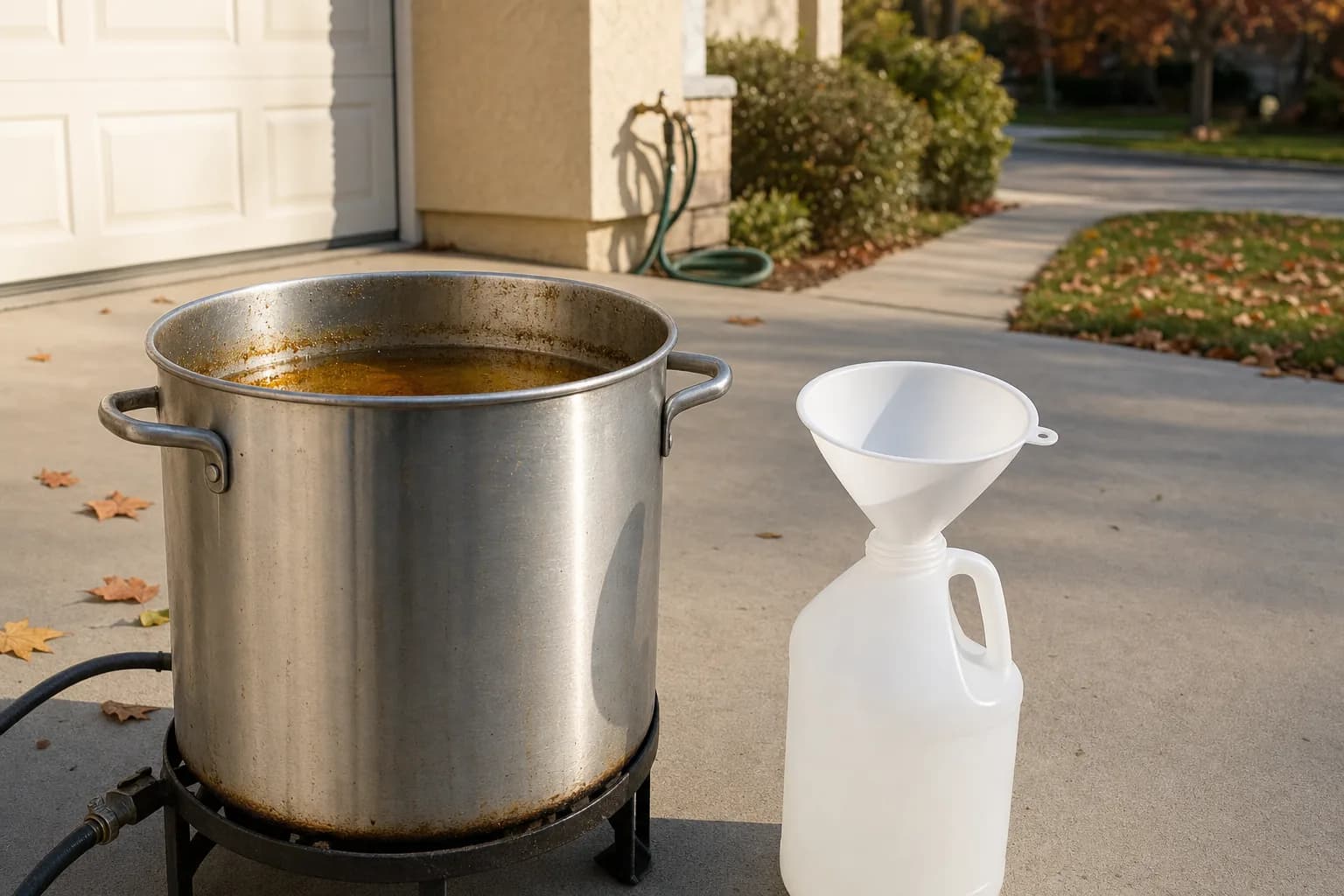
Deep-frying a turkey leaves three to five gallons of oil in one night, which is more than a household produces the rest of the year combined. That is also when the drain shortcut does the most damage: the day after Thanksgiving is the busiest day of the year for plumbers, which is why the trade nicknamed it Brown Friday.
If you fried a bird, the step-by-step turkey fryer oil guide covers cooling, reusing, and storing it. When you are ready to hand it off, the free holiday drop-off runs November 27 through December 27, 2026 in Placentia and South Gate.
Restaurants and Commercial Kitchens Are a Different Lane
Everything above is for households. If you run a restaurant, food truck, caterer, or any commercial kitchen, you cannot use residential drop-offs or HHW centers, which explicitly refuse business waste. California also requires commercial generators to use a registered hauler with proper manifests.
The commercial route is free scheduled pickup with a container at your site, which costs the kitchen nothing and produces the compliance paperwork you need. See the restaurant grease pickup guide for how that works.
The Bottom Line
Recycling cooking oil in Southern California is easy once you know which lane you are in. Skip anything labeled "used oil recycling," because that is motor oil. In Orange County, check your organics cart rules, then use one of the four county HHW centers. In Los Angeles, use a weekend S.A.F.E. center. Cool the oil, seal it in plastic, keep it clean, and never send it down a drain.
And if you are holding a turkey fryer's worth of oil in late November, the free drop-off exists precisely for that.