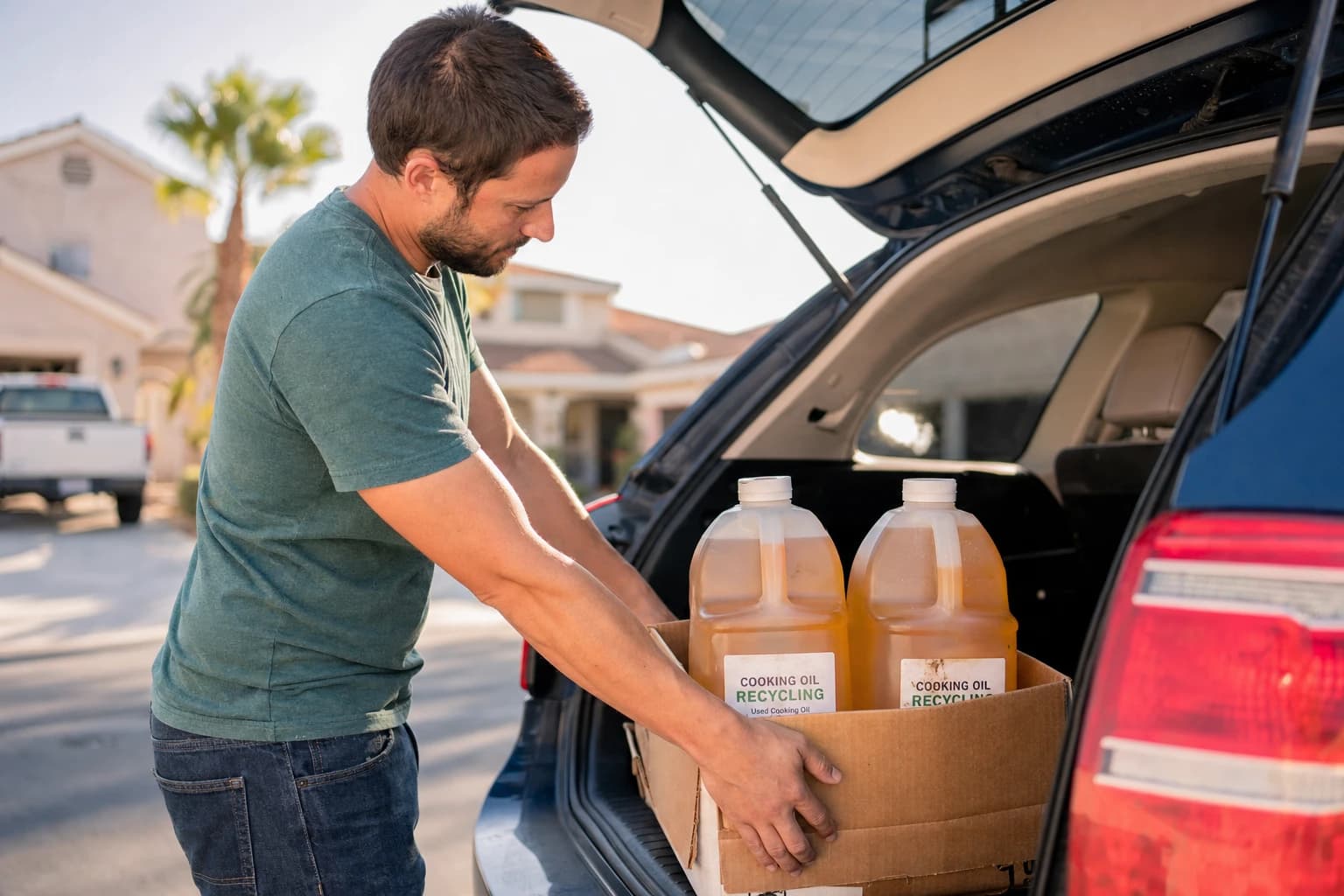

Wingstop's SEC filings contain a number almost no other restaurant chain reports: exactly how many pounds of used cooking oil it recycled last year. In 2021, it was 11 million pounds. By 2024, it had climbed to 22 million. Then, in 2025, it dropped to 20 million, and the filing never says why.
That is the most complete picture of restaurant used cooking oil recycling that exists anywhere in public records. Everywhere else, the numbers are scattered: a press release here, a sustainability report there, most companies saying nothing at all. This is what we found when we went looking, chain by chain, through every SEC filing, sustainability report, and press release we could locate, and what it says about where all that fryer oil is actually going.
TL;DR
- Wingstop discloses used cooking oil recycled every year in SEC filings: 11 million lbs (2021) climbing to 22 million lbs (2024), then dropping to 20 million lbs (2025), unexplained.
- Restaurant Brands International's jump to 55 million lbs in 2025 is mostly a counting change, Popeyes and two new countries joined the tally that year, not a sign Burger King alone tripled its output.
- Wendy's, Chick-fil-A, and Shake Shack have each published one snapshot year and never updated it. Only Wingstop tracks the number annually.
- More than a dozen major chains, including Raising Cane's, Chipotle, Domino's, and Subway, have published nothing at all, and the widely-shared claim that Subway, Dairy Queen, and Carl's Jr./Hardee's run active recycling programs traces back to no source we could find.
- The reason any of this is disclosed at all: EPA just raised the 2026 biomass-based diesel target from 3.35 billion to 8.86 billion gallons, and waste oils now supply 37% of that feedstock, up from 17% in 2020.
- California prices this oil as roughly 80% cleaner than diesel under CARB's carbon-intensity math, even as the credits that reward it have gotten cheaper, not more expensive, since 2023.
Five Years, One Number: The Wingstop Trend
Wingstop discloses the same metric every year in its annual SEC proxy statement (DEF 14A): pounds of used cooking oil recycled. No other major chain has a run this long or this consistent.

| Year | Used cooking oil recycled | Source |
|---|---|---|
| 2021 | 11+ million lbs | 2022 proxy statement |
| 2022 | ~13 million lbs | 2023 proxy statement |
| 2023 | ~17 million lbs | 2024 proxy statement |
| 2024 | ~22 million lbs (4,600+ cars off the road/year equivalent) | 2025 proxy statement |
| 2025 | ~20 million lbs raw (28.6 million lbs on a CO2-equivalent basis; 5,980 cars off the road/year equivalent) | 2026 proxy statement |
The climb from 11 million to 22 million pounds is the real story: five straight filings, same metric, same phrasing, a genuine four-year trend. Then 2025 broke the pattern. The number dropped to 20 million pounds, and Wingstop's filing doesn't say why, which is more interesting than if it had just kept climbing. That same filing also reports a second number, 28.6 million pounds, measured on a converted CO2-equivalent basis rather than raw weight, folded into the same paragraph as a different unit entirely. We're showing both exactly as filed rather than picking whichever one sounds better.
How the Rest of the Industry Compares
Wingstop isn't the only chain putting a number on this, just the only one that's done it five years running.
| Chain | Most recent year | Used cooking oil / renewable diesel recycled | Source |
|---|---|---|---|
| Wingstop | 2024 | ~22 million lbs used cooking oil | SEC DEF 14A proxy |
| Restaurant Brands International (Burger King + Popeyes) | 2025 | 55+ million lbs diverted from landfills (US, Spain, France; scope expanded from prior year) | 2025 Restaurant Brands for Good report |
| Wendy's | 2020 | 24 million lbs used cooking oil, converted to 2.8 million gallons of renewable diesel | PR Newswire |
| Chick-fil-A | 2023 | 637,000+ gallons of renewable diesel across 1,700+ US/Canada locations | Chick-fil-A newsroom |
| Shake Shack | 2022 | 1.9 million lbs waste oil recycled (215 company-operated Shacks) | 2023 Sustainability Report |
| Inspire Brands (Sonic + Arby's) | 2024 | 29.3 million lbs used cooking oil, 1,210 restaurants | Inspire Brands impact page |
| Panda Express | Undated, current | No volume published; Darling Ingredients named preferred nationwide UCO provider for nearly all ~2,400 US locations | PR Newswire |
Look closely and a pattern emerges: everyone except Wingstop has published exactly one snapshot. Wendy's number is from 2020. Chick-fil-A's is from 2023. Shake Shack put its figure in one report and quietly dropped it from the next. RBI's jump from 12 million pounds (Burger King alone, 2024) to 55 million (Burger King plus Popeyes, plus Spain and France, 2025) reads like explosive growth until you notice it's mostly new restaurants joining the count, not existing ones recycling more oil. A single photograph isn't a trend. Wingstop is the only company that's taken five.
Partial and regional disclosures: McDonald's, Yum Brands, and the Darling Ingredients network
A few other names show up in this space, but only in fragments, not a chain-wide total.
McDonald's has never published a single global used cooking oil figure. What exists is a set of regional programs: in the Netherlands, roughly 1,000 tons a year of fryer oil went to Neste for renewable diesel as of 2021; in the UK, the delivery fleet runs on an 85% recycled cooking oil fuel blend, preventing an estimated 1,675 tons of carbon a year; in Hawaii, Pacific Biodiesel processes about 94,000 gallons over the most recent 12-month period on record; and at DFW Airport, five McDonald's locations feed roughly 32,000 lbs of used cooking oil into a Neste sustainable aviation fuel program. Each of these is real and sourced, but none of them add up to a company-wide number.
Yum Brands (KFC, Taco Bell, Pizza Hut) is even thinner. The only KFC figure we found is from 2017, for the UK and Ireland market specifically, and it is too stale to cite as a current number. Yum's own June 2026 sustainability report contains zero mentions of cooking oil recycling. The one current, specific figure we could verify is regional: Pizza Hut Indonesia recycled 31 tonnes of used cooking oil between June 2024 and May 2025 across 200+ outlets, preventing an estimated 102,827 kg of CO2, through a partnership with waste-tech platform Tukr.
Darling Ingredients, the largest single UCO collector in North America, reports in its FY2025 10-K that it collects used cooking oil from approximately 158,300 U.S. locations. That figure spans its entire collection network, restaurants of every kind, not just the chains named in this article, and Darling does not break out a corresponding volume number to pair with it.
The Chains With No Public Used Cooking Oil Recycling Data
This is the part most industry content skips, and it matters as much as the numbers above. We looked specifically for published used cooking oil recycling data, volume, gallons, or a named renewable-fuel partnership, from the following chains and found none: Raising Cane's, Chipotle, Domino's, Jack in the Box, Subway, Dairy Queen, Carl's Jr./Hardee's, El Pollo Loco, Del Taco, In-N-Out, Krispy Kreme, Jimmy John's, Dunkin', Baskin-Robbins, and Buffalo Wild Wings.
A couple of these deserve a specific note rather than a blank entry. Chipotle publishes a general 47% waste diversion figure, but it is not broken out by waste stream, so it cannot be read as a used-cooking-oil-specific number. Jack in the Box shows up only in a third-party vendor case study (RTI) with no company-published volume, and a 2022 SEC filing separately characterizes the company as an ESG "laggard," which is the opposite signal from a chain actively publicizing its recycling program. Buffalo Wild Wings' only mention is a 2016 vendor award, with no volume attached, ten years old at this point.
A few industry blog posts circulating online go further, claiming Subway, Dairy Queen, and Carl's Jr./Hardee's all run active cooking oil recycling programs. We went looking for what those claims were built on: an SEC filing, a press release, a sustainability report, anything. We found nothing. That doesn't make the claims false. It means nobody, including whoever wrote those posts, has shown their work, and we're not going to repeat a number we can't trace back to a source.
Why Any of This Is Disclosed at All
None of this is happening out of goodwill. On March 27, 2026, EPA finalized new Renewable Volume Obligations that raise the required biomass-based diesel volume from 3.35 billion gallons to 8.86 billion gallons in a single year, a jump that has to come from somewhere. Used cooking oil is one of the few feedstocks that can scale fast enough to help fill it: USDA's Economic Research Service tracks the category it falls into, waste oils, animal fats, and greases, growing from 17% of biomass-based diesel feedstock in 2020 to 37% in 2023, about 12 billion pounds. The credits behind that demand, D4 biomass-based diesel RINs, were trading at $2.41 as of June 4, 2026, close to their 2021 all-time high. Refiners need the oil. Chains that can document a steady supply have leverage in that market, whether or not they ever mention it in a sustainability report.
California Runs a Different Calculation
California doesn't just count gallons, it grades them. CARB has certified used-cooking-oil-based biodiesel at 15.92 grams of CO2-equivalent per megajoule, against a 94.71 gram baseline for petroleum diesel sold in the state, roughly an 80% gap. That single number is why used cooking oil is worth more as fuel feedstock in California than in most of the rest of the country.
It's also why the state's numbers don't tell a clean growth story. LCFS credit prices have fallen every year since 2023: $75, then $64, then $60, still $60 as of January 2026, even as more oil and more companies have entered the program. More supply chasing a shrinking credit price is the part of this story California's own data makes hardest to ignore.
The Industry Isn't on a Straight Line, Either
Step back from any single chain and the wider trend holds up, mostly. U.S. renewable diesel production capacity nearly quadrupled between 2020 and 2022, from about 38,000 to about 170,000 barrels a day, per the EIA. Research from the University of Illinois' farmdoc project, an academic source, found used cooking oil's share of biomass-based diesel feedstock climbing from 8.4% in 2016 to 31.9% in 2019, with volume rising from under 100 million pounds in 2015 to more than 4 billion pounds by 2022. Clean Fuels Alliance America, the industry's own trade group, puts 2022 U.S. UCO supply at 850 million gallons and projects global supply could reach 5 to 10 billion gallons by 2030.
Then 2025 happened. The EIA reports U.S. renewable diesel production fell 12% year over year, after the Blenders Tax Credit expired and was replaced by the more restrictive Section 45Z Clean Fuel Production Credit, changing producer economics overnight. Used cooking oil supply grew for most of the past decade because policy and price pointed the same direction. 2025 is the year they didn't, and the production numbers moved with them, even while the restaurants kept recycling the same oil.
What This Means for Your Restaurant or Chain
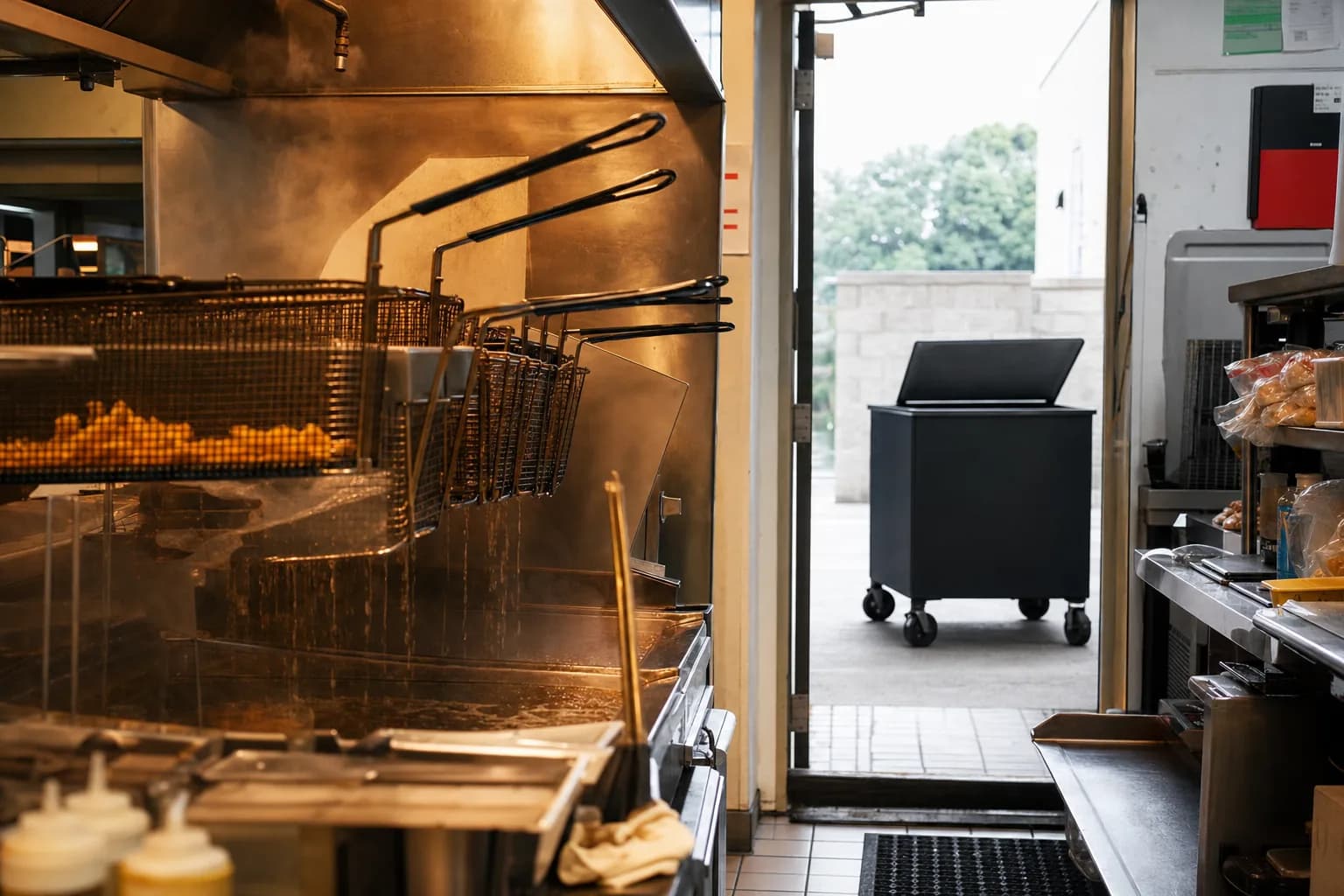
Whether or not your chain publishes a sustainability report, the underlying mechanics are the same for a single unit or a 500-unit group: used cooking oil is generated by the fryer, secured until pickup, and documented from kitchen to renderer. For a single-location breakdown of what drives that volume up or down, see how much used cooking oil a fast food restaurant produces. Multi-location operators trying to standardize reporting across dozens of stores, the same problem a corporate sustainability team faces when rolling up numbers like the ones above, can see how restaurant chains manage used cooking oil pickup across every location. The full fryer-to-fuel mechanics, including the manifest that documents chain of custody, are covered in how fast food cooking oil recycling becomes renewable fuel.
Used cooking oil enters this supply chain as yellow grease, the trade term for collected restaurant fryer oil once it becomes a commodity. For how that collection and grading process actually works, see Yellow Grease Recycling; for how collected oil is aggregated as renewable diesel feedstock at scale, see Biodiesel Feedstock Collection. Restaurant groups in the fast food category specifically can see how this applies to a drive-thru-style kitchen in our fast food used cooking oil program, and any single or multi-location kitchen that wants the same locked-container, manifest-documented model described throughout this article, without waiting to publish its own sustainability report, can see how the free locked grease container program works.
Sources
Official company sources
- Wingstop 2022 DEF 14A proxy statement (2021 UCO data): https://www.sec.gov/Archives/edgar/data/1636222/000119312522104970/d277769ddef14a.htm
- Wingstop 2023 DEF 14A proxy statement (2022 UCO data): https://www.sec.gov/Archives/edgar/data/1636222/000119312523084562/d378642ddef14a.htm
- Wingstop 2024 DEF 14A proxy statement (2023 UCO data): https://www.sec.gov/Archives/edgar/data/1636222/000119312524086632/d642378ddef14a.htm
- Wingstop 2025 DEF 14A proxy statement (2024 UCO data): https://www.sec.gov/Archives/edgar/data/1636222/000119312525072428/d901302ddef14a.htm
- Wingstop 2026 DEF 14A proxy statement (2025 UCO data): https://www.sec.gov/Archives/edgar/data/1636222/000119312526140360/d49901ddef14a.htm
- Restaurant Brands International, 2024 Restaurant Brands for Good Report (Burger King US): https://s26.q4cdn.com/317237604/files/doc_downloads/2025/05/2024-Restaurant-Brands-For-Good-Report.pdf
- Restaurant Brands International, 2025 Restaurant Brands for Good Report (Burger King + Popeyes): https://s26.q4cdn.com/317237604/files/doc_downloads/2026/04/22/report/2025-RBI-Restaurant-Brands-for-Good-Report.pdf
- Wendy's / Darling Ingredients, PR Newswire release (2020 data): https://www.prnewswire.com/news-releases/wendys-restaurants-report-darling-ingredients-partnership-produced-2-8m-gallons-of-renewable-diesel-in-2020--301277096.html
- Chick-fil-A newsroom, "From Fries to Renewable Fuel" (2023 data): https://www.chick-fil-a.com/press-room/from-fries-to-renewable-fuel
- Darling Ingredients / Panda Express, PR Newswire release: https://www.prnewswire.com/news-releases/darling-ingredients-chosen-as-panda-express-preferred-nationwide-provider-for-used-cooking-oil-recycling-for-renewable-fuel-301752210.html
- Shake Shack, 2023 Sustainability Report (2022 data): https://shakeshack.com/sites/default/files/2023-06/ShakeShack_SFSG-Report-2023_Optimized_R2_0.pdf
- Inspire Brands, Environmental Impact page (2024 data): https://impact.inspirebrands.com/environment/
- McDonald's Netherlands / Neste, Biofuels News: https://biofuels-news.com/news/oil-from-mcdonalds-french-fries-to-be-converted-into-renewable-diesel/
- McDonald's UK delivery fleet, Trellis: https://trellis.net/article/mcdonalds-recycle-cooking-oil-power-its-vehicles/
- McDonald's Hawaii / Pacific Biodiesel: https://biodiesel.com/mcdonalds-recycling-uco/
- McDonald's DFW Airport / Neste SAF: https://corporate.mcdonalds.com/corpmcd/our-stories/article/recycle-oil-jet-fuel.html
- Pizza Hut Indonesia / Tukr, PR Newswire release (2024-2025 data): https://www.prnewswire.com/apac/news-releases/pizza-hut-indonesia-partners-with-tukr-to-implement-sustainability-initiative-on-food-production-waste-management-302477541.html
- Jack in the Box, 2022 SEC filing (ESG characterization): https://www.sec.gov/Archives/edgar/data/807882/000121465922002515/d214221px14a6g.htm
- Darling Ingredients, FY2025 10-K (U.S. collection network size): https://sec.gov/Archives/edgar/data/916540/000119312526116070/d26898dars.pdf
Government and regulatory sources
- U.S. Energy Information Administration, Today in Energy (D4 RIN prices): https://www.eia.gov/todayinenergy/detail.php?id=67765
- U.S. Environmental Protection Agency, Renewable Fuel Standard annual standards (2026 RVOs): https://www.epa.gov/renewable-fuel-standard-program/renewable-fuel-annual-standards
- USDA Economic Research Service, Charts of Note (feedstock share growth): https://www.ers.usda.gov/data-products/charts-of-note/109680
- California Air Resources Board, LCFS fuel pathway carbon intensity report: https://ww2.arb.ca.gov/sites/default/files/classic/fuels/lcfs/fuelpathways/comments/tier2/b0629_report.pdf
- California Air Resources Board, LCFS monthly credit transfer activity, January 2026: https://ww2.arb.ca.gov/sites/default/files/2026-02/January%202026%20-%20Monthly%20LCFS%20Credit%20Transfer%20Activity.pdf
- U.S. Energy Information Administration, Today in Energy (renewable diesel capacity growth): https://www.eia.gov/todayinenergy/detail.php?id=55399
- U.S. Energy Information Administration, Today in Energy (2025 production decline): https://www.eia.gov/todayinenergy/detail.php?id=65424
Industry association sources
- Clean Fuels Alliance America, global UCO supply outlook: https://cleanfuels.org/clean-fuels-releases-outlook-on-global-supplies-of-used-cooking-oil-for-biodiesel-and-renewable-diesel-production/
Academic sources
- University of Illinois farmdoc daily, "Renewable Diesel Feedstock Trends over 2011-2022": https://farmdocdaily.illinois.edu/2023/12/renewable-diesel-feedstock-trends-over-2011-2022.html