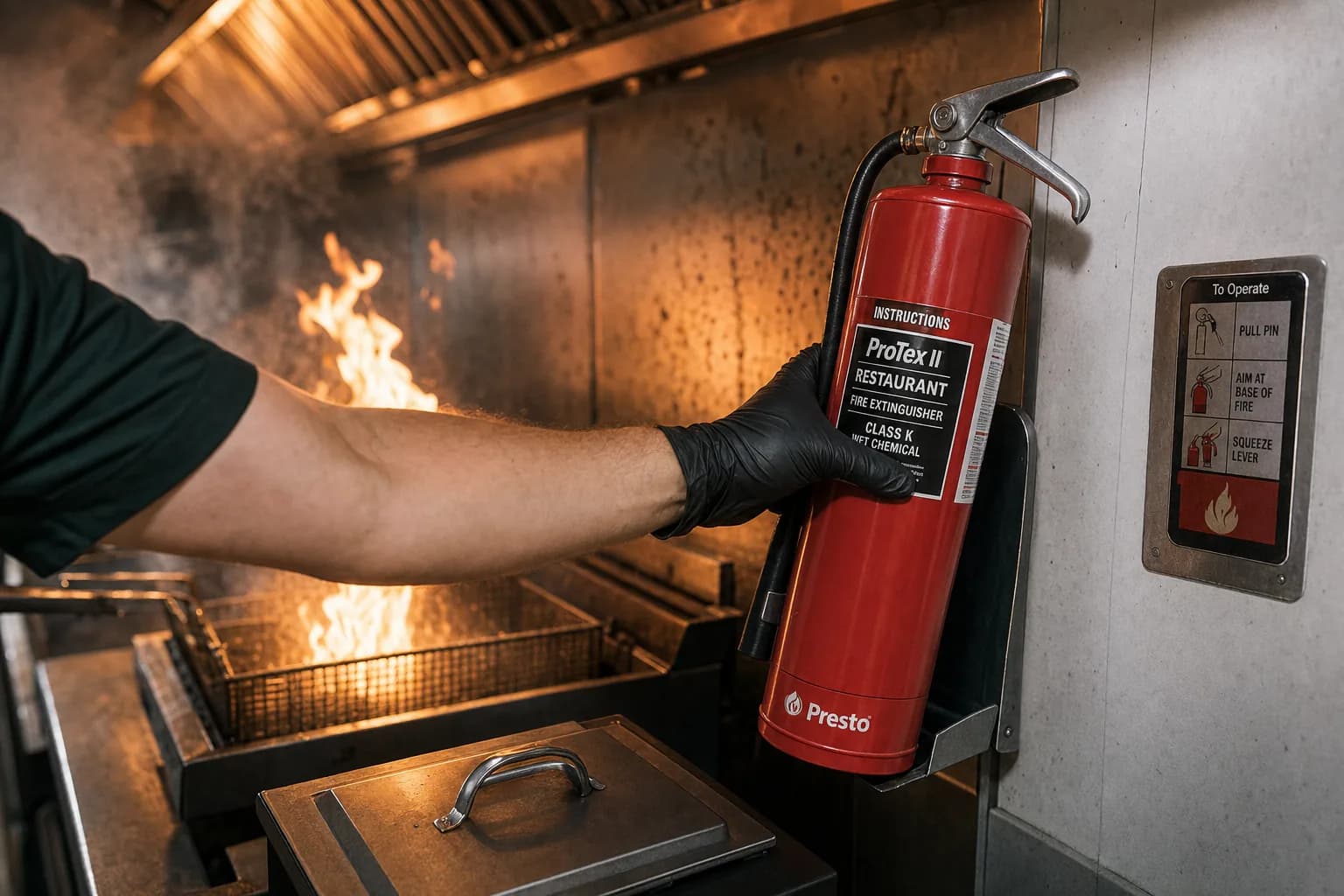

A hot oil burn does not wait for a slow moment. It happens mid-rush, usually during the fryer-to-container transfer nobody budgets extra attention for, and the first five minutes of response matter more than anything a doctor does afterward. This guide walks through exactly what to do the moment it happens, what never belongs anywhere near the wound, how to judge whether it is a first aid situation or a 911 call, and the paperwork a manager needs to have ready once the immediate danger has passed. This is a personal-injury emergency, distinct from a plumbing emergency like an overflowing grease trap, and it calls for a different response plan entirely.
The First 60 Seconds: Get Cool Water Running
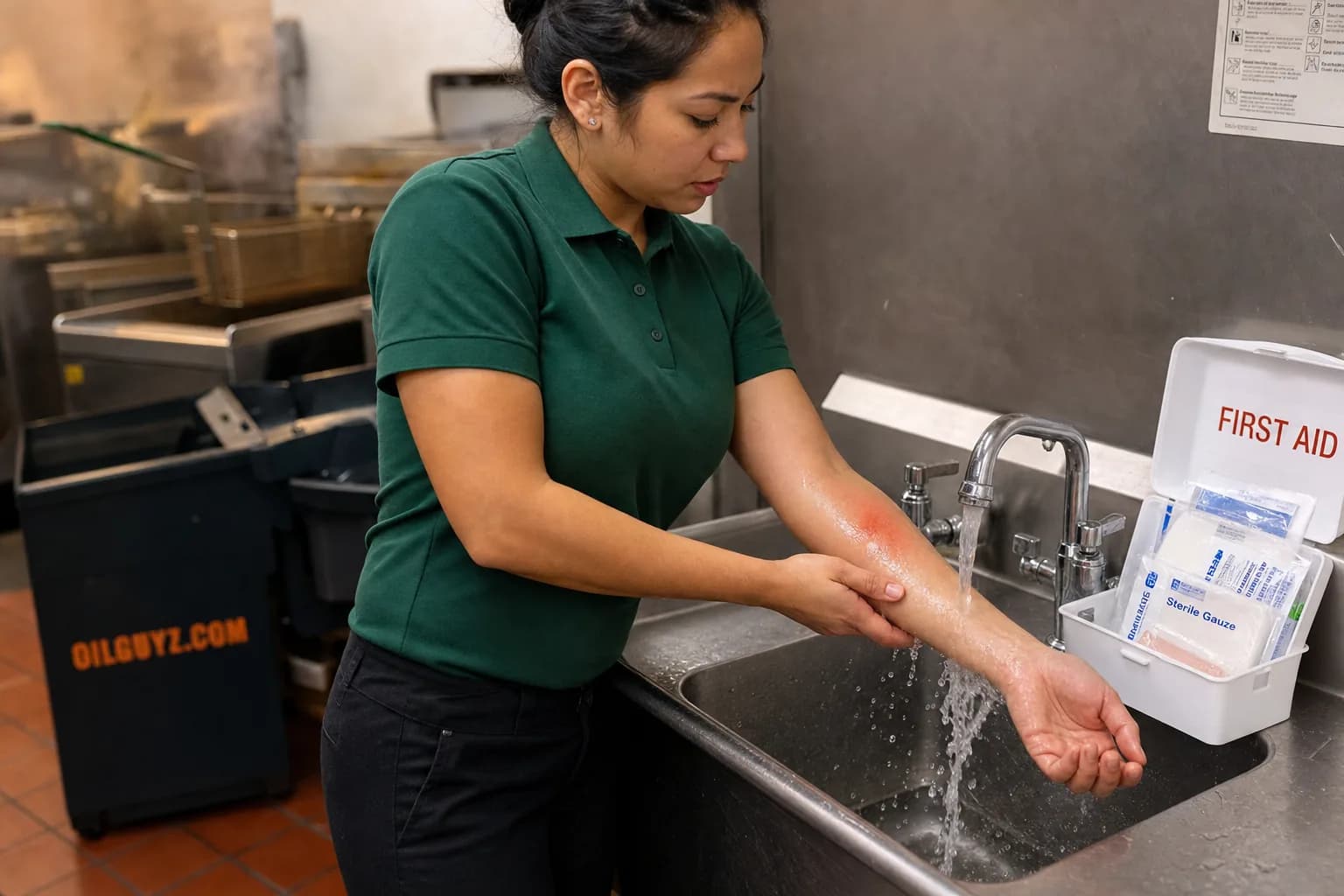
The single highest-value action after a hot oil burn is also the simplest: get the burned area under cool, running water immediately and keep it there. Do not stop to find a burn cream, do not send someone to grab the first aid kit first, and do not waste time debating severity. Water first, everything else second.
The American Burn Association recommends cooling a fresh burn with running water, not ice or icy water, for at least five minutes. For a hot oil burn specifically, plan on longer. Cooking oil holds heat far more efficiently than water because it is thicker and runs at a much higher temperature, so the tissue keeps cooking even after the oil itself is off the skin. Running water for longer, until the burning sensation genuinely eases, does more good than stopping at an arbitrary clock.
While the water runs:
- Remove jewelry, watches, and tight clothing near the burn before swelling sets in and makes it painful or impossible to do later
- Keep the water cool, not ice cold. Extreme cold constricts blood vessels in already-damaged tissue and can deepen the injury instead of limiting it
- Do not scrub or pop any blisters that form. Let cool water do the work and leave the skin intact
- Send someone else to grab gauze and call for help while the burned employee stays under the water. One person cools the burn, another handles the rest
If the burn covers a large area, involves the face, or the employee is showing signs of shock (pale, clammy, dizzy, breathing fast), start the 911 call while the water is still running rather than waiting until cooling is finished.
What Never Touches a Hot Oil Burn
Kitchens are full of instinctive fixes that feel helpful and are not. The American Burn Association is direct about the substances that make a burn worse, not better:
| Never apply | Why it hurts more than it helps |
|---|---|
| Butter, oil, or margarine | Traps heat against the skin instead of releasing it |
| Ice or ice water | Restricts blood flow and can deepen the tissue damage |
| Toothpaste or ointments | Traps heat and introduces contamination into an open wound |
| Cotton balls or fluffy bandages | Fibers stick to burned tissue and complicate treatment later |
If a burn blisters, resist the urge to break the blister open. An intact blister is a natural barrier against infection. Cover it loosely with sterile gauze and let a medical provider decide whether it needs draining.
Stock a real first aid kit in the kitchen, not just a box of adhesive bandages. It should include sterile non-stick gauze, medical tape, and a pair of clean gloves for whoever administers first aid, positioned somewhere every shift lead can find it without hunting.
Deciding Between First Aid, Urgent Care, and 911
The hardest call in the first few minutes is judging severity while adrenaline is running high. The American Burn Association's burn center referral criteria give a concrete framework instead of a guess.
| Situation | Response |
|---|---|
| Small, red area, no blistering, roughly the size of a coin or two | Cool, cover, monitor. First aid is usually enough |
| Blistering over an area larger than the employee's palm | Urgent care or ER same shift |
| Partial-thickness burn covering more than 10% of body surface (roughly one full arm) | Emergency care, per ABA referral criteria |
| Any third-degree burn (white, leathery, or charred skin, often painless at the center) | Call 911 regardless of size |
| Burn on the face, hands, feet, genitals, or a major joint | Emergency evaluation, even if it looks moderate |
| Signs of shock: pale skin, rapid breathing, dizziness, confusion | Call 911 immediately |
Two details are easy to miss in the moment. First, a third-degree burn is often less painful than a shallower one because the nerve endings themselves have been damaged, so "it doesn't hurt that bad" is not a reliable signal to skip the ER. Second, burns on the hands carry outsized long-term risk because of how much scar tissue can limit grip and dexterity, which is exactly why the ABA singles hands out for automatic referral even when the burn looks survivable.
When a shift lead is unsure, the safer default is always the ER. An unnecessary urgent care copay is a rounding error compared to a burn that heals wrong because it waited.
Why Hot Cooking Oil Burns Differently Than a Water Scald
It is worth understanding why a fryer oil splash gets treated more seriously than a hot coffee spill of the same size. Oil runs hotter than boiling water in a working fryer, commonly well above 350°F, and its viscosity means it clings to skin rather than running off the way water does. That combination, higher temperature plus longer contact time, is exactly why Washington State's Department of Labor & Industries hazard alert on hot oil fryers notes that scalds from hot oil are generally more severe than scalds from hot water, both because oil heats to a higher temperature and because it stays on the skin longer once contact happens.
The same alert points to where these injuries actually happen: not just active frying, but the routine tasks around a fryer, cleaning it, adding oil, moving it, where a slip, trip, or splash turns a normal task into a burn injury. That pattern matters for prevention, and it matters for triage too. A hot oil burn that looks the same size as a hot water burn on the skin's surface is very often a deeper injury underneath, which is one more reason to lean toward professional evaluation rather than assuming a small-looking burn is a minor one.
Documenting the Incident: What a Manager Needs on Paper
Once the burn is cooled, covered, and the employee is either back to light duty or on the way to care, the incident is not over from a management standpoint. Two separate paperwork clocks start running, and missing either one creates real problems later.
California Workers' Comp: The DWC-1 Clock
Under California Labor Code 5401, an employer that learns about a work-related injury, including a burn, must give or mail the injured employee a workers' compensation claim form (DWC-1) within one working day. According to the California Division of Workers' Compensation, the employer fills out its portion and forwards the form to its workers' comp insurance carrier; the employee only completes the employee section. This is not optional and it is not something to handle "when things slow down." Keep a few blank DWC-1 forms on hand in the office alongside the first aid kit so the one-day clock is never the bottleneck.
Alongside the form, capture the basics while memories are fresh: date and time of the burn, what task was underway, what caused it, who witnessed it, what first aid was given, and where the employee went for further care if any. A phone photo of the burn area (with the employee's consent) and a photo of the equipment involved take thirty seconds and are worth far more later than a manager's memory of the shift.
OSHA Reporting: What Restaurants Actually Owe
Most restaurant operators assume every workplace injury has to go on an OSHA log, and that is not quite right. Full-service and limited-service restaurants, NAICS codes 7221 and 7222, are on OSHA's list of partially exempt industries, meaning they are not required to maintain the routine OSHA 300 injury and illness log unless specifically asked to in writing by OSHA, the Bureau of Labor Statistics, or a state plan agency.
That exemption has a hard limit, though. Per OSHA's reporting regulation, every employer, exempt from routine logging or not, must report:
- A work-related fatality within 8 hours
- A work-related in-patient hospitalization, amputation, or loss of an eye within 24 hours
A hot oil burn severe enough to require hospital admission crosses that threshold and has to be reported to OSHA, even for a restaurant that never keeps a 300 log in an ordinary year. Post the OSHA reporting number, 1-800-321-6742, somewhere a shift manager can find it fast, because the 24-hour window starts from when the employer learns of the hospitalization, not from a convenient business day.
Where Most Fryer Oil Burns Actually Happen
Burns during active frying get the most attention, but the transfer from fryer to disposal or storage container is where a large share of preventable injuries happen, because it involves moving a large volume of hot liquid by hand under time pressure. A few changes at that specific step cut the risk meaningfully:
- Cool before you transfer. Let the fryer drop well below operating temperature, many kitchens hold to below 100°F, and use a thermometer instead of guessing based on how the pot looks or feels from the outside.
- Use a drain wand, transfer pump, or hose instead of pouring by hand. Restaurant Technologies notes that tools built for oil transfer keep hands away from hot liquid entirely, which removes the highest-risk moment rather than just managing it.
- Wear heat-resistant gloves and, for larger batches, a face shield any time oil is moved manually. A splash that lands on a forearm is a burn; the same splash that lands in an eye is a much longer recovery.
- Never rush the transfer during a rush. The pressure to clear a fryer fast during peak service is exactly when shortcuts, skipping gloves, pouring before the oil has cooled, happen.
Every hour spent building this habit into a checklist rather than tribal knowledge is an hour that pays for itself the first time it prevents a shift from turning into an ER trip. For the full cool-strain-contain routine, including how to keep the transfer point itself safer, see how to prepare used cooking oil for pickup.
Building a Burn Response Card Before You Need One
The best time to decide what counts as a 911 burn is before anyone is standing over an injured coworker with oil still on their hands. Post a short response card near the fryer station, laminated, with four lines:
- Cool water on the burn immediately, minimum five minutes, longer if it is still painful
- Never apply butter, ice, or ointment
- Third-degree, face, hands, feet, or larger than a palm: call 911
- Manager: DWC-1 form within one working day; OSHA's own hospitalization-reporting deadline is 24 hours
A card like that does not replace training, but it removes the need to remember exact numbers under pressure. The employees closest to the fryer at 7 PM on a Friday are rarely the ones who read the employee handbook closely, and a burn injury is exactly the wrong moment to be looking anything up.