
A grease fire does not build slowly. A pan of oil that is smoking one second can be open flame the next, and the wrong reaction in that first ten seconds decides whether you are cleaning a scorched hood the next morning or evacuating a building. Most restaurant grease fires start exactly where you would expect: fryers, flat-tops, and range burners loaded with the fuel every kitchen runs on.
This is a grease fire response guide, not a scare piece. It walks through what to actually do the moment a grease fire ignites, why the instinct to grab water is the single most dangerous thing you can do during a grease fire, what your fire suppression system and Class K extinguisher are each built to handle, and two fuel sources that cause more damage than most kitchens expect: grease-caked hoods and oily rags stored the wrong way, sometimes right next to the used cooking oil container out back.
The First Ten Seconds: What to Do When Oil Ignites
Every second matters, but panic wastes more of them than the fire does. The response splits into two tracks depending on how contained the fire is.
A Small Flare-Up Contained in One Pan
If flames are confined to a single pan on a burner:
- Cut the heat. Turn off the burner if you can reach the control without leaning over the flame.
- Smother it. Slide a metal lid, sheet pan, or a fire blanket over the pan to cut off its oxygen. Leave it in place until the pan has fully cooled, reopening too soon can reignite the oil.
- Do not move the pan. Carrying a flaming pan toward a door or sink is how a contained fire becomes a moving one.
- Do not use water, flour, or a wet towel. None of these smother an oil fire, and water actively makes it worse (more on that below).
A Fire on a Fryer, Range, or Broiler That Has Grown Past a Single Pan
This is where your kitchen's fixed fire suppression system does the real work, not the handheld extinguisher.
- Pull the manual suppression station. It is mounted along your path to the nearest exit, typically 10 to 20 feet from the hood. Pulling it discharges a wet chemical agent onto every appliance under the hood and automatically cuts the gas and electrical supply, removing the fuel source at the same time it cools the fire.
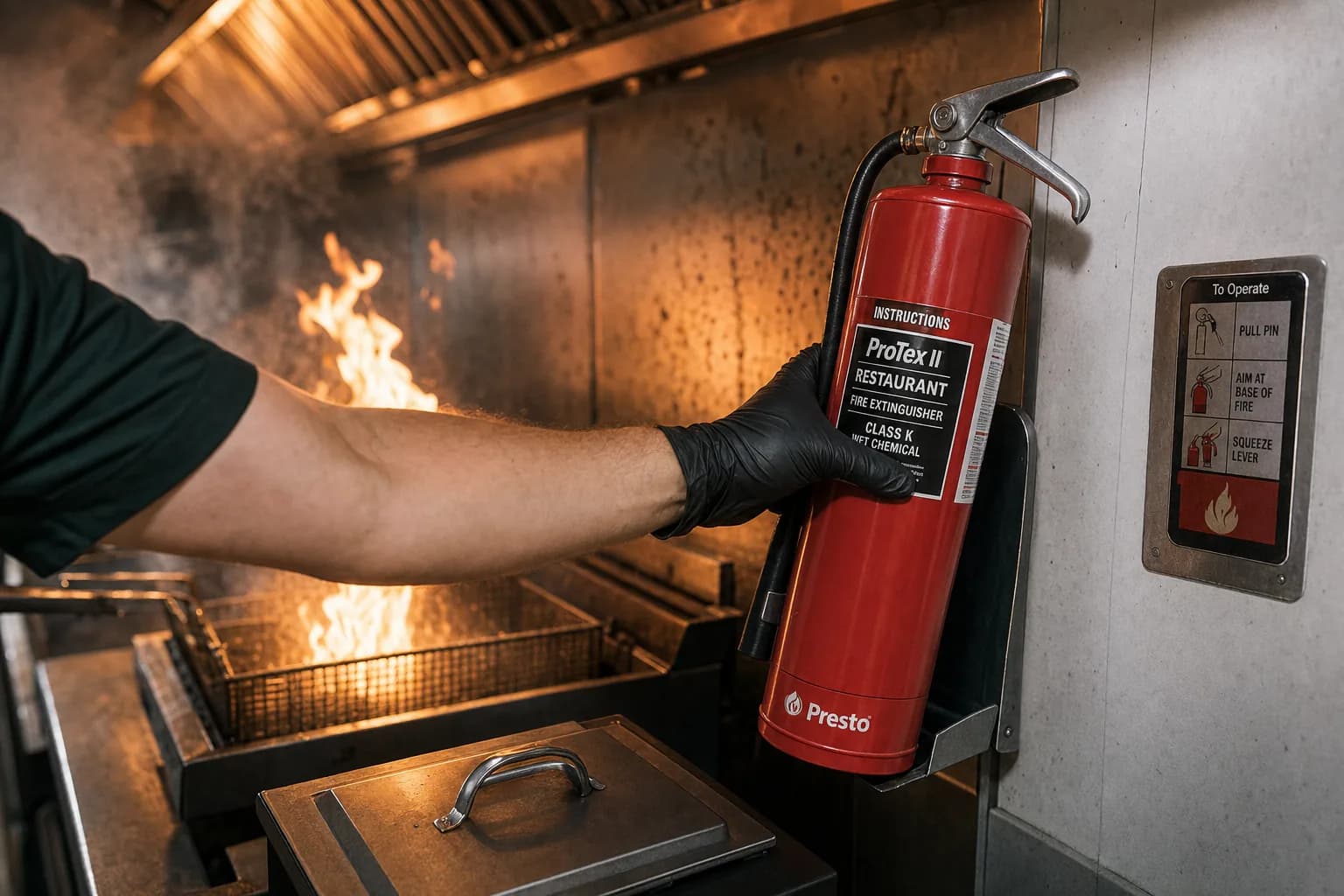
- Grab the Class K extinguisher only as backup. If the suppression system does not fully extinguish the fire, or a secondary flare-up starts after discharge, use the portable Class K unit: pull the pin, aim at the base of the flame rather than the visible fire, and sweep side to side.
- Sound the alarm and call 911 immediately, even if you believe the suppression system has the fire under control. Fire department confirmation matters, and a kitchen fire that looked out the moment the chemical discharged can reignite in the duct minutes later.
- Evacuate if the fire keeps growing or the extinguisher runs empty. Do not attempt a second extinguisher or wait to see what happens next.
Why Water Turns a Grease Fire Into a Fireball
The instinct to douse a fire with water is almost universal, and it is exactly backward for burning oil. Water is denser than hot cooking oil, so it sinks beneath the surface and instantly flashes to steam at frying temperatures, expanding roughly 1,700 times in volume in a fraction of a second. That expansion violently ejects burning oil droplets into the air in every direction, a phenomenon fire crews call a boilover or grease fire explosion. What started as a fire contained to one pan becomes airborne burning oil landing on counters, curtains, and anyone standing nearby.
This is also why a standard ABC fire extinguisher, the kind mounted in an office hallway, is the wrong tool. Its dry chemical powder can knock down the visible flame for a moment, but it does nothing to lower the temperature of the oil underneath. As soon as the powder cloud settles, a fryer that is still well above its autoignition point can reignite within seconds.
Class K Extinguishers: What California Kitchens Are Required to Have
Commercial cooking equipment that uses vegetable oil, animal fat, or any other combustible cooking media falls under NFPA 96, which requires Class K fire protection specifically for that hazard. NFPA 10 sets the placement rule: a Class K extinguisher must be within 30 feet of actual walking distance from the appliance, measured along the path a person would really walk around counters and equipment, not a straight line through them.
| Extinguisher class | What it is designed for | Why it fails (or works) on a grease fire |
|---|---|---|
| Class A | Ordinary combustibles: wood, paper, cardboard | Not rated for cooking oil fires |
| Class B | Flammable liquids and gases | Can suppress briefly but does not cool the oil |
| Class ABC | General-purpose dry chemical | Powder interrupts the flame but does not cool the oil; reignition risk is high |
| Class K | Cooking oils and fats (vegetable and animal) | Wet chemical agent saponifies the oil surface into a cooling foam blanket that blocks reignition |
The saponification reaction is the key detail: the wet chemical agent reacts with the hot oil to form a soap-like film across the surface that both cools the oil and physically seals it from oxygen. That is a fundamentally different mechanism than smothering a flame with powder or foam, and it is the reason no other extinguisher class is an acceptable substitute in a kitchen with fryers or grease-producing equipment. Recent updates to NFPA 96 also require a placard posted directly above every Class K unit instructing staff to activate the fixed suppression system before reaching for the extinguisher, reinforcing that the extinguisher is backup, not the first move.
The Hood Suppression System Is Your First Move, Not Your Backup
Every kitchen with a fryer, range, griddle, or broiler under a hood has (or should have) a fixed fire suppression system with a manual pull station positioned along an exit path. When that station is pulled, three things happen at once:
- A wet chemical agent discharges through nozzles aimed at every appliance under the hood, not just the one that is burning.
- Gas valves close and electrical power to the appliances shuts off, cutting the fuel supply that would otherwise keep feeding the fire.
- Depending on your system's wiring, the fire alarm and, in many installations, the fire department are notified automatically.
Treat this as your primary tool for anything beyond a single contained pan, and treat the portable extinguisher as the backup for flare-ups the suppression system does not fully knock down. Run a walkthrough with every shift, not just management, so line cooks know exactly where the pull station is without hesitating to look for it during an actual fire.
The Fuel Sources Hiding in Plain Sight
The fire response above assumes flames are already visible. The more preventable problem is what is quietly feeding a fire's potential before it ever starts.
Grease Buildup in Hoods and Ducts
Airborne grease from every service coats the inside of your hood, plenum, and exhaust duct over time. A fire that starts small on a cook surface can travel into that grease-lined duct and become a structure fire that is far harder to contain than anything on the line. This is exactly why NFPA 96 sets mandatory hood and duct cleaning intervals based on cooking volume, quarterly for high-volume or 24-hour kitchens, semi-annual for moderate volume, annual for light-duty operations, and why a current, visible hood cleaning certificate is one of the first things a health inspector or fire marshal checks. If your hood cleaning schedule has slipped, that grease buildup is not a cosmetic problem, it is stored fuel waiting for an ignition source. Run your own pre-inspection walkthrough with the compliance checklist tool before your next scheduled visit, and see the full health inspection grease checklist for everything an inspector checks around your hood and trap, to catch a gap before an inspector or a fire does.
Oily Rags and Absorbent Pads Near Your Outdoor Oil Container
This is the fuel source most kitchens never think about until something smolders. Rags and absorbent pads soaked in cooking oil undergo oxidation, a chemical reaction that generates its own heat as the oil breaks down. Pile several of them together in a confined space, and that heat has nowhere to escape until it reaches the ignition point on its own, with no spark, no burner, and no one nearby. Food-service safety guidance recommends storing oil-soaked rags only in listed metal containers with self-closing lids, kept well below capacity and emptied daily during busy stretches, never bagged loosely in a corner or piled next to other combustibles.
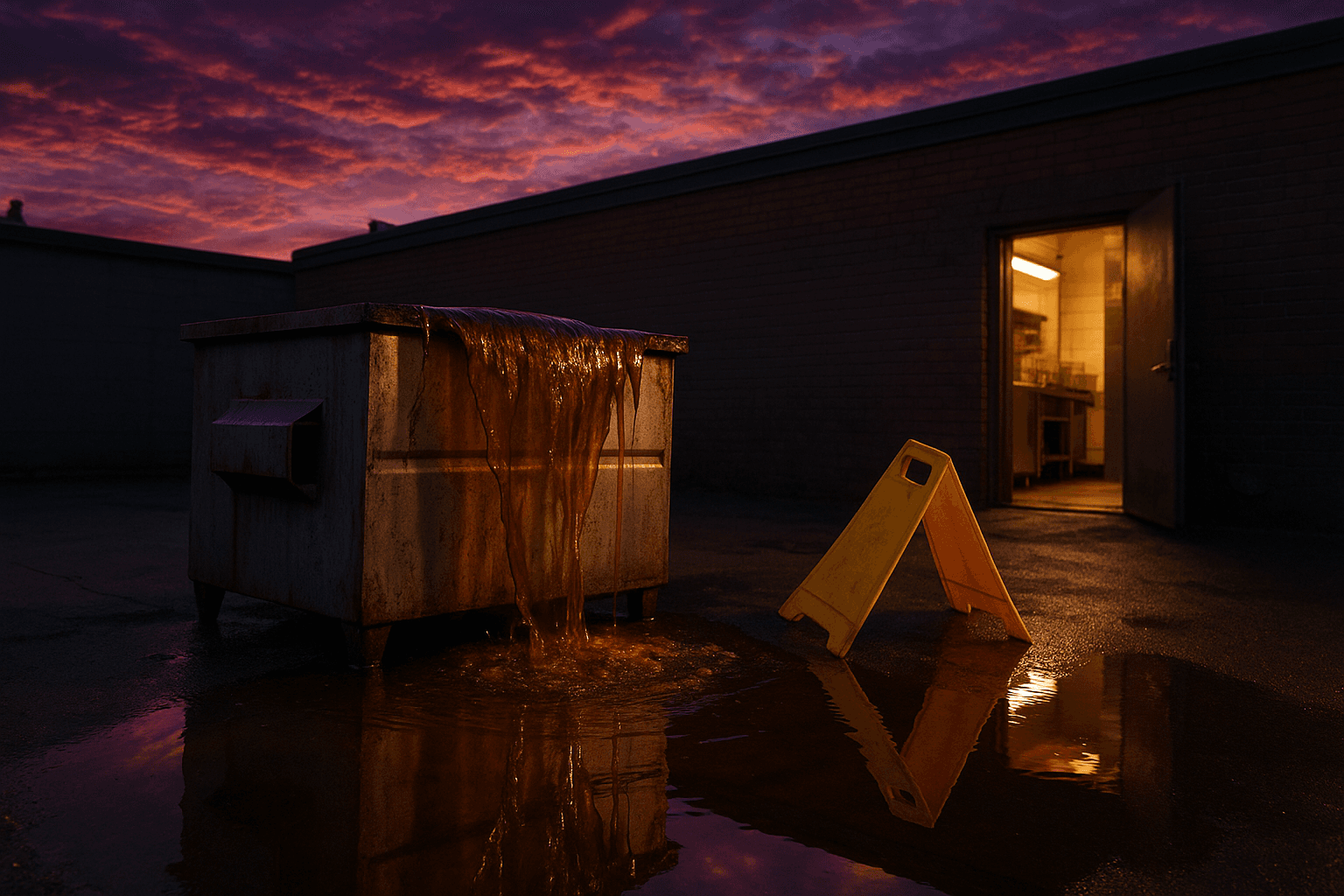
The risk compounds specifically at the back of the building. Restaurants routinely stage absorbent pads, spill kits, and wipe-down rags near their outdoor used cooking oil storage container, since that is where oil handling happens. A warm, dry, low-traffic storage area is exactly the kind of environment that accelerates oxidation, and Southern California's climate provides plenty of it for most of the year. Keep oily rags in a closed metal container, not stacked loosely against or near the oil container itself, and treat that container the same way you treat any other fire risk: with a lock, a clear area around it, and regular emptying rather than letting waste accumulate. A locked, well-maintained oil container that stays free of loose debris around its base solves a theft problem and a fire problem at the same time.
After the Fire Is Out
Once the flames are out and the fire department has cleared the scene, do not resume cooking on affected equipment right away.
- Do not restart any appliance that was involved in the fire until it has been inspected. Heat damage to gas lines, electrical components, or the fryer's own oil reservoir is not always visible.
- Have your suppression system professionally recharged and inspected before it is needed again. A system that has discharged is not ready for a second event until serviced.
- Document the incident, what started it, what was used to fight it, how long from ignition to extinguishment, and whether the fire department responded. This record matters for insurance and for your fire marshal file.
- Deep clean the hood, duct, and surrounding surfaces even if the fire looked contained to one appliance. Heat and chemical residue from the suppression discharge can travel further than the visible fire did.
- Debrief with the crew. What worked, what took too long to find, and what needs to change before the next shift.
Building a Fire-Ready Kitchen: The Checklist
| Item | Standard | How often to check |
|---|---|---|
| Class K extinguisher present and charged | Within 30 ft of cooking equipment (NFPA 10) | Monthly visual check |
| Hood suppression system inspected | Semi-annual professional service (NFPA 96) | Every 6 months |
| Hood and duct cleaned | Quarterly to annual depending on volume (NFPA 96) | Per cleaning certificate schedule |
| Suppression pull station accessible and marked | Along path of egress, unobstructed | Every shift walkthrough |
| Oily rags stored in closed metal containers | Never piled loosely or near heat sources | Daily during service |
| Staff trained on P.A.S.S. and evacuation route | Every employee, not just management | At onboarding and quarterly refreshers |
A restaurant that treats this checklist as a routine, not an annual scramble before an inspection, is a restaurant where a grease fire stays a scary ten minutes instead of a closed kitchen. The equipment and the training exist for exactly this moment: cut the fuel, smother or suppress, evacuate if it grows, and call it in. Everything else is preparation for making sure that moment never has to happen in the first place.
An active flame is not the only kitchen emergency that starts with grease. A grease trap that backs up mid-service demands a different response entirely, contain, call for emergency pumping, and document, but the same principle applies to both: the first few minutes of a clear response plan are what keep a bad night from becoming a closed kitchen.