
How franchise owners standardize used cooking oil pickup across every unit is rarely a vendor problem, it is a program problem. The grease leaves each kitchen the same way it always has; what varies, unit to unit, is the contract behind it, the container in the back lot, and whether anyone at corporate can actually see what happened. One franchisee uses a local hauler on a handshake. Another inherited a multi-year lease. A third has no idea who picks up the oil or whether a manifest was ever kept. Across ten, fifty, or two hundred units, that inconsistency is the real cost: no system-wide compliance proof, no leverage, and no clean sustainability story.
This guide is for franchisors, area developers, and multi-unit owners who want to turn fast food cooking oil pickup from a per-unit free-for-all into one consistent, opt-in program, without trampling the independence of the franchisees who run each location. We cover the franchisor-versus-franchisee dynamic, how to build a corporate program units actually want to join, and the three things worth standardizing across every unit: compliance documentation, visibility, and container security.
TL;DR
- Standardize the outcome, not just the vendor. The goal is consistent compliance paperwork (the same CDFA digital manifest after every pickup), one dashboard across units, and a secure container at every location, not forcing each operator into an identical multi-year contract.
- Franchisees are independent owners. Heavy-handed vendor mandates create friction. A program that wins on merit, better terms, less lock-in, real visibility, rolls out far more smoothly than one that wins by fiat.
- Lock-in works against standardization. Multi-year leases that auto-renew and assign oil title to the vendor create consistency at the cost of flexibility. Month-to-month terms make a system-wide rollout, and unit transfers, much easier.
- Compliance is where franchise systems get hurt. California requires a manifest for every used cooking oil pickup, with a two-year minimum retention; inconsistent records across units mean no system-wide proof of chain of custody.
- Theft scales with units. An estimated $75M of used grease is stolen each year; a free locked anti-theft container at every unit should be table stakes.
- Oil Guyz is regional (CA + PNW), not national, month-to-month, no lease, free locked container, your own retained digital manifest, and one Filtrate dashboard for every in-footprint unit. Honest about coverage; built for opt-in rollout.
The franchisor, franchisee dynamic on cooking oil
The defining tension in any franchise program is ownership. Franchisees are independent business owners who signed up for a brand, a system, and a playbook, not for corporate to micromanage every line item on their P&L. Used cooking oil sits in an awkward spot: it is operationally trivial day to day, but it carries real regulatory exposure, real theft risk, and a real sustainability footprint that ladders up to the brand.
That is why a blunt mandate often backfires. Depending on the franchise agreement, a franchisor may be able to designate approved or required suppliers for consistency, but pushing every operator into one rigid, long-term contract creates resentment, and in some categories, scrutiny. The franchisees who feel railroaded are the ones who quietly let compliance slip.
The durable move is to make standardization the easy choice rather than the forced one. When the corporate program offers better terms than a franchisee could negotiate alone, consistent compliance documentation that protects the operator personally, and one dashboard that saves everyone time, opting in becomes obvious. You standardize by making the standard genuinely better, not just mandatory.
What "standardized" should actually mean across units
Standardization is not "everyone uses the same logo on the invoice." For used cooking oil, three things are worth making uniform across every unit. Get these consistent and the rest is detail.
1. Compliance documentation that is identical at every unit
This is the single most important thing to standardize, because each unit carries its own regulatory exposure and inconsistent paperwork is where systems quietly fall out of compliance.
In California, a manifest is required for every used cooking oil pickup, electronic manifests are explicitly legal, and records must be retained for a minimum of two years (3 CCR §1180.24). The state's inedible kitchen grease (IKG) program registers transporters and licenses renderers specifically to document chain of custody and curb theft and illegal dumping (CDFA MPES).
If every unit keeps records its own way, or not at all, the franchisor has no system-wide proof of chain of custody and no way to flag the one unit that has gone dark. Standardizing on a provider that issues the same digital manifest after every pickup, automatically retained in one place, turns compliance from a per-unit guessing game into a reportable, auditable system. That is also exactly what a brand wants to be able to show during an audit or a unit sale. (Our full breakdown of the documentation requirements lives in Cooking Oil Compliance & Reporting.)
2. One dashboard so corporate and each operator see the same thing
Visibility is the second pillar. A franchise program is only "standardized" if someone can actually verify it. That means one dashboard where the franchisor or area developer sees every unit, and each operator sees their own, same data, role-based access, no phone-and-email scavenger hunt.
This is where many large vendors still fall short: service runs through a call center and an inbox, with no self-service portal across locations. For a multi-unit owner trying to confirm that all twenty units got picked up on schedule and produced a manifest, that gap is the whole problem. With Oil Guyz, every in-footprint unit lives on the Filtrate portal, one dashboard across locations plus per-location mobile apps, so the rollup and the unit-level view come from the same source of truth.
3. A secure container at every single unit
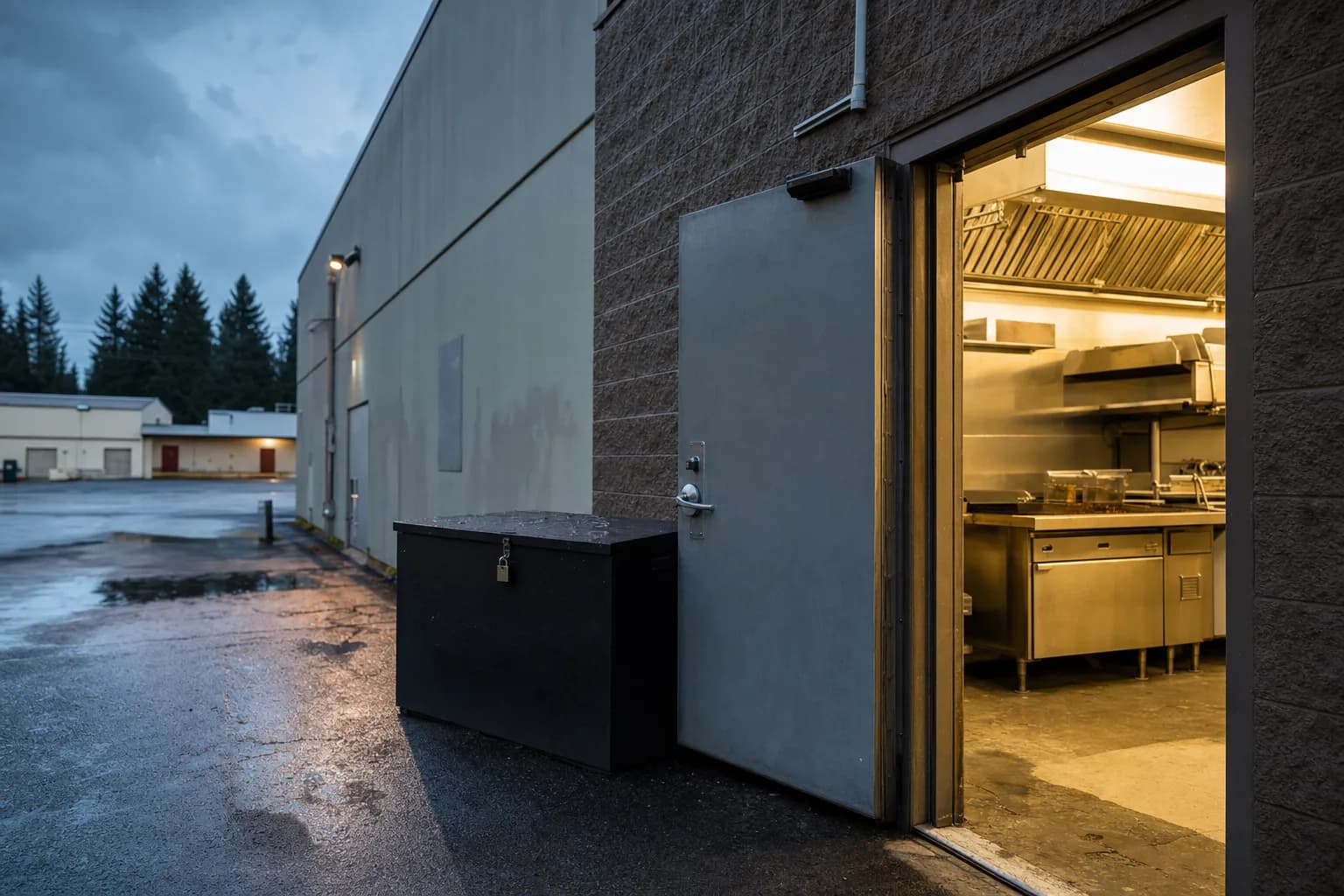
Theft scales with units. An estimated $75M of used grease is stolen each year, and the USDA values roughly 100 lb of used grease at about $25. One unsecured container is a nuisance; an unsecured container at every unit is a system-wide leak that quietly undercuts whatever rebate the program earns. Making a free locked, anti-theft container part of the standard at every location closes that gap, and, paired with a licensed chain of custody, makes the collected oil traceable rather than fungible.
Building a corporate program franchisees opt into
Here is the practical shape of a program that standardizes without alienating operators.
| Program element | The lock-in approach (avoid) | The opt-in approach (standardize on this) |
|---|---|---|
| Contract term | Multi-year equipment lease that auto-renews | Month-to-month, cancel anytime |
| Equipment | Leased, vendor-owned, UCC filings | Free locked anti-theft container, no lease |
| Oil title & manifest | Customer assigns oil title to vendor; vendor signs manifests | Each unit keeps its own CDFA digital manifest as its record |
| Visibility | Phone/email service channel | One dashboard for corporate + per-unit access |
| Rollout | Mandated, signed unit-by-unit | Made the easy default; wins on terms |
| Unit transfers | Lease complicates the sale | Clean month-to-month carries or cancels easily |
A few principles make the opt-in version work in practice:
- Negotiate once, deploy everywhere. A franchisor or area developer sets the program terms, cadence, container, documentation, reporting, and every unit inherits them. The franchisee gets enterprise terms without enterprise paperwork.
- Keep lock-in low on purpose. Month-to-month is a feature, not a weakness, for franchise rollouts. It lowers the activation energy for each operator to say yes, and it keeps unit transfers and refranchising clean, a multi-year lease tied to one location is a headache when that unit changes hands. (For how to evaluate the contract structure itself, see Multi-Location Cooking Oil Collection.)
- Let the operator keep their own compliance record. When each unit retains its own digital manifest, the operator is personally protected and the franchisor can still roll the data up. That is a better deal for everyone than the vendor holding the only copy.
- Onboard new units automatically. When a new unit opens, the program is the default, same container, same schedule, same dashboard, same manifest, so consistency holds as the system grows instead of degrading.
What the numbers look like across a system
Standardization pays off partly because the volume is predictable. A fast food location generates roughly 35 lb of used cooking oil per day, about 12,775 lb per year. Multiply that across a system and a few things become true at once:
- Pickup cadence is easy to plan. Predictable per-unit volume means consistent scheduling and container sizing across the portfolio rather than ad-hoc, unit-by-unit guesses.
- Rebate eligibility is easier to assess at the portfolio level. High aggregate volume is exactly the conversation worth having with a provider; on the restaurant cooking oil management hub we keep rebate guidance honest, it is volume-gated and worth a direct conversation, not a headline.
- A missed pickup is a real problem, not a footnote. At 35 lb a day per unit, even a few skipped pickups create operational and odor issues fast. A uniform schedule and one dashboard to monitor it are worth more than they look on any single invoice.
The sustainability payoff, told once, consistently
A scattered set of local haulers gives a franchise brand no clean way to talk about what happens to its waste oil. A standardized program does. Used cooking oil is a primary feedstock for biodiesel and renewable diesel: renewable diesel cuts carbon intensity by an average of about 65% versus petroleum diesel, and waste-feedstock biodiesel and renewable diesel deliver roughly [79 to 86% lower lifecycle greenhouse-gas emissions](Argonne National Laboratory, Environmental Science & Technology, 2022). Under the federal Renewable Fuel Standard, biomass-based diesel must achieve at least a 50% lifecycle GHG reduction, and used cooking oil qualifies.
With one program routing every unit's oil through a CDFA-licensed renderer, a brand can report a single, consistent sustainability narrative across the whole system, instead of stitching together a patchwork of unknown end-uses.
A standardization checklist for franchise owners
- Inventory how each unit currently handles used cooking oil, vendor, contract term, container, and whether manifests exist
- Pick the outcomes to standardize: same digital manifest, one dashboard, secure container at every unit
- Choose terms franchisees will actually adopt, month-to-month beats multi-year lock-in for system-wide rollout
- Confirm each unit keeps its own retained compliance record
- Set a uniform pickup cadence sized to ~35 lb/day per unit
- Make the program the automatic default for every new unit that opens
- Confirm coverage actually matches your units' locations before you commit
Where Oil Guyz fits
Oil Guyz is a regional used cooking oil pickup and recycling service across Orange County, Los Angeles, San Diego, the Inland Empire, the Bay Area, and Tacoma/PNW, and expanding. We are not nationwide, and we say so plainly. For a franchise system with units inside that footprint, we are built for exactly this kind of opt-in standardization: free scheduled pickup, a free locked anti-theft container at every unit, and month-to-month terms with no lease, no UCC lien, and no fresh-oil purchase requirement. After every pickup, each unit receives a CDFA-compliant digital manifest it keeps as its own chain-of-custody record to a CDFA-licensed renderer, and every location rolls up to one Filtrate dashboard with per-location apps and role-based access. The honest tradeoff: if your units sprawl across thirty states, we can only standardize the ones in our footprint today, tell us where the rest are and we will let you know as we expand.
If you run a multi-unit or franchise portfolio, start with the Restaurant Cooking Oil Management hub, dig into Multi-Location Cooking Oil Collection for the one-program model, and read the vendor comparison for multi-location restaurants before you commit to any provider.
Sources
- CDFA digital/electronic manifest requirement & 2-year retention, 3 CCR §1180.24
- CDFA inedible kitchen grease (IKG) licensing & chain of custody, CDFA MPES
- Fast food location generates ~35 lb/day (~12,775 lb/yr), Frontline II
- Renewable diesel ~65% avg carbon-intensity reduction, DOE AFDC
- Waste-feedstock biodiesel/renewable diesel ~79 to 86% lower lifecycle GHG, [DOE AFDC](Argonne National Laboratory, Environmental Science & Technology, 2022)
- EPA RFS: biomass-based diesel ≥50% lifecycle GHG reduction; UCO qualifies, EPA