
Convenience store used cooking oil is one of those back-room details nobody thinks about until it becomes a problem, a clogged drain, a FOG citation, a missing container, or a roller grill that quietly turned your gas station into a small-volume fryer operation. If your c-store or service-station runs a fryer, a roller grill, or a hot case, you generate used cooking oil, and how you handle it affects your plumbing, your compliance paper trail, and even your security in the back lot.
This guide covers what convenience store and gas-station owners actually need to know: how much oil you really produce, why pouring it out is a non-starter, why unattended sites are a target for grease theft, how scheduling works when your volume is small and irregular, and how to put every location on one agreement if you run a network of stores.
TL;DR
- Even a single fryer or roller grill makes you a used cooking oil generator. It has to be handled like any other commercial kitchen grease, not poured down a drain.
- Volume is low and irregular at c-stores, so a flexible scheduled pickup that matches how fast your container fills beats per-stop fees or hauling jugs yourself.
- Unattended gas stations are soft targets for grease theft, an estimated $75M of used grease is stolen each year. A free locked, anti-theft container is the simplest fix.
- California requires a manifest for every used cooking oil pickup (3 CCR §1180.24); a CDFA-compliant digital manifest gives you a clean chain-of-custody record automatically.
- Multi-site operators can consolidate every store onto one agreement and one Filtrate dashboard, with per-location apps.
- Your oil becomes fuel, biodiesel and renewable-diesel feedstock, through a CDFA-licensed renderer.
Why a c-store has a cooking oil problem at all
A lot of owners assume "used cooking oil pickup" is a restaurant thing. It isn't. The moment you add hot food to a convenience store, you create the same waste stream a restaurant does, just in smaller, lumpier amounts.
The usual sources at a c-store or gas station:
- Fryers, for chicken, potato wedges, jojos, taquitos, and fried sides.
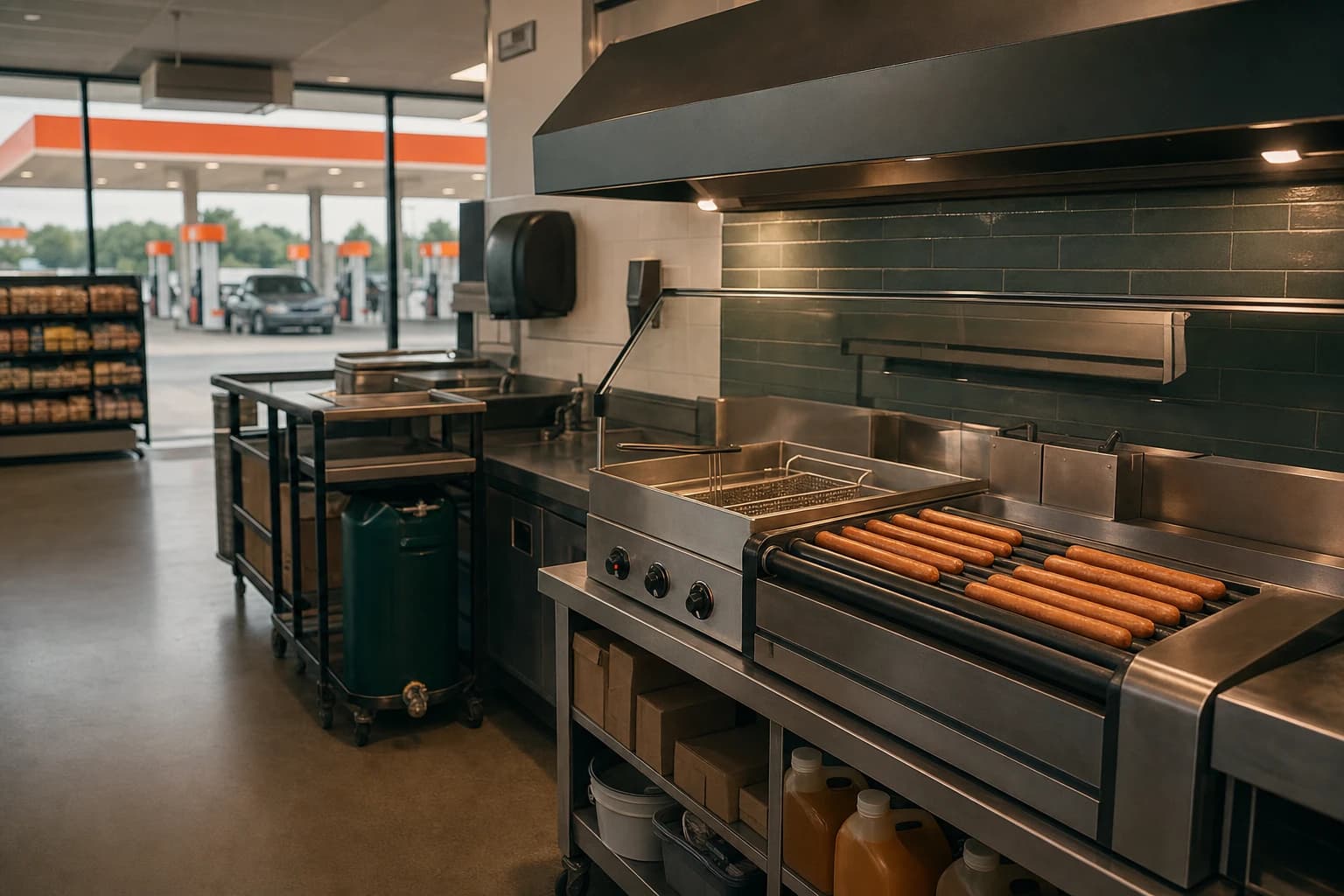
- Roller grills, hot dogs and taquitos shed grease that ends up in drip trays and gets discarded with fryer oil.
- Hot cases and prep, pan grease, deep-fried prep, and oil filtered or dumped at the end of a shift.
All of it is inedible kitchen grease, used cooking oil, and it has to leave your store the right way. It cannot go down a drain or into a dumpster. Used cooking oil congeals in your plumbing, fouls grease interceptors, and is a classic source of FOG (fats, oils, and grease) violations. For the cleanest path from your store to fuel, see our hub on Restaurant Cooking Oil Management, the same principles apply to any commercial kitchen, including the one behind your register.
How much used cooking oil does a convenience store actually produce?
Less than a busy restaurant, but more than you'd guess once the roller grill and fryer run all day.
A useful benchmark from the food-service side: a single fast-food location generates roughly 35 lb of used cooking oil per day, or about 12,775 lb a year (source). A convenience store with one fryer and a roller grill typically runs well below that, often a partial container that fills over several weeks rather than days.
That low, irregular volume is the whole reason c-store oil management should look different from a restaurant's:
| Site type | Typical fryer setup | Used cooking oil volume | What this means for pickup |
|---|---|---|---|
| Busy fast-food location | Multiple fryers, all-day frying | ~35 lb/day (~12,775 lb/yr) | Frequent scheduled pickups |
| Convenience store / gas station | One fryer + roller grill | Well below fast-food levels; fills over weeks | Flexible, lower-frequency cadence |
| Seasonal / promo spikes | Same equipment, higher demand | Bursts around holidays, events | On-call schedule adjustments |
The mistake is signing up for a rigid weekly route you don't need, or, worse, letting oil pile up because "it's not enough to bother with." The right answer is a cadence tied to how fast your container actually fills, with the freedom to move a pickup when fry volume spikes.
The thing most c-store owners miss: grease theft at unattended sites
Used cooking oil isn't trash to a thief, it's a commodity. The USDA values roughly 100 lb of used grease at about $25, and an estimated $75 million of used grease is stolen every year (industry reporting).
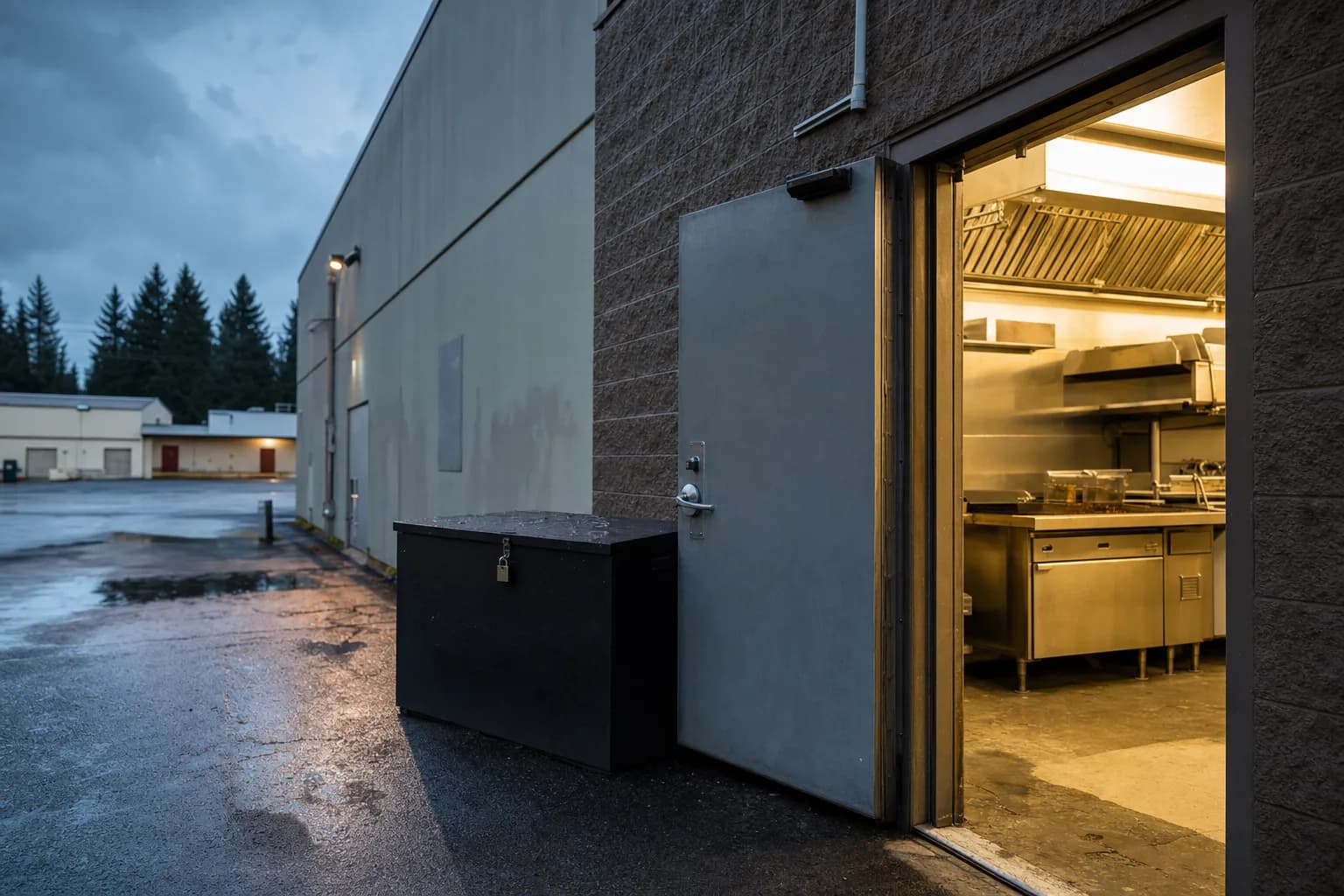
Now look at a typical gas station: an outdoor container in a back lot, long or 24-hour operating hours, and no kitchen staff watching the rear of the building. That's a softer target than a restaurant with a fenced corral and a busy back-of-house. Grease thieves siphon containers at night and resell the oil, and when your oil walks off, two things go with it:
- The commodity value of the oil you generated.
- Your chain-of-custody record, the documented handoff that proves where your oil went.
The fix is straightforward and shouldn't cost you anything: a free locked, anti-theft container. Only our CDFA-licensed renderer can open it, so a casual siphoner can't drain it and your compliance trail stays intact. For unattended sites, this is the single highest-value upgrade you can make to your oil setup. If you want the deeper version, our theft-prevention guide walks through container security in detail.
Compliance: the manifest you need after every pickup
Handling used cooking oil isn't just an operational chore, in California it's a documented one.
CDFA requires a manifest for every used cooking oil pickup, electronic manifests are explicitly legal under California's adoption of UETA, and records must be retained for a minimum of two years (3 CCR §1180.24). The state runs an Inedible Kitchen Grease (IKG) program that registers transporters, licenses renderers, and documents chain of custody specifically to fight theft and illegal dumping (CDFA MPES).
For a convenience store owner, the practical takeaway is simple: you want a CDFA-compliant digital manifest generated automatically after each pickup, documenting custody from your store to a CDFA-licensed renderer. No paper to chase, no binder to maintain, the record lives in your account. For the full picture on compliance and reporting, see Cooking Oil Compliance & Reporting.
What good c-store cooking oil service looks like
Cutting through it, here's what a convenience store or gas-station operator should expect:
- Free scheduled pickup sized to your real (small) volume, not a route you're forced to fit.
- A free locked anti-theft container appropriate to your space, indoor caddy or outdoor bin.
- Month-to-month terms, no long contract, no lock-in, cancel anytime. C-store hot-food programs change; your oil service should flex with them.
- A real person who answers when you need to move a pickup before a holiday weekend.
- A CDFA-compliant digital manifest after every pickup, kept as your chain-of-custody record.
- The Filtrate portal, one dashboard for every location plus per-location mobile apps if you run more than one store.
That's the Oil Guyz model. To be clear about what Oil Guyz is and isn't: we provide the service relationship, the software, and the compliance documentation. The actual pickup is performed by a CDFA-registered transporter. You get one accountable relationship and a clean digital record, without the rigid contracts a small site doesn't need.
Running more than one store? Consolidate the whole network
C-store and gas-station owners rarely run just one location. If you operate a network, or a fuel-brand portfolio with food programs, the win is putting every site on one agreement and one dashboard instead of a different arrangement per store.
With consolidated multi-site service you get:
- One contract across every location, month-to-month.
- One Filtrate dashboard where corporate sees all stores and each manager sees theirs, via role-based access.
- A per-location digital manifest after every pickup, so each site's compliance record is independently documented.
- Per-store scheduling that respects how differently a downtown store and a highway station fill their containers.
That's exactly what Multi-Location Cooking Oil Collection is built for, one MSA, every store covered, full visibility. If you're weighing a regional partner against a national hauler for a multi-site footprint, our comparison guide breaks down contract models, portals, and who keeps the manifest.
Where your oil ends up: fuel, not landfill
There's a genuine payoff at the end of this. The used cooking oil you collect at a c-store doesn't disappear into a waste stream, it becomes clean fuel.
Used cooking oil (yellow grease) is a primary feedstock for biodiesel and renewable diesel. Renewable diesel cuts carbon intensity by an average of about 65% versus petroleum diesel (DOE/CARB), and waste-feedstock biodiesel and renewable diesel deliver roughly 79 to 86% lower lifecycle greenhouse-gas emissions than petroleum diesel (Argonne National Laboratory, Environmental Science & Technology, 2022). Under the federal Renewable Fuel Standard, biomass-based diesel must hit at least a 50% lifecycle GHG reduction, and used cooking oil qualifies (EPA RFS). For a gas station selling fuel out front, there's a fitting symmetry in your fryer oil heading back into the fuel supply.
Your next step
If you run a fryer or roller grill at a convenience store or gas station, you already have a used cooking oil stream, the only question is whether it's documented, secured, and recycled, or leaking into your drains and your back lot. For the industry-specific overview, see Convenience Stores & Gas Stations. Ready to set up free pickup, a free locked container, and a digital manifest after every collection? Tell us your store locations and we'll get you scheduled, and if you're outside our current regions, we'll note your sites and reach out as we expand.
Sources
- Frontline International, Cooking oil collection for fast food (per-location volume): https://nwbiofuel.com/blog/cooking-oil-recycling-in-fast-food-chains-setting-industry-standards/
- California Code of Regulations, 3 CCR §1180.24 (manifest + electronic records + retention): https://www.law.cornell.edu/regulations/california/3-CCR-1180.24
- CDFA Meat, Poultry & Egg Safety / IKG program (transporter registration + renderer licensing + chain of custody): https://www.cdfa.ca.gov/AHFSS/MPES/
- DOE AFDC, Renewable diesel (~65% carbon-intensity reduction): https://afdc.energy.gov/fuels/renewable-diesel
- Lifecycle GHG reduction of 79 to 86% for waste-feedstock fuels (Argonne National Laboratory, Environmental Science & Technology, 2022)
- EPA, Renewable Fuel Standard overview (≥50% lifecycle GHG; UCO qualifies): https://www.epa.gov/renewable-fuel-standard/overview-renewable-fuel-standard-program