Cooking oil disposal in San Diego has one compliant answer for a commercial kitchen: used fryer oil sits in its own locked container until a CDFA-registered transporter pumps it out and leaves a manifest for your records. The city's drop-off site caps cooking oil at 30 residential quarts, so self-hauling is not a business option, and the drain is a misdemeanor under the municipal code. Oil Guyz provides that commercial cooking oil disposal route as free pickup across San Diego County. To get on the schedule, call Oil Guyz at (714) 880-4788
San Diego is one of our core regions, and the disposal questions here come with a local twist: four separate city grease programs, one state registry sitting above all of them, and a recycling center that politely waves commercial oil away. Here is how the county actually works, from the permit on your wall to the manifest in your file.
Who regulates cooking oil disposal for San Diego restaurants?
Two layers: your city's sewer agency and the State of California. San Diego has no countywide grease authority, so the local rules follow your sewer connection and change when you cross a city line.
Inside the City of San Diego, the Public Utilities Department has run the Food Establishment Wastewater Discharge Program since 1989. Every food service establishment in the city must hold a FEWD permit, and the program currently covers more than 5,000 kitchens, each required to run grease-trapping equipment that stops fats, oil and grease before they reach the wastewater system.
The surrounding cities operate their own versions. In Oceanside, the Water Utilities Department handles the city's Commercial Kitchen Grease Disposal Permit. The same program expects grease control devices serviced at least quarterly, with a log to prove it. Chula Vista's FOG program wants grease logs retained for three years. La Mesa ties its FOG permit to a written record of waste oil manifests that the city inspector can review on request.
Then comes the state layer. The CDFA registers every company that transports used cooking oil, which California classifies as inedible kitchen grease, and that registration requirement travels with your oil no matter which city you cook in.
For the full agency-by-agency breakdown with code citations, see used cooking oil pickup in San Diego. The short version: your permit comes from your city, your hauler's registration comes from the state, and your records need to satisfy both.
Is used cooking oil hazardous waste in San Diego?
No. California's Food and Agricultural Code files used fryer oil under inedible kitchen grease, a rendering and recycling framework, not a hazardous waste one. That distinction decides which government door your oil goes through, and plenty of San Diego operators knock on the wrong one first.
The wrong door is the household hazardous waste system. San Diego's HHW Transfer Facility serves city residents by appointment, with proof of residency required, and its own materials list business waste as not accepted. The County of San Diego does run a separate disposal program for small businesses that generate tiny amounts of genuinely hazardous waste, the conditionally exempt small quantity generator category, but fryer oil has no business in that stream either, because it is not hazardous waste at all.
The practical takeaway: no HHW facility, appointment, or fee gets a restaurant's fryer oil handled. Your oil belongs in the state's rendering chain instead, collected by a registered transporter and documented on a manifest at every step. Treating it as a recyclable material rather than a hazard is not a loophole; it is exactly how the state designed the system.
Can a restaurant take fryer oil to the Miramar Recycling Center?
Not at commercial volume, no. The Miramar Recycling Center on Convoy Street in Kearny Mesa takes used cooking oil at no charge, and the city's listing spells out the limits: residential oil only, 30 quarts maximum. Thirty quarts is seven and a half gallons, roughly one oil change on a single mid-size fryer. A kitchen frying through a weekend would outrun that cap before Saturday night, and there is some irony in the cap living on Convoy, a corridor better known for its fry stations than its recycling bins.
The residential label matters as much as the volume number. Once oil comes from a business, moving it yourself raises the transporter question, because state law controls who may carry inedible kitchen grease on a public road, and an owner with jugs in a hatchback is not a registered transporter. The center is a genuinely good answer for a home cook, open six days a week at no charge. It was never built to be one for a restaurant.
For a business, the compliant menu narrows quickly: scheduled collection by a registered transporter, which costs nothing, or the niche bulk and filtration arrangements we cover in our statewide guide to used cooking oil disposal options across California.
What does a compliant commercial kitchen oil disposal setup look like?
Three pieces: a dedicated container, a standing collection schedule with a registered transporter, and a folder of manifests. Get those right and every inspector conversation in the county gets shorter.
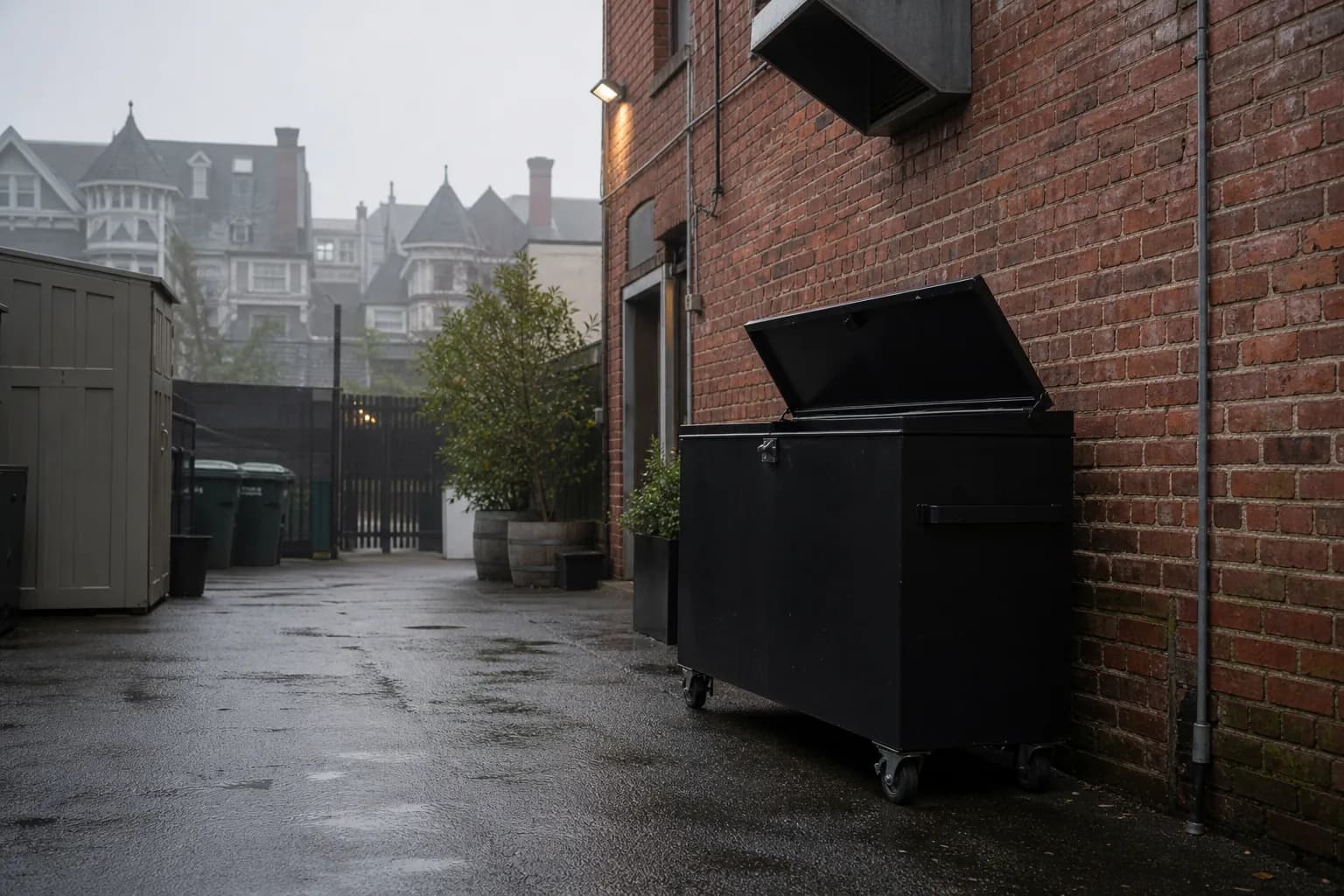
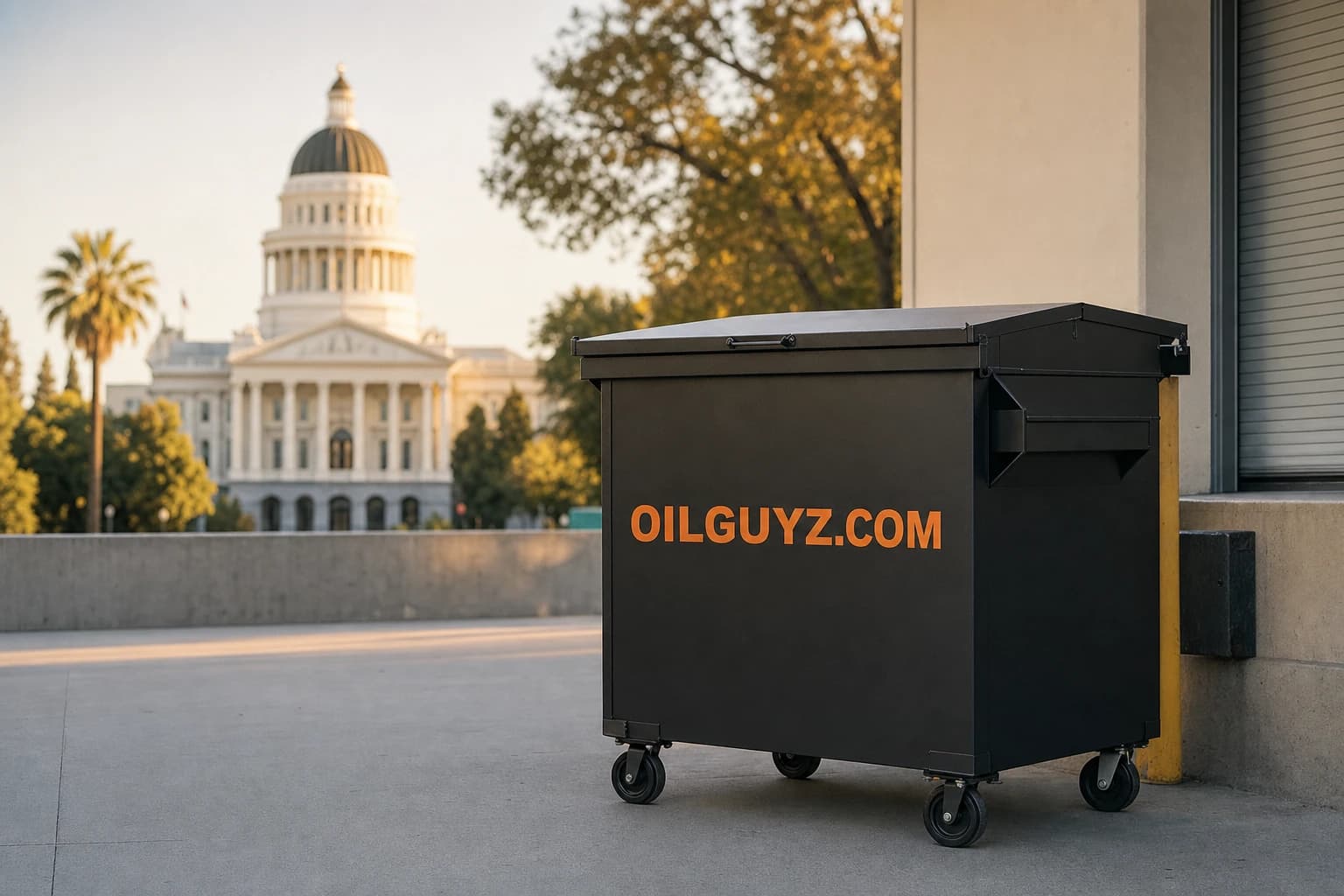
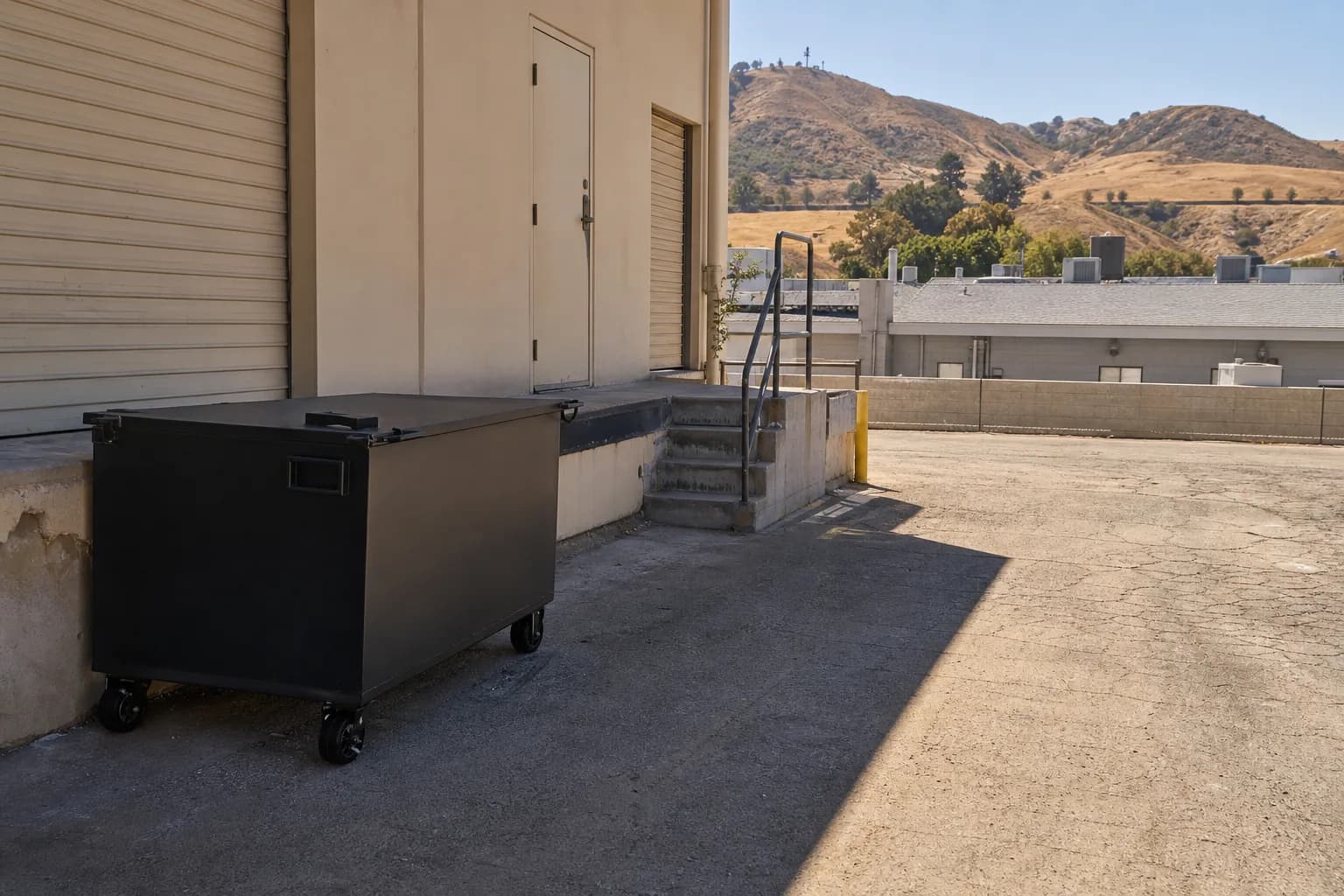
The container comes first. San Diego's municipal code requires permitted kitchens to keep a collection container whose whole job is keeping oils and greasy solids out of the sewer line, and container expectations get even more specific up the coast, where Oceanside wants outdoor bins locked and set in secondary containment. In practice: a sealed, lockable bin or caddy stationed on the shortest safe path from the fryers, lid closed, with water, food scraps, and mop buckets kept out. Clean oil is what a licensed renderer can actually use; a watered-down load can be refused.
The schedule is the part you should never have to chase. A driver pumps the container out where it sits, on a cadence matched to your fry volume, and the service costs nothing because the oil itself funds the route: a licensed renderer processes it into feedstock for biodiesel and ingredients for animal feed, and that end value carries the collection. Our free used cooking oil pickup comes with the container included and no contract behind it.
The records close the loop. Every load gets a manifest, the transporter owes you your copy within 45 calendar days, and the state minimum for keeping them is two years. Chula Vista expects three years of grease records, so our countywide advice is simple: keep everything three years, digitally, and you are covered from Oceanside to the South Bay.
What happens if grease goes down the drain in San Diego?
The municipal code does not treat it as a housekeeping slip. Inside San Diego city limits, a discharge that violates the food establishment wastewater rules is declared a public nuisance and a misdemeanor, and the city can revoke the wastewater permit behind your kitchen and terminate sewer service. La Mesa goes a step further on cost recovery: if a blockage in your line causes or contributes to an overflow, the city can bill your restaurant for its response.
The enforcement logic is easy to picture. The city's own outreach to homeowners names cooking grease as one of the major causes of residential sewer clogs that end in spills, and commercial fryers move multiples of that volume. When a line backs up in a restaurant district, the investigation climbs uphill through every kitchen connected to it. The FEWD program was created in 1989 to attack exactly this problem, and the city reports that grease-related spills from food facilities have fallen dramatically since. An inspector who arrives after a neighborhood backup wants two things: proof your grease equipment is serviced, and proof your fryer oil left with a registered transporter. A thin folder is what converts a routine inspection into a citation.
How do you check that a grease hauler is registered with the CDFA?
Pull up the state's list before the first collection, not after. The CDFA's Inedible Kitchen Grease transporter lookup publishes the companies registered to move restaurant oil in California, alongside its rosters of licensed renderers and collection centers. If the company name you were given is not on the transporter list, the conversation is over, whatever the truck's signage says.
Three details separate a real operation from a doorway pitch. A registered transporter can name the licensed facility that receives the oil without hesitating. It leaves a manifest with every single load instead of promising paperwork later. And it never needs to buy your oil in cash at the back door, because the legitimate market already pays for collection through the free service model. San Diego's dense restaurant blocks, the Gaslamp Quarter and the Convoy corridor especially, draw their share of unsolicited grease buyers, and the state maintains an online grease theft reporter for exactly that traffic.
The stakes are criminal, not clerical. Hauling inedible kitchen grease without registration can bring county jail time of up to a year, fines reaching $5,000, or both on a first conviction. The restaurant that let an unregistered collector in is not the one facing jail, but it is the one left with a hole in its disposal records that nothing can patch afterward. Every route we run is registered with the CDFA as an inedible kitchen grease transporter, and the manifest from each visit lands in your file automatically.
How do you set up free cooking oil pickup in San Diego?
One call does it. Tell us where the oil sits today, roughly how much you fry, and where a driver can reach the container: the alley door of a Gaslamp kitchen, the shared lot behind a North Park taproom, the side yard of a Chula Vista taqueria, a pier-adjacent cafe in Oceanside. We place a free locked container sized to your volume, service repeats on a schedule that matches your fryers, and a digital manifest follows every load into your records.
Most new San Diego accounts see their first collection within a week, and an overflowing container moves to the front of the line. If your current hauler has gone quiet, or you are opening your first kitchen and want the grease file clean from day one, the number is (714) 880-4788