
Cooking oil disposal in the Inland Empire has one rule that holds everywhere: used fryer oil may leave a commercial kitchen only on a CDFA-registered truck, with a manifest to prove it. The household hazardous waste sites in Riverside and San Bernardino counties turn business oil away, so the truck is the whole system. Oil Guyz runs that route across both counties with free pickup, a locked bin at no charge, and a digital manifest with every visit. To get started, call Oil Guyz at (714) 880-4788
Our routes cover both counties, from Riverside and Moreno Valley out through Ontario, Fontana, and the Temecula Valley, and the sections below answer the questions operators actually ask us when we take over an account.
Who sets the cooking oil rules in Riverside and San Bernardino counties?
The agency that operates your sewer sets your grease rules, and in the Inland Empire that agency changes with the city limits. Two counties, dozens of cities, a patchwork of special districts, and no single FOG authority anywhere in it. What an inspector expects from a kitchen on Magnolia Avenue in Riverside is not what Ontario asks of a kitchen near the airport.
A short map of who you answer to:
- Riverside: the Environmental Compliance Section inside city Public Works, which inspects every restaurant in town and works down a checklist that reaches your waste oil container and the records behind it.
- Ontario: FOG enforcement sits with the Municipal Utilities Company, which holds kitchens to a four-year record rule, manifest numbers included.
- Rancho Cucamonga: Cucamonga Valley Water District, where every food service establishment applies for a sewer use permit through the district's industrial waste program.
- Temecula and Murrieta: Eastern Municipal Water District, which runs the pretreatment program for both cities.
- San Bernardino: the city's Municipal Water Department, whose Environmental Control Section issues food service permits.
Corona runs its own utility and its own pretreatment rules, Fontana enforces sewer requirements through its municipal code, and Chino Hills attaches an interceptor requirement to every food service operation in town. None of these agencies collects your fryer oil, though. Transport is state territory: the California Department of Food and Agriculture decides who may haul used cooking oil anywhere in California, and its rules follow the truck rather than the city. The city-by-city detail, interceptor sizing and record windows included, lives on the used cooking oil pickup in the Inland Empire page.
What is the compliant route for commercial kitchen oil disposal here?
One route works in every Inland Empire city: keep used fryer oil in a dedicated sealed container, release it only to a CDFA-registered transporter, and file the manifest that documents each collection. The rest of this guide is detail hanging off that sentence.
Under California's Food and Agricultural Code, spent fryer oil is inedible kitchen grease, and hauling it without CDFA registration is unlawful. That means commercial kitchen oil disposal in Riverside and San Bernardino counties is less about where you take the oil and more about who is allowed to take it from you. The destination must be a licensed renderer or a licensed collection center, and only a registered transporter can lawfully move it there.
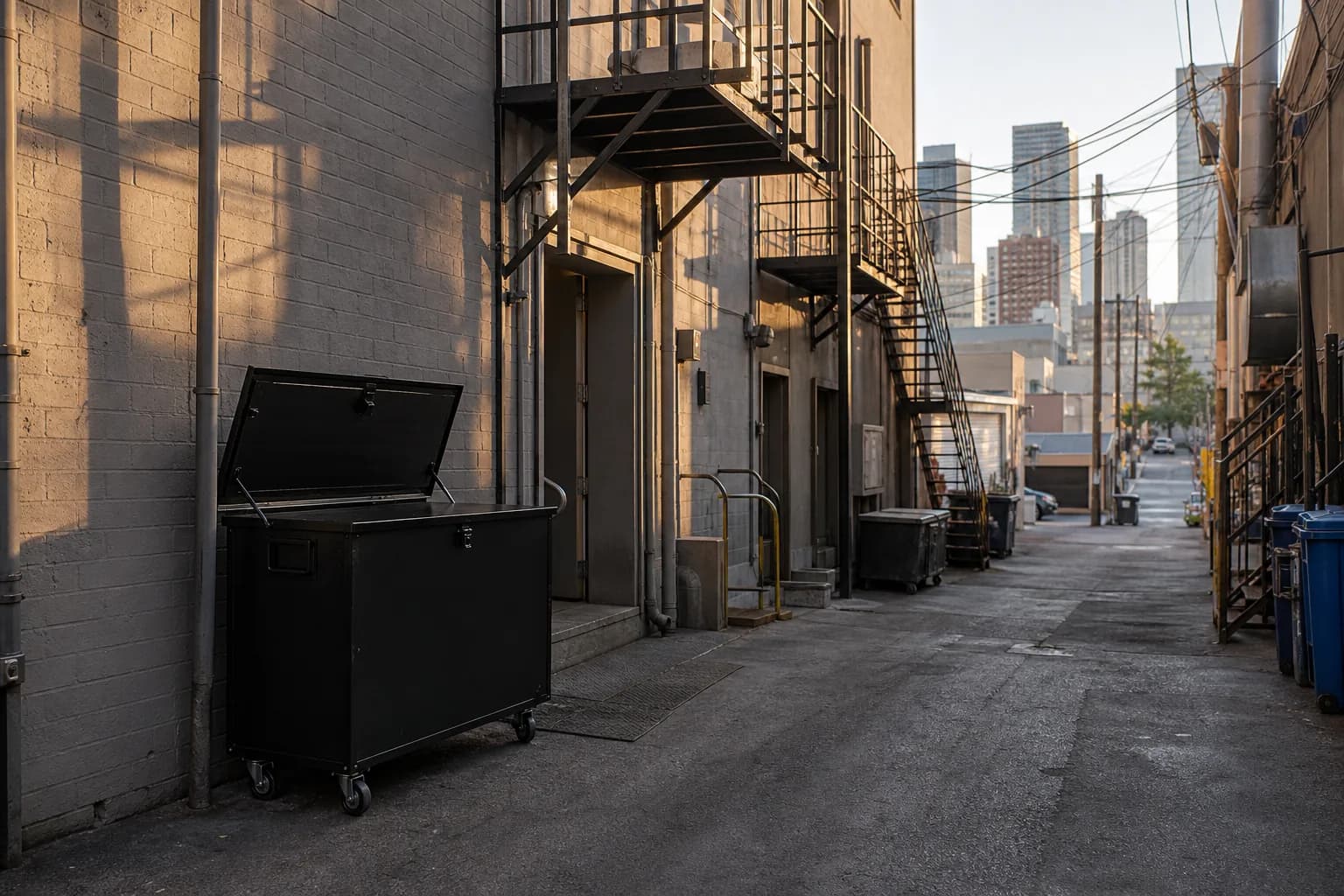
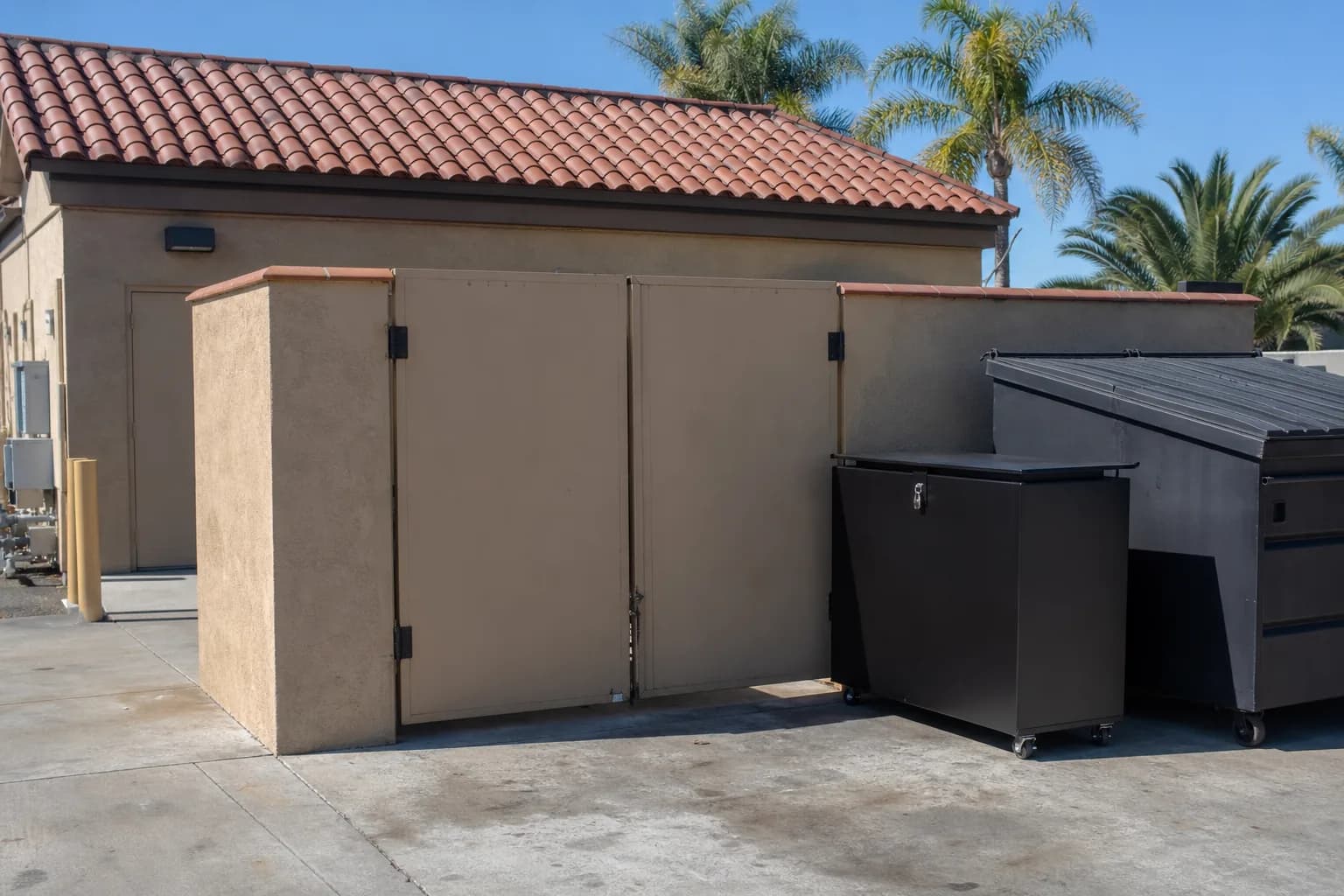
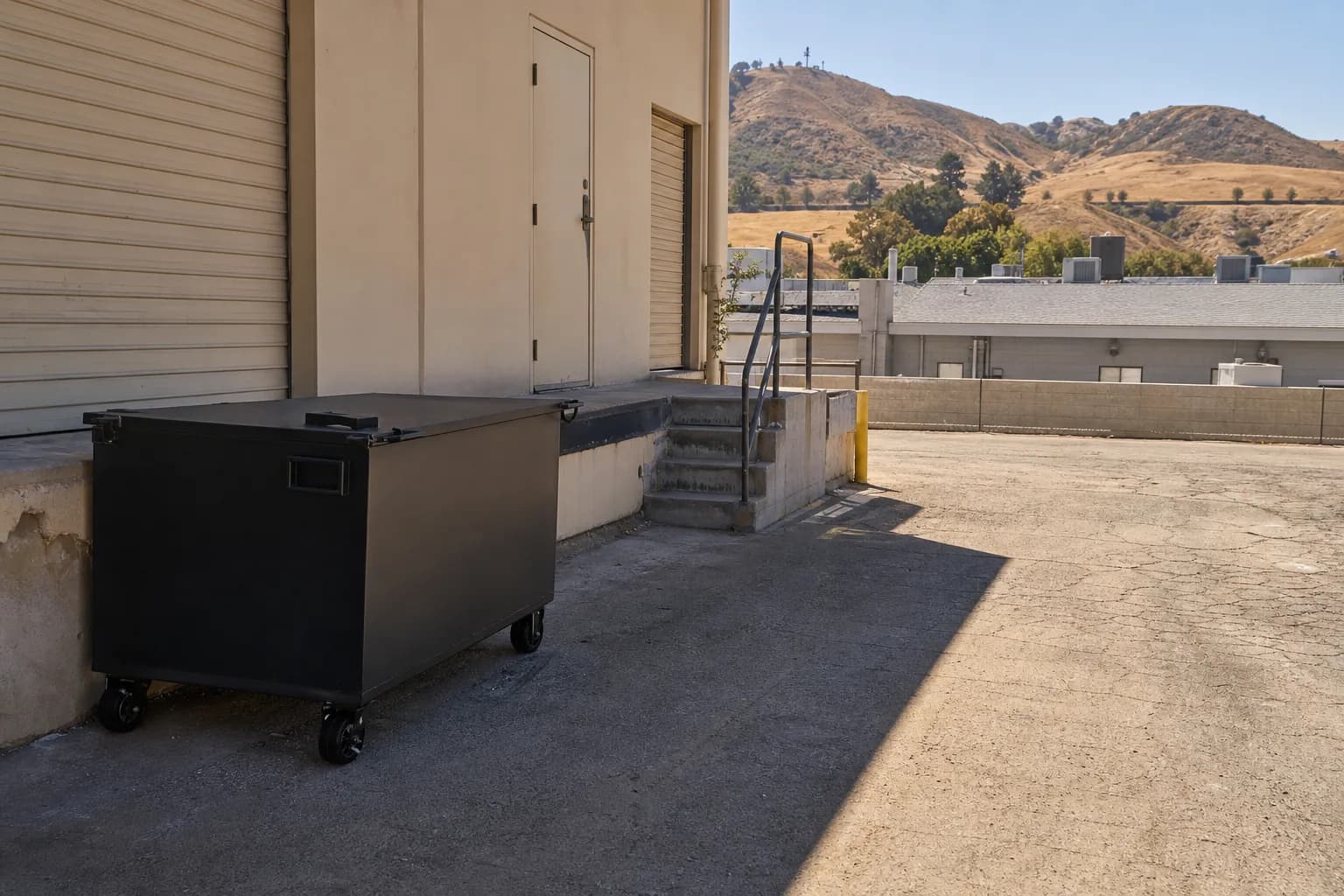
Your side of the transaction stays small. Give the oil a dedicated home that trash, food scraps, and mop water cannot reach. Let the driver pump the container right where it stands, so nothing gets rolled across the lot or exchanged. Then keep the paperwork, because the manifest from each collection is the document your sewer agency's inspector will eventually ask to see, whether your city wants three years of history or Ontario's four.
Free used cooking oil pickup wraps all of that into one arrangement for a restaurant: the container, the scheduled route, and the manifest, with no service charge attached.
Can you take business fryer oil to a county HHW site in the Inland Empire?
No. Both county household hazardous waste programs accept cooking oil from residents and refuse business loads, and they say so in writing.
Riverside County's Department of Waste Resources operates permanent collection facilities in Jurupa Valley, Lake Elsinore, Palm Springs, and Beaumont, plus a calendar of one-day events in cities like Corona, Murrieta, and Moreno Valley. Household cooking oil sits on the accepted materials list. But the county's 2026 collection schedule draws the boundary in plain language: the services are for residential use only, business generated waste sits on the unacceptable list, real estate and nonprofit loads included, and staff may require photo documentation when a load looks like it came from a commercial kitchen. The boundary is spelled out on the department's household hazardous waste page.
The San Bernardino side belongs to County Fire, whose household hazardous waste program runs 14 permanent collection facilities plus an ABOP site, spread across the valley cities and the high desert. Residents can bring household quantities of cooking oil. Businesses cannot. The county does operate a small-business channel for very small quantity generators, but it exists for genuinely hazardous materials in tiny monthly amounts, and used cooking oil is not hazardous waste in California. A fryer program producing forty gallons a month has no lane there.
So the county sites solve the home turkey fryer, not the restaurant fryer. If the oil was cooked for customers, it needs the transporter route at any volume, even one five-gallon jug.
How do commissaries, food plants, and warehouse kitchens handle the volume?
The same legal route, with larger hardware, a faster cadence, and one clear owner for the records. A real share of Inland Empire cooking oil never touches a restaurant dining room, and those operations have their own logistics.
Food trucks in both counties generally work out of approved commissary kitchens, and the commissary usually hosts a single shared collection container for every truck that parks overnight. Ghost kitchen buildings run the same pattern with more tenants. The compliance question in any shared setup is ownership of the paper: the host's manifests should account for every gallon leaving the property, and each tenant should know where those records live before an inspector asks one of them.
Then there is the industrial tier. The corridor from Ontario through Fontana and San Bernardino carries a heavy concentration of food production and distribution operations, and a par-fry line, tortilla plant, or snack manufacturer generates oil at a scale no wheeled bin can absorb. That tier runs on high-capacity containers at the dock, standing pickup schedules matched to production, and tighter contamination control, since one flooded container can degrade a full load. Our operations guide to yellow grease collection for food processors covers container sizing, scheduling, and quality control at plant scale.
What both tiers share is the part that matters: however big the building, the oil still leaves with a registered transporter and a manifest. Volume changes the logistics, never the rule.
What does cooking oil disposal cost in Riverside and San Bernardino counties?
For a standard commercial kitchen, nothing. Collected fryer oil goes to a licensed renderer for processing into renewable fuel feedstock and ingredients for animal feed, and that sale is what funds the route, the bin, and the driver. Treat free as the baseline when you compare providers, and read anything above it closely.
A clean arrangement includes the container, its placement, the pickups, and the manifest, all without charges and without a term contract wrapped around them. Where operators get burned is the slow creep: an environmental fee shows up one quarter, a fuel line item the next, until the free service quietly costs real money. The opposite pitch deserves the same suspicion. A stranger offering cash at the back door for your grease is a known pattern across the Inland Empire, and it usually means an unregistered collector who leaves you with no record that the oil was ever handled lawfully. A locked container and a registry check shut both doors at once.
What paperwork keeps an Inland Empire kitchen inspection-ready?
Two things: proof your hauler is registered, and a manifest for every pickup, retained as long as your city requires.
Verification comes first. The CDFA publishes a public registry of Inedible Kitchen Grease transporters, together with its lists of licensed renderers and collection centers, and the company name on your service agreement needs to appear there before anyone touches your container. No listing means the pickup cannot be lawful, however professional the truck looks. Registration also carries the manifest duty: the transporter documents every collection it makes, and the generator copy stays at your kitchen, which is the half of the system built to protect you.
Retention is where the cities diverge. Riverside and Fontana expect hauling records kept for three years, and Ontario wants four, with the manifest number, hauler name, volume, date, and receiving facility all readable on them. The simple policy is to keep everything for the longest period any of your locations faces. For the wider legal layer above the cities, from CDFA licensing to how the manifest chain works across the region, our guide to Southern California cooking oil pickup rules goes a level deeper.
Our routes run on a CDFA Inedible Kitchen Grease transporter registration. After each collection, the manifest reaches your inbox digitally, so the folder builds itself while you run the kitchen.
Set up before the bin becomes the emergency
Whether you are opening in Rancho Cucamonga, switching providers in Temecula, or looking at a container in Riverside that has not been emptied in a month, the fix takes one call and about a week. We place a locked container sized to your actual fryer volume, the driver empties it in place on a cadence that matches your kitchen, and the manifest follows each visit into your records. Overflow situations across the Inland Empire get moved to the front of the route. To claim the free bin and get on the schedule, call Oil Guyz at (714) 880-4788