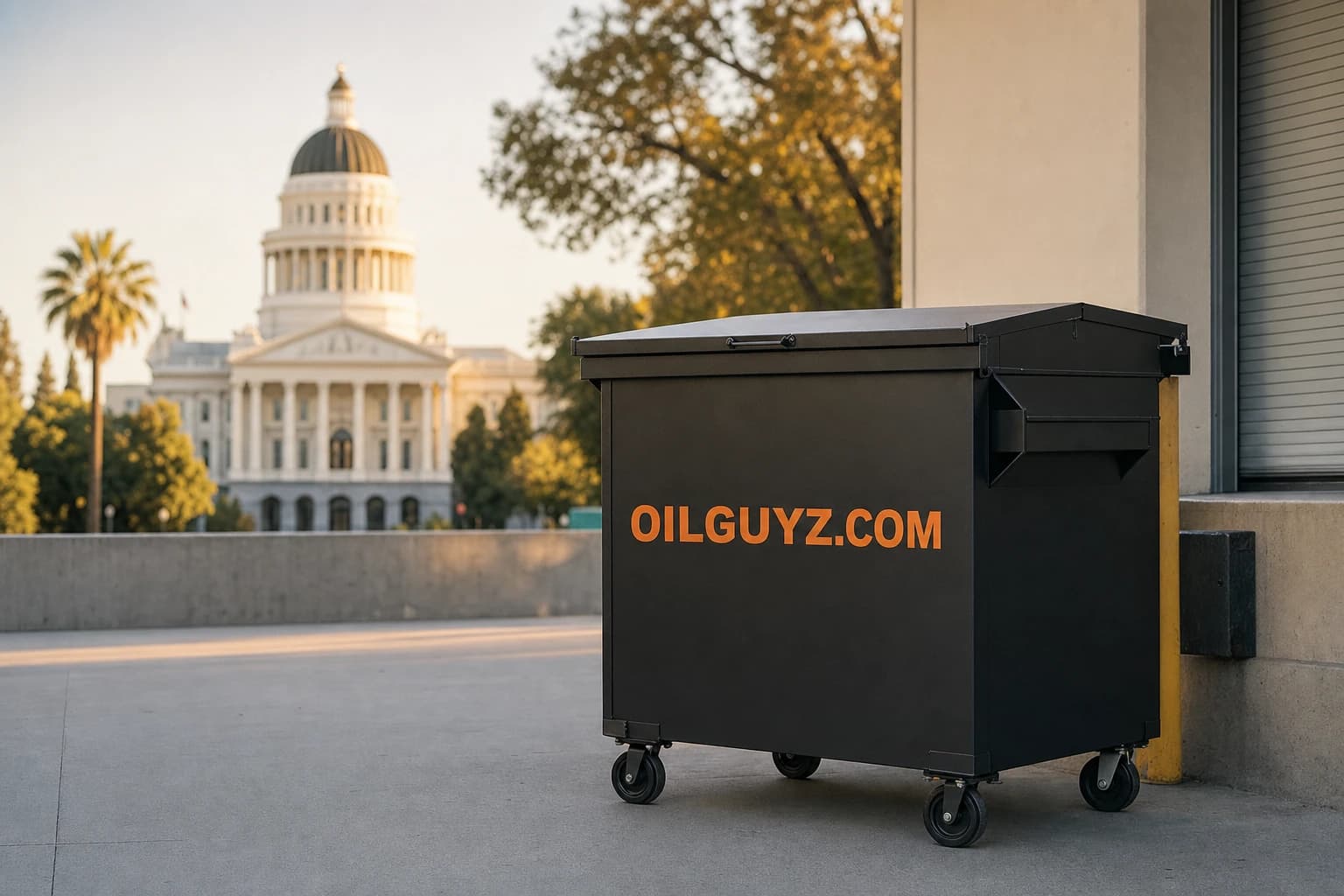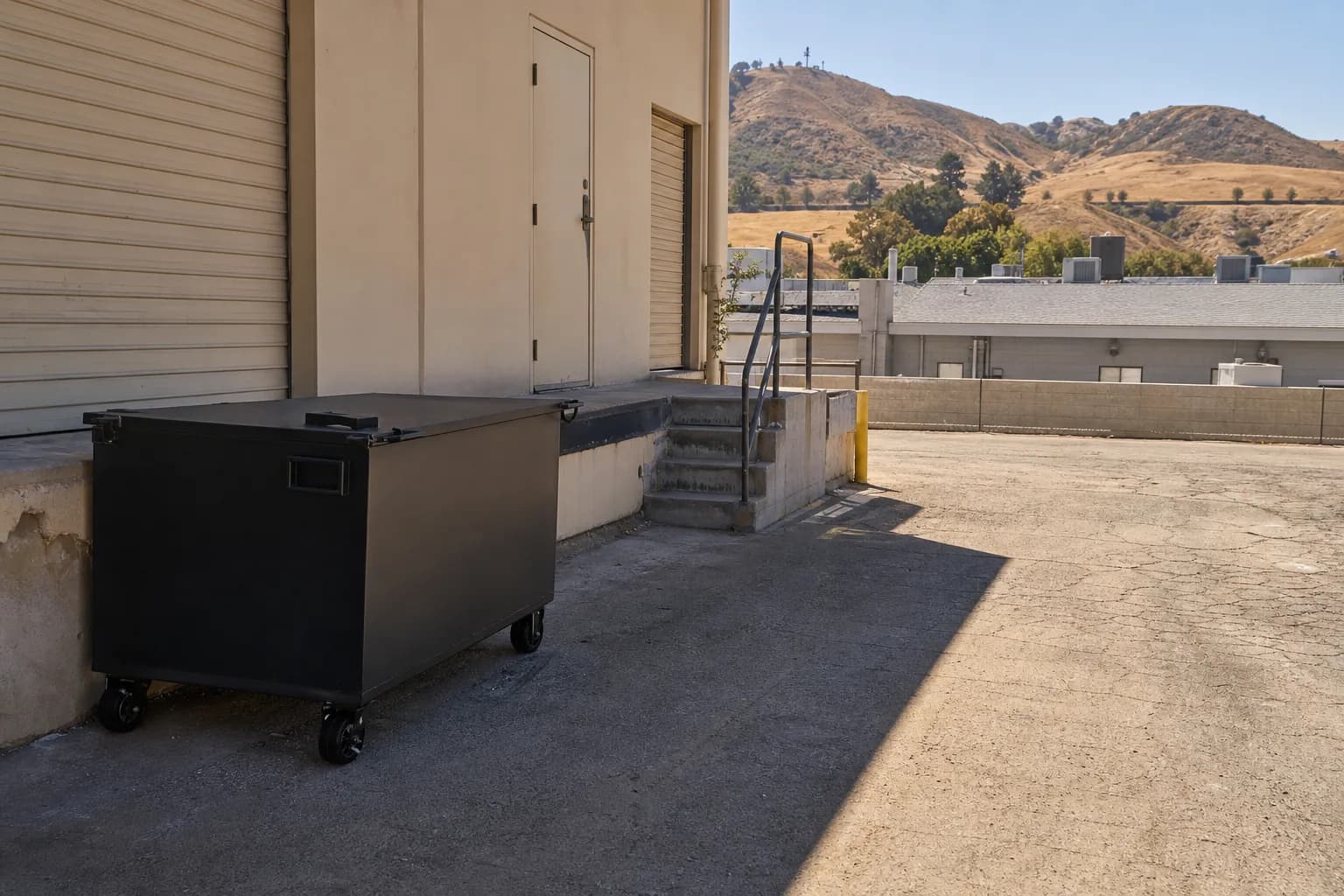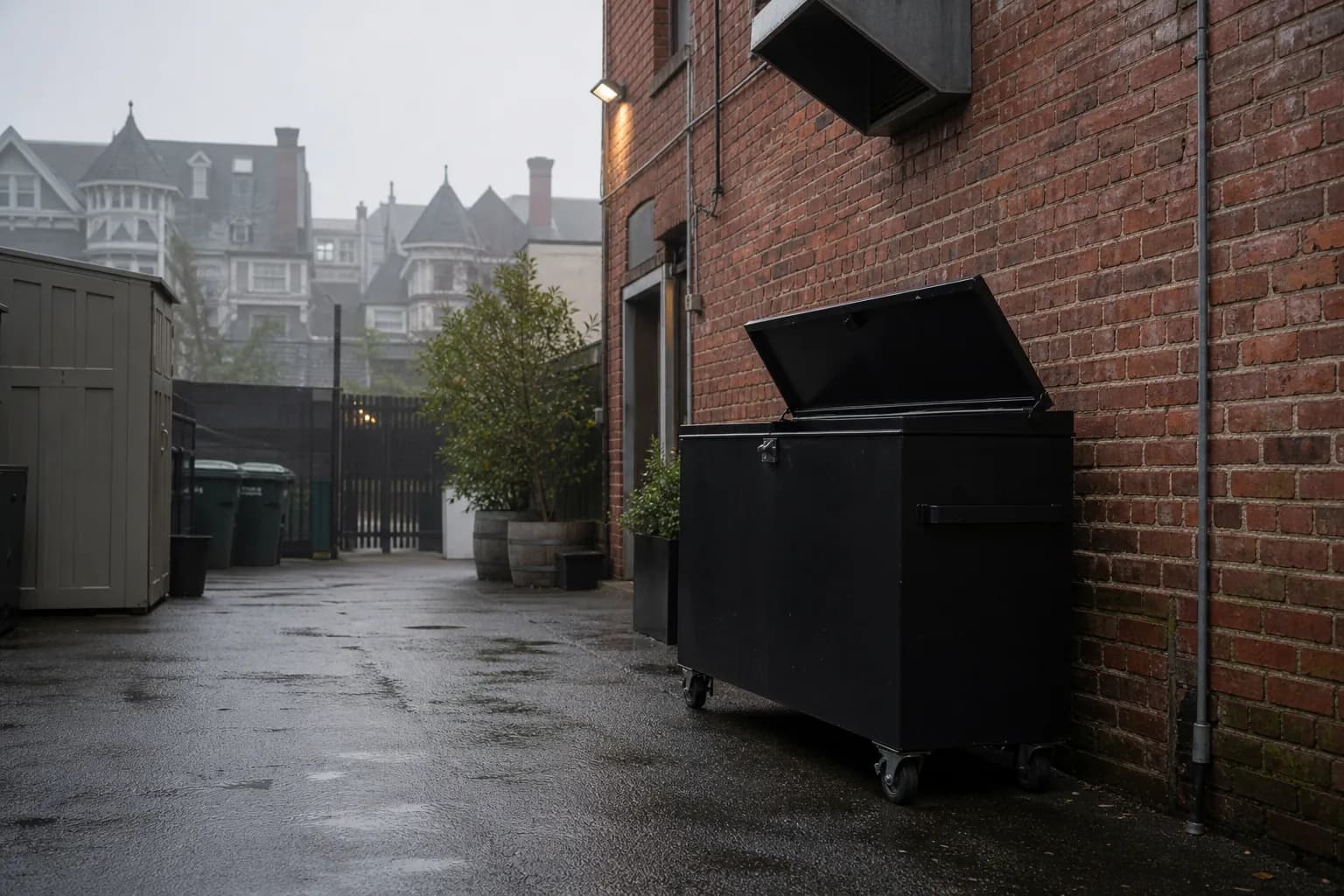

Cooking oil disposal in the Bay Area comes down to one workable route for a commercial kitchen: a sealed bin at your back door, a CDFA-registered transporter emptying it on schedule, and a manifest documenting each collection. Every public drop-off program in the region serves households, not businesses. Oil Guyz runs the registered route across San Francisco, Oakland, San Jose, and the Peninsula for free, locked bin included. For free pickup at your kitchen, call Oil Guyz at (714) 880-4788
We schedule pickups from the Richmond District down to South San Jose, and the question behind most first calls is the same one: where is this oil actually allowed to go? The Bay Area supplies more wrong answers to that question than most regions, because every city runs its own programs. Here is the full set of options, what each one is really for, and the single route that holds up on both sides of the bay.
What can a Bay Area restaurant actually do with used cooking oil?
Four routes exist on paper, and only one of them was built for a commercial kitchen.
Scheduled pickup by a registered transporter. This is the standard across the entire region, and it is what free used cooking oil pickup means in practice: a collection container at the kitchen door, a state-registered company emptying it on a route, and a manifest closing out each visit. It costs nothing, and it is the route the rest of this post sets up.
Public drop-off sites. These are real and well run, and they are residential. The hazardous waste facilities, the oil receptacles, the directory listings that surface when you search for disposal near you: all of it is built around gallon caps, residency checks, and household funding. We break down exactly why below.
Self-hauling to a county business program. The counties do run small-business waste services, with appointments and fees. They exist for the solvent shelf and the paint tray, not the fry station, and fryer oil was never in their scope.
The drain, the trash, the organics cart. Not routes at all. Every sewer agency around the bay prohibits grease discharge, bulk liquid does not belong in either cart, and a single pour can undo years of staying off an inspector's radar.
The interesting part is not the list. It is how differently each city dresses up the same answer.
How the disposal answer shifts across San Francisco, Oakland, and San Jose
The residential answer changes at every city line. The commercial answer does not, and seeing the patchwork side by side is the fastest way to stop second-guessing it.
San Francisco is the clearest case, because the city says it outright. SFPUC's used cooking oil guidance tells food businesses to contact a local grease hauler that provides free pickup, and it keeps a short list of private companies on the page. The Recology drop-off at 501 Tunnel Avenue stays reserved for residents, with a residency check and a ten-gallon cap per trip. In other words, the city itself treats free private pickup as the commercial disposal system. The interceptor side of a San Francisco kitchen has its own rulebook, covered in the San Francisco FOG rules breakdown.
Oakland and the East Bay route the question through StopWaste, the Alameda County public agency, whose RE:Source directory answers "where does this go" for nearly everything in the county. For cooking oil it sends households to the county facilities and tells commercial kitchens to arrange service with a grease hauler. Oil Guyz appears in that directory as a used cooking oil vendor for the Bay Area, which is a directory listing, not an endorsement. EBMUD's own drop-off receptacles follow the household pattern too: capped at fifteen gallons and closed to commercial kitchens.
San Jose and the South Bay take a third approach. The city publishes a courtesy list of grease haulers and pumpers that completed its training on device maintenance and documentation, while stating plainly that the list is neither an endorsement nor complete. You still choose and contract privately, and the company you choose still needs state registration.
The Peninsula has no single program at all. Redwood City, San Mateo, Palo Alto, and their neighbors each answer to their own city or district office, so the local branding changes every few miles while the underlying expectation stays fixed.
Which agency inspects your kitchen, and under which municipal code, is its own map. We keep that one current in our Bay Area grease and FOG rules by county guide, so this post can stay on the disposal question. The takeaway here is simpler: the patchwork only matters if you are a resident. For a kitchen, every city lands on the same instruction, hand the oil to a registered private hauler and keep the record.
Why the drop-off network turns business oil away
Because the entire network is built and funded for households, and it says so.
Alameda County is the cleanest example. Its four household hazardous waste facilities, one each in Oakland, Hayward, Livermore, and Fremont, take drop-offs from county residents free of charge, no appointment needed, funded through a small annual charge on each household. The same program states plainly that the facilities cannot accept business waste. A restaurant van in that line gets turned around no matter how the oil is packaged.
There is a business-shaped exception, and it proves the point. The county runs a small-business waste service for very small quantity generators, meaning sites producing under 220 pounds of hazardous waste a month. Using it takes a hazardous waste generator ID number, a signed certification form, an appointment, and a $25 minimum charge per delivery. That machinery makes sense for a contractor clearing out solvents. As a weekly plan for fryer oil, it is paperwork and fees for a material you could have collected at no cost from your own back dock. Santa Clara County splits along the same line, residents drop off free while small businesses go through a separate appointment-based program.
The deeper mismatch is legal, not logistical. California never put used cooking oil in the hazardous waste system to begin with. It is inedible kitchen grease under the state Food and Agricultural Code, a regulated recycling stream with its own transport registry and its own paper trail. Hauling fryer oil to the hazmat door is not just the wrong line, it is the wrong building. The system built to handle it comes to you.
The registered-transporter route, from first call to manifest
Set up once, the compliant route runs itself. Here is the whole arc.
The container comes first. A locked bin lands wherever your oil already lives, sized to your fry volume, at no charge. Kitchens already using barrels or caddies keep them, since the driver pumps containers out right where they stand. Then the schedule: pickup frequency gets matched to how fast you actually fill, tightened for holiday stretches, loosened when volume drops. Every collection ends with a digital manifest recording what left, when, and who took it, and those records stay retrievable for two years. That is the arrangement we run as used cooking oil pickup in the Bay Area, and the manifest is the piece an inspector actually asks about.
Before any company's first visit, yours included, spend two minutes on the state registry. The CDFA publishes its Inedible Kitchen Grease transporter lookup for exactly this check. Search the precise name on the quote or on the truck, and treat a missing entry as a closed door. Registrations expire December 31 every year, so current standing matters more than an old decal. Then ask where the loads end up. A legitimate operator answers with the name of a licensed receiving facility, no hesitation.
The economics explain why the whole arrangement costs a kitchen nothing. Collected oil is processed through a licensed renderer into renewable fuel feedstock, and that downstream end of the chain underwrites the schedule, the container, and the collection itself. A company billing your kitchen to haul it is charging for something the recycling chain already covers, and an unfamiliar collector turning up at the bin has earned a registry lookup before the lid ever opens.
One disposal setup for kitchens in more than one city
If you operate across city or county lines, disposal is the one compliance item you can fully standardize.
A group with kitchens in San Francisco, Oakland, and San Jose answers to three different FOG offices, three inspection styles, and three sets of local expectations. The oil stream is the exception, because the state rule underneath it never changes. The same registration requirement, the same manifest format, and the same renderer destination apply at every address, which means one transporter can carry every location on one records system. When an inspector in any of the three cities asks how oil leaves the building, the answer reads identically, only the address changes.
That consolidation is also the painless way to fix a patchwork you inherited. Plenty of multi-site operators end up with a different hauler at each kitchen, each with its own paperwork habits. Replacing them one location at a time, keeping the final manifests from each outgoing company, gets the whole group onto a single folder within a few weeks, without a single service gap.
Start free pickup anywhere in the Bay Area
Whether the kitchen sits in the Mission, off International Boulevard, in a Fremont plaza, or along El Camino on the Peninsula, the setup is one call. We place the locked bin, set the schedule to your volume, and leave a manifest after every collection, with the first pickup typically inside a week. No contract, no fees, and the drop-off dead ends stop mattering entirely. Call Oil Guyz at (714) 880-4788