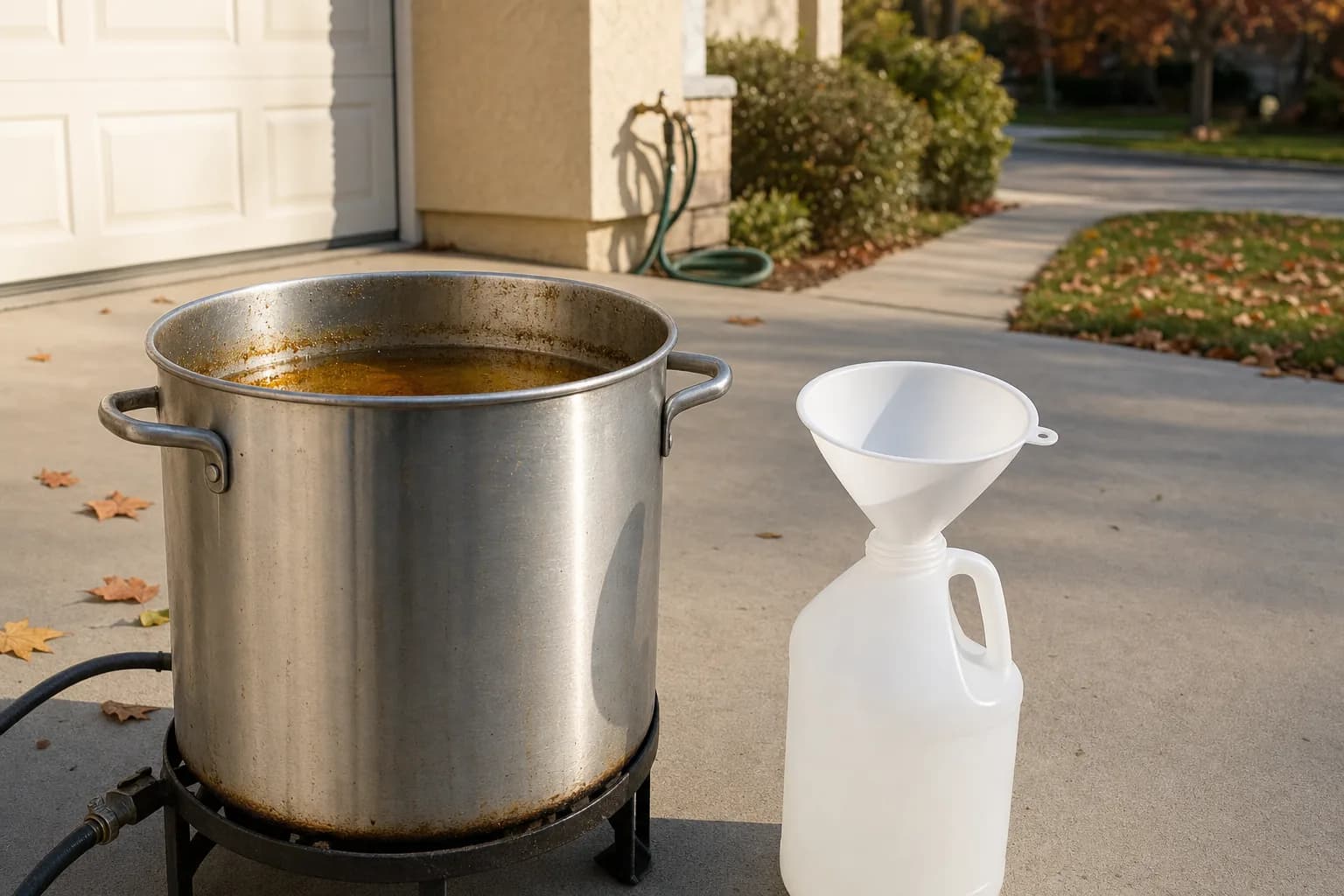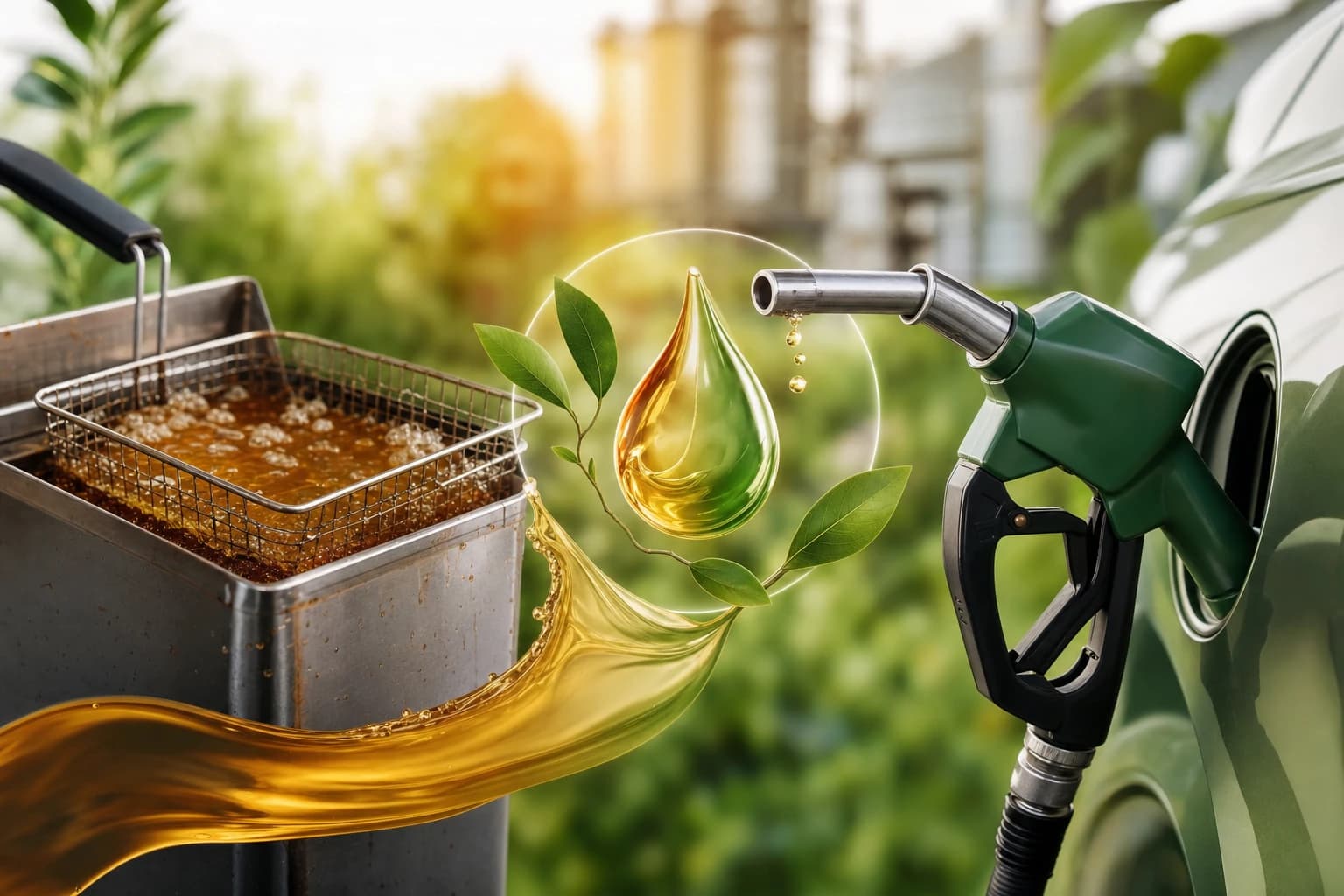
Recycling cooking oil delivers two big environmental wins at once. Every gallon collected becomes low-carbon fuel, biodiesel, renewable diesel, or sustainable aviation fuel, producing up to roughly 80% lower lifecycle greenhouse-gas emissions than the fossil fuel it replaces. It also keeps fats, oils, and grease out of sewers and landfills, preventing the overflows and pollution that come from dumping oil down the drain.
The rest of this article breaks each benefit out with the actual rules and numbers behind it, the carbon math, the sewer data, the landfill diversion, and the fuel regulations that make recycled fryer oil so valuable, all attributed to the government and peer-reviewed sources that document them.
Benefit 1: Deep Carbon Reduction When Oil Becomes Fuel
The headline environmental benefit is carbon. When your used cooking oil is processed into fuel instead of discarded, it displaces fossil diesel and jet fuel with a far lower-carbon alternative.
The U.S. Department of Energy's Alternative Fuels Data Center, citing a lifecycle analysis from Argonne National Laboratory, reports that 100% biodiesel (B100) produces 74% lower lifecycle greenhouse-gas emissions than petroleum diesel. That figure already counts the full lifecycle, production, transport, and combustion.
When the feedstock is specifically waste oil rather than a virgin crop, the reduction climbs higher. A peer-reviewed lifecycle study (using Argonne's GREET model) found that biodiesel and renewable diesel made from used cooking oil, tallow, and corn oil achieve roughly 79% to 86% lower lifecycle GHG emissions than petroleum diesel. The reason is straightforward: used cooking oil already did its first job in the kitchen, so it carries none of the upstream farming, fertilizer, or crop-production emissions assigned to purpose-grown biofuel crops.
There is also a biogenic-carbon advantage. The carbon in cooking-oil-derived fuel came from plants that absorbed atmospheric CO2 while growing, so re-releasing it on combustion adds far less net carbon than burning fossil diesel or jet fuel, a point made repeatedly by groups like the International Council on Clean Transportation. In plain terms, you are recycling carbon that was already in circulation instead of pulling new carbon out of the ground.
This is the core of what cooking oil recycling delivers: not just keeping oil out of the trash, but actively replacing fossil fuel with something dramatically cleaner.
Benefit 2: Protecting Sewers, Streets, and Waterways From FOG
The second environmental benefit is about what doesn't happen when you recycle, the pollution you avoid.
Cooking oil poured down a drain does not disappear. It cools, congeals, and forms fats, oils, and grease (FOG) that coat and constrict sewer pipes. The U.S. EPA's Report to Congress: Impacts and Control of CSOs and SSOs identified grease from restaurants, homes, and industry as the cause of 47% of reported sewer blockages, the single most common cause.
Those blockages drive sanitary sewer overflows (SSOs): events where untreated wastewater backs up into buildings or spills out of the system entirely. EPA's program guidance is blunt that FOG is an inappropriate material for the sewer precisely because it causes these overflows, which can discharge raw sewage into:
- Streets and storm drains
- Homes and businesses (backups)
- Creeks, rivers, beaches, and groundwater
Every overflow is an environmental and public-health event, and grease is the leading trigger. Recycling your used cooking oil through a licensed collector keeps that oil out of the drain entirely, which is the most effective FOG-control step a kitchen can take. It protects the local waterways downstream of your sewer system, not just your own pipes. (Grease that ends up in your interceptor is a separate stream; the point here is that recycled fryer oil never enters the drain in the first place.)
If you want the full picture of how to keep oil out of your drains, our guide to cooking oil disposal walks through the proper handling steps.
Benefit 3: Full Landfill and Waste-Stream Diversion
Recycling cooking oil also keeps it out of the landfill completely.
The two common "easy" disposal routes, pouring oil down the drain or throwing it in the trash, both have an environmental cost. The drain causes FOG overflows; the trash sends a usable, low-carbon resource to a landfill where it does nothing but take up space. Recycling avoids both.
When your oil is collected for recycling, every gallon is diverted from the waste stream and converted into a usable fuel feedstock rather than discarded. The U.S. DOE and EPA both treat used cooking oil as a renewable-fuel input, not waste. For a restaurant or commercial kitchen tracking sustainability or ESG goals, that is measurable landfill diversion plus a documented lower-carbon outcome, two metrics that are increasingly reported and audited.
A CDFA-compliant digital manifest, emailed after every pickup, doubles as your diversion record: it documents exactly how much oil was collected and that it entered the recycling supply chain rather than the trash. Records are retained for seven years, so the paper trail is there whenever a sustainability report, a corporate client, or an inspector asks for it.
Benefit 4: Lower-Carbon Fuels the LCFS and RFS Actively Reward
The environmental value of recycled cooking oil is not just a claim, it is built into federal and state fuel regulations, which is the clearest third-party confirmation that this benefit is real.
California's Low Carbon Fuel Standard (LCFS). Run by the California Air Resources Board, the LCFS rewards fuels with a low carbon intensity (CI), the grams of CO2-equivalent emitted per unit of energy. Used-cooking-oil fuels score exceptionally low. The U.S. Energy Information Administration reports that renewable diesel, much of it made from used cooking oil, has averaged about 30 gCO2e/MJ, versus roughly 102 gCO2e/MJ for the ultra-low-sulfur petroleum diesel it replaces. Renewable diesel from waste feedstocks has scaled rapidly in California's diesel pool under the LCFS, demonstrating real-world displacement of petroleum diesel at commercial volumes.
The federal Renewable Fuel Standard (RFS). Under the EPA's RFS, used cooking oil qualifies as an advanced biofuel feedstock, a category that requires at least a 50% lifecycle greenhouse-gas reduction to qualify. Biodiesel and renewable diesel made from waste grease clear that bar comfortably, which is why the EPA recognizes recycled restaurant oil as a legitimate advanced-biofuel input.
Here is how the carbon picture compares across the fuels your fryer oil can displace:
| Fuel | Approx. lifecycle carbon vs. its fossil baseline | Source |
|---|---|---|
| B100 biodiesel | ~74% lower than petroleum diesel | U.S. DOE AFDC / Argonne |
| Biodiesel & renewable diesel from used cooking oil | ~79 to 86% lower than petroleum diesel | Peer-reviewed lifecycle study (GREET) |
| Renewable diesel (carbon intensity) | ~30 gCO2e/MJ vs. ~102 for petroleum diesel | U.S. EIA / CARB (LCFS) |
| Waste-derived sustainable aviation fuel (SAF) | up to ~80% lower than conventional jet fuel | U.S. DOE / ICCT |
The pattern is consistent across every authority: waste-based fuels from used cooking oil sit at the cleanest end of the range, specifically because the feedstock is a waste with no cultivation footprint.
Benefit 5: Feeding Sustainable Aviation Fuel (SAF)
One of the newest and most consequential destinations for recycled cooking oil is the airplane.
Sustainable aviation fuel (SAF) is jet fuel made from non-petroleum sources, and used cooking oil is one of its leading feedstocks via the HEFA processing pathway. The U.S. Department of Energy reports that waste-derived SAF, from used cooking oil, tallow, and similar wastes, can cut lifecycle carbon emissions by up to about 80% versus conventional jet fuel. The federal SAF Grand Challenge targets at least a 50% lifecycle reduction and 3 billion gallons of SAF by 2030.
Aviation is one of the hardest sectors to decarbonize because planes can't easily run on batteries, so a drop-in low-carbon jet fuel is especially valuable. The fact that a commercial kitchen's fryer oil can become aircraft fuel that flies at up to ~80% lower lifecycle carbon is a striking illustration of how far this recycling chain reaches. Your oil isn't just avoiding harm, it's substituting for one of the most stubborn fossil-fuel uses there is.
How Oil Guyz Routes Your Oil Into the Low-Carbon Chain
The environmental benefits above only happen if the oil actually reaches a legitimate, traceable refiner. Here's how the collection works:
- Free locked containers. You get free anti-theft containers dropped off, so your used cooking oil is stored cleanly and protected until pickup.
- Scheduled pickup. A CDFA-licensed route driver collects on a reliable schedule, no chasing anyone down, no oil sitting around degrading.
- Processing at a licensed renderer. The oil is filtered, dewatered, and delivered to a CDFA-licensed renderer, where it becomes biodiesel, renewable diesel, or SAF feedstock.
- Digital manifest after every pickup. You get a CDFA-compliant digital manifest by email documenting the load, your proof of compliant, traceable recycling, retained for seven years.
There are no contracts, no fees, and no minimum volume, free used cooking oil pickup is the standard offer because the oil itself has downstream value as a biodiesel feedstock. That value is exactly what the LCFS and RFS create, and it is what lets the environmental upside and the free service coexist.
Oil Guyz collects across California, including Orange County, Los Angeles, San Diego, the Inland Empire, and the Bay Area, and in the Pacific Northwest around Tacoma and Seattle, Washington.
The Bottom Line
Recycling cooking oil is one of the highest-leverage environmental moves a commercial kitchen can make. It cuts lifecycle carbon by up to roughly 80% by turning waste into biodiesel, renewable diesel, and sustainable aviation fuel; it keeps FOG out of sewers and waterways, preventing the overflows that grease causes nearly half the time; and it diverts every gallon from the landfill into a fuel the government's own LCFS and RFS programs reward. None of that requires extra effort from your staff, it requires a licensed collector who routes the oil into the legitimate chain and documents it.
Ready to make your fryer oil part of the low-carbon fuel supply chain? Contact Oil Guyz for free, no-contract used cooking oil pickup with a CDFA-compliant digital manifest after every visit.