
If you are operating five, twenty-five, or a hundred restaurants under one corporate umbrella, the way your locations buy cooking oil pickup probably does not match the way the rest of procurement works. Linens, dishware, dry goods, and waste services are all negotiated centrally with master agreements, portfolio-wide pricing, and a single accounts-payable touchpoint. Cooking oil collection, on the other hand, is usually whatever the location GM handshook with a local hauler during the soft opening, and corporate procurement has been quietly absorbing the cost of administering it ever since.
This guide walks through what a real multi-location cooking oil collection contract should include in 2026, what to negotiate, and what to walk away from. It is written for the people who actually sign these agreements: VPs of operations, directors of procurement, franchise system administrators, and the finance leads who get stuck cleaning up the mess when an under-performing site triggers a CDFA inspection across the rest of the portfolio.
Why this contract matters more than it looks
Cooking oil pickup looks like a small line item on the operations budget, a few hundred dollars a month per location for the typical restaurant. But the total cost of running fragmented hauler relationships across a multi-location portfolio is almost never just the invoice amount.
Consider the actual labor footprint. Every location has its own service relationship that someone has to manage. Your AP team is processing invoices from a different hauler at every site, each on a different cadence with a different pricing structure. Your district managers are fielding calls when a pickup gets missed and chasing down whoever signed the original contract. Your corporate compliance team has no central view of CDFA manifest status across the portfolio, and when an inspector asks for last year's documentation at the worst location, the answer is a multi-week scramble through paper records or scattered email attachments.
The dollar cost of all that internal labor usually exceeds the hauler invoice itself. Most of our multi-location clients report that AP processing hours drop 60 to 80% within the first quarter after consolidation, and operational coordination time drops even more steeply. That savings does not show up as a line item on the new contract, it shows up as the same number of people getting their afternoons back.
What a real multi-location cooking oil contract should include
A contract worth signing covers the operational layer, the financial layer, and the compliance layer at the same time. Skip any one and the consolidation does not actually simplify anything.
Master Service Agreement structure
The single most important contract feature is the Master Service Agreement structure. The MSA covers every location in the portfolio under one set of terms, and individual locations get added or removed through a one-page schedule rather than a new contract. This is not a cosmetic detail. It is what lets you open a new restaurant on a Tuesday and have grease pickup running by Friday without involving your legal team. It is what lets you exit a concept without unwinding a contract. And it is what lets franchisees opt into corporate pricing without each one needing their own legal review.
Look for the following in the MSA structure:
- One master contract covers all locations regardless of brand or concept
- A schedule (or "rider" or "site list") is the only document that changes when locations are added or removed
- Pricing is set at the master level, not duplicated per-site
- The MSA term and the location-schedule term are decoupled, locations can join or leave without restarting the master term
Portfolio-wide volume pricing
Pricing should be set at the portfolio level based on combined annual gallons, not on a per-location basis. A flagship producing 2,000 gallons annually and a small cafe producing 200 gallons should receive the same per-gallon rate negotiated against your aggregate volume. As the portfolio grows, the rate should step down at agreed volume thresholds without requiring a contract renegotiation.
This is the structure restaurant groups expect from every other procurement category. Any hauler offering true multi-location service should adopt it. If you see per-site pricing in the draft, push back, that is a sign the hauler is repackaging local-account economics as a multi-location program.
Centralized digital CDFA manifests
Every used cooking oil pickup in California must be documented with a manifest under CCR Title 3 Section 1180. The manifest must be signed at point of collection, retained for at least two years under Section 1180.24, and producible on demand for an inspector. Two years is the legal floor, not a target. Most multi-location operators write a longer retention window into the contract so records outlast staff turnover, ESG reporting cycles, and any audit lookback. When each location uses a different hauler with a different manifest format, your compliance posture is only as strong as your worst-documented site.
A real multi-location contract centralizes manifests digitally:
- Generated at every pickup, every location, in a consistent format
- Stored centrally, searchable by location, date, volume, and driver
- Tied to the corresponding invoice line item for audit reconciliation
- Role-based access, corporate sees everything, district managers see their territory, site GMs see their location
- Two-year retention handled by the hauler, not your team, meeting the legal minimum
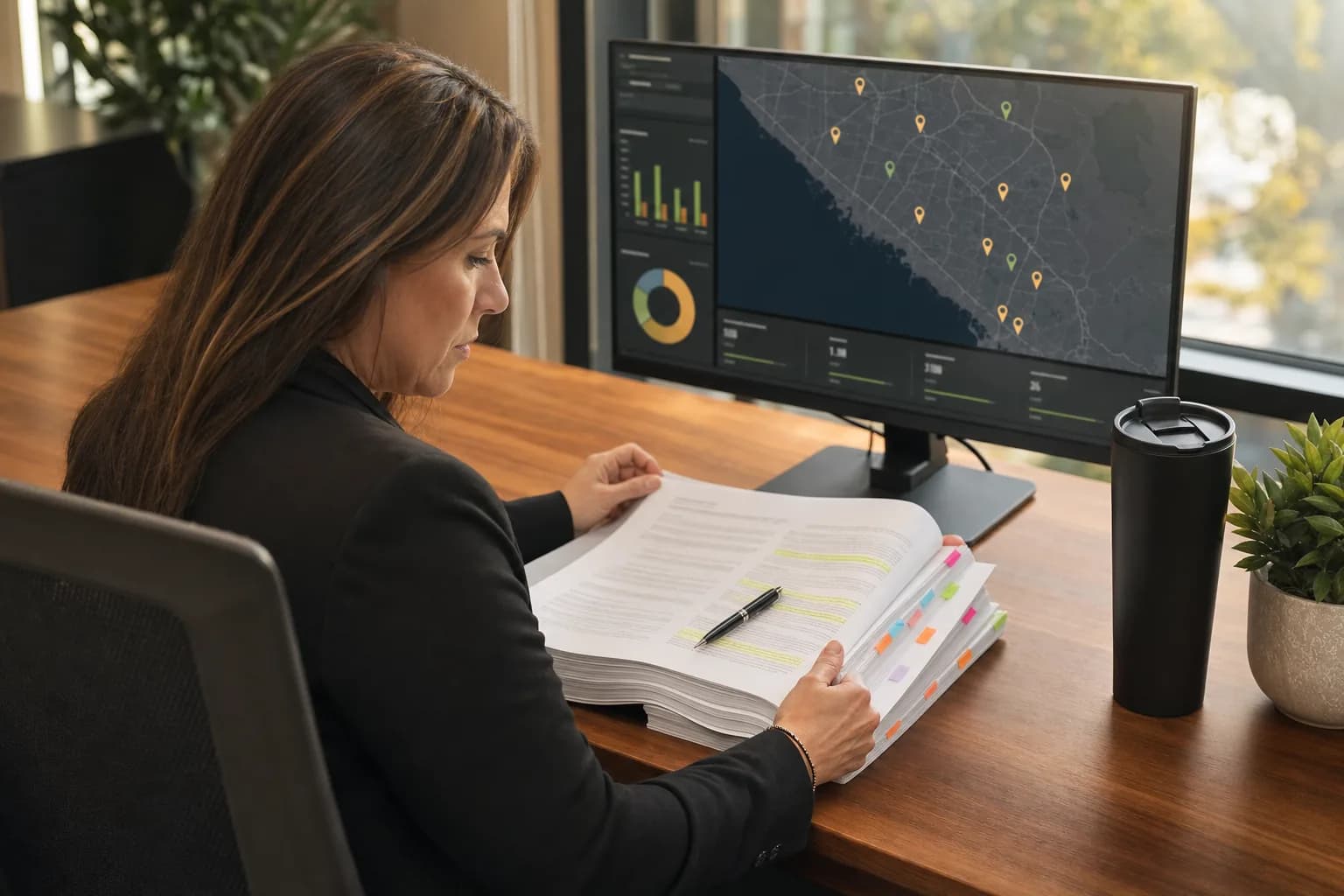
When an inspector asks for records, you should be able to produce them in minutes from one dashboard. If the draft contract does not specify how manifests are delivered and stored, that is the wrong contract.
Consolidated billing on your AP cycle
One invoice per period covering every location in the portfolio. Line items should roll up by location with subtotals by region and concept so your corporate AP team gets the granularity they need without the noise of twenty separate vendors. Billing cadence should match your AP cycle, weekly, biweekly, or monthly.
For portfolios above 25 locations, the hauler should integrate with the major AP automation platforms, Coupa, Ariba, Bill.com, for PO matching workflows. PO matching is the single feature that drops AP processing time the fastest, because it eliminates the per-invoice human review step that does not scale across a multi-location portfolio.
Named account manager, not a call center
Every multi-location account should be assigned a named account manager whose job is to know your portfolio in detail. When your district manager needs a pickup moved because a stove went down, they should call one number and reach a person who already knows that the Tustin location only has alley access between 6 and 10 AM. When a franchisee onboards a new restaurant, the account manager should coordinate the site survey and first pickup without your corporate team brokering anything.
A national hauler with a call center will sell you "dedicated account management" and deliver a 1-800 number where the person answering has never seen your portfolio. The way to test this in negotiation is simple, ask for the account manager's direct phone number and email address before you sign. If you cannot get one, the program is not what is being sold.
Contractually binding SLAs with automatic credits
Service-level agreements only matter if they have financial consequences for misses. Three SLAs are non-negotiable in a 2026 multi-location contract:
- On-time pickup performance measured per location per month at a 95% threshold, with automatic invoice credits when missed
- Emergency response for spills, missed pickups, or volume surges, with credits when missed
- CDFA manifest delivery to your dashboard at point of pickup, with a 24-hour backstop
Walk away from any contract that has "best effort" or "commercially reasonable" language without measurable thresholds and automatic credits. SLAs without skin in the game are aspirational, they only protect you when the hauler has something to lose by missing them.
A clean exit path
The contract should allow termination with 90 days written notice on either side, with the following protections:
- Full data export of every manifest, invoice, and pickup record across the contract term, delivered as CSV + PDF archives within 14 days of termination
- No equipment-hostage tactics, containers and locks the hauler provided should be collected within 30 days at no charge
- A defined transition window so your replacement hauler can pick up service the day after termination with no operational gap
Avoid any contract with multi-year auto-renewal, early termination fees that exceed one month of service value, or "remove our equipment within 72 hours" clauses that create artificial pressure during a vendor transition. The hauler that fights the exit terms in negotiation is the hauler that will fight you in execution.
What to negotiate before signing
The standard hauler proposal is rarely the best deal available. Three things almost always have room to move before signature:
1. Pricing tiers. Most haulers will propose a flat per-gallon rate. Push for step-down tiers tied to combined annual gallons across the portfolio, so as your operation grows, the rate improves automatically without re-negotiation. Get the tier breakpoints in writing.
2. SLA credit amounts. The default SLA credit on a missed pickup is usually nominal, twenty dollars off the next invoice, that kind of thing. Push for credit amounts that reflect the actual cost of the miss (lost prep time, expedited replacement pickup, customer impact). A meaningful credit makes the hauler care as much about the SLA as you do.
3. Onboarding timeline for new locations. Standard is 5 business days from notification to first pickup. For portfolios with frequent openings, push for 3 business days as a contractual standard with credits if missed. New-location onboarding speed is one of the operational metrics that most differentiates good multi-location haulers from average ones.
What to walk away from
Some contract terms are signs that the hauler is not actually built for multi-location work. If you see any of these in the draft, ask for them to come out, and if they will not, find a different vendor.
- Multi-year auto-renewal with short termination windows. Lock-in language that makes it hard to leave is a sign the hauler expects to underperform.
- Per-location pricing dressed up as portfolio pricing. Read the rate schedule carefully. If each location has its own line with its own rate, it is not a master agreement, it is twenty contracts stapled together.
- No SLA credits. SLAs without automatic credits are marketing copy, not service guarantees.
- Restricted manifest access. If the contract limits which of your staff can see which manifests, the hauler is not building a real compliance tool, they are building a billing tool with a dashboard skin.
- Vague exit data export terms. "Reasonable cooperation on termination" is not a commitment. You want specific timelines, specific formats, specific data scope.
How to model the consolidation ROI
Before you decide to consolidate, run a simple model with three numbers:
- Current annual cooking oil pickup spend across all locations, summed.
- Internal labor hours per month spent administering hauler relationships, AP processing, missed-pickup coordination, compliance documentation, site-level vendor calls. Multiply by a blended internal hourly cost.
- One missed-pickup or compliance incident cost from the last 12 months, a real number from your own portfolio.
The annual hard cost (#1) is what shows up on the invoice. The annual soft cost (#2 × 12) is what consolidation actually recovers. The risk cost (#3 × likelihood of recurrence) is what consolidation protects against.
For most multi-location portfolios, the soft cost alone exceeds the invoice savings. Consolidation pays for itself on the operational simplification before any per-gallon price negotiation. That is why we recommend operators evaluate consolidation on labor and compliance grounds first, and treat pricing as the secondary benefit.
Ready to evaluate consolidating your portfolio?
If you operate three or more restaurants across Southern California and you are tired of running cooking oil pickup as twenty separate vendor relationships, talk to our multi-location program team. We will model the consolidation against your current vendor mix and walk you through what a Master Service Agreement would look like for your sites, no commitment, no pressure.
The full multi-location program details, comparison table, included SLAs, and FAQs live on the Multi-Location Cooking Oil Collection page.