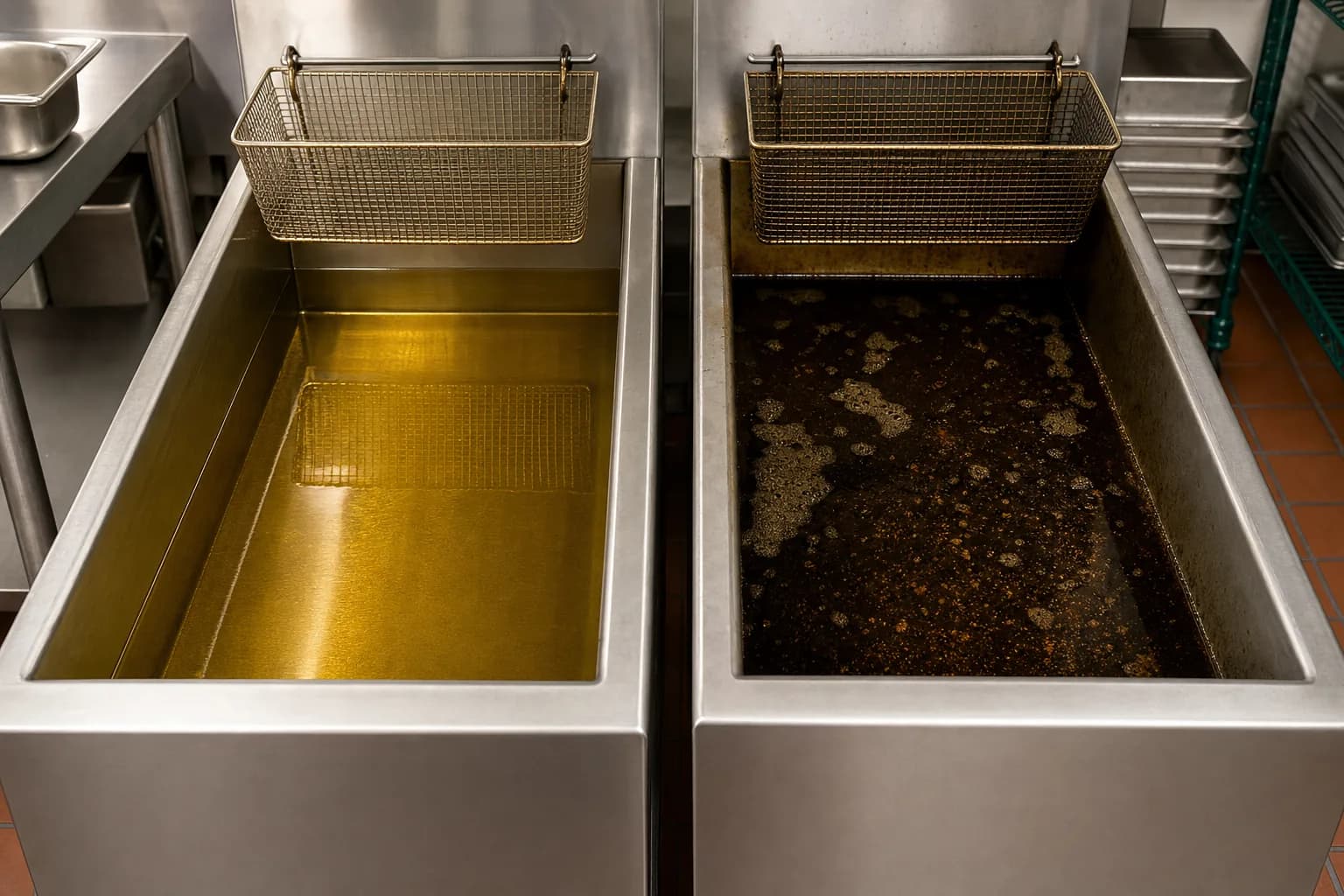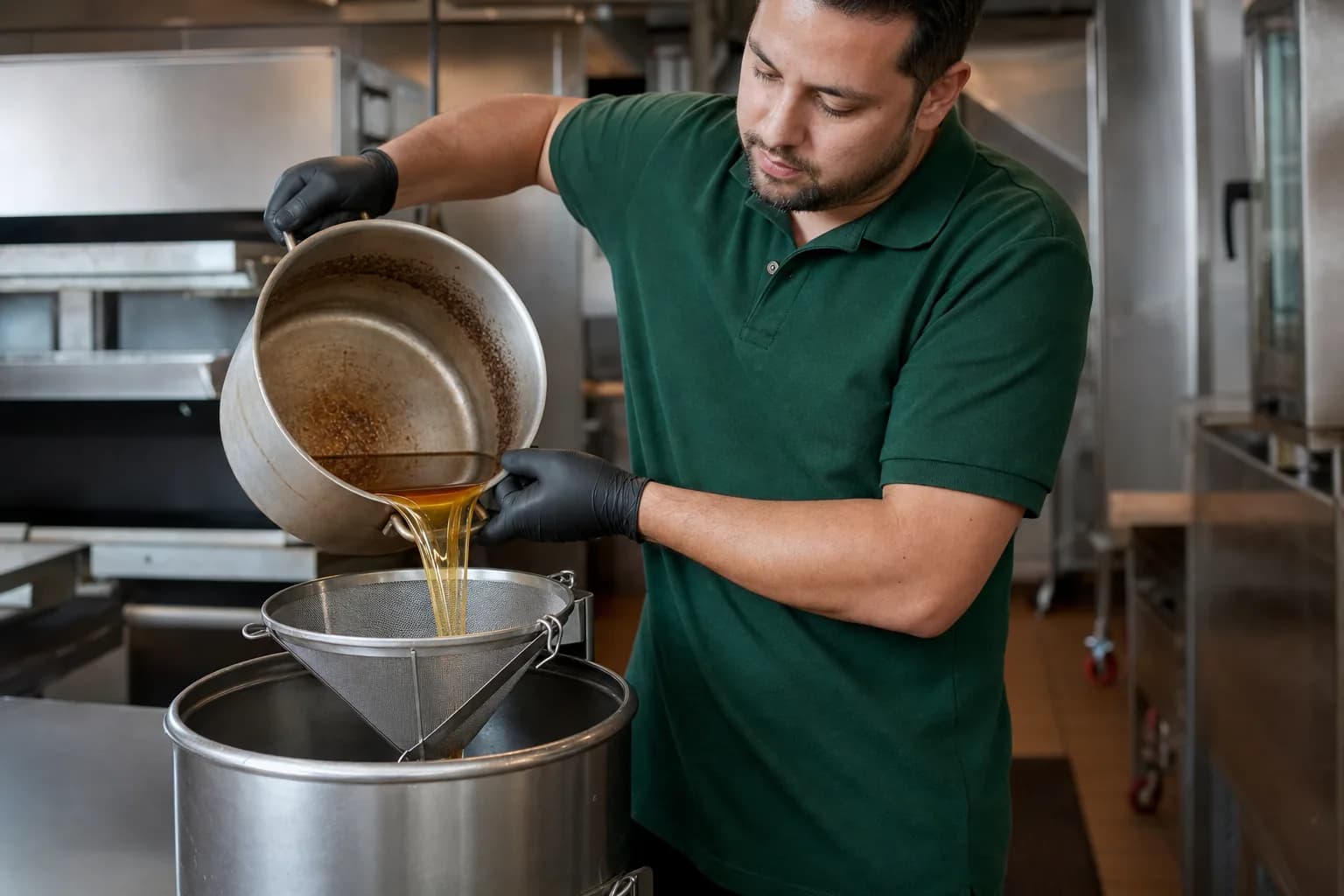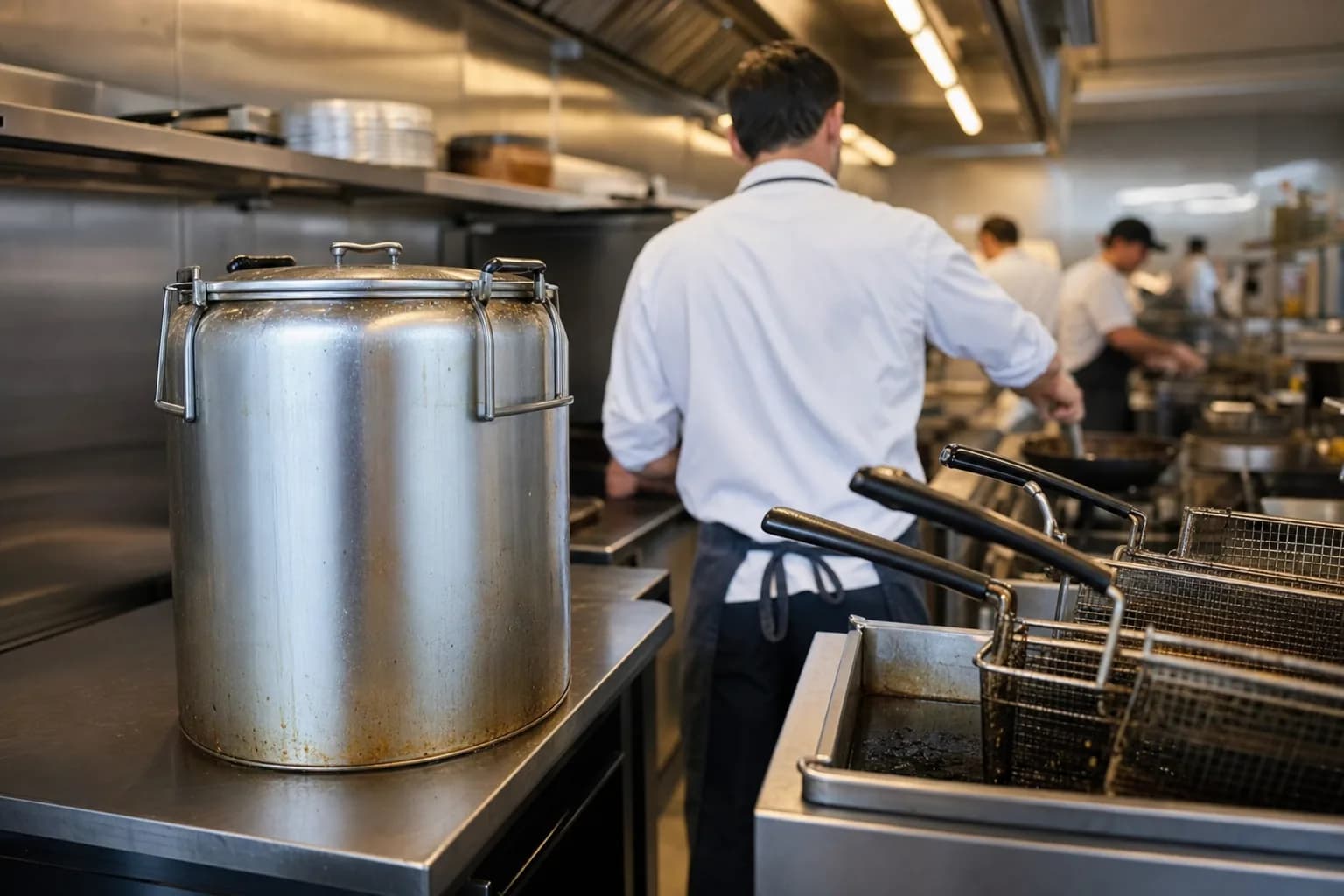

When your restaurant has leftover cooking oil, do four things: let it cool, pour it into a sealed, lockable used cooking oil container kept in a secured spot, never put it down a drain or in the dumpster, and schedule free used cooking oil pickup from a CDFA-registered hauler who leaves you a manifest. That is the entire compliant playbook, store it secured, keep it out of pipes and trash, and let a registered collector recycle it into fuel.
Everything below explains why each step matters, what the rules actually say, and how to set up a system that takes the decision off your kitchen staff's plate for good.
Step 1: Never Pour It Down the Drain
The fastest way to turn leftover cooking oil into a compliance problem is to send it down any sink, floor drain, or mop basin. Oil that looks liquid and harmless in the fryer cools and hardens inside your pipes.
The U.S. EPA's guidance on fats, oils, and grease (FOG) identifies restaurant grease as a primary cause of FOG buildup that solidifies, coats, and clogs pipes, and triggers sanitary sewer overflows (SSOs). That makes it a recognized Clean Water Act compliance problem, not just a plumbing nuisance.
The penalties are not theoretical. Under the Clean Water Act, the EPA's criminal provisions put negligent violations of pretreatment and effluent standards in the $2,500 to $25,000 per day range, and knowing violations at $5,000 to $50,000 per day. Closer to home, the local FOG and pretreatment program run by your Publicly Owned Treatment Works (POTW) can fine your establishment, add sewer surcharges, or even terminate water and sewer service for non-compliance. Many municipal utilities, the San Francisco Public Utilities Commission is one example, explicitly tell restaurants to use a registered grease hauler with free pickup and to never pour grease into drains or onto streets.
The rule for staff is simple and absolute: nothing oily goes down any drain, ever. Wipe pans, scrape plates, and route all fryer oil to the collection container.
Step 2: Never Put It in the Dumpster
The second instinct, bagging it up or pouring it into the trash, is also a violation. Used cooking oil is a liquid waste. CalRecycle's used oil guidance is built on the principle that liquid waste belongs in a recycling stream, not a solid-waste container.
Putting it in the dumpster creates three problems at once:
- It's illegal. Liquid waste in a solid-waste container violates solid-waste and health-code rules, and your regular trash hauler cannot legally collect it.
- It's a mess and a hazard. Leaking oil draws pests, contaminates everything around it, and creates spill and slip risks in your back-of-house.
- It fails inspection. Health inspectors look specifically for improperly stored or discarded waste products, and an oily dumpster area is an easy citation.
There is no "small enough" amount that makes dumpster disposal acceptable. If it came out of the fryer, it goes in the collection container.
Step 3: Store It in a Sealed, Locked Container
Between pickups, leftover cooking oil needs a real home, not an open bucket by the back door. The standard is a sealed, lockable container in a secured location.
This matters for two reasons. First, an open or flimsy container is a fire risk, a pest magnet, and a spill waiting to happen, all of which show up on a health inspection. Second, used cooking oil gets stolen, and grease theft is organized crime. CDFA's anti-theft program notes that thieves typically use unmarked, unregistered trucks at night to siphon oil out of restaurant containers.
CDFA's theft-prevention guidance advises restaurants to store oil in secured, lockable containers, locking lids, anti-siphon baffles, fenced corrals, and to confirm their hauler is CDFA-registered. There's a sharp edge to this: a restaurant can be cited by its local wastewater department if it cannot show its oil was collected by a registered hauler. A locked container plus a verified hauler protects you on both fronts.
A good storage setup looks like this:
- Cool the oil first. Never transfer hot oil, it warps containers and burns staff. Let it come down to a safe temperature.
- Keep water out. Water contamination can get a load rejected, makes the oil harder to turn into fuel, and can cause containers to bubble over. Drain and dewater before transfer.
- Use a sealed, lockable lid. This is your front-line theft and spill defense.
- Place it in a secured spot. A back-of-house corral or fenced area is far better than an exposed alley.
- Keep it locked between pickups. The lock only works if it's used.
If you don't already have a compliant container, Oil Guyz provides a free locked anti-theft container as part of standard setup, there's no reason to run an open drum.
Step 4: Schedule Free Pickup From a Registered Hauler
The leftover oil leaves your kitchen one correct way: a CDFA-registered used cooking oil hauler collects it on a schedule and hands you documentation. This is the step that converts a waste problem into a closed-out compliance record.
Verify the hauler is actually registered
In California, every commercial used cooking oil hauler must hold a valid CDFA Inedible Kitchen Grease (IKG) Transporter registration and display the company name plus a current state-issued CDFA decal on the vehicle, under CCR Title 3 §1180.20. Before you let anyone take your oil, confirm both. An unmarked truck offering to take your grease away on the spot is the exact profile CDFA warns about.
Insist on a manifest every single time
CCR Title 3 §1180.24 requires a manifest for every collection and delivery of inedible kitchen grease. It must document:
- the type and amount of grease (gallons or pounds),
- the generator's on-site representative name and signature, and
- the driver's name and signature.
The regulation explicitly allows electronic manifests, which is why a digital, emailed manifest is fully compliant, and far easier to retrieve during an inspection than a smudged paper copy in a drawer. Those records must be kept and available under the same rule, so a clean digital archive keeps you audit-ready.
Oil Guyz handles this end to end: a CDFA-registered transporter runs a reliable scheduled route, and a CDFA-compliant digital manifest lands in your inbox after every pickup. Records are retained for two years, well beyond what you need on hand.
Ready to close the loop? Schedule your free pickup. A locked container is placed at no cost, and the first manifest hits your inbox after the first visit.
Accepted vs. Not Accepted: The Quick Reference
Use this table to settle any back-of-house debate about where leftover cooking oil, and the things people confuse with it, actually goes.
| Material | Where it goes | Why |
|---|---|---|
| Fryer oil / vegetable oil | Sealed UCO container → registered pickup | Liquid waste that is refined and converted into renewable diesel and biodiesel |
| Oil with water contamination | UCO container (dewater first) | Acceptable, but water can get a load rejected and risks overflow |
| Grease-trap waste (brown grease) | Separate registered trap service | Different waste stream; not yellow grease |
| Cooking oil, down the drain | Never | FOG buildup, SSOs, Clean Water Act penalties |
| Cooking oil, in the dumpster | Never | Illegal liquid-waste disposal; health-code violation |
| Cooking oil, to an unmarked, unregistered hauler | Never | No manifest, likely theft, leaves you uncovered |
How Often Should You Schedule Pickup?
Pickup frequency is driven by your oil volume, which is driven by how much you fry. The goal is to never let your container overflow and never let oil sit so long it draws pests or thieves. These are practical starting points, your provider tunes the schedule to your actual flow.
| Kitchen profile | Approx. monthly volume | Typical pickup cadence |
|---|---|---|
| Café, food truck, small kitchen | Under 50 gallons | Every 2 to 4 weeks |
| Standard full-service restaurant | 50 to 150 gallons | Weekly to biweekly |
| High-volume / heavy fry concept | 150 to 300 gallons | Weekly |
| Multi-station / commissary kitchen | 300+ gallons | Multiple times per week |
Reliable, scheduled routes matter more than the exact number. A missed pickup is what forces a staff member to improvise, and improvising is how oil ends up in the drain or the dumpster. Working with a provider whose routes are consistent and where a real person answers the phone is the difference between a system that runs itself and one you have to babysit. You can see how this works across Orange County, Los Angeles, and beyond.
Where Your Leftover Oil Actually Goes
It helps your team to know the leftover oil isn't just "going away", it's becoming fuel. The U.S. Department of Energy's Alternative Fuels Data Center states plainly that biodiesel is a renewable, biodegradable fuel manufactured domestically from vegetable oils, animal fats, or recycled restaurant grease. Recycled feedstocks, including used restaurant cooking grease, are a major source of U.S. biodiesel.
The demand is real and growing. Used cooking oil is now a cornerstone feedstock for renewable diesel and sustainable aviation fuel (SAF), and demand has been outpacing domestic collection. That's the bigger reason proper restaurant collection matters: every gallon your kitchen routes correctly through cooking oil recycling and into the biodiesel feedstock supply is a gallon that displaces fossil diesel instead of clogging a sewer line.
Putting It Together: A Repeatable System
The reason "what do I do with leftover oil?" keeps coming up is that most kitchens never set up a system, they decide ad hoc, shift by shift. Lock it down once:
- One designated container. Sealed, lockable, secured. Staff know exactly where oil goes.
- One firm rule. Nothing oily down any drain or in any dumpster, no exceptions, no "just this once."
- One registered hauler on a schedule. Verified CDFA registration and decal, manifest every pickup.
- One records folder. Digital manifests retained, ready for any inspector.
Set that up and the question disappears. Your team stops improvising, your compliance file stays clean, and your leftover oil becomes someone's renewable fuel instead of your liability.
Leftover cooking oil is not trash and it's not a drain problem, it's a recoverable resource that the law wants handled a specific way. Oil Guyz makes that easy with free used cooking oil pickup, free locked containers, no contracts, and a digital manifest after every visit, just schedule a free pickup and the system runs itself.