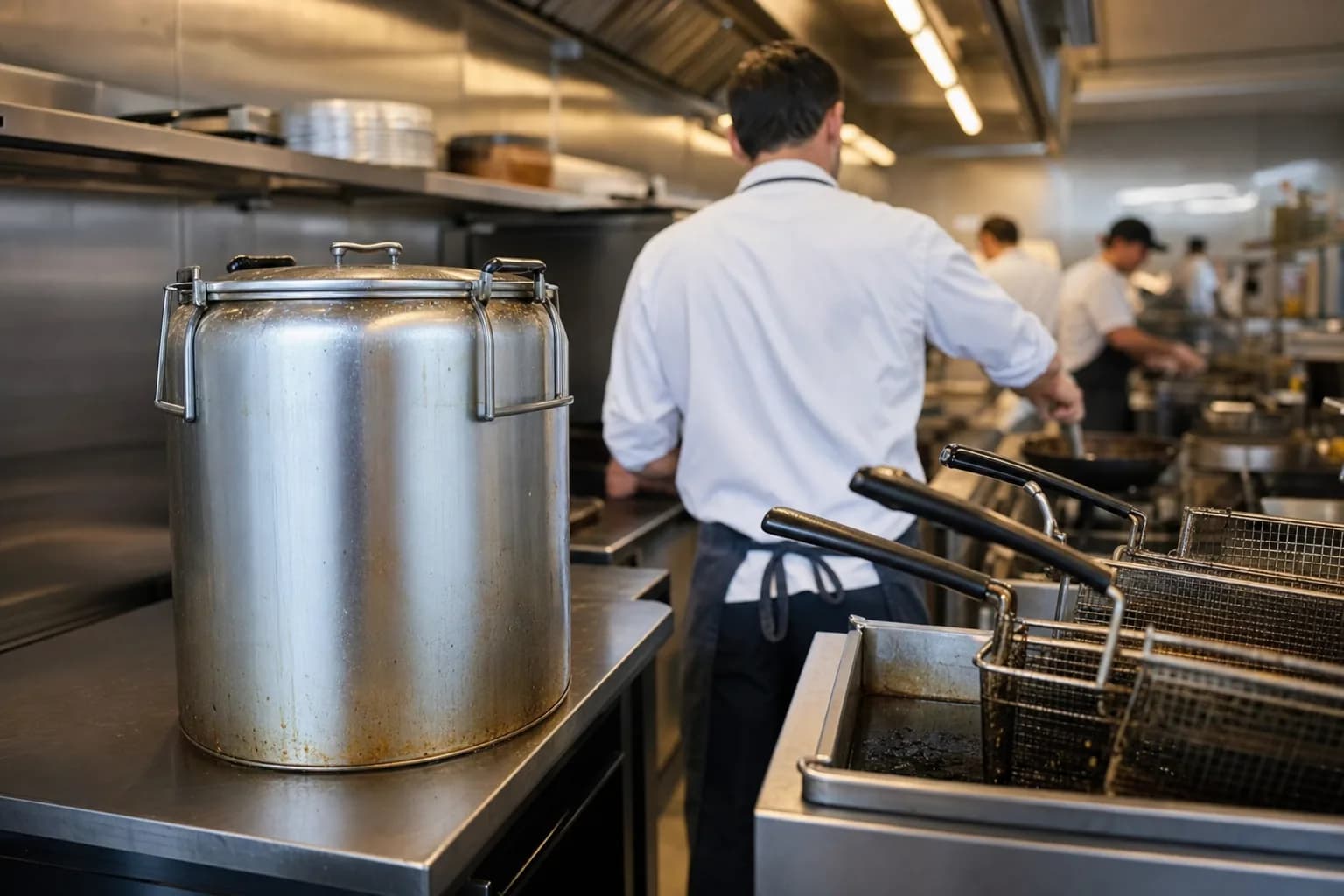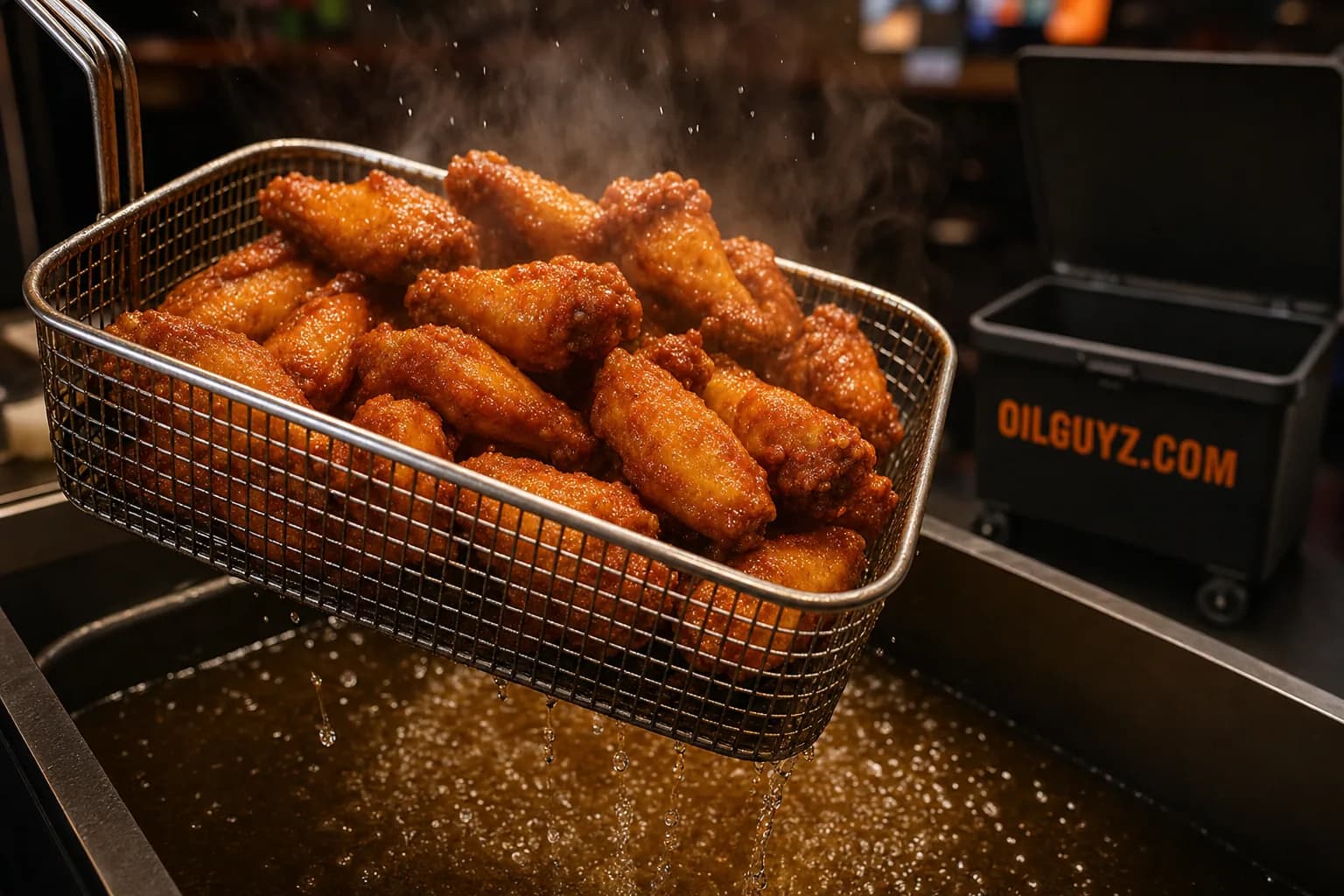

TL;DR, How often should a fried chicken restaurant change its fryer oil? There's no single number, it depends on your volume, but busy chicken kitchens often run on a 1 to 3 day cycle, and the highest-volume fryers change daily. Breading, flour, and marinade break oil down faster than almost any other food, so generic "change it weekly" advice is wrong for you. Judge each batch by the signs, dark color, persistent foam, off-smell, smoking under temp, and let your change frequency set your pickup cadence and container size. Oil Guyz handles the free scheduled pickup and the compliant manifest, so your only job is knowing when the oil is spent.
How often should a fried chicken restaurant change its fryer oil?
How often should a fried chicken restaurant change its fryer oil? The honest answer is: it depends on volume. Anyone who gives you a flat number doesn't know your kitchen.
That said, here's the real-world benchmark. Industry sources put commercial frying oil at "every one to two days in a busy restaurant," and they name the drivers directly: frying volume, food type, temperature, and filtration. For a fried chicken operation hitting all four hard, you're at the demanding end of that range. Many high-volume chicken and wing fryers change every 1 to 3 days, and the busiest ones change daily.
The reason is fryer oil change frequency in a high-volume kitchen isn't about the calendar, it's about how fast the oil actually degrades. And chicken degrades it fast. So the right question isn't "what day is it," it's "is this oil still good." We'll give you a repeatable way to answer that below.
Why your oil dies faster than the burger joint next door
This is the part most generic fryer posts miss. Fried chicken and wings are arguably the single hardest cuisine on fryer oil, and it comes down to three things.
Breading and flour shed sediment. Loose breading and flour fall off in the basket, sink, and carbonize at the bottom of the vat. Those burnt particles accelerate oil breakdown. Industry sources are blunt about it: "Breaded foods like fried chicken shed particles that break down oil faster than items such as french fries." A fry cook dropping potatoes all day is running an easier vat than you are.
Egg wash and marinade add emulsifiers. Egg proteins coagulate and release lecithin, a natural emulsifier that drives dark, sticky polymer buildup in the oil. Buttermilk and brines pile on acid, moisture, and protein, all of which speed degradation.
All-day, double-fry cooking never lets up. Chicken is often double-fried and fried continuously through the rush. Oil under constant heat and load climbs toward spent condition far faster than a fryer that sits idle between orders.
Put those together and you understand why "change weekly" advice doesn't fit a chicken kitchen. You're not frying like the burger place, so don't dispose like them either. For the full operations picture, see our deeper guide on fried chicken used cooking oil management and, if wings are your volume driver, chicken wing oil disposal.
Signs your fryer oil is bad: a good-vs-spent table
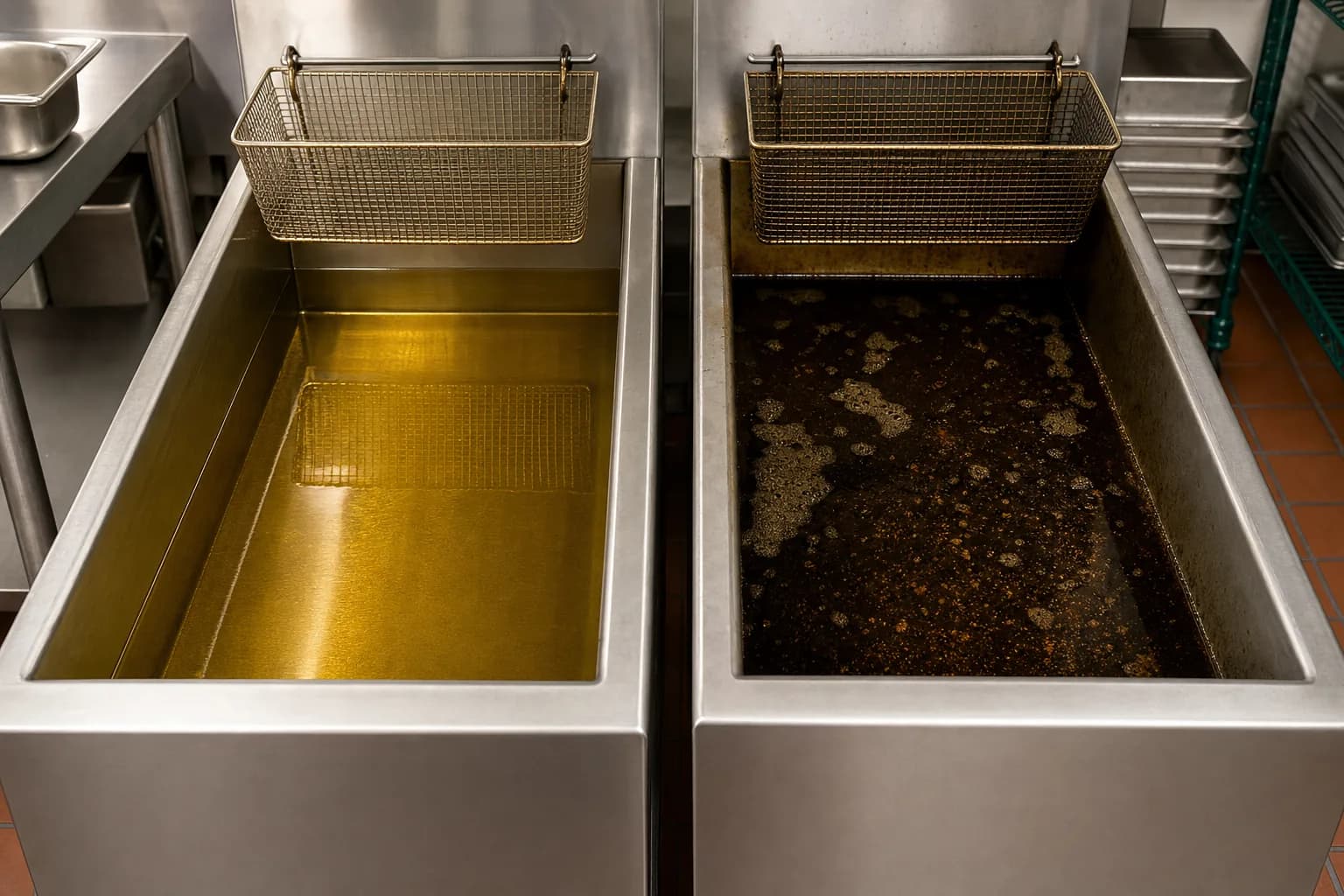
Forget the calendar. These are the signs fryer oil is bad, the same indicators you can check every shift without a lab. When several show up at once, the oil is done.
| Check | Oil is still good | Oil is spent, pull it |
|---|---|---|
| Color | Light golden to amber, see-through | Dark brown to black, opaque, "tea-colored" or worse |
| Foam | Bubbles rise and dissipate fast | Persistent foam that sits on the surface and won't clear |
| Smell | Clean, neutral, mild fried aroma | Rancid, burnt, or "old crayon" off-smell |
| Smoke point | Holds temperature without smoking | Smokes at normal fry temps (lowered smoke point from free fatty acids) |
| Texture | Thin, pours freely | Thick, viscous, sticky |
| Food result | Crisp, clean flavor | Greasy, off-flavored, darkens too fast |
Want an objective number on top of the eye test? A fryer oil test strip or meter checks Total Polar Compounds (TPC). The widely adopted international discard standard is around 25% TPC, that's the threshold most strips and meters are built to flag. The U.S. has no single federal TPC limit, so treat it as the global food-safety benchmark and a useful tiebreaker, not a California law. The strip backs up your senses; it doesn't replace them.
Filtering vs. replacing fryer oil
Filtering between changes and a full replacement do two different jobs, and for a chicken kitchen, you need both.
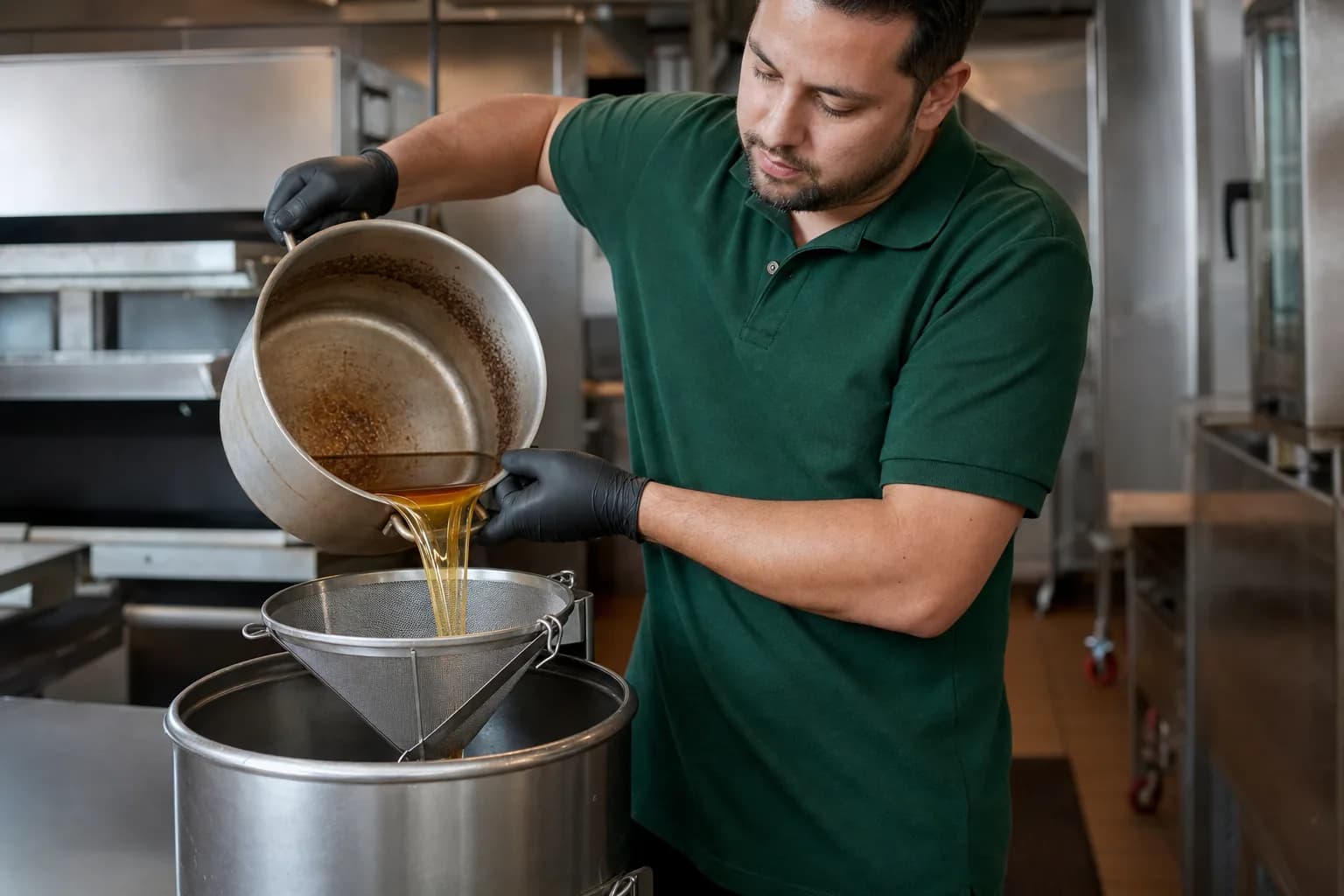
Filtering pulls out the breading sediment and carbon that chicken sheds. That's real value: it keeps your oil cleaner between changes, protects food quality, and stretches oil life. For a vat full of flour crumbs, daily filtering is close to mandatory.
But here's the catch on filtering vs. replacing fryer oil: filtering removes solids, not chemistry. It cannot reverse the polar-compound buildup, the polymerization, or the dropped smoke point that come from heat and time. Once the oil is chemically spent, no amount of filtering brings it back, it just looks slightly cleaner while still cooking poorly. Filter to extend good oil; replace when the signs say it's done.
A quick decision checklist, when to change fryer oil in your restaurant:
- Look, is the oil dark brown to black and opaque? That's one strike.
- Watch the surface, persistent foam that won't dissipate? Second strike.
- Smell it, rancid, burnt, or "old crayon"? Third strike.
- Check the heat, smoking at normal fry temps? That alone is a pull-it-now signal.
- Confirm if you want a number, TPC strip near ~25%? Confirmed spent.
- Decide, black + persistent foam + smoking under temp = pull it today. Two soft signs = filter and recheck next shift.
Run this at opening and during the rush. It turns "how often should I change my oil" into a repeatable test instead of a guess.
How change frequency sets your pickup schedule and container size
Here's where it gets practical. How often you change directly drives two things: how big a container you need and how often it gets emptied.
Start with the baseline. A widely cited industry rule of thumb puts an average fast-food location at roughly 35 pounds of used cooking oil a day, and a high-volume fried chicken or wing kitchen runs well above that. Fast-food kitchens generate enough used oil that scheduled collection sized to the operation is the norm, not the exception. If you're changing oil every 1 to 3 days, you're producing used oil at a clip that a small caddy and a once-a-month pickup can't keep up with.
That's the whole point of matching the fryer oil pickup schedule to your real volume:
- Daily / 1 to 2 day changers → larger locked container, frequent scheduled pickups so you never overflow.
- 2 to 3 day changers → mid-size container, a steadier cadence.
- Multi-location operators → per-site sizing, with every pickup visible across locations.
Oil Guyz sets all of this up for you. You get free scheduled pickup sized to your kitchen, a free locked anti-theft container (used cooking oil is a theft target because it's valuable biodiesel feedstock), and our CDFA-registered transporter pumps the container in place, your staff never wrestles with hauling oil. After every pickup, a CDFA-compliant digital manifest lands in your Filtrate account, so your chain-of-custody record is automatic. California requires a manifest for each pickup, allows it to be electronic, and expects records kept for two years, Filtrate handles that paperwork so you don't.
For the bigger picture on running this across a busy or multi-unit operation, see our restaurant cooking oil management hub and the cooking oil compliance guide. Running a high-volume wing program for game day? Our work with stadiums and arenas and fast food kitchens covers exactly that surge.
The recycled oil doesn't go to waste, either, used cooking oil is a confirmed feedstock for biodiesel and renewable diesel, and renewable diesel reduces carbon intensity on average by 65% compared with petroleum diesel.
The bottom line
There's no magic number for how often a fried chicken restaurant should change its fryer oil, but there's a clear method. Your oil dies faster than most kitchens because of breading, marinade, and all-day frying, so judge each vat by the signs, filter to extend the good oil, and replace the moment it's spent. Then let that change rhythm set your container size and pickup cadence. Oil Guyz covers Orange County, Los Angeles, San Diego, the Inland Empire, the Bay Area, and Tacoma/Pacific Northwest, and we're expanding. Outside those areas? We'll capture your location and notify you as we reach it. Tell us your volume and we'll size the free pickup to match. Not sure how this compares across your menu? Our guides on fried chicken oil management and wing oil disposal go deeper.
Sources
- Pitco, The Real Reason Why Commercial Fryer Oil Isn't Lasting (commercial fryer oil change frequency; volume, food type, and filtration drive degradation): https://www.pitco.com/blog/real-reason-why-commercial-fryer-oil-isnt-lasting/
- Food Safety Magazine, Monitoring Polar Compounds in Fryer Oil (heat and time create polar compounds; water-rich and breaded foods accelerate breakdown): https://www.food-safety.com/articles/5522-monitoring-polar-compounds-in-fryer-oil
- Klipspringer, Total Polar Materials (TPM) in Cooking Oil: A Complete Guide (signs of spent oil; ~24 to 27% TPM/TPC discard standard; test strips and meters): https://www.klipspringer.com/blogs/total-polar-materials-tpm-in-cooking-oil-a-complete-guide/
- Frontline International, Cooking Oil Collection for Fast Food (fast-food kitchens generate significant used cooking oil requiring scheduled collection): https://nwbiofuel.com/blog/cooking-oil-recycling-in-fast-food-chains-setting-industry-standards/
- California Code of Regulations, 3 CCR §1180.24 (manifest required per pickup, electronic manifests legal, 2-year retention): https://www.law.cornell.edu/regulations/california/3-CCR-1180.24
- CDFA Inedible Kitchen Grease program (renderer licensing, transporter registration, and chain of custody): https://www.cdfa.ca.gov/AHFSS/MPES/
- U.S. DOE Alternative Fuels Data Center, Biodiesel Production (used cooking oil as a biodiesel feedstock): https://afdc.energy.gov/fuels/biodiesel-production
- U.S. DOE Alternative Fuels Data Center, Renewable Diesel (−65% carbon intensity vs. petroleum diesel): https://afdc.energy.gov/fuels/renewable-diesel